Blue Ocean Thoughts: Sell Me On…

My friend Jon is really big on Blue Ocean Strategy, a book and business methodology based around expanding from a saturated market into new territory in new and innovative ways. I’ve been thinking about different ways that RPGs might find a blue ocean (Story Games thread here), and I’ll be bringing Jon on board for a podcast about it in the near future, but right now I want to talk a bit about some tangential stuff that came from the book’s chapter called “Build Execution into Strategy”. This is not as relevant to exploring the potential of blue ocean strategies in RPGs, but very, very relevant to how I’ve been trying (and too often, failing) to sell my friends on trying out different games.

5c4e117254b88649498a07cb548b774d

However awesome an idea seems to you, you have to demonstrate its merits to the other people involved. This is common sense, but it’s entirely too easy to get too wrapped up in your own ideas and forget. The book talks about a concept called “Fair Process” at length, and it’s the main focus of this blog post. Fair process aimed at gaining trust within an organization to carry out the kind of radical changes necessary for a blue ocean strategy, but I think the ideas here are applicable to most anything where you’re trying to introduce something new to a group, whether a massive company or a little gaming group. The stakes aren’t as high as for factory workers fearing that the new reorganization will cost them their jobs, but that doesn’t excuse laziness about the presentation.

With Mouse Guard, I basically made the mistake of throwing the rulebook at my friends and saying “This game is awesome! Read it so we can play.” I’m a voracious reader when the mood takes me, and my relationship with RPGs and not a few other things basically starts with sitting down and reading a book as a matter of course, to the point where it’s easy for me to forget that not everyone is like that. I’m sure somewhere there’s a group where everyone would dutifully sit down and read a 320-page book cover-to-cover when someone asks, but I don’t know those guys. Likewise, my verbal presentation of the game was… let’s say muddled and leave it at that. Some people no doubt do fantastic presentations of the games they want to play as a matter of course, but perhaps because of my orientation towards reading I apparently needed it spelled out for me by a book to really get it.

“Fair Process” is the idea that even if the outcome is going to be fair, people will be far more willing to accept it if they see the process leading up to it also fair. A reorganization scheme that will ultimately benefit employees can be met with outright hostility if a company doesn’t communicate what it’s doing. There may be times when you can slide by (as I managed to do with 3:16), but needless to say relying on luck isn’t a winning strategy. The book outlines what it calls the “Three E Principles of Fair Process”, all of which are necessary to create a perception of fair process to get people on board.

  1. Engagement: Everyone involved should have the chance to discuss and debate the merits of the new thing. This improves the quality of your ideas, and makes everyone better thinkers about these things. While it’s nice if people are open-minded about trying new things, if you can’t overcome objections and concerns about it, there’s obviously something lacking somewhere. The burden of proof is on the person who wants something new. Also, engagement helps people feel that they’re being valued in the process, even if the ultimate decision doesn’t go their way.
  2. Explanation: The people involved need to know what the heck is going on. In an RPG group that means clearly explaining what kind of game we want to play, and giving an accurate picture of how it works. What kind of game are we dealing with? What kind of rules does it use? What materials are required?
  3. Expectation Clarity: Once you know what you’re doing, people need to know very clearly what will be expected of them. In an RPG this means things like what kind of time commitment is required, what kind of character to make, what kind of role-play to mentally prepare for, etc.

Setting aside the marketing jargon stuff, the point is that from here on out I’m going to consciously try to have a much clearer and more deliberate approach to introducing new games to my gaming group.

Maid RPG Update: Bonus Scenarios

maid_extra_scenraios_1

We have at long last put up a free PDF of the Maid RPG scenarios that didn’t quite make it into the English rulebook. Go to the Resources page of the Maid RPG site, and click on “Five Additional Maid Scenarios” for the 24-page PDF.

  • Farewell, Master: Mistress Norrie is caught up in intrigue that could end her happy life with her maids forever! A well-meaning Knight Templar, a scheming mother, and a girl who just might be the true heir to the throne!
  • The Master Has Amnesia?!: After a month spend unconscious, the Master finally wakes up After being attacked by robbers, but he has memory loss. The maids must help him find the truth and regain his memories!
  • Tales of Suspense: Master Kira Tsukishima is moving to one of the family villas to live closer to his new school, and the family has sent a butler because they feel maids alone won’t be enough. As they get settled in, a tale of intrigue unfolds!
  • Secret Base: Valuables have been going missing from people’s houses around the neighborhood, and the young and frankly not terribly smart young Master fancies himself a Sherlock Holmes, on the case and ready to ferret out the perpetrators!
  • Until The Master Is Born!: Sir Lepton has just died, and his adopted daughter Natalie and the maids are deep in grief, but Julio Lepton, the estranged son, comes to the mansion claiming to be the sole heir. The maids have to do something, and fast, or their happy life with Natalie will be lost forever!

Yaruki Zero Podcast #8: Subcultural Contexts

ykz_008

In this episode I talk about the referential nature of geek subcultures, and how that affects and can be used by role-playing games. Nerds naturally reference stuff, and use that to communicate better by generating a shared subculture. The question is, how can RPGs take full advantage of that, in both play and design? This is another solo episode, because in some ways I like doing those better, despite the fact that it’s harder to come up with good topics for them.

Yaruki Zero Podcast #8 (42 minutes, 17 seconds)

Show Notes

  1. Introduction
  2. Intertextuality of Geek Subcultures
  3. Big Setting Games
  4. Otaku Culture
  5. Using and Creating Subcultural Contexts

This podcast uses selections from the song “Click Click” by Grünemusik, available for free from Jamendo.com. If you like the song, consider buying some CDs from Nankado’s website.

Very awesome caricature of Ewen courtesy of the talented C. Ellis.

somerights20en

Role-Play This! My Life as a Teenage Robot

I haven’t done a “Role-Play This!” post in ages–about a year!–and I found this one nearly finished while going through my draft posts. I may have to do some more. Anyway, here goes:

jenny_intro

What Is It?
My Life as a Teenage Robot is a cartoon that aired on Nickelodeon from 2003 to 2007.

Nora Wakeman, retired pulp heroine and scientific genius, built a robot to protect the town of Tremorton and the world from threats. That is XJ-9, also known as Jenny. She is at once a powerful superheroine and an ordinary, likable teenager, and while she’s equipped to save the world in more ways than you can count, fitting in at school isn’t exactly easy for her.

Why’s It Awesome?
My Life as a Teenage Robot is one of those kids’ cartoons that’s not only for kids. It has this wonderful art deco style, and while it’s light and silly overall, you might be surprised at how sophisticated it can be. The writers have a knack for establishing a villain and then finding an awesome way to completely turn your expectations on their head. It’s hard to give an example of this without spoilers, but even the machine world of Cluster Prime doesn’t turn out to be what you’d assume.

The humor of it really won me over too. There’s an episode where it turns out Tuck (one of Jenny’s close human friends) is afraid to go on a ferris wheel not because he’s afraid of heights, but because he has a fear of wheels. The same episode has a mob of townspeople coming after Jenny, and one of them takes a bite out of his “torch,” which turns out to be cotton candy.

Despite Nickelodeon’s abject failure to make the series available on DVD, it has a strong cult following, as evidenced by how The Teenage Roblog site still posts up new fanart pretty regularly.

Gaming It
If I ever get around to finishing Adventures of the Space Patrol, I’m totally going to make a “Teenaged Robot Superheroine” archetype. Statting up characters like Jenny and her mother in a traditional RPG would require a system with some wiggle room. Tri-Stat or even Risus would let you be vague enough to represent Jenny’s seemingly endless array of weapons and gadgets, and someone who knows the Hero System well enough could probably figure something out with multipowers. Other characters like Dr. Wakeman, Vexus, and Sheldon likewise call for a flexible and cinematic approach.

A game that really captures the feel and storytelling style of the cartoon would have to be a little weirder than that. I’m thinking more of a free-wheeling story game that encourages all the players to inject random gags and contribute to the flow of the story. There is a definite sense that in a given episode there’s a sort of agreed-upon moral or conclusion, and everything works towards that, albeit often in the silliest way the writers can devise.

Miscellany

Of Podcasts
As I alluded to before, I’ve decided to slow down the podcasting a bit, not that I ever had much of a schedule to speak of. I’m slowly setting up a couple more interviews, but I have more than enough other stuff going on at the moment.

However, WalkerP over at The RPG Haven has started up a podcast of his own. The first episode, an interview with Cynthia Celeste Miller (of Spectrum Games), just went online today.

More on Raspberry Heaven
PIC-0024
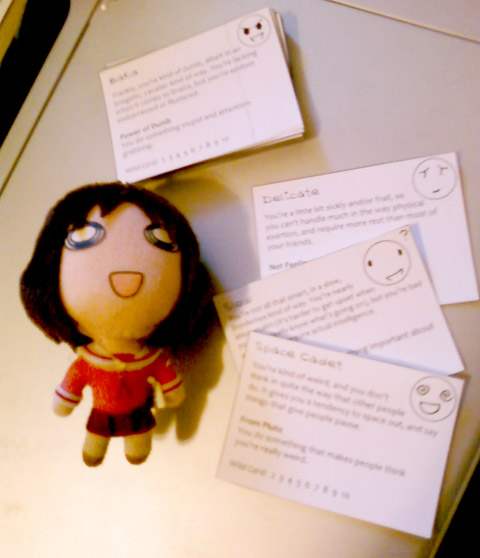
As you might have surmised, I’m gearing up to start playtesting Raspberry Heaven, and having entirely too much fun preparing the materials for it. I printed and cut out two sets of quirk cards, and even made a (flimsy) box for them. There was also a short thread on the game on Story Games, where it was pointed out (not for the first time) that the text doesn’t make it clear enough that the characters are all schoolgirls; I’m working on fixing that now.

I’m also working on scripts for 4-koma comics to put in the book, but I’m not having any luck finding an artist to hire who can actually draw 4-panel comics with screen tone. I may have to look into getting someone from Japan, something I’ve been wanting to figure out how to do anyway.

Raspberry Heaven Playtest Version 0.3

PIC-0022

After getting some important inspiration out of the blue, and doing a good amount of writing, I’ve got a new playtest draft of Raspberry Heaven, my silly high school slice of life RPG.

The biggest change is that I’ve vastly simplified how Special Moves work in play. Players pick a card rank from 2 to 10 for each Special Move to be a wild card associated with it. This also makes it really easy to create new Quirks. I’ve put together a set of Quirk Cards, which will hopefully make it all-around easier to keep track of things. On the cards you circle the number of the card rank you’re using as wild cards for that Special Move.

The introduction mentions some stuff I’m working on/thinking about for the game. I’ll hopefully be doing some serious playtesting/playstorming soon, and generally whipping the game into shape.

Update (9/22/09): Added v. 0.3.2.

Raspberry Heaven Playtest Version 0.3.2
Scene Template
Character Cards
Quirk Cards2

Yaruki Zero Podcast #7: Random Thoughts

ykz_007
In this episode I talk briefly about a variety of different topics that have been on my mind.

  1. PDFs and Piracy
  2. Randomness and Cinematic Role-Playing
  3. Oban Star-Racers
  4. Grognardia: Genre Bending
  5. Raspberry Heaven Design Notes
  6. The “Pink Panther” is what you get when you put a scoop of strawberry ice cream into lemon-lime soda.

Yaruki Zero Podcast #7 (32 minutes, 26 seconds)

Next Time
I haven’t decided what to do next. ^_^;

This podcast uses selections from the song “Click Click” by Grünemusik, available for free from Jamendo.com. If you like the song, consider buying some CDs from Nankado’s website.

Very awesome caricature of Ewen (with his mascot character Kurumi) courtesy of the talented C. Ellis.

somerights20en

Yaruki Zero Podcast #6: Marketing Anime RPGs

ykz_006

jon5In this episode I’m joined my by longtime friend Jon Baumgardner. He’s worked at several different companies doing marketing and brand management for anime, and I brought him on to talk about marketing techniques for small-press/indie RPGs, and for marketing to anime fans.
There’s a bird cooing in the background in some parts. I don’t feel like re-recording. Meow.

Yaruki Zero Podcast #6 (50 minutes, 37 seconds)

Show Notes

  1. Introductions
  2. What is marketing?
  3. Small-Scale Marketing
  4. Selling an Experience
  5. Marketing to Anime Fans
  6. Specific Techniques
  7. Addendum: New Millennium Currencies

Next Time
The next episode will be “Random Thoughts”, another solo podcast, where I’ll talk briefly about several different topics that have been on my mind.

This podcast uses selections from the song “Click Click” by Grünemusik, available for free from Jamendo.com. If you like the song, consider buying some CDs from Nankado’s website.

Somewhat embarrassing but very awesome caricature of Ewen courtesy of the talented C. Ellis.

somerights20en

(For an added bonus, I recorded a piece on Dragonball Evolution for Anime Confessions.)

Yaruki Zero Podcast #5: Japanese RPGs (Part 2)

ykz_005

In the second half of my discussion of Japanese RPGs with Andy Kitkowski, we talk about indie/doujin TRPGs, some neat games we’ve seen, and localization issues. Also, for whatever reason the mp3 file worked out to be precisely 40 minutes.

Yaruki Zero Podcast #4 (40 minutes)

Show Notes

Next Time
Next time I’ll be joined by my longtime friend Jon Baumgarder to talk about marketing for small-press/indie RPGs and to anime fans.

Andy and I will definitely be talking about Japanese RPGs more in the future, so please feel free to let me know about any other topics you might want to hear more about.

This podcast uses selections from the song “Click Click” by Grünemusik, available for free from Jamendo.com. If you like the song, consider buying some CDs from Nankado’s website.

somerights20en

D&D Race: The Wild Folk (v2)

ruin_explorers

A while ago I posted up my first draft of a new D&D4e race called the “wild folk”. Earlier this week I went crazy working on them more, and came up with a revised version, thanks in part to feedback from folks at RPG.net, and my local friends. I got inspired to do all this because one of my friends is running a one-off 4e game and out of the blue he offered to let me play as one, something I wouldn’t have been bold enough to ask for, but wasn’t about to turn down.

The wild folk are basically a mishmash of races and characters from several different Japanese games. In particular, the Varna from Arianrhod, the weird tribes from the Grandia games, Fam from Ruin Explorers (pictured above), and to a lesser extent some of the part-animal races from Final Fantasy, all became part of it. They’re also a way to play a catgirl in D&D, and I wouldn’t really fault any DM that doesn’t want to use them in his or her campaign. On the plus side, I did some interesting things with their culture, and they have a vivaciousness and optimism that seems to be lacking in the existing D&D races.

I’ve put together an excessively complete write-up, basically the equivalent of a Dragon Magazine race article, plus monster stats. I’m pretty happy with the actual race write-up and the feats. The paragon paths probably need more polish, and the monster stats are… passable at best.

Wild Folk (Beta v2) PDF

Just for fun, I’ve also started statting up the Tabbit race from Sword World 2.0 (little rabbit people who excel at magic), and making a maid class (loosely based on Maid RPG). It’s going to be a quirky defender with some leader elements, and designing it is going to be a total bitch to do.