America’s Next Top Reality Show

I made another thing. Let’s back up a little. I’ve been working on a humor book called I Want to be an Awesome Robot,[1] and I decided to include an section with Fun Activities, which will (for the most part) fully functional activity book type stuff, if with kind of a weird sensibility.[2] I’m also working on a mini Choose Your Own Adventure type thing, a super stripped down Maid RPG variant (“Schoolgirl RPG”), and some other things that get a bit geekier and more involved than just coloring pages and stuff (though there will be those too). One thing I came up with but may or may not put into the book is a mini Channel A type spinoff game, intended to have a deck of a more reasonable size and play a bit quicker. A while ago NPR had an article on “The 25 Magic Words Of American Television.” When it first came out I sent the link to some friends, and one immediately declared that he’d watch a show called “Mob Pets.” Putting together a small list of title cards was a very easy thing to do.

I’m not sure what I’ll actually do with the game from here–if it works out well as a game I could totally see doing it in the form of a full card game in a reasonably sized tuck box–but for now I’m tossing out a free PNP version for the heck of it. This is very much like the ones I’ve done for Channel A and Studio B, with the little 2″x2″ cards you can print on cardstock and cut out. You’ll also need two six-sided dice.

America’s Next Top Reality Show PNP Version PDF

Here are some titles I made by messing around with the cards for a bit:

Mob Apprentice, Fear Shack, Hell’s Zookeeper, Star Swap, Amish Hot Rod, Bachelor Dynasty, The American Factor, Who Wants To Be A Cat?, So You Think You Can Catch, Sex House, Dance Kitchen, Pimp My Duck, Extreme Cake, The Deadliest Family, Party Boss, Millionaire Pets, The Doctor Whisperer, The Big Monster Project, Hell’s Hot Rod, The Amish Hunter, Love Chef, Superhero Makeover, Bachelor Island

On other Channel A type news, I recently visited my sister and brother-in-law in Washington DC, and got my new fancy prototype of Studio B (the American B-movie reskin of Channel A). We got to play a good amount of both games, and did very successful demo games at Labyrinth Games & Puzzles, an excellent game store near Capitol Hill.


[1]I already decided that the sequel is going to be called “Most of My Friends Are Potential Supervillains.” You know who you are.
[2]The answer to the crossword clue “Like a crossword without balls” is “WORDFIND.”

Kyawaii RPG #8: Saving Throw

Saving-Throw

One of the funny things about American culture is how there are certain divides that are hard to see past. There are certain figures who have millions of fans, yet are largely unknown to people at large. One such figure is Jack T. Chick. He’s the man behind Chick Publications, which publishes Chick Tracts, of which about a billion copies have been printed. Chick Tracts are tiny comics intended to help fundamentalist Christians proselytize. They can show up all kinds of places–I even have a couple I found at a bus stop here in godless[1] California–and they provide a window into a very distinct and unique worldview. For Jack Chick there is Good (the things he believes in) and there is Evil (absolutely everything else). Good is his particular flavor of fundamentalist Christianity, evil is Darwinism, Buddhism, paganism, Islam, and especially Catholicism, or at least his strange caricatures of these things.

Chick Tracts are generally incredibly easy to pick apart on a purely factual basis, and certain tracts are rather reprehensible on a moral basis (the infamous and emphatically discontinued “Lisa” tract comes to mind). Gamers mainly know of Chick Tracts because of the Dark Dungeons tract, which embodies much of the paranoia of the anti-D&D moral panic of the 80s. Whatever else Chick Tracts are, they’re a fascinating body of outsider art. Chick draws some himself, and has employed other artists as well, so the art ranges from eccentric to genuinely impressive. Aside from the inevitable parodies, there are a a few people who collect and study his work, expressing fascination and admiration even if they find his actual beliefs ridiculous and occasionally repugnant. There are a couple of books about Jack Chick, and even a documentary, God’s Cartoonist.

A friend of mine had the idea to make a Chick Tract RPG, following the same form factor as a Chick Tract (which is to say a little 2.75″x5″ booklet). When I heard the idea, a game popped into my head nearly fully formed. My friend hasn’t gotten around to putting together his take on the concept, but just as Chick Publications has put out over 250 tracts, there’s certainly room for more than one satirical RPG. Saving Throw (aside from being a dumb pun) is my satirical Chick Tract RPG. This version is a letter sized PDF, but I do aspire to get a few illustrations done and do a small print run in booklet form.

To play you will need a d20, 15 tokens of some kind, and a basic familiarity with Chick Tracts (which for better or for worse you can view for free online).

Saving Throw PDF Download


[1]Not really. This area is maybe less religious than some, but there are still churches everywhere.

Fantasy Friends Design Journal

The other day I sent the first draft of Faerie Skies out to backers, along with a request for fans who are from the UK (or just knowledgeable about it) to offer feedback on how I portrayed the English countryside. Thankfully it looks like it’s mostly small details that I missed, and not anything really huge or offensive.[1] As I said in the backer update I’m more of an anglophile than the average American, but I’ve nonetheless lived in California my whole life. On the other hand I’m definitely going to take some liberties with fairy lore, just as Kamiya did with Japanese myths. This is partly because I basically have to make something that works with the GSS rules, and partly just to better fit with what I think would be more fun. Faerie Skies is going to need some fine-tuning and some more playtesting and such, but in the meantime I’ve been working on Fantasy Friends, mainly because being productive helps me not be crazy anxious about the whole Kickstarter thing.

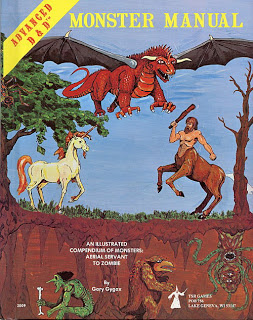
monster_manualLooking through old Monster Manuals (and the Fiend Folio and Monstrous Compendium and such) for monster ideas was kind of daunting. In AD&D1e the monsters are for the most part terribly vicious things, many of which basically exist because an evil wizard figured out a demented new way to kill incautious adventurers. WotC’s takes on D&D focused that much more on monsters that you fight, and at times it seems to be full of angry, spiky, glowing things, especially in the higher-numbered books. Navigating the game towards having friendly versions of beholders and gelatinous cubes make sense feels a bit daunting, since unlike with more classic mythical creatures the D&D monsters have very seldom been made friendly. (Rusty and Co. is pretty fun though.) Fox spirits could be downright terrifying in Asian myths,[2] and the old, unvarnished fairy lore reads like a long list of things to stay away from if you want to stay alive, but the works of fiction around them make them relatively easy to picture as friendly. (And with fairies, the friendly modern version is now more prevalent, so there’s a lot more about happy pixies and elves and a lot less about Jenny Greenteeth eating children.) In GSS, the henge’s self introductions usually address the myths about them, and in some cases they “debunk” the myths. This is especially true of Kuromu the cat henge, who wholly rejects the veracity of folk tales about bakeneko and nekomata and such.

I realized that for the creatures I want to put into Fantasy Friends I essentially need to carry out this same process, though I have to start a little further back as it were. Under the influence of anime and Discworld and such (plus looking at real life), I hit on the tack that in this fantasy world most beings basically just want to live their lives, and it’s mostly politics, ignorance, and misunderstandings that keep them apart. Without that Dark Lord jerk mucking things up, the so-called Forces of Darkness would just be people (with a rather broad definition of people) being more or less decent to each other. For people in an unremarkable little village, the sight of a beholder or whatever is still quite a shock, but ultimately coexisting is better than fighting for everyone involved.

From WotC's Monster Slayers kids version of D&D
From WotC’s Monster Slayers kids version of D&D
I also ended up using Mononoke Koyake as my template for how to approach the new set of character types. In MK, each character type has a whole two extra pages that lay out basic info on the character type, eight or so possible reskins, the rules for how they transform, and advice on naming. This was basically the only way to even make a dent in the possibilities presented by “monsters from D&D and similar fantasy works.” I had considered doing something like this for Faerie Skies, but found that it didn’t really feel necessary, as the different types of fae didn’t lend themselves to there being too many sub-types. For D&D-type monsters on the other hand I ended up with things like an Aberration character type, which covers beholders, rust monsters, chimeras, and so forth. The others are Constructs, Dragons, Elementals, Shapeshifters, and Slimes. Some of these can be quite powerful in D&D terms, but then this is where the way that GSS operates somewhat orthogonally to typical RPG concerns is very helpful. In GSS’ later supplements there are new character types like the Elder Henge that have some very potent powers (snake henge actually have some powers that affect time!), but a power that costs a full 20 points of Wonder is unlikely to be usable until the story is winding down in the first place. And perhaps more importantly, when the final objective is to help people and heal relationships and such, special powers only go so far in the first place. I’ve seen Powers like Peek Into Hearts undo a GSS scenario’s Gordian knot, while flashier powers go unused.

One thing I’m adding in that’s pretty much new for GSS is magic items. In game terms these would basically be a “container” for 1-2 Powers and possibly a Weakness, and in story terms they’d essentially be a plot element roughly on the level of an NPC. Characters wouldn’t just own random magic items, but an item could play an important role in the story. Very much like with Faerie Skies, I’m rounding out the book with a sample town (“Grassdale”), some story seeds, and some new NPCs. So far the NPCs are basically just the archetypes that a fantasy town calls for, such as the priest, innkeeper, and hedge wizard, not to mention adventurers.

Overall it’s kind of surprising how different an energy this project has from Faerie Skies. Fantasy Friends is RPG-style fantasy, and while there are some tropes I want to hit, I’m basically making stuff up, whereas for Faerie Skies I culled through about a dozen different books for reference, from classic literature to recent RPGs. Not having to worry about getting a real-life culture right is also rather freeing. The tricky part is the volume of stuff I have to tease out to create a GSS character type. For fairies coming up with 12 powers and 6 weaknesses was basically a matter of digging until I found enough ideas in fairy lore, while D&D monster writeups tend to have relatively few things that can work as GSS-style powers, and in many cases not a lot of other source material on account of having come from the game with little to no basis in myth. Fantasy Friends also feels a lot more like I’m subverting a genre.[3] Taking something with violence at its core–in some cases so much so that it can obscure everything else–and making a nonviolent heartwarming version is challenging yet oddly appealing. Anyway, I should actually get something done instead of sitting here blogging about it, so I’ll stop here.


[1]People do seem to take the names of British pubs very seriously, though I assume that’s in part because British pub names are awesome.

[2]This is especially true of the Korean version, the kumiho.

[3]Though with this and Retail Magic and Dragon World that seems to be becoming a pattern with me.

Adventures of the Space Patrol Playtest Version 2

It’s been a while since I did anything new with Adventures of the Space Patrol, but I’ve always been fond of the game. It’s got some of the heartwarming fun of Golden Sky Stories, and not unlike GSS it has its own aesthetic, not quite like other entries in the same genre.

I originally designed the game as a very simple custom build of Fate. When I started working on it, Spirit of the Century was the definitive version of Fate, and Awesome Adventures was the about the only simpler version out there. I really like the core concepts of Fate, but these days I’m generally not a fan of 300-page RPG rulebooks. There are also issues like how SotC gave characters a full TEN Aspects, which to my mind is about three times too many. I saw an awesome rules-light game lurking inside of Fate, and Space Patrol was in part my best attempt at creating that. More recently, Evil Hat had their explosively popular Fate Core Kickstarter. Along with a zillion other things, it brought Fate Accelerated Edition into the world. There was suddenly a 48-page version of Fate (available in print for a mere $5), which kept the essence of Fate and included the slick refinements of Fate Core.

You can probably see where this is going, but it was pretty much a no-brainer to revise Space Patrol to take full advantage of FAE. The way it handles the four actions, the rules for challenges/contests/conflicts, and so on do a lot to address the few things about my game that I had been trying to figure out how to smooth over. With OGL and Creative Commons licensing options, readily available SRDs, and the Fate Core Glyphs font, Evil Hat has made Fate pretty awesome to use from a publishing standpoint. Otherwise I didn’t change Space Patrol all that much. I tweaked a few things here and there (like making it so the GM just gets a flat 10 Atom Points per episode), adjusted some things to fit the new rules, and added a new character to the lineup (Cosmo the Wonder Dog). I also finished up the two sample scenarios I’d been planning to write. It’s all very first draft, but it should be totally playable. I’m hoping to get in some playtesting before too long, and to more thoroughly read Fate Core with an eye for finding elements to adapt to Space Patrol.

Me being the way I am I’m thinking about possibly doing a Kickstarter for it at some point. It’d have to wait until a lot more Golden Sky Stories stuff is out of the way, and if I do it I’m definitely going to keep it a lot simpler and sleeker than what we did with GSS. Also, I’m looking forward to having the excuse to get a bunch of cute, stylish retro sci-fi art done.

Anyway, without further ado, here is the current playtest draft PDF:

Adventures of the Space Patrol Playtest Version 2 PDF

Yaruki Zero Podcast #20: Today in Geek History Part 1

ykz_020

This special episode is a compilation of the first six months of the “Today in Geek History” daily podcast I’ve been posting on Tumblr. I’ve been working on a humor book titled “I Want to be an Awesome Robot,” and one rather large section of it is a calendar with a fake fact about the history of geekdom for every single day of the calendar year, plus one or two days I made up. I does have plenty of RPG stuff in it (including the tale of Gary Gygax’s quest for the Rod of Seven Dice), though there’s also entries relating to anime, video games, sci-fi, literature, science, history, and more besides. Filling up 365 days is hard, especially when you make it so that it’s actually 379. The whole thing is a bit over an hour and a half, though on the plus side you can now listen all the way through without clicking on dozens and dozens of individual Tumblr posts, most of which are less than a minute long. Expect another similar compilation episode in January 2014!

Yaruki Zero Podcast #20 (1 hour, 36 minutes, 32 seconds)

Caricature of Ewen courtesy of C. Ellis.

Destiny Dice

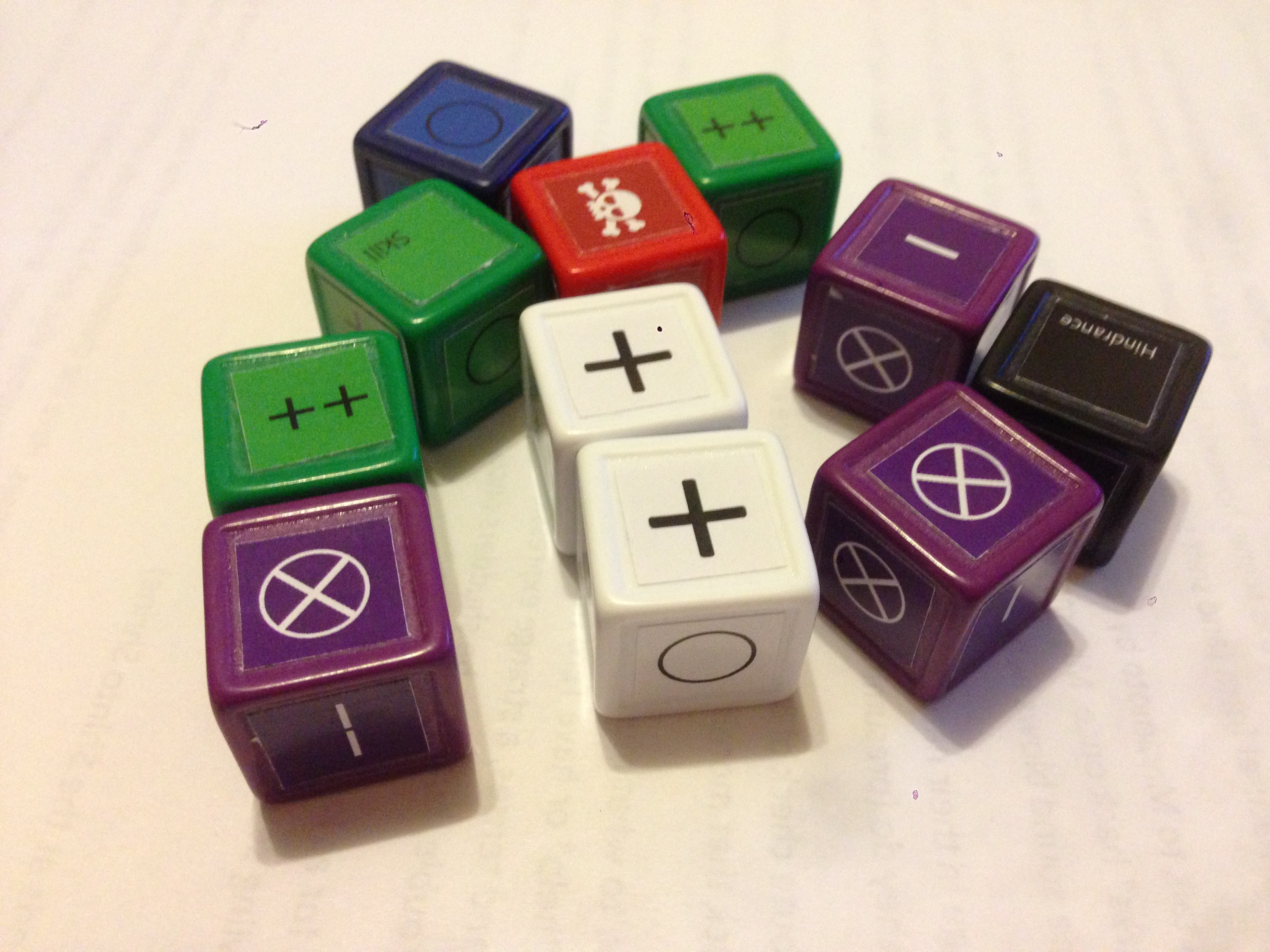
A while ago I tried out the Star Wars: Edge of the Empire Beginner Game, and a while before that I tried out WFRP3e too. Warhammer was downright overwhelming for its preponderance of board game style components, more in line with one of FFG’s Lovecraftian board games than any prior RPG, but as unconventional as it was, I really liked the dice mechanic. The basic idea is that you roll a pool of various types of special dice representing different factors in the game, including not only your character’s abilities, but the difficulties you’re facing as well. The dice have different symbols that you use to figure out the outcome of the roll, with a number of possible side effects. The Star Wars game presents a more refined version of that. The selection of symbols and dice is a little simpler, and it has this nice aspect where the more potent dice have more sides. (The Star Wars symbols aren’t quite as intuitive as the Warhammer ones though.) Apart from those dice and some Star Wars flavor, Edge of the Empire is basically just a fairly solid, rules-medium traditional RPG.

IMG_0770

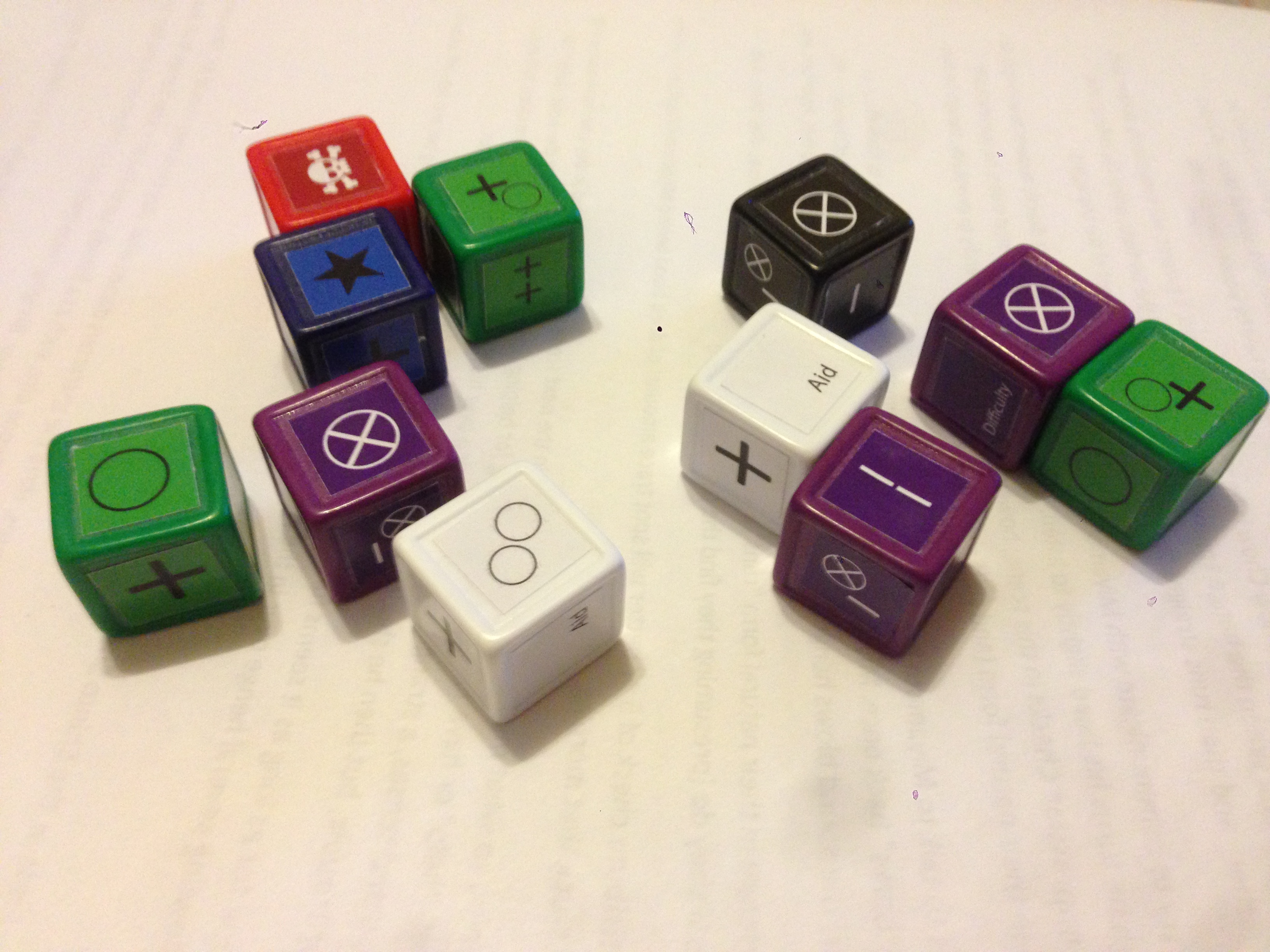
For a while I’ve been wanting to put together my own genericized version of this style of dice, and I finally sat down and did just that. I call these “Destiny Dice” (like they’re some weird, elaborate cousin of Fate dice). I don’t really expect to establish a new standard, not even on the level of Fudge/Fate dice, but I do expect to make something that’ll at least be fun for me to play with. For practical reasons, at least for this initial iteration, I’m using only six-sided dice. Chessex charges by the side for custom dice, which makes prototyping a bunch of dice where every side is custom prohibitively expensive. Q-Workshop also does custom dice, but they want fancy designs and the it’s not really at that stage yet. But what I can do is get blank six-sided dice and custom-printed stickers from The Game Crafter. I stuck pretty close to the Edge of the Empire version otherwise, so the dice produce both Successes/Failures and Advantage/Disadvantage, plus the occasional Hope and Despair symbol. Success/Failure determines whether a given task succeeds, while Advantage/Disadvantage lets other good or bad things potentially spin off from it (the simplest being mechanical stuff like giving an ally a bonus die), and Hope/Despair is basically a more potent version of Advantage/Disadvantage.

IMG_0771

In order to actually have a system to play it with, I put together a hack of Fate Accelerated. With the new Fate Core the Evil Hat team has done an incredible job of refining the Fate rules, and with FAE they’ve really distilled the essence of it down to the sleek little game that’s been buried inside of Fate’s usual bricklike books all along. This is going to necessarily change the feel of the game a bit. For more rolls than not you’re going to be figuring out how to spend the Advantage/Disadvantage symbols that come up, plus Aspects aren’t quite as powerful as in standard Fate. I’m thinking I’ll make the dice available for purchase through TGC in case anyone is interested in trying it themselves (and willing to spend an hour or so applying stickers to dice), but not until I’ve done some playtesting and refined the whole thing a bit in terms of both game design and graphic design. In the meantime here’s what I have so far for the rules:

Destiny Dice Rules (PDF)

Faerie Skies: Design Journal

The pre-release of the Golden Sky Stories PDF is off to backers, which means that people are getting their first taste of the full version of the game. (Also, Channel A has reached most backers, and is now available in the Asmadi Games web store.) We have a ton of stuff to do yet (a good portion of which is in other people’s hands besides mine just now), but I wanted to take some time to talk about what I’ve been doing with Faerie Skies, the first of the two alternate settings I’m developing for GSS.

For Faerie Skies I’m sticking very close to the basic rules of Golden Sky Stories, essentially adding fae as a new group of character types and providing supporting material to go with them. The challenges then are more aesthetic than mechanical, since I’m setting myself the task of creating a suitable take on fairies out of the great mass of folk tales and their many reinterpretations. There are certain major archetypes of fairies, but once you include all the regional variations (even just within the British Isles) there are literally hundreds of different types, often with oddly-spelled Celtic/Gaelic names.[1] With some help from a friend who’s well-read on the subject I’ve settled on a set of six character types: brownies, elves, gnomes, nymphs, pixies, and pucas. The aim is to put together a set of archetypes that cover a reasonably wide range of types of fairies while avoiding a lot of the decidedly non-GSS elements of the folklore. The original folk takes are largely a series of warnings; “stay the hell away for faeries” is the most common moral. I don’t want to wholly go into Disney Fairies territory, but I also need to make something heartwarming for GSS.

I_samma_ögonblick_var_hon_förvandlad_till_en_underskön_liten_älva

In Faerie Skies, elves are specifically the faerie nobility, the Tuatha de Danaan and such, beautiful, magical, and melancholy. Gnomes are workers and creatures of the earth, nymphs are nature spirits (which can be water spirits, wind spirits, dryads, etc. depending on how you flavor them), brownies are helpful household fae, and pucas are shapeshifters with animal traits. On top of that there will be guidelines for using henge and mononoke to create other faerie characters. A cait sith can simply be a cat henge, the Black Dog can be a dog henge or a michinoke (or a bit of both) depending on how you flavor it, a will-‘o-the-wisp is hands-down a michinoke (and basically a Western equivalent of a hitodama), and so on.

Teasing out enough material to come up with 12 powers and 6 weaknesses for each character type is one of the more difficult parts, since creatures from folk takes tend to alternately be totally vague or flagrant deus ex machina in terms of the special powers they display. Elves and pixies[2] have been fairly easy to come up with traits for, while brownies have been a lot harder. On the other hand the sum of fairy lore has more potential ideas for powers and weaknesses than even the 108 slots I get from 6 character types, and I may end up making some optional powers and weaknesses players can slot in to further customize characters. (Which is actually the approach they took for the Touhou Yuuyake Koyake book.)

Faerie Skies is also going to include a selection of NPCs, similar to the archetypes included in the GSS rulebook, where they’re not so much character writeups as a delivery system for plot hooks. Some of these are simply more Western/British character types (like the Vicar), while others are people with distinct relationships to the world of the fairies (like the Sighted, who is touched with the ability to see through fae illusions). Tony DiTerlizzi and Holly Black’s series of children’s books The Spiderwick Chronicles is turning out to be an excellent source of inspiration for how it shows different ways human characters can interact with fairies.[3] Along with the people I’m putting in some animals (like sheep) and faerie creatures (gryphons, unicorns, the White Stag) that might play a role in stories. I’d like to do a writeup of an English town too, though being an American city kid makes that quite a challenge.

Digging into fairy lore and works of fiction for ideas has been a pretty interesting experience. RPGs instilled in me an interest in mythology,[4] and while I wasn’t more interested in fairies than other kinds of mythical creatures (and maybe less so than the likes of the tengu), I always found them interesting, enough so to inspire a flirtation with Changeling: The Dreaming. I’ve also been rediscovering things like the movie Labyrinth that I haven’t been near in ages. All in all this is proving to be a really fun project, though there’s still quite a bit of work to do all around.


[1]Having been a victim of an oddly-spelled Gaelic name my entire life, the likes of the Cait Sith and Gwragedd Annwn have my sympathy.

[2]I’m using the word “pixie” in the modern sense here. In the actual folk tales a pixie is a kind of brownie, and to the extent that the little people with fluttering wings are a thing, they’re more typically called sprites.

[3]It also doesn’t hurt that Mark Hamil did the voices for the audiobook.

[4]Thinking about it now I’m feeling a little nostalgic for trips to the Sunnyvale library, which had among other things a bunch of AD&D books and stuff like Folk Legends of Japan.

Magical Burst 2013

Needing to step away from Beyond Otaku Dreams, I ended up getting back into Magical Burst. (Also, making some notes for the alternate settings for Golden Sky Stories.) Getting away from Magical Burst (I was last seriously trying to work on it in October of last year) was apparently the right thing to do, because I feel like I’m coming at it with fresh eyes, and making some important changes that feel just plain refreshing.

sample_e264e3c732772bb289d3605e58a37cac7a01509a

One thing that’s been on my mind lately, something that I think not very many people would be in a position to notice, is how different designing and translating games are. As a translator I get very intimate with the actual text of the game. While I don’t remember every word of Golden Sky Stories, I’m exceedingly familiar with the contours of the text, with what goes in what sections. In contrast, when I have my game designer hat on I have an image of the rules in my head, and it’s a struggle to update the text to fit that image as it changes over time. Last month I had a bunch of ideas for Magical Burst (while I was at an anime convention as it happened), and coming back to the actual text is weird because the game in my head has changed so much from what’s in the Word doc. It feels weird that I come across references to relationships taking Strain when in my head I have the much more straightforward system of them having levels that can be gained or lost.[1]

The single biggest thing is that I’m significantly reworking certain key aspects of combat. I decided to implement a “Battlefield” system inspired by Nechronica and Meikyuu Kingdom, basically because it’s something I really, really like. I was never quite happy with the combat system in Magical Burst before, and this gives me a place to implement one of my favorite new game mechanics to come along in a while. I had been thinking of trying an Engagement system like in Arianrhod and 13th Age, but I find the Battlefield map approach far more interesting, and easier and more fun to hang mechanics off of. (It’ll also be a bit of a trial run for implementing a similar system in Slime Quest, which is going to be an altogether more involved project.) I’ve talked about it at great length before, but the core concept is that combat takes place on a semi-abstract map with a small number of positions/areas arranged in a line, and stuff like range and movement is in terms of this set of positions. This provides a potentially fun element of tactical combat while vastly reducing the overhead of having map-based combat at the table.[2]

I also decided to make Magical Attribute assignments semi-permanent. I never really liked the concept of swapping them around on the fly, and it was really an attempt to solve a problem (how to go about tying Heart, Fury, and Magic stats to something meaningful) rather than something I like on its own merits. I’m changing it so that you can rearrange them only when you take certain advancement options. This in turn reverberated through a bunch of other elements of the system, so that it was no longer necessary to have the rule that no two Magical Attributes could have the same value, and didn’t make sense to have relationships follow those types. (And the concept of Fury relationships was throwing people off anyway.)

85c94f7a3f61908afdec54c6067201ad42d8293e

That’s in addition to the other stuff I was talking about previously with specializations (which give characters more special abilities to emphasize Attack, Defense, or Support), and making Magical Effects into Magical Talents, of which there are a lot more available. One of the things I really like about Magical Burst overall is that it puts my diverse RPG inspirations on full display all at once. It’s traditional, hippie, and Japanese all at once, combining elements of games like D&D, Don’t Rest Your Head, Nechronica, Smallville, and Apocalypse World. The tactical combat aspect might seem a weird approach to the game, but it’s making me a lot more excited to play it.

At this point I’m thinking I’d like to make it a goal to finally publish Magical Burst in about a year or so, though of course I don’t expect life to be so straightforward. The part about how I want the tie-in novel to be ready is going to be a big deal, since that thing is still a first draft and needs a ton of work. On the other hand a new draft of the rules shouldn’t be *too* far off, and I intend to keep a free version available regardless.


[1]The main inspiration for this was the fan-made “Magical Burst ReWrite,” which I’m trying to borrow ideas from (there are several that are too good to pass up!) without plagiarizing.

[2]One of the issues with the 3rd and 4th Editions of D&D is that while doing stuff with a grid can be a lot of fun, you have to put a lot of effort into what is normally a single-use set piece to make it that way. A Battlefield map is both totally reusable and relatively easy to customize (just attach special effects to certain positions).

Beyond Otaku Dreams Alpha

I finished up a first draft of Beyond Otaku Dreams, and just has a rather messy, abortive playtest.[1] Right now I’m kind of lost as to what to do with it, so I’m tossing it on the internet to see what people make of it.

Beyond Otaku Dreams Alpha 001 PDF

The core game is definitely a branch of the Fiasco family tree. I’m really liking the idea of RPGs whose rules don’t particularly concern themselves with success and failure, because it seems to open up a huge number of types of genres and stories that wouldn’t work nearly as well in a traditional RPG (as evidenced by games like Fiasco, GxB/BxB, Hot Guys Making Out, etc.). I especially like the idea of handling an epic “final battle” that way, though I didn’t get as far as trying those rules out in the playtest. I think the big issue with the game right now is that it leaves a bit too much blank canvas for players to fill it, but I’m not sure how to go about fixing that.


[1]We were a bit tired and hot and in mixed moods, so I don’t know how much was problems with the game and how much was from other stuff.

More on Beyond Otaku Dreams

I have a ton of different things I need to work on, including getting more done with the Golden Sky Stories Kickstarter (though at this point a lot of that is waiting for people to get back to me), making progress on Magical Burst, and I’ll stop there because I could easily do a whole post just on neglected projects. One that’s been on my mind a lot lately, that keeps popping up in my thoughts even when I don’t intend it to, is Beyond Otaku Dreams. I talked a bit about the idea in a previous post, but recent experiences have helped me solidify the concept a bit more, and really zero in on the heart of what I want it to be about.

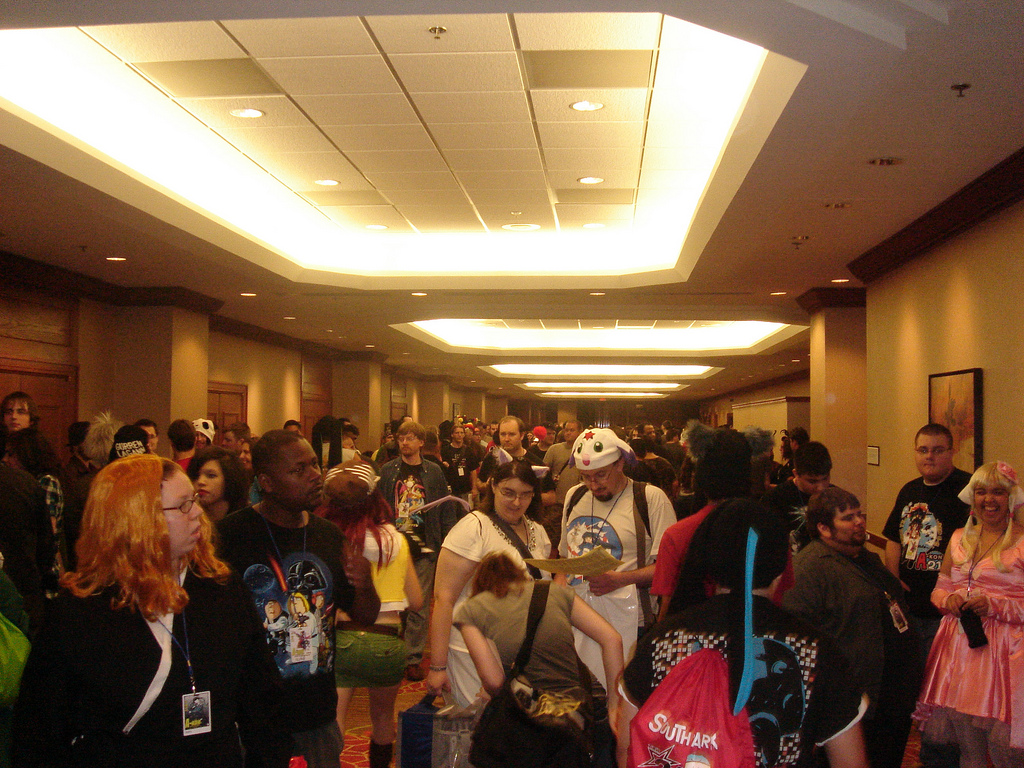
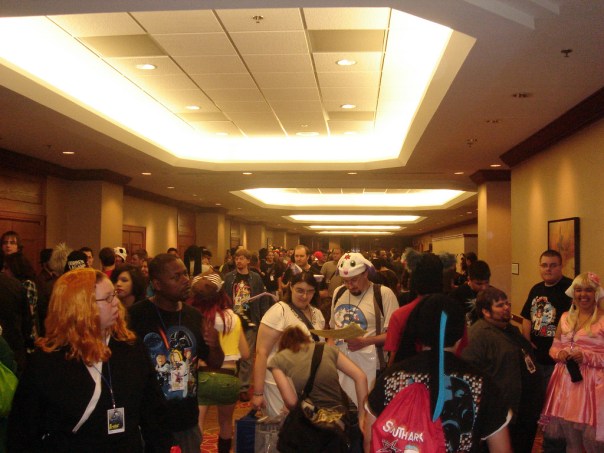
For a long time I’ve wanted to make something about anime fans who see into another reality, a “dream layer” superimposed on the world, where they interact with beloved characters and fight spectacular battles while the rest of the world assumes they must be insane. I had a lot of ideas for a novel, and later for an RPG, but neither ever quite came together. Then last year I went to FanimeCon, and I saw the most amazing scene. The Jesus freaks with signs were protesting the terrible circumstance of people having fun, and a bunch of fans were counter-protesting and generally jeering the shouty Christian guys. One guy was playing Final Fantasy music on a saxophone. And while all that was going on, there was an ambulance, and they were loading a girl in full costume, in a powder blue wig, on a stretcher. My FanimeCon 2012 story was mainly about how I bought some stuff in the dealers room, hung out with my friends Jono and Sushu, and wound up playing Jenga with some random people in the gaming area. Someone else’s story was about how a friend who’d worked very hard on a costume had left the con in an ambulance. It reminded me of all the things I’ve seen at cons over the years, covering every hue in the spectrum of human emotions. I’ve seen raucous joy, but also deep anguish, paralyzing shame, perfect religious serenity, and a million other things. Anime fandom has its good and bad points, but it is above all very human. I realized that my game needed to be about that above all else.
4671812308_3dddf8ff23_b

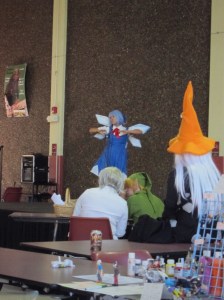
More recently I went to Anime Conji, a small anime con in San Diego. It was kind of a shock to be so suddenly and thoroughly immersed in the anime con culture, and it reminded me of the sheer intensity of the experience. I can’t speak with authority on how anime fans behave in real life (I remember how my friends and I were in high school…), but it always feels like people are letting out things they have to keep in most of the time. There’s also a sort of ritualistic aspect of anime cons, and people create new patterns of group behavior that you don’t really see anywhere else. One really striking example is that if someone is wearing a costume, it’s apparently perfectly acceptable to just sort of yell the name of the character at them. Chatting with my friend Guy Shalev about the ritual nature of anime fandom made me realize how important, how immediate the convention experience could be. I realized that I should frame my game around characters going to a convention. The sheer intensity, the amplitude of hope, the collision of reality and delusion, make it the perfect setting for stories about both the humanity of anime fans and about the line between dreams and reality getting blurry.

(The other thing at Anime Conji was that I saw a panel put on by Chocolate Covered Cosplay about taking your fandom passions and making a living off of them. It would not have occurred to me that cosplay could also lead to a career in modeling–cosplay isn’t something I’ve ever been seriously involved with–but they’re apparently way ahead of me when it comes to being anime fans boldly realizing their potential.)

Narratives about and discussions of anime fandom tend to be either highly idealized or treat fans as human garbage. There are academic articles that go on about how amazing and post-modern otaku are, and blog posts griping about how obnoxious they are. Beyond Otaku Dreams is in part me planting a flag in the neglected middle ground, the place where anime fans are human beings with both problems and potential. It’s become a rather personal work (insofar as an RPG can be personal), based much more on my own experiences than references to works of fiction. I have a hard time thinking of many RPGs that quite have that kind of origin (maybe some Jeepform or Norwegian Style games?). I don’t think that makes it better, but it definitely makes it that much more something I want to bring to fruition. It also means that there’s almost zero inspirational material to look at (Akibaranger and Dramacon are probably the closest), which is liberating in a way.
6017620796_9cce30bda9_b

The game that’s just starting to form in my head has some bits of Don’t Rest Your Head, Fiasco, and Polaris (plus a tiny bit of Maid RPG and a few other things). It’s definitely leaning towards the GM-less shared storytelling activity side of things. Like Fiasco it’ll be aimed more at one-shots, but since the characters will tend to survive and become better people, it’ll lend itself to doing “sequel” sessions where you revisit them at the con the following year (or maybe have them going to an even bigger con, or even an event in Japan), learning what new challenges they’re facing. It’s not going to be a game with a lot of numbers–I’m thinking the main thing will be a dynamic of Hope, Trauma, and Delusion[1]–and the more important part of character creation will be a series of DRYH-like questions, including things like “What is your obsession?” and “What do you hate about yourself?” The game would play out in a series of acts and scenes. Acts get random events from tables to shake things up, and scenes will involve stuff based on a character’s answers to the questions. Over the course of the game the situation with dreams intruding into waking hours explodes and climaxes, and then each character gets an epilogue partly based on their numerical scores. Or something like that.

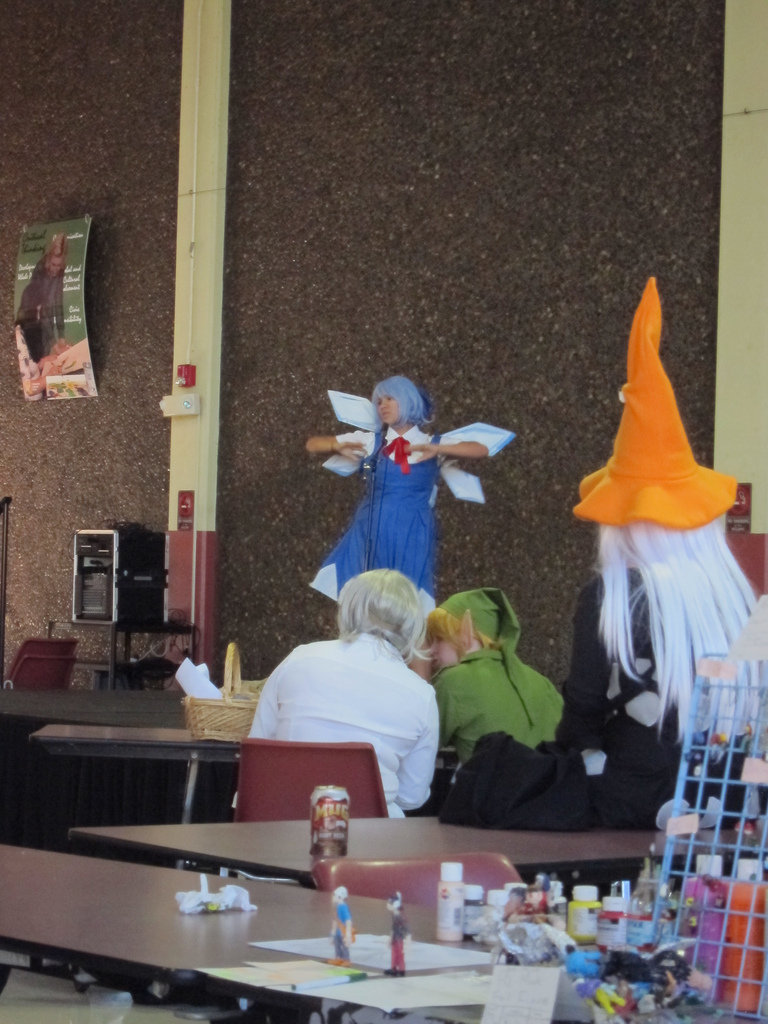
One thing I’ve decided about the end product is that I want the visuals in the book to be mostly or entirely actual photos of cosplayers and convention stuff (kinda like what I put in this post but, you know, all-around better). I love artwork, and I love working with artists, but a lot of the most important parts of this game are about reality, and I want to reflect that visually. I know there are some stock photos I can use–there are a good number of cosplay photos available that way–but it’ll be interesting figuring out how to do the rest, to capture the feel of Artists Alley and a the masquerade and such. The decision to use photos may in turn lead me to have the book be in color (and maybe formatted more like a convention program guide?[2]), though of course that’s getting way ahead of things.

Update (4/30/2013): A conversation with a friend about the game led to kind of an interesting idea. One of the challenges with Beyond Otaku Dreams is helping create something of an anime convention feel even when the players are potentially in a plain, quiet room at someone’s house. Some of the things you can do go a bit outside the scope of the RPG. The Ambiance app provides sound loops for things like a convention hall or manga cafe for example, there’s stuff like having props around (I want to make convention badges, and I’d love to play with someone in full costume), and of course you could just play the game at an anime con. My main idea for helping with that on the game design end is a step just before character creation called “the buzz,” where the group puts together a list of anime titles[3] that everyone in the play group is reasonably familiar with, with the option to put in some made-up ones (say if you just had a memorable game of Channel A?). I think part of the appeal of going to an anime con is entering a special space where your arcane knowledge temporarily becomes shared knowledge, but in my experience even good friends don’t necessarily have quite the same canon of anime series, so I think establishing a baseline for the game will go a long way towards helping players emphasize what they do share. The Buzz should then influence (but not dictate) some elements of characters; if you want your character to be obsessed with a specific anime character, it’ll potentially be more effective to go for one from a series listed in the Buzz. The Buzz will probably also include some elements of the convention itself, like notable guests or events. It would be pretty natural to have a character obsessed with the new anime series Kaiser Bunny Legend[4] and then have the creator of KBL as a guest at the con who plays a role in the story as an NPC.


[1]Specifically “delusion” as a translation of the Japanese word mousou (妄想) as used by otaku, referring to a kind of deliberate, flagrant rejection of reality in favor of self-indulgent fantasies.

[2]Except it would show up on time instead of halfway through the thing. :rimshot:

[3]And other works that fit into the general zeitgeist; putting Idol Master or Homestuck into this list would be fine.

[4]Which is straight from a Channel A playtest, though some day I want to write that story. A group of doujin artists find themselves in a colorful world of magic where imagination has power, so as creative types they find they have all sorts of magical powers. One guy finds his mascot character, a fanservice bunny girl, comes to life. She in turn accidentally takes up the Kaiser Gauntlet, and thus must become the hero who saves the world. With that as a backdrop, the story is really about their relationship and how it changes as she gradually transforms from a fairly shallow character into a complex human being. But anyway.