Category Archives: games

Arianrhod 2E: The Focus System

ara2e_jyoruI wound up getting a copy of the Advanced Rulebook (上級ルールブック) for Arianrhod 2nd Edition, F.E.A.R.’s dungeon fantasy RPG with an anime/JRPG style. The book includes advanced classes (that characters can take at level 10), prestige classes, new skills for the base classes, items, guild skills, monsters, traps, dungeon objects, and optional rules. The thing in it that I found the most interesting is what the designers call the Focus System (FS for short). The Focus System is something a lot like Skill Challenges in D&D4E, but better in pretty much every way. There’s even an FS Check Management Sheet, which isn’t quite as insane as it might look. It has spaces for three FS checks, and F.E.A.R. is just really big on making sheets for things.

An FS check goes in rounds, and one of the neat things about it is that you can have an FS check going at the same time as combat. Making a check for the FS uses your main action, so you have to choose between that and attacking. During the FS check a character can make Progress Checks or Assistance Checks. A Progress Check is a check[1] on the attribute (or other appropriate check) determined by the FS check’s specifications, and you gain or lose Progress Points according to your margin of success, anywhere from -2 to +4 (with a special bonus of +1d6 plus 1 per die that rolled a 6 on a Critical), and your ultimate goal is to accumulate enough Progress Points to complete the FS check. However, an FS check has a limit on how many characters can make Progress Checks per round (2-4 in the examples), so other characters can make Assistance Checks during the initiative phase, and if successful they give a +2 bonus to another character. A typical FS check needs 10 to 20 Progress Points to proceed (10 in most of the examples), but the PCs have a limited number of rounds to pull it off (in the included examples 3-5 rounds). When you design an FS check, you take the preferred number of participants times the number of rounds to determine the Progress Point objective.

Events are the other major thing that make an FS check more interesting. These trigger based on how many Progress Points the PCs have gained, usually around one event per 3 Progress Points (paced so you get one every 1-2 rounds). Events can change what stat you need to make a check with, alter the difficulty you have to beat, or also affect the FC check’s end conditions (giving you more or fewer rounds to complete it say). The book has 5 full writeups of example FC checks, and one of these is for disarming a particularly complex trap. It starts with Trap Removal checks (a special Thief skill, based on Dexterity), then the difficulty drops as you start to understand the trap, then thwarting a mechanism requires Strength checks, and finally at the end you’re left with the choice of the red wire or blue wire, and you need to make a Luck check. If the PCs get enough Progress Points at once to trigger multiple events, you take the most recent check requirements and retain things like modifiers to difficulty numbers from intermediate events.

If the PCs get enough Progress Points in time, they’ll succeed and get an XP reward at the end of the game session. The text also notes that you can have competitive FS checks basically by having two groups doing the same FS check in parallel and competing to be the first to get the required number of Progress Points.

That’s the basics in a nutshell. I find it pretty fascinating both as a game mechanic and for the simple fact that I don’t think I’ve ever seen this kind of thing from a Japanese TRPG before. I don’t know whether D&D4e played into its design (the Arianrhod 2E Advanced Rulebook did come out in 2011, and 4e is available in Japanese), but conflict resolution mechanics are about as nonexistent as GM-less RPGs there. Needless to say I want to use some ideas from the Focus System in Slime Quest’s Challenge system, though I think my take on it will have some elements of the Mouse Guard RPG as well. There’s a lot of interesting things in Japanese TRPG design, but sometimes there’s a certain rigidity at least in the rules as written, which shows here in how Progress Checks involve predetermined attributes and strategies. I’d much rather just ask the players how they’re tackling the problem and have that then play into the rules. On the other hand it’s substantially more developed than D&D4e’s Skill Challenges, and if I was going to run a 4e game I’d put together a houserule for improved SCs drawing from the FS check rules.


[1]In Arianrhod you make a basic check by rolling 2d6 and adding your attribute’s modifier (which is 1/3 of the base attribute number, and typically in the low single digits to start with). Snake eyes is a Fumble, and box cars is a Critical. The game doesn’t have “skills” in the Western RPG sense, but certain classes can have abilities that let them make special kinds of checks such as trap-finding or alchemy.
Peerless Food Fighters 2.0 (PNP)

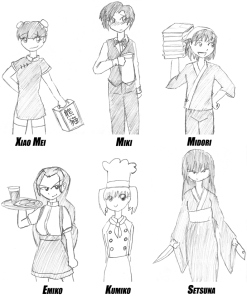
Peerless Food Fighters! was the first Kyawaii RPG I did, way back in 2008. It was a GM-less little thing about fighting waitresses, with Noodle Fighter Miki a major inspiration. When I took it into my head to try to make an RPG with board game style presentation, PFF was the first one to come to mind. It was already kind of mechanistic and board-game-like in its design, and in terms of its basic design this new version isn’t all that different. The major thing I did was to go completely crazy with cards, plus implementing the “dueling” concept that came out of the time I played the Kyawaii version with some friends. It involves a grand total of 110 cards, spread across four different varieties that serve different purposes. I got about $6 worth of generic board game components (12 pawns, 6 poker chips, 6 card stands) to complete the set, though if you’re crafty you could find some printable pawns and such.

PFF-Characters

I’m rather inordinately fond of the approach of having a set of pre-made, color-coded PCs. I’m planning to commission some better artwork done so that I can replace my kind of lame attempts at drawing the characters, though I have to hold off a little on spending that money. Using colors and symbols was generally interesting to me, and the Noun Project and Game Icons were invaluable for getting icons for the attributes/card suits.

The Fate Deck wound up being one of the more interesting parts of the game. I decided to replace the six-sided dice from the game with a deck of cards, which in turn led me to add more and more interesting information to the cards. About half have game effects, and the other half have flavor to influence role-playing. They also have suits that match the attributes, which figures into the flavoring and effects, as well as adding a small bonus if your chosen attribute matches.

Peerless Food Fighters 2.0 PDF

The game’s gotten zero testing, though I’m hoping to give it a try pretty soon.

i.hate.everyone

Not too long ago I was in contact with a game publisher who was interested in a game in the general style of Cards Against Humanity, a tasteless drinking game type of thing. I got a good start designing and testing such a game, but the publisher went with something else. I don’t bear them any ill will (I will admit to being disappointed), but I like the game I created enough to want to share it. I may eventually pursue publication, but I have enough other projects going on that without a publisher lined up I’m going to shelve it for the time being.

i.hate.everyone is a game of social media whoring. It follows the query/response from a card format of Apples to Apples and CAH, but everyone plays a response, and everyone votes by giving a Like token to the player whose response they liked best. Cards can also have special effects, ranging from reading cards in a French accent to various shenanigans with the cards. For me and my friends the silliness with drawing and discarding cards fixes the single biggest issue with the game’s predecessors, namely the tendency to get stuck with a lousy hand.

I picked the name “i.hate.everyone” partly because I feel it conveys about the right sentiment, and partly because it leaves it wide open for expansions and alternate versions called “i.hate.[something].” I already started on one called i.hate.fandom, which was the game I was kinda sorta thinking about doing before the aforementioned publisher came into the picture.

To play you’ll need to print out the cards on cardstock, preferably with a different color for the Status Cards, and you’ll need a decent supply of tokens of some kind. I find bingo chips or sorting chips work well, but pretty much anything will do as long as you have at least 100 or so. You can also pretty seamlessly shuffle them in with the print and play version of CAH if you want.

Players: 3-8
Play Time: 30+ minutes
Recommended for Ages 17+

i.hate.everyone Rules PDF
i.hate.everyone Status Cards PDF
i.hate.everyone Comment Cards PDF

Studio B PNP Prototype

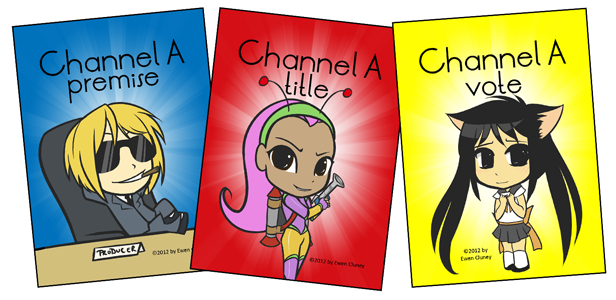
As usual I’m screaming through this stuff, making a thing and flinging it onto the internet. Studio B is a variant/reskin of Channel A, but for American B-movies instead of anime. I’m specifically going for the kind of stuff that came out of the drive-in culture that sprang up because of the removal of film-making restrictions in 1948, the cheesy black and white stuff like Robot Monster, Teenagers From Outer Space, and Plan 9 From Outer Space.[1] The rules are pretty much the same as Channel A, though the part about being able to add simple articles (of, the, etc.) is going to be much more important.

Studio B Print and Play Prototype PDF

Anyway, I also have some news about Channel A. I decided to make a fancier prototype for further testing, so I assembled the necessary files in Photoshop to get it printed through The Game Crafter. I just put in the order last night, so we’ll see how it goes. Their backend for assembling a game is actually really good overall, though I do wish the proofing process was more efficient. POD printing for 310 cards makes it pretty expensive, but I’m thinking I’ll make it publicly available since some friends have expressed interest in getting sets to play at anime cons and such. And thus I lament that I’m at this point in developing the game when the convention season is pretty much over.

I’m reasonably happy with what I was able to produce on my own,[2] but for the final version I’m hoping to hire Clay Gardner to do proper graphic design. He’s done a ton of amazing work for Minion Games, not to mention Golden Sky Stories. And now that I think I’ve gotten that out of my system for now, back to working on RPG stuff!

[1]Though I’m definitely going to do an expansion for mixing in 80s cheese. I’m thinking of calling it “Studio Z.”

[2]Sometimes I forget just how much stuff about Photoshop and whatnot I learned in college. I’m definitely not a pro, but at least I have some idea what I’m doing.

Dragon World Hack v0.2

I’ve posted about it a good amount already, but Dragon World is my 90s comedy fantasy anime hack for Apocalypse World, a very silly fantasy game. Dragon Half and Slayers are major inspirations, but just about every fantasy anime I’ve ever seen figures into it a bit, along with Discworld and the sillier parts of every D&D campaign I’ve ever been in.

This is the “Hack” version of the game, so to play you’ll need to have a copy of Apocalypse World, or at least a good knowledge of how AW works.

Here are the major changes I’ve made from the previous version:

  1. Leveling Up: I replaced marking experience with leveling up, which characters can simply do once per session between scenes.
  2. Guts Points: PCs now have Guts points that they can spend to avoid Falling Down (or to affect die rolls), but every time they do they have to make a roll to avoid having a Stress Explosion.
  3. Wealth: The group shares a special Wealth stat that can fluctuate up or down, and which they get to roll on when they buy stuff.
  4. Story Threads: Instead of connections/History, PCs now have Story Threads, which encompass other PCs as well as other story elements. These don’t have mechanical significance, but they do create relationships and story hooks.
  5. Setting Ideas: I filled out my initial section of NPC and setting ideas.

Dragon World Hack 0.2 PDF
Dragon World Reference & Class Sheets PDF

Raspberry Heaven Practice Test

I made some interesting contacts and it looks like the RPG app project is definitely going to go forward in some form. As I mentioned before, I decided to have my first RPG app also finally realize the Raspberry Heaven project I started some time ago, a game for slice of life stories about high school girls in the vein of Azumanga Daioh and Hidamari Sketch. The prior versions never quite worked out, and the RPG app is going to follow my prior intention to restructure the game with some vital inspiration from Fiasco.

Raspberry Heaven Practice Test” is my analog proof of concept for the eventual app version of the game. Because the actual app will take advantage of the ability to automate stuff that would be awkward for people to do, this is necessarily simplified in some places, but shows the basic chassis of the game and how I envision its gameplay working. If you’re interested in this project, please take a look and let me know what you think. To play you’ll want to print up the included reference sheets and have a pack of regular playing cards.

Download Raspberry Heaven Practice Test PDF

Dragon Ball Oracle

Looking through my documents folder for something to mess with, I came across a nearly-finished Dragon Ball inspired oracle for In a Wicked Age, and decided to finish it up. IAWA is a really fun little game that captures the spirit of old-school sword and sorcery fiction, and before the letter Z got added Dragon Ball was a charming manga about the weird little adventures of a kid with a monkey tail.

Most of the stuff in the oracle is from the first 16 volumes of the manga (before the bit that became Dragon Ball Z in the anime), but 52 elements are a lot to come up with, so I dipped into Z and the movies a bit for ideas towards the end.

Dragon Ball Oracle (PDF)

Dragon World Hack (v0.1)

Dragon World is my Apocalypse World hack for stuff inspired by 90s comedy fantasy anime, and to a lesser extent the silly parts of a typical D&D campaign. I was most directly inspired by Dragon Half and Slayers, but quite a bit of other stuff crept in. This is a very silly game, and the MC (or rather the “Dragon Master”) section is in part a distillation of what I learned from running Toon and Maid RPG.

I decided to put a rough version of it up on the site for people to enjoy and hopefully play a bit. This is the “hack” version, which lacks explanations of some of the basic rules, such that you’ll need a copy of Apocalypse World (or at least to be well-versed in the basics of AW) in order to play. It’s had a little bit of playtesting, such that I refined the basic moves and the Pure Sacrifice, Dumb Fighter, and Conniving Thief character types a bit, but there’s also a lot of stuff I finished up in one big rush over the weekend.

Download Dragon World Hack v0.1 (PDF)
Dragon World Hack Playbooks and Basic Move Reference Sheet

Other Ideas
I’m pretty happy with the selection of character types here, but I literally have about 30 ideas for others, plus I’ve found that the game very frequently inspires people to suggest new ones as well. If I publish a proper book, there’s a very good chance I’ll end up doing some kind of compendium of character types as a supplement. I’m also going to be working more on a few other possible things for the rules, and a section with setting and NPC ideas.

“Story moves” are kind of a neat little thing I came up with the other day but haven’t implemented yet. I’ve been reading through the Discworld novels from the beginning (which is why stuff like Failed Wizard, Oblivious Tourist, and Octogenarian Barbarian crept into my list of possible character types), and in the first two books there’s the thing about how Rincewind has one of the eight great spells from the Octavo stuck in his head and all the trouble it causes. A story move is a thing like that, represented as a special move that at turns helps and hinders the character, and also has an end condition of some kind, after which you lose the move and get a free advance.

Steven Savage suggested adding a wealth system, which would basically be a special stat shared by the group that would fluctuate depending on when they bought major stuff or found treasure, and there would be treasure with associated custom moves to make their lives more interesting. It could fit in nicely with Temptations and make room for some kind of merchant character type, but I’m still thinking about it.

Kyawaii RPG Omake: Monday Afternoon Blues Audio Edition

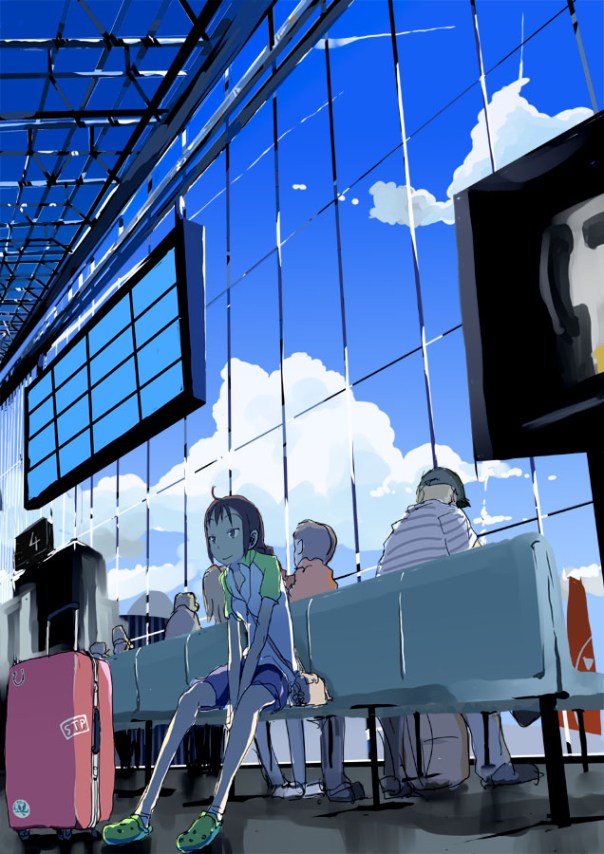
This is something I’ve been wanting to do for a while and finally got around to putting together. This is an mp3 you can use to play Monday Afternoon Blues, a role-playing poem I did a while back inspired by Stoke-Birmingham 0-0 (only with an anime convention spin because me and my friends know nothing about soccer). This new version consists of an audio introduction, 15 minutes of ambient airport sounds (thanks to Freesound.org), and an announcement that’s your cue to end the game. I’ve also included a set of character cards you can print out to make it a little easier to keep track of who’s who.

Monday Afternoon Blues Audio Edition (mp3)
Character Cards (PDF)

This file uses the AtlantaAirportAmbient.mp3 by jm Creative Commons audio sample.

Triptych & Fast Fantasy

Most Friday nights I game with an awesome bunch, and we’ve gone through a bunch of different indie games (and we’re playtesting Magical Burst next week). One member of that group, Aaron Smith, has been working on some nifty games for a while, and (what with me being kinda sorta internet famous) asked me to post them up here. So, for your consideration (and hopefully enjoyment), two free games he’s been working on.

Triptych is a simple, fast-playing game with indie sensibilities that draws on FATE. It also includes three settings: Stardust & Æther Winds (science fantasy with space-faring sailing ships), Megatropolis (a setting for romantic comedies with anime elements), and The 5 Kingdoms – Earth Under Heaven (a deliberate mishmash of wuxia and chambara martial arts movies).

Fast Fantasy is a quick and easy fantasy adventure game, inspired by epic fantasy novels.