Magical Burst: Second Draft

A while back on Twitter I posted, “Magical Burst is going to be like if Sorcerer and Don’t Rest Your Head got a civil union and adopted a beautiful baby girl from Japan.” In my head there’s this godawful idea for a one-panel cartoon with caricatures of Ron Edwards and Fred Hicks on either side of a Japanese schoolgirl. Ron is saying, “How far would you go to get what you want?” while Fred his holding up some oversized dice and saying, “What’s been keeping you awake?”

Anyway, on Story Games Christopher Kubasik linked to Steven Pressfield’s book Do the Work, which is a sort of manifesto for creative types, and available as a free Kindle e-book (and given the range of platforms you can get a Kindle app for, you have no excuse for not reading it). I’m about halfway through it (it’s pretty short), but so far the most important thing it preaches is to just fucking get in there and create stuff. Don’t obsess about research or fuss with getting everything right–that can come later–just start creating and create passionately and honestly. I mention this because I think that Magical Burst is working in part because that’s about how I’ve been doing it. I’m going to have to get into some more serious analysis and playtesting and whatnot, but I came up with most of the really critical ideas behind the game when scribbling the first broad strokes. Not obsessing over polishing the text is really liberating, though from here on out I think my process is going to have to become much more rigorous.

Is there a way through this pain and sadness to a better conclusion? You'll learn soon enough.

I got a ton of really great ideas from a thread started by Judgment on 4chan’s /tg/ board (you can see an archive of it here). I wouldn’t even know where to begin listing off all of the ideas I got from here, but while I have been, let’s say skeptical of 4chan in the past, I’m not exaggerating when I say this thread has some of the very best feedback I’ve ever gotten on one of my games. The major things I got invaluable help on here were Overcharge and the combat rules. As I mentioned before, Kurt, who sent me several pages of notes, was likewise immensely helpful, and the folks on the #becomethemeguca channel likewise had some helpful comments.

Again getting way ahead of myself, I’ve put a bit of thought into the potential final appearance of the game, which would have a very deliberate manga style. This is a bit different from “anime” style (which is what you usually see when people do anime/manga-inspired RPGs), with use of line weight and screen tone, but not all that much shading per se. I am very lucky to be friends with a fair number of talented artists, and all the more so to be friends with C. Ellis, who (amongst other things) can do great manga-style comics (check out her portfolio!) and is really enthusiastic about my creations, perhaps more than I deserve. Of course, the graphic design of the overall book is going to be an interesting challenge too, since I want to channel some of Akiyuki Shinbo’s use of patterns, abstractions, and typography. That in turn could involve stuff like digging through BibliOdyssey for visual elements to adapt, plus I want do do something similar to the runes from Madoka Magica.

Update: I posted up the third draft for your enjoyment.

Magical Burst Second Draft (2.1a)
Magical Burst Character Sheet (kind of kludgey, but functional)
Magical Burst Battle Cards
Magical Burst Overcharge Tokens

[1]And in the case of D&D4e I find those potentially fun to play, but tedious to set up and run.

Magical Burst Development Update

I have officially made it my goal to get the second draft of Magical Burst done by the 21st, in time for the airing of the last two episodes of Madoka Magica, and I thought I’d post a bit about what I’m working on for that. I am very grateful to Judgment for starting a thread on /tg/ that wound up producing some incredibly useful feedback and ideas, not to mention Kurt, who e-mailed me several pages of comments. Someone’s also running a game on IRC already too. I have a lot of work ahead of me, but it’s feeling more and more like I’m on to something, and this may be my first original game to reach fruition. Time will tell.

The final book is looking to be pretty table-riffic. Not quite Maid RPG table-mania, but much closer than I’d have expected going into the project. I don’t know if I’ll be able to finish up the “Instant Magical Girl” tables in time–they’re a low priority and they’ve been proving difficult–but I’ve also been adding more tables for stuff like developing tsukaima (and I arranged the Secrets into a table just because). It’s yet another example of the tremendous influence Ryo Kamiya has had on me as a wannabe game designer.

animated; click to be disturbed

I’m doing a considerable rework of the available Fallout effects. The major thing is that all three types of Fallout include “Changes,” permanent alterations to characters. The Magic ones are the mutations that were already in the first draft (though I’m expanding the mutation table), while Heart and Fury changes can cause lasting derangements or impulses. I’m contemplating a few other things, but this should go a long ways towards making all three varieties of Overcharge equally undesirable. I’m also contemplating a thing where high-level Heart and/or Fury Fallout can spawn a youma focused on harming someone you care about.

The combat system is getting a major overhaul too, on account of having been hastily cobbled together in the first draft in the first place. The core of the new system I’m working on is that at the start of a combat round each participant has to pick one attribute to use for attacking (which also becomes your initiative number) and another for defending. I’m still working out other details, but teamwork, helping or hindering others, etc. will definitely be a part of it.

I’ve figured out a lot of what I want to do with the relationship rules. The big change is that Relationships can take Strain, and three points of Strain will break a relationship. For relationships with normal people, any time you expose them to the unnatural effects of magic there’ll be a point of Strain, and if you harm or betray someone there’ll be Strain too. (You can’t have a relationship with a tsukaima though; they’re not emotionally equipped.) Magical girls can also sacrifice relationships to help themselves out in battle. Some forms of Fallout will also get much nastier for magical girls without relationships too. I’m not sure how I want to handle relationships with other magical girls vs. with regular people. The latter are obviously more fragile, but thematically it makes sense for them to be more important in some ways. Regardless, the text now recommends drawing a relationship map as a group.

Characters are getting both Magical Effects and Finishing Attacks, which have some specific mechanical effects. Magical Effects are things you can attach to your Magical Element or Magical Power that give a specific benefit (like healing, an initiative bonus, etc.), while Finishing Attacks are more powerful attacks you can only use occasionally (probably once per session). I’m also adding character advancement, though nothing too fancy. It’s going to be a little bit like The Shadow of Yesterday, and I may just explicitly give each character a Key.

And for a little extra Madoka-ness, I added some optional rules for playing “potential magical girls.” The way the game is set up it’s not going to necessarily be the most interesting way to play–you never get to roll dice–but the role-playing opportunities are neat at least.

Anyway, as you can see I have a lot of work ahead of me, though I’m hoping to get a whole lot more done this weekend.

Update (4/18): I didn’t get nearly as much done over the weekend as I’d hoped. That’s been a routine problem with my weekends lately… I did finish the expanded magic mutation/Change table, though for now it’s looking like it’s going to be massive compared to the Heart and Fury Change tables. I basically have all the changes I want to make figured out. Implementing them shouldn’t be a problem as long as I can make time to do so (which is going to be hard), but I highly doubt I’ll be able to finish up all the tables I want to make for the final game. The Instant Magical Girl section needs 4 or 5 D66 tables written up to be completed, and I aspire to do a bunch of sample youma, tsukaima, and maybe a few sample rival magical girls.

Also, “planefag” from /tg/ wrote a Magical Burst short story.

News Post Trio

It turns out a bunch of news about a bunch of really neat stuff popped up all at once, so here’s a post about three different things that I think are really awesome.

Madoka Magica
The broadcast of the last two episodes of Puella Magi Madoka Magica got delayed because of the earthquake and tsunami (the relief efforts are still ongoing, and our Maid RPG charity thing is still going on for a few more days by the way), but they’ve announced that those episodes will be airing at long last on April 21st. Not a few fans, myself included, are going to be relieved to finally see the conclusion of this exceptional series.

I feel like I ought to try to get the second draft of Magical Burst done by then, but I’m not sure if I can actually pull it off. Thanks to the recent thread on /tg/ and other people offering feedback I have a laundry list of great ideas to try to implement in the game, on top of all the stuff I already wanted to do myself. (Plus I’m significantly expanding the mutation table, which means lots of time consuming brainstorming and such.)

Atarashi Games x 3
Jake and the gang at Atarashi Games have THREE new games just about to come out, all available for preorder:

  • Panty Explosion Perfect: A major revision of AG’s flagship psychic schoolgirl adventure game, full of instructional manga and other neat stuff.
  • G x B: A shoujo dating sim game for four players. One player is a shy girl named Momoko, and the other three are her potential suitors.
  • Tulip Academy’s Society for Dangerous Gentlemen: A “romantic adventure” game in the vein of Ouran Academy.

Do: Pilgrims of the Flying Temple
Daniel Solis’ new storytelling game, Do: Pilgrims of the Flying Temple, has launched its Kickstarter (and already met its goal!).

The game is about pilgrims, young people in a world with kind of an Avatar: The Last Airbender vibe, who get in trouble, help people, and have adventures through a fantastic world.

Kyawaii RPG #7: Manly Men!

It’s been forever since I last posted up a Kyawaii RPG, but got something like half a dozen I started and never finished. I ended up tossing together the rest of this one this morning. It’s kind of a self-parody in that I seem to come up with a lot of RPGs where the characters are all girls, so I decided to make one where they’re all ridiculously masculine guys. At first I wasn’t sure how to go about making this game, but it basically turned out to be “Chuck Norris Facts: The Role-Playing Game.”

Click here to download.

I got a Kindle. It’s mostly awesome.

I’ve been thinking about it for a while now, but since I had a little bit of extra money to spare (thanks in large part to Maid RPG) I bought an Amazon Kindle. My home life has increasingly felt like a losing battle against clutter, so while I do appreciate the beauty of a book made of paper, I just have too many things, especially when it comes to books I’m not likely to read more than once or twice. I really want to take the opportunity to cull my book collection and have more room for stuff.

I get eyestrain a little too easily for a backlit display to be an option for serious reading (doubly so when I work in front of a computer all day), so frankly I find it kind of baffling to hear people saying the iPad is somehow superior to e-book readers despite having a display that shoves light into your eyeballs[1]. I already read half of the Harry Potter novels on a monochrome Palm Pilot back in the day, while on my iPhone I got through only two or three pages of Cory Doctorow’s For The Win (pictured on the Kindle below, and a great read so far BTW).

I specifically got the new Kindle 3, which is much improved (and much cheaper) compared to its predecessors. It is phenomenally easy to use, at least for things that are readable on its 6″ display. Books in .azw or .mobi format use the Kindle’s built-in font, which is eminently readable. There’s also text-to-speech, which is about what you’d expect. When you plug it in via the included USB cable it just acts like a drive, and you can drag and drop any supported file type into the documents folder. If you buy an actual Kindle book from Amazon it’ll be delivered to your device automatically via wireless at the next opportunity. (Its “whispernet” thing can also grab software updates and such.)

3x3 Eyes, Volume 1 (of 40)

Reading manga scanlations is shockingly easy too. You can put a folder of jpg files or even a .cbz file into the documents folder and it’ll read them more or less fine. (When it first starts up it sometimes fails to render part of the right-hand side of the image, but fiddling with the back and forward buttons fixes that.) The resolution is just about right for the big and breezy panel pacing of manga, and I would be worried about how well it’d work with more compact Western comics (or anything by Ken Akamatsu or Masamune Shirrow for that matter). There is a simple program called Mangle that can take files and put them into a numbered folder to make sure they show up on the Kindle and get displayed in the correct order, which seems to help a lot.

I don’t think the Kindle is going to have all that much to offer for RPGs in its current form. Although the Kindle 3 significantly improves the time it takes to turn pages, the kind of quick navigation you’d want to do for a typical RPG isn’t really there, as it’s more aimed at leisurely novel reading. (Though it would help if more people making PDFs would include bookmarks and so forth.) Thus for most RPGs it’s better as a way to read the book than as a format for having it at the table, though from what I’ve heard A Penny For My Thoughts can be played while reading the book from front to back, and thus might sidestep this problem.

The PDF reader works very well as long as the pages are small enough to fit on the Kindle’s screen. The above image is of Ben Lehman’s latest game, On the Ecology of the Mud Dragon, and as you can see its small pages (5.5×8.5″), relatively large text, and simple monochrome art look awesome on a Kindle screen. Things get more difficult with larger page sizes and smaller type, and I found the PDFs of Blowback and FreeMarket all but unreadable. You can zoom in and pan around, but it’s probably the single most cumbersome aspect of using a Kindle. It is possible to convert a PDF to a .mobi file to read as an e-book with programs like Calibre, but I suspect an RPG is exactly the kind of thing what could trip it up and become difficult to read.

It also features a web browser, which is pretty decent considering it’s on a device that’s not quite meant for that kind of thing–e-ink is at its best when stuff doesn’t move around much–and unsurprisingly it doesn’t support stuff like flash. It can also play mp3s and audiobooks, but since I already have that kind of thing taken care of with my iPhone I don’t have much reason to bother.

The Kindle is a device that’s meant to do this one thing, and does it incredibly well. It extends to a few other things, but it doesn’t try to be an all-in-one thing like the iPad. I don’t really see it becoming much of a thing for RPGs, at least not until the e-ink technology improves and navigation becomes dramatically faster, so the iPad and the Android tablets and such that are just hitting the market are probably legitimately better for such purposes. On the other hand if I ever decide to self-publish fiction (say, a Slime Story novel as an “accessory” to the RPG), the Kindle will definitely be a part of it.

[1]Though this seems to have more to do with publishers wanting to charge $14 or so for e-books instead of $10 or so, despite both price points being significantly more than a paperback, much less a used or clearance copy of a popular book. On the other hand, Amazon’s 70% share of Kindle e-book revenue is pretty painful, and I’d be seriously tempted to offer my own works in DRM-free mobipicket and epub formats.

Maid RPG Update: Donating For Japan

It seems like there have been a lot of natural disasters around the world lately, and the recent turmoil in Japan hit particularly hard because Andy and I have friends and family there. So far the people there we care about there (including Maid RPG designer Ryo Kamiya and his cohorts) are safe and sound, if uneasy. There are still aftershocks and rolling blackouts, to say nothing of people unaccounted for. Where people have said “Pray for Japan” I’ve been quick to add, “And please consider donating too,” and it’s time for us to put our money where my mouth is.

Here’s the deal: For the next month or so, for every copy of Maid RPG sold, print or PDF, we will donate the profit, plus $5 out of our own pockets to the Red Cross for disaster relief. That’s all there is to it. Buy it at the usual places, namely Indie Press Revolution or the Maid RPG website.

Update: Ben Lehman is also donating the proceeds of sales of his own game Bliss Stage to disaster relief until the end of the month!

There are plenty of other ways to donate to help Japan, and we encourage you to donate however works best for you. RPGNow is also taking donations, not to mention you can just donate to the Red Cross, Doctors Without Borders, or other aid organizations directly. And by the way, kudos to the guy who bought godhatesjapan.com and turned it into something positive.

Yaruki Zero Podcast #17: Malcolm Harris

Yaruki Zero Podcast #17 (60 minutes, 13 seconds)

I became acquainted with Malcolm Harris because we’d both been invited as guests of honor for A-Kon (an anime convention in Dallas) in 2010. He’s the driving force behind Channel-M Publishing, an independent publisher of comics and RPGs, including Witch Girls Adventures. I’ve met very few people who are quite so passionate about creating and sharing their creations, and his enthusiasm is wonderfully infectious.

We finally got around to connecting on Skype to record a podcast, and Malcolm shared his insights on Witch Girls Adventures and how with it he’s designed and marketed a role-playing game aimed at teenage girls. He also talks a bit about the Witch Girls movie short he’s working on, as well as other games (Macho and Nemesis: Remix) and forthcoming Witch Girls supplements. He’s a really busy guy, to put it mildly.

  1. Introduction
  2. What is Witch Girls Adventures?
  3. A Drama Diaries Game
  4. Marketing to Girls
  5. Daytrippers; volunteers who hand out fliers at events
  6. Witch Girls as an (introductory) RPG
  7. How do girls play RPGs?
  8. Witch Girls as YA fiction
  9. Witch Girls: Beyond Convention, the forthcoming Witch Girls short film, plus forthcoming WGA supplements
  10. Macho, Malcolm’s over-the-top action hero RPG, due out this year
  11. Nemesis: Remix, a superhero RPG for fans of superhero comics, due out in late 2012
  12. Even more stuff on the horizon for Channel M!
  13. Malcolm says believe in your self!

Technical Notes
The technical quality of the recording wasn’t quite what I hoped; my voice is too loud, while Malcolm’s is too quiet (usually it’s the other way around) and has just enough of a background hum that it’s hard to boost without reducing the audio quality. (Plus you can hear me breathing far more than I’d like.) I hope you’ll bear with me all the same, because this is probably my most interesting podcast episode so far.

This podcast uses selections from the song “Time Machine” by To-den from the Grünemusik album of the same name, available for free from Jamendo.com. If you like the song, consider buying some CDs from Nankado’s website or via Jamendo.

Very awesome caricature of Ewen courtesy of the talented C. Ellis.

Maid RPG Tumblr

Maid RPG 120%, my attempt at a Maid RPG supplement, has been kind of floundering for a while now. One of the most ambitious aspects of this is trying to put together a new item table in the style of the original one, which means making 216 of the things. I decided to make a Tumblr and try to post one item up every day (I have a good amount done already, and Tumblr has a nice queue feature, so hopefully I should be able to keep it consistent) until I have a D666 table’s worth, and I set it up to allow for submissions too.

Also, I added a Steward Character Sheet to the Maid RPG 120% page, though it’s basically just a maid sheet with the word “stewart” added in several places (and a different font because I don’t have the one that was originally used).

Magical Burst: First Draft

The first draft of the aforementioned Magical Burst RPG is done. This is kind of an unusual thing for me in that I got a first draft done without lots and lots of wrangling, and in that I haven’t terribly over-written the book while the rules are still rough. (Hence the text is rather unpolished at this point.) The game is simple enough that at this stage I was mostly writing down and filling out the game in my head. The only major change from the concept I’d started out with was that I changed how the dice rolls work. It was originally a dice pool system, and I ended up changing it to a 2d6+Attribute type of deal, but with exploding dice. I usually hate exploding dice in RPGs, but the concept is eminently appropriate to a game about magic going dangerously out of control at random.

As I’d discussed in my last post on it, Magical Burst is a game about magical girls, adolescent girls who wield magical powers to fight monsters. This is a darker take on the genre, inspired in part by Puella Magi Madoka Magica. Magic is the only means to fend off the youma, but it’s also an unpredictable force that can disrupt your life in alarming ways. This is probably the single most “Forge-like” game I’ve ever done. Its rules are laser-focused on one kind of story, and it trusts the play group to work out everything not in the rules (which is pretty much everything that doesn’t involve magic) by free-form role-play.

I also wrote a script for a 6-page intro comic, which I’m inordinately happy with. Although writing for Neko Machi has been a great experience, I’m finding that writing for more serious comics is really interesting. It’s hard to say if the game will get that far, but I have a pretty solid vision for a manga-style look for the end product.

Anyway, here’s the file:

Magical World (First Draft) PDF Download

At this point I need to step back and actually deal with other stuff for a bit, but I can already see a few things I want to work on (notably, tightening up combat and possibly expanding the role of relationships). In any case, I would welcome any feedback on it.

Thoughts on Alignments

The recent spate of Story Games threads about d20 have got me thinking a bit about alignments. Alignments in RPGs are a weird thing. They’re a defining feature of the #1 RPG, but they’re fairly rare in the range of RPGs that have been published. And like a lot of things in D&D, they’ve become a fixture of the game while kind of losing sight of the way they were originally intended, much less the source material that Gygax and company pulled the concept from.

D&D style alignments are rather awkward when it comes to describing morality per se. I know in playing D&D I’ve ended up making lots of True Neutral/Unaligned characters, and for certain D&D haters love to harp on it as one of the game’s flaws. While the 9-point alignment system is okay for describing characters in terms of how they relate to a society, it gets weird when you consider clashes with other societies. Will a Lawful Good paladin have a problem with slaying orc women and children, who his Detect Alignment power tells him are objectively Evil?

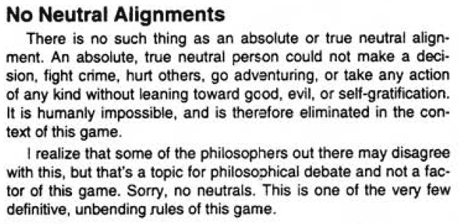
Another place I ran into some conundrums with alignment was in the various Palladium games. Palladium has of course clung to an alignment system that started with AD&D’s and went into something more to Kevin Siembieda’s liking, including the “No Neutrals” rant based on the idea that a True Neutral character would just stand there[1]. To be fair, neutral alignment was rather vague until D&D 3rd Edition or so, but it’s nonetheless weird to see rants against aspects of AD&D 1st Edition as recently as a new Robotech RPG published in 2008. This in turn led to animals being True Neutral in D&D (which made perfect sense to me; ethics are a matter for the sentient) and if I remember correctly Unprincipled or Anarchist in Palladium. It also didn’t allow for characters with different ethics depending on who they were dealing with. At one point I was writing up a race of tiger aliens (closely based on the Kzin), who would be perfectly good (Principled or Scrupulous) to each other, but treated those not of their own species as non-entities, utterly unworthy of respect. I ended up giving them a good alignment with a parenthetical, though I was maybe 15 years old when I was writing that. It might seem like an unlikely quandary, but in real life every people wants to believe they’re good, and it seems like there’s a constant struggle to own the meaning of “good” in the first place.

Hear that? An UNBENDING rule! Also, the XP and level system I use is extremely realistic an practical.

Pre-AD&D, alignment was inspired by the works of Michael Moorcock and Poul Anderson, and were limited to Lawful, Neutral, and Chaotic. More importantly, these reflected cosmic affiliations rather than moral leanings per se. That makes them less constrictive on character motive, and easier to relate to the setting. It’s less the difference between being nice or mean, and more like the difference between being Alliance or Horde. Adding the Good-Evil axis complicates this, but thinking of alignment as an affiliation lets Alignment Language make some small amount of sense. Planescape was probably the best D&D campaign setting for this, since everyone was a short jaunt away from the Outer Planes, which were manifestations of the alignments in the same way that the elemental planes represented the building blocks of the physical world. Truly being Lawful Good makes more sense if Tyr’s domain of Lawful Goodness is a place you can just go out and visit.

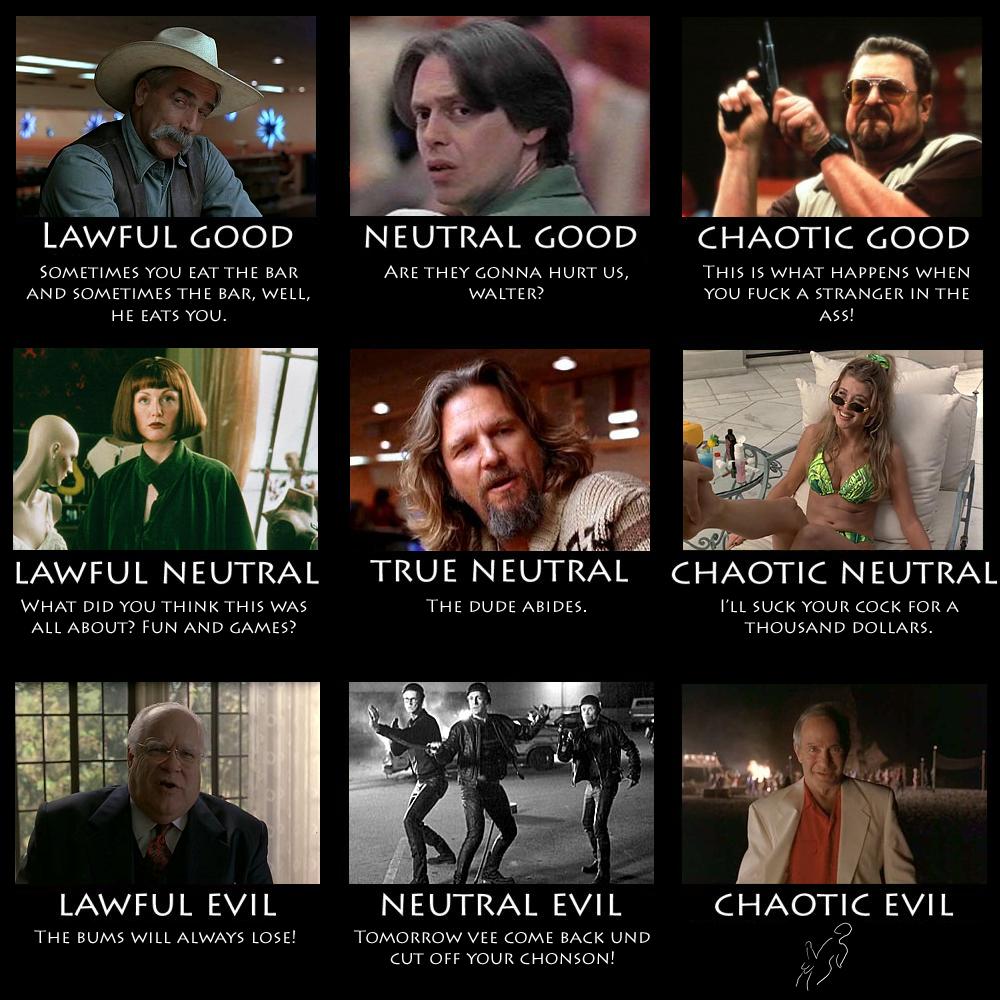
I don’t know that I want to be so overwhelmingly negative about alignments, but I do think that to the extent that the concept has merit, it hasn’t really been used to its full potential. Online conversations about old-school D&D too often seem to treat alignment as an excuse for DMs to dole out XP penalties, while in the more recent edition wars there seem to be a lot of complaints about how 4th Edition has deprived DMs of the ability to rob paladins of their powers[2]. I still like the various D&D approaches better than the Palladium approach of copying and pasting the same ranty alignment rules from a few decades ago into every single game, regardless of genre[3]. While alignments can sometimes produce interesting questions (and some amusing image memes), without giving it some cosmic significance or otherwise going beyond what they have been I feel like the whole concept can’t compare to good Aspects, Beliefs, Instincts, Values, Relationships, etc. in terms of informing how RPG characters relate to the world.

[1]Though amusingly, Erick Wujcik’s Mystic China (one of the few Palladium books I’ve kept) adds a Taoist alignment.

[2]Which strikes me as a little weird. Even if it’s not an assumption of the rules, when you have settings like Forgotten Realms where the gods are a little too involved in mortal affairs, a paladin who goes against his religious principles could have much worse things to worry about than whether or not he can still lay on hands.

[3]And I hate to sound quite so negative about Palladium (I had a lot of fun with their games in high school), but the treatment of alignments are a prime example of how the Megaversal system rules have basically been frozen in time since the early 80s.