Adventures of the Space Patrol

For whatever reason I’ve been very inspired to put a lot of work into Adventures of the Space Patrol. I think it’s partly because I’ve been thinking about shorter games in general (and I hope to have some exciting news to share before too long!), and (in MS Word with normal margins and 12-point type) AotSP is likely to top out at around 40 pages maximum.

I’ve posted about it before, but Adventures of the Space Patrol is a game about “Space Agents” trying to help ordinary people with problems from outer space. The setting is inspired by a mixture of the art of Shane Glines and other illustrators/animators, and a mishmash of cheesy old sci-fi as seen through that general kind of lens. The rules are a very light implementation of FATE 3.0, with a little bit of a Japanese TRPG sensibility added, and a whole lot of influence and attitude derived from Yuuyake Koyake. Thus, it’s a game of bold, stylized, heartwarming adventure, with cute girls, beautiful women, square-jawed heroes, and strange aliens. Unlike a lot of my other games, it’s not based on a particular genre or range of actual titles (though My Life as a Teenage Robot is probably the closest to what I’m going for) so much as a general attitude and aesthetic. That also means that getting the right artwork–with some of that amazing confidence and fluidity of line–is going to be critical for making the final product work.

The biggest change I’ve made to the game in my renewed enthusiasm for this game is to make all of the characters be pregens. It saves me some work making up extra Shticks (basically the same thing as Stunts in SotC), it reinforces the “pick-up role-playing” aspect of the game, and they’re just plain fun to work on (especially when I can give them names like Jenny Jetstream and Rick Fireball). Each character also has only three Aspects and three Shticks, to keep the character concepts simple and tight and give PCs a few interesting tricks to try. Billy Smith, the Plucky Kid who’s a Deputy Space Agent, has my favorite Aspect in the game so far: “Hey, mister, what’re you doing?” Coming up with Shticks that are flavorful and useful yet don’t at all relate to anything violent is really fun but very challenging too, as it runs against the grain of what we’re used to for RPGs. (Yuuyake Koyake is quite impressive in this regard, and I’m going to spare you the whining I could be doing about how hard it’s been to come up with clique-based Talents for Slime Story.)

I also finally finished the episode creation tables. The idea is that in order to very quickly plan out a scenario, the GM can use playing cards to get elements from three different oracle-like tables (Who’s in trouble? What’s their problem? What space thing is involved?), which of course meant I had to come up with 156 different story elements. The tables are packed with references that range from obscure (“Mo-Ran, a Robot Monster”) to silly (“Stephen, an arrogant talk show host”) to personal (a few people I know are subtly mentioned in there). On the whole I’m really happy with the result. I tried it out to make a sample scenario, and I got “Cindy, a veterinarian who loves animals very much,” “Something important has gone missing,” and “The Men In Black, secret agents that try to cover up weird stuff.” Hence, the MIBs carried off one of Cindy’s patients because they mistook him for a missing alien diplomat.

I still need to think more about the overall rules. In particular, the game is meant to be mostly non-violent, and while I’ve made a point to avoid Shticks that serve violent purposes (hence I’ve gotten rid of Jenny Jetstream’s “Ray Gun” shtick), I’ve left in Conflict rules (albeit a very simplified version of the Awesome Adventures version of FATE), I’m not sure how or even if I could/should enforce nonviolence in the rules. Yuuyake Koyake strongly cautions against violence, and I think the rules make it uninteresting and unrewarding.

Anyway, all of that means that playtesting won’t be too far off, and I’m really looking forward to giving the game a try.
Slime Story Design Journal: New Stuff

Now that NaNoWriMo is finally out of the way (and I’m starting to recover from such), I’ve started working on Slime Story again. Here’s a quick look at what I’m working on right now.

Elective Talents
Playtest Version 2 just had the Base Talents of each class and clique (which I’m refining a bit), but I’ve started working on the “elective talents” that players get to choose themselves for their protagonists. These are an aspect of the game that’s at once interesting and tedious. They have an element of exception-based design, so I get to figure out a bunch of different ways for characters to bend the existing rules in interesting ways. On the other hand, writing up well over a hundred of the things can get to be a bit of a slog after a while.

I had been toying with an idea for “Talent Pools,” and having each class and clique give you access to a couple of pools, but I wound up just having separate sets of talents for each class and clique, which also lets me customize the abilities of the different character types much better.

Vignettes
This is probably the most important change in terms of how the game plays, and it’s my attempt to address the issue of interludes not involving much role-playing. During an interlude players can create “vignettes,” short scenes in the overall story. These can take place a bit in the past or even the future relative to the monster hunting run going on in the game, which will makes it much easier to involve secondary characters without contriving to have them show up during a hunting session. More importantly, you pretty much can’t do an active action in an interlude without wrapping it in a vignette of some kind, though there’s quite a bit of freedom in terms of what kind of active action a given vignette can take you to.

I’m still not sure how Crafting (making or modifying items) will fit into things. It doesn’t seem like something that would make for good vignettes, and I may just separate crafting from the Action Point economy.

Terrain Variations
This is a simple but interesting little rule, which basically lets you add special properties to positions on the battlefield map. It’s kind of an obvious idea when you think about it, and the kind of thing where adapting the relatively simple concept to the rules’ abstractions is kind of neat. I can make little cards for the GM to lay down on the battlefield map, a random table of terrain setups, and customized maps with those setups already on them. On top of that, I can do a bunch of neat stuff with certain monsters and items affecting the terrain variations.

Portal Flora
I’ve made a small but interesting change to the setting, which is that the portals also deposit immobile plants from time to time. My grandmother recently passed away, but a little before that I gave her an audio recording of the prologue to Slime Story: The Legend of Doug. She had a dream where there were trees that produced amber. People took the amber from the Mother Tree, and all the other trees wept and created a flood, but the Father Tree sheltered them. Under the circumstances I couldn’t not do something with the idea.

“Portal flora” include those amber trees (though taking the valuable “portal amber” tends to attract angry monsters), but also herbs and other plants with special properties similar to monster parts, dangerous plants like razor ivy, and “monster grass,” which herbivorous monsters seem to particularly like. These also add to the variety of terrain variations.

I’m contemplating some kind of rule for “foraging” (not sure if that’s the right term), seeking out useful stuff from portal flora, abandoned monster parts, etc., but it runs into the same difficulties as crafting.

Monster Variations
These are basically Slime Story’s version of d20 monster templates, and a way to use different combinations to expand the range of possible monsters. In terms of the setting, there are certain plants, parasites, symbionts, mutations, etc. that can substantially change what a monster is like. A monster that eats a certain portal fauna shrub becomes a berzerker, certain monsters get a fire aura if they somehow eat a salamander crystal, and there can be mundane stuff like a stumpy that inhabits a metal trash can instead of a tree stump can take more damage.

Slime Story: First Playtest Report

Yesterday I finally ran the first playtest of Slime Story. For a first run I think it was very encouraging, though it definitely needs more work. The 2d6+Attribute mechanic does seem to work well, and having Fumbles on snake eyes and criticals on double 6s adds an oddly nice random element.

(Incidentally, I’ve cross-posted on The Forge and Story Games Praxis about a particular element I think I need outside help on.)

Character Creation
Making character was a bit time-consuming, but basically painless. I think combining a clique and class to get your character worked well, and buying gear was the most time-consuming part. Of course, I haven’t implemented non-Base Talents, which would add another element of choice-paralysis.

I had changed how you handle character ownership from an earlier draft without changing how you initialize character connections to match, and wound up giving each character a flat 2 connection ranks to assign as desired. That was still kind of time-consuming, though I’m not sure that’s avoidable apart from changing where that element fits into the session.

Rita by StreyCat

Encounters
The encounter rules seem to work well overall, and from here on out it’ll be a matter of refining rather than rewriting. The abstract range system and the system of actions and attacks and such seem to have worked pretty well, but with a group of 5 hunters the monsters were never much of a threat. They fought a bunch of squishies, then two salamanders, then a mixed group of two shadow dogs and three stumpies.

  • Suichi’s monster tamer character wound up being at a severe disadvantage. I need to figure out a better metric for selecting pet monsters, and having the tamer and monster have independent initiative slots makes it so the pet monster too often winds up just sitting there. I’m thinking Monster Tamers need a Base Talent to assist their monsters better.
  • Monsters die pretty quickly. On the one hand I don’t want combats to drag on, but on the other hand they’re dropping like flies and not having a chance to do much. With their current HP totals there would have to be more of them per encounter or something.
  • The only time monsters won a Positioning Check was when the protagonist rolling for the party rolled a fumble (auto-fail). This is partly due to letting PCs Help one another. I’m thinking monsters (and maybe characters in general) will just get a flat bonus for how many they have on their side. Allowing Help on Positioning Checks also means that whoever’s got the second- and third-highest Hunter ratings gets a mark on their connection to whoever has the highest for every single Encounter.
  • Consumable attack items suffer the same problem as alchemy items in D&D4e, which is to say that they’re really expensive for a one-shot attack that can miss.
  • Having Aura attacks (like the salamander’s fire aura) be a Clash actually makes it easier to hit the monster, which is not at all what I’d intended.
  • The Assist action potentially puts you at a disadvantage, especially if you’re dealing with a monster that has a high defense rating.
  • Since I used all common monsters, the players never once had to do a Monster Knowledge check, which in turn made the Geek character’s Monster Encyclopedia talent irrelevant.

Interludes
Interludes, which are meant to carry the lion’s share of the role-playing, were probably the weakest part of the game. Some of that came from the fact that we had too many secondary characters that weren’t particularly involved in monster hunting, plus I think I as the GM wasn’t trying hard enough to drive the role-playing oriented elements. I’m not sure what exactly needs to happen with this part of the game. We weren’t in fact playing it quite how the rulebook suggests, but then it wasn’t a difficult mistake to make.

Some of it is that I need to try to as the GM to do more RP-oriented stuff with the existing rules, but I’m thinking it might also be a good idea to put something in the rules to push towards role-playing. I really have no idea what that would be though.

Conclusions
On the whole a good start, but I’ve got a fair amount of writing, revising, and brainstorming to do before I do another serious playtest. There were also a fair number of elements we didn’t touch on, including achievements and social conflicts, so we’ll have to see where those go next time.

A Small Update

I haven’t been doing quite as much on the RPG front the past few weeks because I’ve had a lot of other distractions.

Yuuyake Koyake Mail
Today two new Yuuyake Koyake books came in the mail. Kore Kara no Michi (“The Road From Here”) has rules for playing as humans, as promised. Interestingly, they do have Powers, but almost all of them have a cost of 0. There are also 3 pages of Weakness/Additional Power pairs for humans. The Touhou Yuuyake Koyake book has around 80 pages of replays, which apparently has Riko (the raccoon dog girl from YK) visiting Gensoukyou. The rules section has two new character types–shrine maidens and fairies–and also, intriguingly, four pages of powers followed by two pages of weaknesses for “Gensoukyou Residents.” It has writeups for several Touhou characters, and it’s interesting that several of them list more than one character type, like Reisen’s statblock says “Rabbit + Visitor.”

42457957-c36944d558e89f25f1c6ba494bc10cf7.4afc97d3-full

Slime Story Playtest
I’m planning to run my first Slime Story playtest this Sunday. I’ll have quite a bit to say about it later.

NaNoWriMo
I’m doing NaNoWriMo again this year, working on an oddity called “UFO Girl” that I’ve wanted to do for ages. I’m a bit behind right now though.

kitty_shockNeko Machi: A Webcomic
Way back in early 2003 I started a webcomic called Neko Machi (“Cat Town”), about a bunch of catgirls in high school, loosely based on me and my friends. It went on pretty regularly for 3 or 4 years, but I had to stop after a while. I’ve now enlisted my friend C. Ellis to handle the art side of things for a resurrected and reinvented Neko Machi. We’re off to a rocky start in some ways, but I’m really excited to be doing it again. The tools are vastly better than they were 6 years ago, and my writing has improved, and I get to work with a very talented artist this time around. There’s been some talk on Story Games about what indie RPGs can learn from webcomics, and I’m definitely looking forward to seeing where we can go with marketing this comic and what I might glean from the experience for RPGs. (I definitely smell a podcast topic…)

Slime Story: Playtest Version 2

slime_story_christine

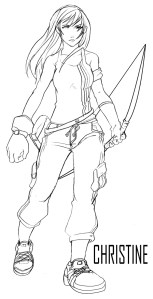
If you’ve been following this blog, then by now you know that Slime Story is my RPG of “teenagers hunting cute monsters for spending money.” Basically, imagine monsters from Ragnarok Online and Maple Story invading American suburbia. I finally have the new playtest document for Slime Story ready to go. It’s very different from–and hopefully altogether better–than the last one.

This game is a weird hybrid of traditional, indie, and Japanese RPG design sensibilities, or to put it another way, Meikyuu Kingdom, D&D4e, and Mouse Guard were all key inspirations (though there’s a long list of others). It has a rigid scene structure (you alternate between encounters and interludes), powers usable depending on the game’s time units, an abstract range map, characters defined by a “class” and “clique,” achievements (kind of like in video games, but a bit free-form), relationship mechanics, and other wacky stuff. It’s also meant to be largely player-led, and protagonists need to define and pursue their own goals.

Playtest Notes
I’m making this playtest draft publicly available so that people can read it and perhaps even try it out. If you do, I want to hear all about it! Tell me what you think, tell me how it plays, and share your war stories! However, it hasn’t been playtested yet AT ALL–I’ll hopefully be rectifying that fairly soon–so some of the stuff that I thought looked good on paper might not work at all.

The playtest version is deliberately incomplete, on account of me not wanting to try to come up with over 100 Talents and 40 or 50 monsters just to wind up having to rewrite them to make up for rules changes. I also left out the supplemental rules chapter (which is meant to have rules for experimental alchemy and quests, amongst other things) because it’s nowhere near ready. There’s enough to sit down and play the game though, and the overall goal at this stage is simply to make sure the basic design is sound.

Tasty, Tasty Files
I’ve put together the necessary materials in PDF form to the best of my ability, though especially for the character sheet I don’t really have the necessary skills to make something great-looking. For action cards, I recommend just using index cards, but most anything will do. Likewise, you can easily substitute miniatures for the battlefield tokens (which at this stage are just a placeholder using dingbat fonts).

Slime Story RPG Rules (Playtest v2) PDF
Protagonist Sheet
Secondary Character Sheets
Battlefield Map
Battlefield Tokens
Rules Quick Reference Sheet

Slime Story Design Journal: Advancement

Slime Story Phoebe

I got kind of lazy with my original version of the character advancement in Slime Story. I did the thing where characters accumulate points and then spend them piecemeal on whatever they want to improve, like in a White Wolf game. (I also did that with Tokyo Heroes by the way.) There was some neat stuff with how you got those points–a combination of video game style achievements, deepening connections with other characters, invoking characters’ issues, and achieving goals–but the way you used them was still just lazy design.

That’s why I’ve wound up giving it a level-based mechanic, which is a bit Savage Worlds and a bit D&D4e. There are one or two other uses for Character Points, so characters don’t level up automatically, but instead spend points to gain levels between episodes. Having what characters gain at what level be predefined makes character growth a little more interesting. There was a time when I disdained classes and levels as artificially limiting, but just throwing points around more or less like in character creation is really boring and lazy (if functional). Levels aren’t the only way to go–not by a long shot–but they seem to be a good fit for Slime Story.

Anyway, this was another one of those things I thought up in the middle of the night and implemented right away. At this point a playtest draft (albeit a simplified one without many Talents or monsters included) will just be a matter of filling in some necessary details, more equipment and such than rules per se. If I don’t get distracted by other stuff (which is a very distinct possibility) I’ll be posting it up in the next week or two and hopefully doing some playtesting myself in the near future.

And Some Other Stuff

  • Guy Shalev has a blog called Geekorner-Geekulture which deals mainly with anime/otaku stuff, including regular features on anime/game/etc. figures (and his obsession with Saber from Fate/Stay Night). Not wanting to start up yet another blog myself, I’ve started contributing posts there, which will all be under the “Ewen’s Corner” tag. Most of these will be reviews of strange manga I’ve read, but my first post is about my experiences commissioning custom plushies.
  • I’ve started a second podcast, called Trapped Inside the Dream Forever. It’s all recordings of my bizarre fiction writing (and probably some of my poetry too at some point). So far it’s updating every Friday, but that’s because I still have a big backlog of stories to record. If anyone thinks they can do better recordings than me and wants to do so, let me know.
  • I may have inspired Ben Lehman to make a new game, for a second time.

Yaruki Zero Podcast #11: RPGs For Anime Fans

ykz_011

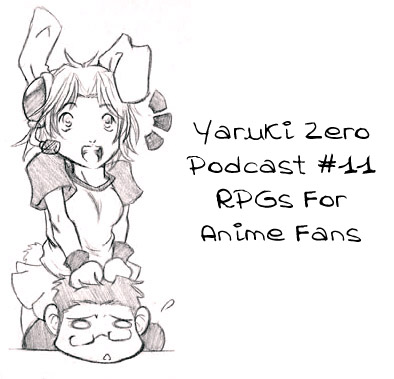
In this episode I’m joined by Jake Richmond–one of the designers of Panty Explosion and other great games–to discuss anime fans as a potential market for RPGs. We discuss our experiences running games at anime conventions (particularly his experiences at Kumoricon in Portland, Oregon), and how best to design games that can appeal to anime fans.

Yaruki Zero Podcast #11 (46 minutes, 57 seconds)

Show Notes

  1. Introductions
  2. RPGs at Anime Cons
  3. Designing For Anime Fans

This podcast uses selections from the song “Click Click” by Grünemusik, available for free from Jamendo.com. If you like the song, consider buying some CDs from Nankado’s website.

Very awesome caricature of Ewen courtesy of the talented C. Ellis.

somerights20en

Anime Fans and RPGs

LOS ANGELES, CA - JULY 02:  Nathan Smith looks...
Image by Getty Images via Daylife

Recently Jake Richmond, Ben Lehman, and some other story gamers from the area went to Kumoricon (a local anime con with attendance of a bit under 5,000) to run various anime-themed RPGs. Ben and Jake have both posted about their experiences, and they’re encouraging to say the least. Between them they ran seven different sessions of a wide range of games–the Atarashi Games line, plus Bliss Stage and Maid RPG–and all were a resounding success. At a relatively small con, and with minimal promotion for their anime RPG track, they still had sessions overflowing with enthusiastic players. Not only that, but these folks were in many ways more open-minded than typical tabletop RPG players. No one was turning their noses up at playing anime maids or Japanese schoolgirls, or at having sexual content in Bliss Stage, much less getting turned off by anime/manga style art.

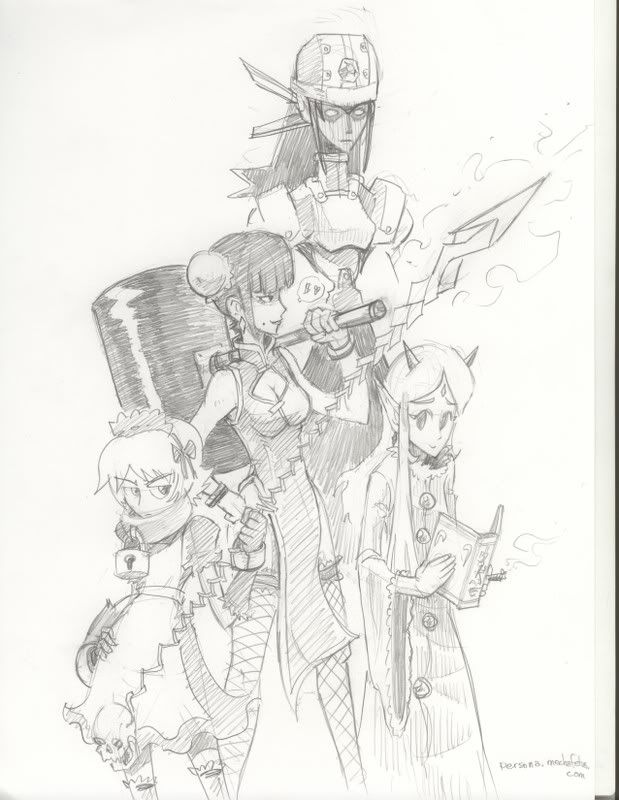
I haven’t been nearly as ambitious as those folks, but I did run sessions of Maid RPG at FanimeCon and Anime Expo last year, and they were likewise met with enthusiasm. At Fanime, even the guys who came off at first as being run of the mill D&D players jumped into playing maids without any hesitation. One gentleman was already a fan with a copy of the book who’d been talking it up on DeviantArt, and a couple more went ahead and ordered the book online before the con was even over. At Anime Expo I got an enthusiastic group, a first-time role-player, and one guy even went so far as to commission Persona to do a sketch of the PCs.

Interactivity at Anime Cons
There are a lot of different things at work here, which I’m trying to unravel a little. There is a very definite overlap between RPG and anime fandoms, but as is often the case, gamers on the whole are very mixed (and in some cases outright hostile) in terms of their opinions of anime. No game can please everyone of course, but while anime art is a turn-off to many gamers, good anime art is a huge draw for anime fans. Most cons have an Artists Alley where artists have tables to sell prints and commissions and such, and they’re generally packed. At conventions especially, anime fans are always looking for things to do. Every anime con has a big schedule of anime showings, but apart from stuff like the AMV contest, Anime Hell, etc. that you can’t get off of BitTorrent, they aren’t the real draw. Things like karaoke contests, maid cafes, panels, workshops, and, yes, tabletop gaming rooms, are what get people interested.

One major issue I’m pondering in all this is how to go about making things happen. Running games is relatively easy, though even where an anime con has a bustling tabletop gaming room, it’s likely to be dominated by CCG tournaments. The folks who ran games at Kumoricon lamented that they could’ve easily sold 10 or 20 copies of each game if they’d had them, but for the larger cons a dealers room booth costs something like $600 to $1,000. For a smaller con it’d be closer to $200, though I’m not entirely sure how the costs would line up with the money made in either case. I do have a contact with a local anime store that goes to what seems like every con ever (“Didn’t I see you last week in California? Why are you in Texas?”), but I’m not sure that having some Maid RPG books getting lost in a sea of plushies and trading figures would be all that effective. On the other hand, it might be possible to persuade a con to let people sell self-published RPG books through Artist’s Alley, which is dramatically cheaper, but not something I would expect to be able to do consistently, depending on each con’s policies and the attitude of whoever’s running their Artist’s Alley.

Expanding to Other Realms
This is also just one example of how RPGs can potentially reach a new (and more targeted) audience. People were also running games at PAX, and I can’t really think of a nerdy subculture that doesn’t have at least some room for tabletop gaming. The only thing that makes anime fandom a bit different is that in terms of published RPGs it’s one of the more underserved, especially considering just how big it is. Companies are having a hard time monetizing the actual anime content–not a few DVD publishers have closed their doors over the past few years–but sales of just about everything else to do with anime are still relatively strong (even if the state of the economy has been a problem for those dealers like everyone else).

Although this goes without saying, I’m talking about small press/indie RPG stuff here too. I would be more than a little surprised to hear that anime RPGs are catching on so much that Wizards of the Coast needs to take notice, but as I’ve said before, if Maid RPG is any indication, by small press standards a good anime-themed RPG can be a resounding success. Maid RPG’s sales have been competitive with the very top tier of indie RPGs, on par with the likes of Vincent Baker and Evil Hat. While it does have its share of adherents from among the indie gaming crowd, I highly doubt it would’ve been so successful without the anime fandom demographic. On the other hand, that makes me a little nervous in that without anything resembling a marketing plan we’ve still had a hell of a time keeping Maid RPG in stock. While turning a profit, however modest, is nice, not being able to consistently get the books to people who want them just bugs me, and I don’t really feel I have the tools to properly gauge the extent to which addressing this new fanbase will elevate demand. Being able to print books in greater volume has benefits for everyone involved of course (cheaper per-unit cost, and at a certain point traditional rather than POD printing becomes more feasible), but the up-front investment from the publisher can still get impractically large. I know Gregor Hutton has said that it was basically a financially fortunate situation that let him print enough copies of 3:16 to meet the unexpectedly high demand.

Conclusion
Regardless, I definitely intend to work more on promoting the RPGs I like through anime conventions. At the very least, I know for sure that the con closest to me (FanimeCon) has an ambitious tabletop gaming department as a decent number of role-players. Admittedly, my skills and personality are better suited to the writing/translating side of things, but wherever one falls in the equation, there could be exciting times ahead.

In any case, in the near future I’m going to be recording a podcast with Jake Richmond to discuss these issues, his experiences at Kumoricon, and more.

Reblog this post [with Zemanta]

Kyawaii RPG #5: Monday Afternoon Blues

203403f61eb70096790939f08e13ee827fc3d71a

I got the Norwegian Style book in the mail the other day, so naturally I got inspired to make a role-playing poem, which is to say a mostly freeform role-playing thing meant to be played in 15 minutes. Monday Afternoon Blues is a bit derivative of Stoke-Birmingham 0-0, only it’s about the aftermath of a big anime convention.

Click here to download.

Update: I also made an audio version of this game.

Slime Story Design Journal: Bits and Pieces

Since Slime Story has become a very ambitious project that I’m very determined to complete (i.e., turn into a complete, playable, and fun RPG), I’ve decided to start posting “Design Journal” entries so that folks can see the process and maybe get a little more excited about the game. (And maybe offer suggestions too.) I do kind of feel like I’ve been piling lots of bells and whistles onto the game, and I’m wondering if I won’t have to just get rid of some of them depending on how they work out in playtesting, but that’s how it goes, I guess. Here are the major things with the game that are on my mind at the moment:

Encounters
Slime Story’s encounter rules are meant to be a relatively simple tactical game that players can enjoy on its own merits. It’s turned into a sort of D&D4e-light, mixed with bits of Meikyuu Kingdom and a few other things. Characters take turns and can do one Full Action (attacking and other involved stuff) and one Maneuver Action (moving and other actions that help indirectly) per turn.

The Action Stack is a set of cards representing each participant in an encounter. The GM simply shuffles the cards, and that’s the initiative order. (Certain conditions will let characters shift their card up or down in the stack.) The GM simply flips through the cards, and whoever’s card is on top gets to act.

The Battlefield Map is an abstract map with seven spaces arranged vertically. Characters can attack enemies that fall are within a number of spaces based on the Range of their attacks (a typical melee weapon has a range of 0-1, so it can hit enemies in the same area or an adjacent one), and can use a Maneuver Action to move from one area to an adjacent one.

To make both elements work more smoothly, I’m thinking of having a PDF with three sets of generic action cards and battlefield tokens/pawns for monsters (numbers, letters, and symbols), which you can use rather than having to prepare them for each type of monster you want to include in advance.

Right now the main boondoggle with encounters is that I want to have some way for characters to try to get a positional advantage, but I’m not sure how to go about that without having it be too time-consuming or giving too overwhelming of an advantage.

Achievements
Achievements are probably one of my favorite things about the game. Achievements are very much like the things from Xbox 360 and other video game platforms, in that they archive a character’s accomplishments and contribute to his or her overall reputation. In Slime Story, the GM hands them out to players where appropriate during play, and everyone can suggest achievements after the session is over. Characters can “cash in” achievements for Character Points (to improve attributes and buy new abilities) and/or Influence (to buy stuff with).

I have a notion of having achievements cause characters to gradually build up a Renown rating, but I’m not sure what it would actually do in the game.

Happenings
This is the newest thing, which wound up being a combination of a couple different things that were rattling around inside my head. During Interludes (the stuff that goes between encounters, where characters can quarrel, bond, make items, etc.), players have a limited number of Action Points (they get one per Interlude, and each gets one extra AP per episode) to spend on doing stuff. I’ve been wanting to have some mechanism for players to earn more AP if they want/need to. I also had a vague idea of having rules for random events, which the GM would periodically throw in to make things more interesting (so the monster hunters might run into a dead deer, get caught in a sudden downpour, bump into a police officer, get a call from home, etc.). It occurs to me that inconvenient “Happenings,” whether rolled randomly, devised by the GM in advance, or suggested by the people at the table, make an excellent way to both make protagonists’ lives more interesting and give an appropriate “fee” for awarding Action Points.

Reblog this post [with Zemanta]