Magical Burst: Getting Started

This is an idea I’ve had for some time, though it just coalesced into something I think I can really make work. I’ve been fascinated by magical girl anime for entirely too long, but it’s a genre that cried out to be satirized and subverted. Some might remember how way back when I made a campaign setting called Magical World, a contemporary setting with a dangerous excess of Sailor Moon style magical girls, heavily inspired by the Magical Girl Hunters improfanfic. Later on I had the idea of doing an updated version, titled Magical Burst, which would incorporate Maid RPG style randomness and Superflat insanity, but I didn’t get very far with it.
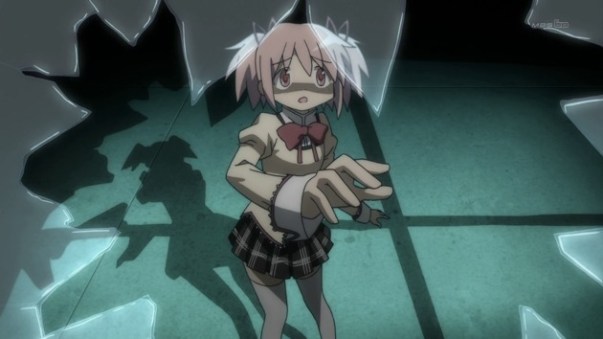
What has me so incredibly inspired is a new anime series called Puella Magi Madoka Magica. It’s a magical girl series from Akiyuki Shinbo, the prolific anime director known for series like Hidamari Sketch, Sayounara Zetsubou-sensei, and many others. (It also doesn’t hurt that the character designs are by Ume Aoki and the music by Yuki Kajiura.) Lyrical Nanoha challenged some of the conventions of magical girl anime–such as by having the protagonist actually sit down and talk to her mother about what she’s doing–but Madoka Magica is the dark magical girl series I’ve been wanting for a long time. It is a series where death is a very real danger, where the desires of adolescent girls are dangerously magnified by magic, and where the forces they’ve aligned themselves with are not so benevolent as they might seem.

Then I stumbled across the TV tropes page on the series, and it turns out that the main writer is Gen Urobuchi. The staff had tried to keep his role a secret as long as they could. Why? Well, in the postface of the first Fate/Zero book he wrote he said, “I am full of hatred towards men’s so-called happiness, and had to push the characters I poured my heart out to create into the abyss of tragedy…” The series is about halfway through its 12-episode run, and it seems like it’s going to get even darker, which is saying something.

This new attempt at Magical Burst incorporates many of my own ideas–too many for it to be Madoka Magica with the serial numbers filed off–and is meant to be fundamentally a game about fighting youma and the unwanted consequences of doing so. The game is shaping up to be sort of like a magical girl version of Don’t Rest Your Head (“Don’t Rest Your Wand”), though quite a few other elements have made their way into the rules, including a D66 table of random magical mutations.

I think the major thing that has me really wanting to realize this game is that it has the potential to create intense stories that really push characters to their limits, all wrapped up in an anime genre I find fascinating. One of the strengths of the magical girl genre is that it thematically works around a feminine coming of age process, and when you stop sanitizing that in the manner of Sailor Moon and Tokyo Mew Mew you’re quickly reminded that girls can be pretty amazingly vicious. (Of course, that’s half the premise of Panty Explosion.) I also love how Madoka Magica emphasizes the unnaturalness of magic. One thing about Sorcerer that never came across to me until I listened to the Canon Puncture Game Advocates episode about it is that it’s assumed that your PCs have managed to do something that violates the nature of normal reality. While in other settings there’s fertile ground for magic as something well understood, the consequences of exposing magic to a world completely and utterly unprepared for it are fascinating.

Anyway, I just wanted to throw that out there. The actual game should be fairly short and simple, so hopefully it should hold my attention long enough to at least let me finish a full first draft. I’m still digesting Ben Lehman’s (unusually) lengthy essay on playtesting (especially since I barely read it an hour ago), but the main thing I’m taking away from it is I need to be much more rigorous and dedicated than I have been about design.

Role-Play This! A Certain Scientific Railgun

I haven’t done a “Role-Play This!” thing in forever, but I got inspired all of a sudden.

What Is It?
A Certain Magical Index is a series of light novels that has been adapted into an anime series. It takes place in the Academy City, a cutting edge city of mostly students, constructed to instruct people in the use of special powers. Index presents a dichotomy between the world of science (which includes special powers) and the hidden world of magic, which actually exist in a delicate balance of power.

One of the most popular characters from Index is Misaka Mikoto, a Level 5 power-user (which is as high as the power scale goes) with an exceptional talent for generating and manipulating electricity. She can do a tremendous variety of things with her power, but her signature move is to create magnetic fields to propel a coin at supersonic speeds, hence her being nicknamed “the Railgun.” A Certain Scientific Railgun is a spinoff series that stars Mikoto and delves deeper into the lives of Academy City students.

Why’s It Awesome?
Railgun is unusual among anime in that it both develops an interesting setting and tells a good story. It takes place in a near-future setting that presents “super powers” as a phenomenon that science (mostly) understands, and uses that in lots of interesting ways, both in terms of cool sci-fi stuff and how it affects the characters. The Academy City has both the Anti-Skills (a paramilitary force for dealing with dangerous power-users) and Judgment (a group of students that assist with law enforcement as well as everyday problems), not to mention plenty of people who resent the prestige that high-level power-users seemingly have handed to them on a silver platter. There are also hidden conspiracies, strange technologies that affect power-users, and memorably insane villains.

In Railgun especially this is all conveyed with a bunch of fun, likable characters. Mikoto is joined by her roommate/stalker Kuroko, who also has a scarily effective teleportation power, and Ruiko and Kazari, who remind us that not everyone in Academy City has spectacular special powers, however much they might wish for them.

Gaming It
The setting of the Academy City seems all but made for role-playing. It has a population of 2.3 million, of which 80% are students hoping to develop their special powers, so it’s not the slightest bit implausible to introduce new characters with their own powers.

My #1 pick for an existing RPG to use would be Smallville. With its relationship mechanics and orientation towards melodrama, it needs little or no changes to work for the Index/Railgun setting. It even allows for powered and non-powered PCs to exist side-by-side, so characters like Ruiko (who has no powers at all) and Kazari (whose power is inconsequential) are easy to put alongside Mikoto and Kuroko. About the only things I would change would be more flavor, specifically that while characters might have more than one power in game terms, for the purposes of the story they should have only one (“Dual Skills” are only a hypothetical thing in the setting) and that characters without powers in game terms can have a small, mostly useless power for flavor if they really want (again, like Kazari).

For a more traditional approach, most any superheroes RPG worth its salt should be able to represent the kinds of powers seen in Railgun just fine. (And frankly I’m kind of surprised that the anime characters page of Surbrook’s Stuff doesn’t have any Hero System writeups for Index/Railgun characters.) Hero System, Mutants & Masterminds, Truth & Justice, and so on should work without too much effort.

Yaruki Zero Podcast #16: Steven Savage

Yaruki Zero Podcast #16 (24 minutes, 48 seconds)

This episode presents a succinct but interesting interview with Steven Savage, the man behind both Seventh Sanctum and Fan To Pro. In the interview, Steven talks first about the Seventh Sanctum generators site and his philosophies of how randomness can inform creativity, and then about how RPG gamers can leverage the things their hobby involves into career stuff.

This is my first time recording a podcast with a guest in the same room (using my little Sony digital recorder), so there’s a little bit of background noise here and there, but I think it turned out surprisingly good considering.

This podcast uses selections from the song “Time Machine” by To-den from the Grünemusik album of the same name, available for free from Jamendo.com. If you like the song, consider buying some CDs from Nankado’s website or via Jamendo.

Very awesome caricature of Ewen courtesy of the talented C. Ellis.

GET PARSELY: Adventures With Text and Maybe Pictures

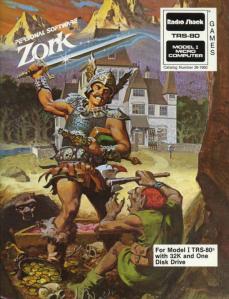
Thanks to Parsely I’ve been really interested in text adventure games/interactive fiction of late. I’m currently playing the original Zork and generally trying to digest what implications IF might have for tabletop RPGs.[1] RPGs can use some visual elements during play, but as with text adventures, we often only convey images during play through descriptive words. On the other hand when you look at the packaging of any given Infocom game, it’s full of visual stuff to excite the player, to a degree that contemporary video games very rarely bother with. They even went so far as to include “feelies,” weird little props to enhance the experience. (Leather Goddesses of Phobos even had a scratch and sniff card with different scents that came up during the game.)

As video games started to become able to have some semblance of visuals, there was still a certain imaginative leap asked of the players. Game publishers usually had a professional illustrator do a painting that conveyed the general feel of the game, and even when, say, Nintendo, used pixel art on game covers, they still had more detailed art in the game manuals. There’s definitely a parallel to RPGs, which can have all kinds of illustrations to put you into the right mood, but ultimately consist of setting info, game rules, etc. and aren’t a visual medium per se. There might be some times when you can point to the professionally-done fantasy art in a D&D book and relate it to something in your campaign, but chances are the price tag for artwork of that caliber for your own characters will be out of your reach.

From the NES Metroid manual

Pixel Art
What’s rather interesting is how the role of pixel art has changed. The so-called “AAA” video game titles use 3D graphics and aspire to something like photorealism, and genres that were traditionally all sprite-based (shmups, fighting games, platformers, etc.) have come to use 3D polygons too. These days pixel art pretty much only comes up as an artistic choice, which in turn means that it’s more likely to be used in a stylish indie computer game (or by the likes of Paul Robertson), than to suffer the mediocrity of the kinds of games that keep the Angry Video Game Nerd raging away.

In an important sense we’ve more recently reached a point where pixel art is normally the proper visuals ans seldom winds up a rough representation of what the designer wants to communicate. Some of it is no doubt nostalgia, but I would like to see pixel art make its way into tabletop games more. As far as I know Jonathan Walton is the only one who’s really been experimenting with this kind of thing (check out the cover of Super Suit). Not unlike with Blowback‘s brilliantly effective use of photography (a mixture of stock and original), pixel art won’t work for every game of course, but as I’ve started looking into commissioning pixel art I’ve found that the artists on DeviantArt who do it don’t charge very much, plus there are quite a few free pixel fonts out there. I’m definitely going to be experimenting with this kind of thing whenever I finally put together a Parsely game of my own[2] (and I may even mess around with ASCII art a bit too).

A Side of Parsely
Parsely[3] is much more interesting than it might appear on the surface. It might be a bit of a stretch to call it an RPG, but it’s definitely an analogue RPG-ish thing played by people. While the layout of rooms and how things work within a given Parsely game is tightly restricted (almost comically so; there’s exactly one way to get past the orge), reading any given Parsely game you’ll find there are places where the Parser/GM must, at a minimum, think up how to explain what happens on the fly, and while you could give obtuse computer-like responses to things not already covered by the game (“That sentence isn’t one I recognize.”), players will inevitably come up with commands that are eminently plausible even in the absurd, constrained world of a text adventure (“Kiss the princess.”)

While Action Castle is a sort of medieval mini-Zork, Jared gets into trying an assortment of different things in the successive Parsely games. In some (Spooky Manor and Pumpkin Town) characters can turn into different forms with different abilities, for example, and Space Station makes use of a stopwatch. There’s also the concept of “Microgreens,” super-short Parsely games of 1-3 rooms, of which Flaming Goat is the only specimen so far. (Update: Scratch that; Jared posted up a second one, Blackboard Jungle.) Just as people have done all kinds of strange things with the medium of text adventures–from Infocom’s more experimental titles to the avant-garde efforts of the IF hobby scene–there is tremendous room for trying out different kinds of things.

The Parsely game I’ve started working on is called Miyuki Kobayakawa’s Doki-Doki Adventure, and aside from using pixel art and having the conceit of a setting inspired a bit by Paul Robertson and Takashi Murakami, it’s going to have an event that changes the nature of the locations in the game. I’m also contemplating a game based off of the webcomic I write for, where you switch between different cast members to resolve all of their various little quandaries.

[1]Also, I’ve been reading Twisty Little Passages, which is highly informative but also in an extremely academic style.
[2]I’m also contemplating trying out Inform 7 to make an electronic version once it’s done.
[3]Which BTW is now available in PDF; 99 cents per game.

Fiasco: Super Kart Party 3 Plus!

I figured I might as well post this up rather than waiting. It’s yet another Fiasco playset, and hopefully my last one for a while (for one thing I need to find time to actually play these things).

Super Kart Party 3 Plus! is about video game testers at Nakatomi Games. Not only do they have the shitty grunt job of the industry, but it’s crunch time on an utterly idiotic, hopeless, terrible game (from which the playset gets its title) that upper management will not let go under any circumstances.

I wrote it as a birthday present for a longtime friend who’s worked as a game tester for a number of years, so a substantial portion of it is based on the various stories he’s told me. Like Liquidation, I based it more off of real life stuff, so it’s hard to recommend viewing material, but jPod and maybe Grandma’s Boy come to mind, and Once Upon Atari and this Destructoid article could be good sources of ideas.

Download Super Kart Party 3 Plus! PDF

Fiasco: The Knights of Light

Yes, another Fiasco playset. I have another in progress too, though I’m trying to get started on a Parsely game too.

This one is about the members of a small local guild in an extremely popular MMORPG. It is of course heavily inspired by The Guild. It couldn’t really find any other works about MMO players, but a Google search for “guild drama” provided plenty more inspiration, specially the Drama Mamas column on WoW Insider.

The playset is a little bit non-standard in that (1) when setting up a scene you declare whether it’s IRL or online (so there can be scenes entirely in the game, or that consist of narrating angry forum posts), and (2) I’ve replaced the Locations table with an Events one (which if you’re feeling adventurous you can also use during the Tilt).

The Knights of Light Fiasco Playset (PDF)

Fiasco: Liquidation

Liquidation is my second attempt at a Fiasco playset. Crossings is a big chain of big bookstores (get it?!) that has just filed for bankruptcy. With the clock ticking on the local store’s inevitable closing, the employees and regular customers are scrambling to get the best deals (or steals), resolve their grudges, or just get their lives in order before the store’s doors close permanently.

I couldn’t really come up with a “Movie Night” section for this one, because it’s mostly based on real experiences, my own and those of friends who’ve worked in retail, exaggerated (in some places more than others) to make for a good Fiasco.

Liquidation (PDF) Download

2010 In Review

2010 was a weird year for me in a lot of ways. Professionally, I went from being unemployed (as I was lamenting in my last belated year in review post) to having a job localizing freemium MMORPGs, which has me doing a job I enjoy, but making a good deal less money than I would like.

In terms of what I was playing, this year saw a big change in that I joined a second gaming group. It started as an attempt to get together to play Polaris, but subsequently fell apart and reformed as a sort of RPG tasting group on Friday nights. Thusfar we’ve done The Mountain Witch, Fiasco, Warhammer Fantasy 3rd Edition, D&D4e, Swashbuckers of the 7 Skies, and Sons of Liberty, with varying degrees of success. The other group has been almost exclusively D&D4e, though our Forgotten Realms campaign petered out and I started running a Dark Sun game (albeit rather infrequently). I did very little video gaming, something I’m hoping to fix in 2011, though both my Xbox 360 and Wii need repairs.

In terms of design, for me this year was mostly about Slime Story, with a bit of Slime Quest and a tiny bit of Raspberry Heaven on the side. I poked at Adventures of the Space Patrol a little (and did a couple playtests too), but only made very minimal changes to the game. On the other hand for Slime Story, Apocalypse World happened and had me again rethinking substantial parts of how the game works, and starting yet again a process of ripping out some bits and replacing them with better stuff. (Notably, trying to make the social side of the game more robust.)

I did a fair amount of blogging, but only a little bit of podcasting, and only one of the four podcasts I did in 2010 had anyone else on. (There are a few people I still need to bug about coming on the podcast…) Looking through my older posts, I was mostly preoccupied with Slime Story, though over the past few months I’ve been thinking a lot about the thematic and historical underpinnings of D&D. As with last year, I think I only did one Kyawaii RPG, though I still have half a dozen or so in varying states of incompleteness.

In July I went to A-Kon, an anime convention in Dallas, as a guest of honor. I didn’t get nearly as much out of it as I would’ve liked to, on account of being ill, anxious, and unprepared, but I had a good time all the same, and the panels I did were pretty successful. My favorite bit was at the independent RPGs panel I got to close by saying something like, “Everyone can create something that no one else ever would, everyone has their own unique vision that they can realize if they try, and that’s incredibly awesome.” Meeting Malcolm Harris (who does Witch Girls Adventures) was cool too.

In terms of non-RPG stuff, the webcomic I write for (Neko Machi) got started in November of 2009, but 2010 was its first full year. It’s had its ups and downs, and although the readership is not yet there, creatively I’m happier with it than ever. I didn’t get all that much writing done though, in December I finished four short stories (see my DA), and hopefully that momentum will keep up.

As for 2011, the big thing on the horizon is a publishing project that I’ll hopefully be announcing publicly pretty soon. I’m also aiming to have a table for Neko Machi at the Alternative Press Expo (though some RPG stuff may make it in there too). I don’t have any other plans in the way of going to conventions (money’s much too tight for Gen Con to be feasible), but I have more than enough plans for games to play and design. I also want to get more into language learning, both brushing up on my Japanese (before it deteriorates to mere manga-reading level) and expanding into new territory (although it’s not technically required, at my work not being able to read any Korean[1] is becoming frustrating).

So, what have we learned?

  • D&D was loosely based on several different kinds of fantasy (and understanding those will help you better understand the game), but it’s evolved into its own genre based on how it works in actual play.
  • Board game fans have this blind spot that prevents them from seeing that not everyone is into board games.
  • 4E haters make me not want to play D&D, both to make it easier to avoid their nonsense, and because half of what they complain about applies to most editions of D&D.
  • The internet has a certain baseline level of toxicity, and you’re better off not having too much of it.
  • Being a guest of honor at a con is pretty sweet, but pretty exhausting too.
  • What a game’s rules don’t do is sometimes at least as important as what they do.
  • Fiasco is really awesome, but chances are you knew that.
  • Mostly, I just need to get off my butt and do stuff.

[1]Alas, unlike Japan, South Korea doesn’t seem to have much of a tabletop RPG scene. Also, 안녕하세요.

A Strategy Guide For D&D

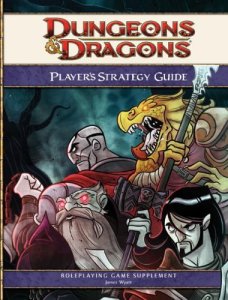
I recently picked up a copy of the D&D Player’s Strategy Guide from a local used bookstore. I wouldn’t have bought it normally, but it was relatively cheap and I had some leftover store credit that I’d been hanging on to for the better part of a year.

Unsurprisingly, some people have balked at the very idea of a “strategy guide” for an RPG. I had figured I wouldn’t need it much myself because I have so much experience with the game already. I was right–two years of playing a game will do that–but there’s an awful lot of stuff in the book I wish someone had spelled out for me from the get-go. 4E is a sufficiently complex system that it has a distinct learning curve, and this is a book that can help smooth that out for new players by explaining all kinds of stuff that the rulebooks either leave out (and that most RPG rulebooks would leave out) or only mention in passing. It’s common sense to focus fire and eliminate individual enemies as quickly as possible[1], but the Strategy Guide goes to the trouble of illustrating how big of a difference it can make with diagrams and everything.

The book covers a whole range of topics, including character building, party composition, tactics, role-playing, and some of the social stuff (including a section titled simply “Don’t Be A Jerk”). It’s all grounded in a very solid understanding of how the game works and what it can do, so that players can skip over some of the trial and error (emphasis on the “error” part) that we went through in the first year or so of playing 4E. If we’d had a better idea how to play defenders, or just how much it would cost us not to have a leader in the party, we might’ve done things very differently, and altogether better.

The thing about D&D in particular is that while it draws on various kinds of fantasy literature, it was always its own thing. In some ways this was a limitation of the designers’ understanding of this new “role-playing game” insanity they’d devised, and in other ways it was likely deliberate. Certainly when fans asked questions about why the game wouldn’t allow for a given element from Lord of the Rings or some other beloved fantasy title[2], Gygax’s usual answer was that it was a game first and foremost. While D&D started off culling ideas from fiction, it gradually became more and more about itself, I think in part because that’s all that its rules could really effectively provide.

I think that explains why works of fiction based off of D&D are at their best when they reflect what goes on at a typical gaming table. Typical D&D novels come off as stilted, and struggle to find the happy medium between slavish adherence to what the rules can do and getting into stuff the game inherently can’t do justice. That’s where the new D&D comics from IDW and even stuff like The Gamers really shine. The fun of D&D is less in Aragorn reclaiming the throne of Gondor, and more in the silly bickering and strange accidents that happen along the way (which makes movie Gimli the most D&D-like character in the whole of Middle Earth).

What I like most about the Player’s Strategy Guide is that it’s unabashedly situated in the same realm as D&D actual play rather than wishful thinking about such. It has lots of pragmatic advice about how to get what you really want out of the game, both from a social perspective and in terms of working the rules and building characters, and it’s written in a friendly tone, with cute little cartoons that lighten the mood and call to mind the ones in the AD&D1e Dungeon Master’s Guide.

[1]That’s a tactical thing so basic you can pick it up from the original 8-bit Final Fantasy.

[2]Dragon Magazine once published stats for Conan. Very few of his ability scores were below 20. You know that guy in the books you love so much that inspired you to play this game? Your guy will never, ever be as bad-ass as him.

Kinds of Fantasy

As I mentioned the other day, I’ve never been much into sword and sorcery fantasy, and it’s largely unknown to the friends I game with. I decided to start reading some Conan to at least get a feel for what the stuff is like. “The Phoenix on the Sword,” one of R.E. Howard’s first Conan stories, is a great tale of the barbarian as a king, which relentlessly looks out to a far bigger and older world.

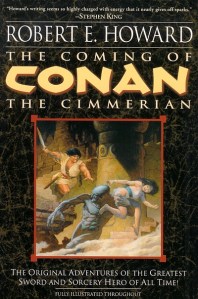
The anthology “The Coming of Conan the Cimmerian,” which strives to put together Howard’s original stories in an unmodified form in order of publication. It has a lengthy forward which makes clear something that’s fairly obvious from The Phoenix on the Sword, namely that Howard saw a certain value and freedom in barbarism, and in his stories expressed a distrust of civilization. It occurs to me that in the matter of “barbarism vs. civilization,” Japan’s version of Western fantasy falls squarely on the side of civilization. In Slayers, for example, civilization is pretty unambiguously positive, and the antagonists are mostly savage monsters and ancient demons. In Final Fantasy there has been the occasional evil empire, but savagery isn’t really the solution; a character like Gau (from FF6) is an oddity whose feral upbringing is an adorable character quirk and the basis of an unusual and difficult-to-use ability.

This is especially true when it comes to the way the differing styles of fantasy present magic. In the Conan stories magic is the province of evil sorcerers meddling with forbidden forces that threaten to make them spiral into madness. A magician on or near the throne is a travesty to be undone by a barbarian’s fierce blade. In the Japanese version magic is typically a tool, a kind of neutral technology. That’s why in J-RPGs and anime a school of magic is a viable concept. In the Hyborian Age a school of sorcery would probably be a den of madmen doomed to breed unconscionable evils.

I don’t know if I am in fact onto something here, but it does seem like the old sword and sorcery fantasy, especially that of R.E. Howard (who would’ve happily written historical fiction if he could’ve gotten paid enough for it) harkens back to ancient history, while the Japanese version has a distinctly modern sensibility. Of course, the history of D&D has been a transition from sword and sorcery to modernist fantasy. The Tolkien influence already muddled the sword and sorcery style that Gygax seems to have preferred, and in terms of genre influences D&D became more and more about itself. I think D&D has largely sidestepped the kinds of issues brought up by the notion of barbarism vs. civilization, and any themes inherent in the game as written are more from the way the rules, derived from wargames in a rather haphazard fashion, happened to play out. I haven’t made much of an effort to experience the breadth of what’s out there, but In a Wicked Age really seems to capture the essence of sword and sorcery, in a way that D&D scarcely even aspires to, much less achieves. (Though Dark Sun probably comes a lot closer than any other part of D&D.)

Although I can definitely appreciate the mythic grandeur of Conan and his ilk, I think on the whole my tastes fall more on the side of modernistic fantasy. I like the fantastic things that are possible in the fantasy genre, but I think I find modern sensibilities more capable of involving themes that I can readily relate to. That’s another reason why I’m looking forward to bringing Slime Quest to fruition.