My gaming group recently finished up a short campaign that started in the Smallville RPG and finished in Primetime Adventures. I enjoyed both games a whole lot, though I think PTA was the better fit for us. There are a lot of neat things about Smallville, but the thing that benefited our game the most was the Pathways character creation/relationship map system. I’m sure we still would’ve had fun, but I think the game wouldn’t have been quite so good without that sprawling relationship map.
I wanted to be able to put that kind of nifty stuff into other games, so I ended up writing up this thing called “Entanglements.” It’s essentially a genericized version of Pathways, with a few new elements I thought would be neat, plus some suggestions for using it with specific games. I haven’t actually tried it out yet, but I want to, especially for the next time I’m starting up a campaign of a game like D&D that has minimal built-in support for such things. So, this is a rough draft, and I eventually want to do a finalized version with an extended example and maybe an illustration or two. I might even get into more copious examples and d66 tables eventually, but we’ll see.
Update (2/1/2012): I made some smallish changes to Entanglements based on trying it out for a Wushu game a while back (which was tons of fun, but exposed a few things that needed refinement). I also added some stuff about group setting creation and expanded the section on using Entanglements with specific RPGs.
It’s a little overdue, but here’s the new draft of Magical Burst. I’m not totally happy with it, but some things have definitely improved.
Added a set of Normal Attributes and Apocalypse World style moves. These definitely need some work before they’re fully ready, and they may have been muddled by the fact that I didn’t do the AW thing where only players roll dice. On the plus side, they rather eloquently dealt with certain things.
Made some refinements to the relationship rules, notably in how new relationships are formed (they effectively start with 2 Strain, so starting a new relationship isn’t better than fixing an old one) and how they’re used (I scaled back the benefits of sacrificing them, so that it’s not better than taking Overcharge).
I reworked the Change tables so that each attribute has a full d66 table. To do that I dropped the notion that Heart and Fury changes are mostly mental.
I changed the youma creation rules to make them scale to the number of magical girls they’re fighting. The idea seems sound, but it needs a little more work. I think I didn’t take magical girls’ special attacks into account, and was a little too stingy with the special boss powers the youma get.
Added a set of variant rules to for making the game more closely based on Madoka Magica to the appendix.
A few weeks ago I did my first playtest, which was kind of mixed, though heat and allergies did play a role in that. I’ve also been playtesting Dragon World, which has been a lot of fun, but has driven home the point that getting the moves right is really important. I need work more on how to better handle the investigation part of the game (which is my un-favorite and which I may need to find a way to sidestep or something). I also had this notion of having players take turns framing scenes, and it needs to either get developed more fully or be dropped from the game. I’m also not really happy with how the combat system has been playing out (even if I do like how the youma design system is going), and I may try to rethink it from the ground up again.
A couple of other random things I’m thinking about:
Tables/whatever for the origins and motivations of youma.
Making the magical girls just start with relationships to one another automatically. Also, clearer guidelines for adding new PCs after the game has started.
A turn marker that you move along the action cards in combat. It’s surprisingly easy to lose track of stuff.
In any case, this is where I start really seriously looking for feedback and generally trying to finish a damn game for once.
Most Friday nights I game with an awesome bunch, and we’ve gone through a bunch of different indie games (and we’re playtesting Magical Burst next week). One member of that group, Aaron Smith, has been working on some nifty games for a while, and (what with me being kinda sorta internet famous) asked me to post them up here. So, for your consideration (and hopefully enjoyment), two free games he’s been working on.
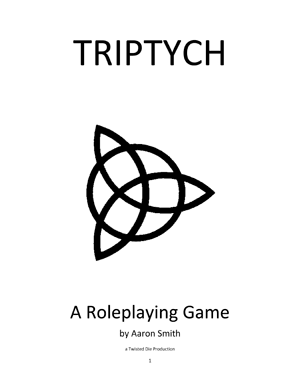
Triptych is a simple, fast-playing game with indie sensibilities that draws on FATE. It also includes three settings: Stardust & Æther Winds (science fantasy with space-faring sailing ships), Megatropolis (a setting for romantic comedies with anime elements), and The 5 Kingdoms – Earth Under Heaven (a deliberate mishmash of wuxia and chambara martial arts movies).
Fast Fantasy is a quick and easy fantasy adventure game, inspired by epic fantasy novels.
Let’s Talk About Neat Things: Jake is interested in the food cart scene in Portland and wants to start one to sell awesome noodles. Ewen’s been geeking out about Slayers because of Dragon World.
“Something is wrong with these people, and I don’t know what it is.”
I’ve said it before, but Apocalypse World provides a fascinating framework to work with. There have been certain big hit games that have thrived in part by encouraging hacks and customization. Fiasco’s playsets are an obvious example, and there are AW hacks, IaWA oracles, and Technoir‘s transmissions are poised to become the next example of this phenomenon. Technoir also joins AW in having a printable player reference book[1], an idea I think I’ll have to try for quite a few of the games I’m working on.
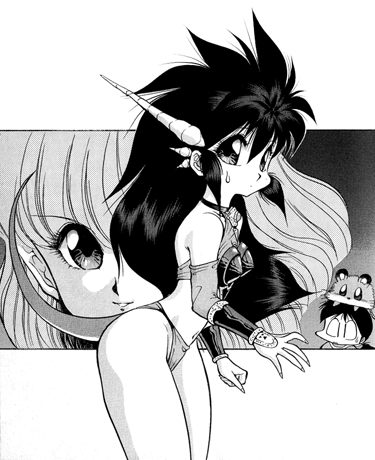
The more I work with moves, the more fun I have with them. Where AW has moves that play into desperate badassery, Dragon World moves reinforce a very different kind of fiction. I’ve ended up writing a lot of moves that say things like “You end up looking stupid in front of everyone.” Writing up moves for the different character types is proving a little harder, and I suspect that’s where a lot of the real challenge of this thing is going to come from. Here’s my first draft of the Explosive Mage character type, which is basically for players who want a character like Lina Inverse from Slayers. I’m not satisfied with the moves yet.
Writing the MC moves for Dragon World is really interesting too, since in a sense I’m trying to distill my own best practices for running silly games like Maid RPG. And when I think about it that way, it becomes incredibly awesome in my head, since it means I’m using ideas and techniques that go back to when I first got my copy of Toon back in middle school, literally something like 20 years ago[2]. I’m too intuitive a designer to make some grand point about how humorous RPGs should work, but I think I’m on the track with Principles like “Break your toys in the name of comedy.” Comedy is subjective and challenging and all that, but I think if an RPG can give players better tools for, say, horror, then the same is surely true of humor.
The thing that’s been sticking in my head for quite a while now is how slapstick characters react to physical punishment. Toon handles this by having Hit Points[3], except if you run out you Fall Down for three minutes and come back. A while back I dug out my Toon rulebook and ran a session. It was a lot of fun, but the whole time part of my brain was saying, “Cartoon characters don’t have hit points!” I’m still feeling out how to handle this kind of thing, but I think that cartoon physics work more on a scheme where characters are fine until they hit a certain threshold, whereupon they Fall Down, and then the scene changes shortly thereafter. Right now I’m trying to figure out how to implement that, and especially how to implement it gracefully within the framework of Apocalypse World’s rules. The big problem with a binary system like that is making it work appropriately for a genre where powerful evil overlords are pretty much a given. For that I think I’m going to have to sit down and really rigorously brainstorm.
Also, it occurs to me that if I finish this and try to publish it, finding someone who can do the right style of art is going to be a challenge.
[1]Though AW’s ludography mentions that Vincent got the idea from XXXXtreme Street Luge.
[2]The fact that there are notable things in my life that were 20 years ago makes me feel old, though my grandma would tell me that I’m nowhere near old yet.
[3]Specifically, a Toon character gets 1d6+6 HP, and things typically do 1d6 damage. Also, I’m trying to not think about rewriting Toon to use AW moves.
This post wound up being a lot of text (over 2200 words including this bit), and it’s about personal stuff rather than some RPG I’m working on and/or drooling over.
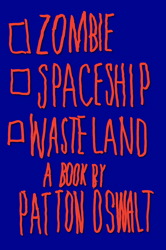
A book you should read.Patton Oswalt‘s book Zombie Spaceship Wasteland is well on its way to becoming one of those rare books that I periodically reread to refresh its influence. I’ve liked standup comedy for as long as I’ve been aware that there was such a thing, and Oswalt is easily my favorite. Not only is he a fellow geek, but he has a really profound passion for what he’s doing that’s always showing through. You get glimpses of it in stuff like his magician bit, which is a story from early in his comedic career, but his book is angry and sad and beautiful and puts his passions on display. It’s got humor mixed in, but more than anything it’s a series of self-portraits, snapshots of different moments in his life.
My own life has never been very good at furnishing events that would make good stories. In middle school and high school I came to dread autobiographical writing assignments because I never seemed to have anything to say. My most successful such essay turned the assignment into a lament about how boring my life was. Things have gotten more interesting with time–in my early 30s I have just enough personal history to be able to tell stories about myself now and then–but certainly nothing on the level of what you’ll read in Zombie Spaceship Wasteland. One place where life resembles role-playing games is that events just kind of happen, and without adrenaline burning them into your brain, memories of events can slip away. There are moments that stand out, but it takes effort and craft to form an enduring narrative. Continue reading RPG Wasteland→
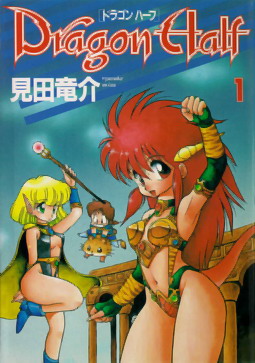
I may need to come up with a better name, but I ended up starting up yet another RPG project. I’ve been reading an obscure and in my opinion tragically overlooked manga called Dragon Half. When the renowned warrior Rouce went to slay a dangerous red dragon, he ended up marrying her instead, and the result of their union was Mink, a “dragon half.” She’s ridiculously strong, but all she really wants is to meet the handsome monster hunter/pop idol Dick Saucer. The magna got a 2-episode OAV series, which barely touches on Mink’s grand adventures. (There are, however, scanlations out there…) Webcomic artist Josh Lesnick also cites Dragon Half creator Ryusuke Mita as one of his major influences, and having finally read the manga I can definitely see why.
It occurred to me that Dragon Half is part of a genre of anime/manga, along with titles like Slayers, Maze, Ruin Explorers, and Those Who Hunt Elves, and that I really enjoy that genre. I don’t really go in for the nostalgic lamenting of the current state of the anime industry that’s become so trendy these days, but there is something I miss about the style of anime that made me such a fan back in the 90s. Since I’ve had Apocalypse World on the brain after it helped me get over a major design block with Magical Burst, it occurred to me that I could probably rejigger the basic rules of AW to make a game for that genre. AW’s moves–both player and MC moves–really reinforce the genre, and changing them is a very powerful tool to make a game that does what you want it to. I’ve tentatively titled it “Dragon World.” Thanks to Dragon Quest, in Japan “dragon” strongly evokes Japanese-style Western fantasy, but I already get it mixed up with Dungeon World in my head, so I’m going to be on the lookout for a different title.
Rules-wise I’m probably going to drop the concepts of harm, gear, and barter (i.e., a lot of the stuff that puts the apocalypse-y stuff in AW). I need to explore the idea more, but I’m increasingly of the opinion that rather than having “hit points” or whatever, characters in a very comedic world (whether wacky anime or Looney Tunes) should have more of a threshold before they fall down, after which the scene ends and the action jump-cuts to whatever consequences there are. (Though in Dragon Half if the foe is a disposable monster they’ll often jump cut to Mink and company eating its roasted carcass.) Likewise, gear tends to be part of characters’ overall shtick (like Gourry and his Sword of Light) and money will tend to be ephemeral one way or another (food bills, thievery, etc.).
My tentative list of character types goes:
Adorable Mascot (Mappy from Dragon Half)
Conniving Thief
Dodgy Alchemist
Dumb Fighter (Gourry from Slayers)
Explosive Mage (Lina Inverse)
Half Dragon (Mink)
Nutjob Cleric (Amelia from Slayers)
Tweaky Shaman (a nuttier version of Fam from Ruin Explorers)
Useless Bard (pre-4e stereotypes of D&D bards, and a bit of Lufa from Dragon Half)
The MC moves are especially interesting to work on, since they very directly relate to the flow of the fiction (and I’m going to have to start watching relevant titles with an eye towards how stuff works in terms of moves), so there’s stuff like add silliness and introduce a new version of an old nuisance.
The other thing about AW that’s striking is the sheer economy of it. The rulebook feels like it’s written as though the book is a necessary evil for conveying the game, and it’s very clear that this is the right way to play/run the game. Moves often take up one to three sentences where other games would write them as a paragraph; AW gives an evocative name and the minimum text to tell you what a move does, and continues to the next one. Given my penchant for overwriting my games, the game’s economy of prose may turn out to be a good influence, but time will tell.
Mostly, this is a project that seems like it’ll be really fun to work on and even more fun to play. I started a thread on the AW forums, though the response has been kind of anemic so far, not that I expect a huge overlap between Apocalypse World tinkerers and Slayers fans. Anyway, I just wanted to toss this out there.
More on Magical Burst
I really want to bring Magical Burst to fruition, ideally within the next year or so. Not only is it a project I’ve been wanting to do for ages, but the game is already just on fire. It’s still a rough draft, yet it’s been played by something like five or six different groups that I know of, and checking site stats it turned out that some Taiwanese fans have already translated most of it. Although I doubt the creators of Madoka Magica are going to pull an Endless Eight and alienate all the fans, the current buzz about it won’t last forever.
Yesterday for the second time I went to the local Panera with all my notes to brainstorm, and this time I tried running a test combat (Yuna and Makoto vs. “Hellerina”). I think the combat system is more or less on the right track. The amounts of damage characters can dish out is pretty brutal (and I’m upping magical girls’ base Resolve to around 18), but I want combats to go pretty quickly. However, thinking back to the clouds and boxes stuff I’ve been re-reading lately I think I’ve allowed it to become a little too much of an abstract sub-game, so I’m going to pull back a bit on that.
Looking at Apocalypse World for inspiration, I ended up deciding to add a set of Normal Attributes (tentatively, Aggro, Cool, Social, and Sharp) and rules that use them in various ways. I’d been kind of avoiding doing that up until now, but I think having that dichotomy in the rules, with magic being explicitly stronger, is more interesting. It’ll also let normal people and potential magical girls actually have something to do in the rules. It’s also making me realize just how powerful AW’s “moves” model is. I was trying to figure out how to handle magical girls facing psychological shocks and how to handle what happens when they lose all their Resolve in a fight, and adding Stay Calm and Revive moves might be just the solution I was looking for. On the other hand that puts my notion of a Shinobigami-style scene-framing system like I wrote about in my last post into doubt, but I’ll just have to see how all that shakes out as I work on it more.
One thing I have explicitly decided to do is to let magical girls take Overcharge after the dice hit the table. In Smallville I definitely like how in a conflict you can struggle to spend Plot Points to win out, and I think that’s even better when each point gets you closer to Fallout. That also means I’m going to have to make voluntary relationship Strain a bit less of an attractive option compared to Overcharge, and I may just limit it to healing or some such. One thing I do need to get better about as a game designer is examining what incentives my rules are creating.
No Dice
Every now and then I’ll see someone post on a forum that they’ll refuse outright to play an RPG that’s diceless or that uses cards. Lately I’ve realized that if someone says this, I want to know what diceless/card-based RPGs people are playing that’s soured them on the idea, because in each case you can probably count the number of fully-developed games on one hand. In a sense they’re both underdeveloped “technologies,” especially compared to the hundreds or thousands of RPGs that use dice in countless different ways.
As a (wannabe) designer I try to design games based on what I think will work best for the game I’m trying to design. My preferences can intrude on things (I’ve come to really like the Japanese style 2d6+Bonus type thing, I mostly hate exploding dice, and I’m lukewarm on die-step systems), but I can’t imagine outright rejecting any given element or approach without considering its merits.
Of course, with something like playing cards you need to actually use its merits. There are a zillion things you can do with playing cards that are difficult if not impossible to do with dice, as well as drawbacks of playing cards that you would need to work around, but using them as 13-sided dice is a total waste. Diceless games seem to be harder to pull off, though I think that’s at least partly because there’s less existing stuff to build on and less of what is customary in RPG design works the same. Just comparing numbers is boring, but comparing numbers combined with die rolls somehow becomes much more exciting (though not sufficient in and of itself). Amber Diceless seems to get a lot of its success in play from how the people at the table handle things, and the only really successful (design-wise) resource-based RPG design I know of (Yuuyake Koyake) works in part because it has an unconventional tone and mode of play for an RPG, and mostly sidesteps the competitiveness that can make bidding an unsatisfying mechanic.
Rules and Not-Rules
The other day Ben Lehman did another guest post for anyway, about different kinds of rules and their functions. I’ve talked before about how things that aren’t normally rules, or that are “negative space” in the game (like Yuuyake Koyake’s lack of combat rules) can affect the game. In the essay Ben draws a distinction between “continuous” and “immediate” rules, where the latter is what we tend to think of as rules and the former is what we tend to think of as just how the game is played, stuff like speaking in character. Looking at Polaris, Ben is certainly willing to treat the continuous rules as part of his design space, and while not every game needs to mess with that, it’s definitely good to consider such things. There are people who’ve tried to characterize GM-less games as somehow an attempt to strike a blow against tyrannical GMs who are big meanies or something, but in my experience the consensus is overwhelmingly that this is simply something else that designers need to consider in terms of what what’s good for the game at hand, and that can include shaping participants’ responsibilities and interactions differently from a typical RPG. That goes back to Vincent Baker’s thing that games change the parameters of people’s social interactions, which I’m still digesting.
My Little Sunset
Alas, I have become one of those adult males who watches My Little Pony: Friendship Is Magic. It’s a cartoon for girls, but it has appealing, well-made characters, excellent animation, and good writing. I haven’t become one of the bronies, but I do sometimes see episodes in Yuuyake Koyake terms. Fluttershy just spent 2 Feelings to overcome her Scardey-Cat weakness, then made an Adult check to scold the dragon. I may have to write a hack at some point.
Webcomic Merchandise
I’ve been wanting to start doing merchandise and such for Neko Machi for a while, and it’s looking like we’re going to get into that finally in a small way with a booth at a local anime convention called Kin-Yoobi Con. There are a bunch of things that comic and webcomic folks do as a matter of course that might be interesting to explore more in RPGs. The big ones on my mind (on account of they’re the ones I’m planning to make for Neko Machi) are buttons and mini-comics.
To make buttons you have to make an initial investment in a button press (the cheap kind run about $120, and average bench press ones are $300+), but after that the materials are very cheap per unit, and you could very easily make a healthy profit selling them at $1 each. Being able to make glossy round things of an inch or so in diameter with any art you want seems like a natural boon to the right kind of RPGs. I could totally see replacing D&D minis with 1″ buttons, or using buttons as came tokens in some other way, not to mention just making buttons to go with a given game. There are also some places you can go to order buttons to be made for a reasonable fee, though you typically need to get at least 50 made of a single design, and if you do 4+ orders ever, you get to where a hand press would be cheaper in the long run.
If you go to any comics-related event, you’ll see lots of mini-comics. Some or more elaborate than others, but the standard mini-comic is simply photocopied, folded, and stapled from one of the common paper sizes, possibly cut in half. I have a box of these, and it fills up a bit more ever time I go to APE. RPGs have different standards of value than comics, so while there have been a few examples of RPGs taking up this kind of format–XXXXtreme Street Luge, Weird West, and House of Horiku come to mind–I don’t know that it’ll be received well among gamers. What I do know is that when I saw the Forge booth at Gen Con SoCal, I was really blown away by the 100-page coilbound books, which showed me that an RPG doesn’t have to be a giant 200 to 300-page tome. I’d kind of like to see that barrier broken down even more, though it raises the question of whether that stuff can create the kind of traction it needs for actual play to happen.
Matt Sanchez’s recent blog post on Adventure Planning Service‘s Saikoro Fiction[1] system got me inspired to finally sit down and read the rules of Shinobigami, which had been sitting on my bookshelf for way too damn long. It’s a really neat game, and the design of it makes me wonder how much is American indie RPG influence and how much is Kawashima just being that brilliant by himself. The rules are pretty short too–something like 70 pages including stats for NPC enemies and setting info–and about 2/3 of the book is taken up by a replay.
There are a ton of things I could gush about with regard to Shinobigami (especially where the combat system is concerned), but Matt’s planning to cover all of the Saikoro Fiction games in depth, so you can tune into his blog for more detail in the future. The big thing from Shinobigami that has me all inspired to work on Magical Burst after taking a bit of a break from it is the way it breaks the action into scenes. I’ve realized that on paper at least my problem with the current version of Magical Burst is that the rules do very little to guide the action. There are important bits of the narrative (like how the magical girls actually find the youma) that are pretty much handwaved. I know for a fact that the folks who’ve been playing the game have been able to work with that, but personally coming at the game I’m not sure I could actually do that good a job of running it.
Shinobigami is about modern-day ninjas, and while it’s possible to have the PCs all work together, the default assumption is that they end up in two competing factions[2]. With conflicting goals and secrets (established by the GM giving out Handouts[3]), the players basically take turns setting up scenes where they pursue information, relationships, etc. that can get them closer to their goal. You can also attack another PC on your turn, but you have to first figure out where they are. After a certain number of rounds of player-led scenes (usually 3), they arrive at the Climax Phase, which is typically an epic battle.
I think something similarly player-led is about what I’m looking for to make Magical Burst more like what I want. There can be other variations, not to mention a distinct possibility of failure or just ignoring the threat, but the base Magical Burst story is about the magical girls finding and defeating a youma and what it costs them to do so, so the kind of structure that Shinobigami uses makes a lot of sense for it. That’s going to affect how I approach a bunch of other things (especially relationship scenes), but we’ll see how it goes.
Aside from that, the things I’m looking at in this stage are going to be relatively small until deeper analysis and/or playtesting suggest otherwise.
I’m planning to make youma stats scale with the number of magical girls. It’s become a thing for me with both design and actual play that finding the right balance in terms of opponents that can challenge an entire group of foes while not being burdensome for the GM to keep track of is a big deal. On top of that, in Magical Burst a youma is (in D&D4e terms) normally a solo, and even the guys at WotC have had a hard time getting those right. This is mirroring some of the stuff I’ve been working on for Slime Quest, and I think “solo” type monsters need to scale not only stats but capabilities in order to keep up with a growing number of PCs.
In general I need to do a more rigorous analysis of the math to keep things on track. Luckily today a fan pointed me to AnyDice.com, which I think will become a very useful tool for that kind of thing.
Obviously, the Change tables need some work. Since I made the decision to switch from Magic uniquely producing Mutations to all three kinds of Overcharge producing Changes, I want to have three full d66 tables instead of one giant table and two half-size ones. I’ve tried to make the Heart and Fury ones be more derangements, but I’m thinking I’ll let them get more into the realm of mutations. Plus, I can prune the Magic Change table considerably, since I’m sure there are results in there that are at the far end of what I got from wracking my brains.
The magical girl creation tables were one of those “stumbling across the finish line” kind of things, and I do need to revise them some. The costume table in particular has a bunch of elements that belong (or are duplicated) in the weapons table. Plus I think “Key” is in there twice. (Did anyone catch on to how the names table is mostly taken from names of magical girls and other anime heroines?)
A Couple Other Things
Jake Richmond is going to be on the Yaruki Zero Podcast at some point to talk about the new Cel*Style games and such, but in the meantime you can listen to him on the Found in the Alley podcast. Jake and the podcast hosts are really entertaining, and I got really inspired listening to him talk about the new games. There’s also the full Panty Explosion head-punching story (amongst others), and it seems Jake is even worse than me for having his eyes glaze over from long rulebooks.
I’ve also been brainstorming for a new iteration of Raspberry Heaven, my heartwarming slice of life Japanese schoolgirls game. There will definitely be some other things at play, but it seems like it’s going to look a lot like a cute, happy version of Fiasco that uses playing cards. I really like Fiasco’s subtlety, and I think the trust it puts in the players is one of the things that Raspberry Heaven really needed. I have half a page of notes so far, but I’ll have to get into things to get a better idea what’s what.
[1]“Saikoro” means “dice,” and the logo on the back of the books abbreviates the name to “Sai-Fi.”
[2]The book also offers Battle Royal as a scenario setup (but warns it can be time-consuming) and hybrids of the various types.
[3]It’s an increasingly common thing in Japanese TRPGs that the GM gives players “handouts” that set up where their respective PCs fit into the story. I’m sure it would get mixed reactions from Western gamers, but it also seems like it’s one of the things that would make Shinobigami sing in actual play.
I’m going to try hard to avoid spoiling the Madoka Magica finale, but among the revelations was the fact that in the series’ setting there are magical girls/puella magi in every part of the world, and they have existed throughout human history. Before that the series had largely avoided the question of what lay beyond Mitakihara Town, and indeed cultivated a surreal atmosphere to the point where I was beginning to wonder if there wasn’t a Dark City type thing going on. The architecture, which has landmarks from all over the globe, certainly added to that impression.
I didn’t need Madoka Magica’s “permission” by any means, but I do want to explore possible alternate settings and campaign concepts for the game. I’m going to come up with some ideas in this post, and I invite my readers to throw in more. I’ve stuck to ones that I might actually run, and that I think I could do justice, so I’m sure other people could do a lot more, especially when it comes to interesting historical settings.
War
What do magical girls do when a war breaks out? The power of their magic vastly exceeds the capabilities of any mortal war machines, so magical girls could decimate virtually any military force if they’re careful. Of course, magical girls are not immune to national loyalties, so there will inevitably be magical girls fighting not to end war but to bring victory to their homeland. Chances are the tsukaima don’t actually care about what strife is visited on humanity so long as their mission is fulfilled, so they won’t have any compunctions about providing magical girls to the great villains of human history.
In Space
Mankind expanding into space doesn’t mean that there won’t be any more magical girls. Whether a tiny moon colony, a gargantuan spaceship, a fragile agricultural colony on a distant world, a great galactic empire, or some other configuration that puts people in space, magical girls can still end up fighting youma.
Magical World
The Magical World setting I did way back when was based on the idea that magical girls were not only public, but so common that they’d started to become a nuisance. Anyone who cares will try to talk you out of becoming a magical girl, and there are people who see the destruction magic can cause and seek to eliminate magical girls from the equation.
In The Lab Hello, and welcome to the Enrichment Center. Suppose someone decided that they needed to learn more about the magical girl phenomenon. The players’ magical girls are trapped in some kind of research facility under the control of a deranged AI, and they must find a way to escape despite all the dangers the “tests” hurl at them. This isn’t brave. It’s murder. What did I ever do to you?
Apocalypse Girls
The world as we know it has come to and end, and humanity struggles to survive in a blasted landscape where might makes right because there’s no other order left. There might be something about a psychic maelstrom too, and a Thunderdome is a distinct possibility. Are the tsukaima somehow responsible? Was the end of the world only the next stage in their plan? Whatever the case, magical girls still exist, and their powers can make all the difference in a world where there are men who would happily kill for a gallon of gas.
Magic Nine
Taking a cue from Alien Nine, youma outbreaks are such an everyday thing that people are almost blase about them. Each school has a tsukaima on the staff, and each class has to elect someone to become a magical girl who fends off whatever youma might come cause trouble at the school. This version would require changing the game a little, so that the relationship between magic and non-magic isn’t drastically one-sided.










 Yaruki Zero Games