Game Idea: Magic School Diaries

I finished NaNoWriMo this morning. What I wrote is definitely a first draft of Magical Girl Radiant Yuna, with a lot of flaws I’ll need to fix in the revision process, but also a lot of elements I really like. Right now I want to get into the stuff I was setting aside through November, including some blog posts like this one and some podcast stuff. There’s some pretty exciting stuff brewing, and generally lots of finger-crossing on my part.

Here’s yet another game idea that I want to blather about while I don’t really have time to properly work on it. A few years back I did a 24-hour RPG called “Hikikomori.” At the time I was reading a Japanese novel called Welcome to the N.H.K., which was a rather twisted take on the hikikomori phenomenon, where young men are basically refusing to engage with the world. Although the book had a cover by Yoshitoshi ABe and got adapted into a manga and anime, at its core it was more in a modern Japanese literature style. (Though the same author did a novel called “Negative Happy Chainsaw Edge,” which had kind of a magical realism thing going.) Anyway, since I was making a game about intense isolation, it only made sense to me to have it be a game you play by yourself. That was how I hit on the idea of an RPG that’s a sort of fictional diary-writing exercise with some RPG elements involved.
54c59a698efc3359e5b71fdd9b7e8c5bc2c769da

In January of 2011 there was the RPG Solitaire Challenge, a solo RPG design contest. I don’t get much into design contests because they almost always manage to pop up when I’m buried in more important stuff, and this one was no exception. I came up with an idea I really liked though, and the other day when someone tweeted to me that they were having enormous fun with Hikikomori I got reminded of my other solo RPG idea.

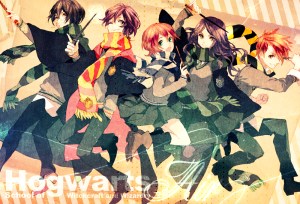
For a long time I’ve found the idea of a school where people learn magic to be fascinating.[1] Harry Potter is the blindingly obvious example, and despite some issues[2] I’ve been a fan of the series for a while. There’s also a Japanese light novel series (with manga and anime adaptations, plus a tabletop RPG) called Magician’s Academy, which has lots of embarrassing anime fanservice crap, but also some interesting setting ideas here and there.

I’ve had the idea for the “Mage Academy” for quite a while.[3] It’s a present-day magic school in the U.S., and fairly new. Where most magic schools date back many centuries, the Mage Academy is barely 10 years old. Moreover, its founders specifically wanted to explore areas of magic those older schools were neglecting. Thus they’re doing stuff with techno-magic, as well as comparing the different magical traditions. Before the Mage Academy came along, basically anyone who wanted to learn about another form of magic was out of luck. A Western Merlinist wizard trying to learn Chinese qi magic would be in for the journey of a lifetime, and the great European schools would probably just turn away a Chinese sorcerer. In America there’s a bit of an American Gods thing where all these immigrants brought their magic with them, but the only magic school is on the east coast and tied up with the Freemasons, so most of the people who practice non-Western magic learn it through their families. Taking a cue from Magician’s Academy, the Mage Academy sits in a pocket dimension, though its physical entrance is anchored to an inconspicuous spot in the New Mexico[4] desert.

71f227a26db234e652f0ec9cc972654ca1150ac6

I haven’t quite nailed down the neologistic tag line for Magic School Diaries, but it would be a diary-writing role-playing exercise, where you follow RPG type rules to guide you through writing a Mage Academy student’s diary of his or her experiences at the school. I envision it letting you make your own character, but having a small number of clear archetypes that heavily influence certain aspects of play. (I hate how much Hogwarts-style houses make sense for that.) It would also have several pre-made NPCs that players interact with in different ways, giving it a little bit of a “visual novel on paper” aspect I guess. I’m eyeing using playing cards for randomness, both for the different ways you can use them, and because having a dedicated pack of cards that you keep in the box in a particular order is kind of an intriguing idea.[5]


[1]Really, I think there’s a lot of interesting and fertile territory in exploring the non-adventuring parts of fantasy type settings. I also want a game about working in a magic item shop, and a game that’s basically “Fantasy Oregon Trail: The RPG.”

[2]Some day when I have nothing better to do I’m going to write a fanfic about an American wizard who visits Hogwarts and is horrified to learn about all the bigotry and other deeply problematic things in Wizarding Britain. (“Wait, you don’t arrest people for using love potions? Seriously?”) He would also be completely and utterly uninterested in quidditch.

[3]I also have this whole idea for a story set there that involves a student mage who came from the distant future as part of a rather dubious time travel experiment. If I do the game I’ll have to make her an NPC though.

[4]“Land of Enchantment” indeed.

[5]The other day I started a thread titled “What can RPGs learn from board games?” There is a ton of stuff to think about there, though I think Magic School Diaries actually lends itself to being a book, at least insofar as it lends itself to being analog instead of digital.
Magical Burst Development Stuff

I had kind of hoped that my next post about Magical Burst would be the release of the next version, but I’ve wound up setting myself up with a lot of work to do before it’ll be ready.

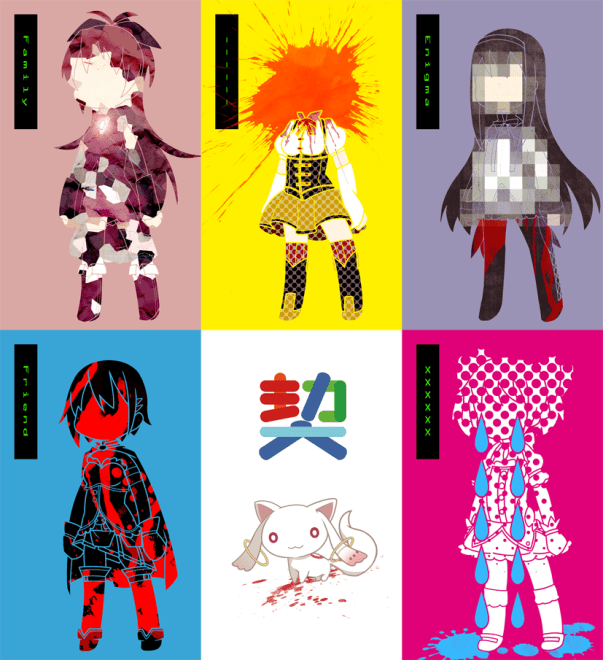
One thing I’m doing is a lot of writing in general, filling in advice and even setting information in more detail. I’m trying to better articulate the aesthetic for magic and the youma for example. In Madoka Magica, it’s as though characters don’t have spells so much has colors of paint they can use to scribble all over reality. Mami uses magical flintlock rifles, but that goes anywhere from hauling out a single one to making about a dozen appear to creating a giant cannon version for her finisher. I also want to dig into the characterization of the youma a bit more, about how destructive they are emotionally.[1] I’m also filling out tables of Secrets and Youma Motivations, and I expanded the magical girl costume tables. More importantly, I’m trying to properly clarify and nail down a lot of things that had been entirely too vague in previous versions of the game, like running out of resolve, stealing Oblivion Seeds, when Fallout kicks in, etc. There’s also the stuff with Shocks that I mentioned previously.

I have quite a bit to do in the way of digging into the actual rules. Overall I’m doing more refinement and less adding novel elements, but there are a couple key things I’m now planning to add.

Looking at one of the /tg/ threads I found out about someone’s “Magical Burst ReWrite Edition.” I don’t want to steal from it, but I do really like their idea of giving magical girls different specializations similar to D&D4e’s roles. I myself like games that give characters a decent amount of mechanical differentiation, so I’m hoping to pursue this route, though I’m not totally sure what I want the specializations to be.

That dovetails into some stuff I’m doing tinkering with the combat mechanics. I’m adding something like the Movement and Engagement rules that have appeared in numerous F.E.A.R. games. I really like semi-abstract movement and positioning type rules, but for Magical Burst I need them to be a bit more fluid than the Meikyuu Kingdom style battlefield concept allows, on account of magical girls can potentially do so many different kinds of things with magic, including the most outlandish modes of movement. (It also gives me an excuse to get printable cardstock magical girl and youma minis made.) 13th Age does have something kind of similar to this, though without the “engagement” vocabulary. I think it does a good job of creating a distinction between melee and ranged combat,[2] which I’m hoping will make magical battles a little less like a series of attack rolls. I also like it for how it gives me some more things to hang crunchy bits on, and I think it’s going to be really helpful in terms of the aforementioned specializations.

With NaNoWriMo I’ve tended to go to extremes of not trying or cranking out the requisite 50,000 words, if just barely in time for the end of November. This year I had originally been planning on trying to do a sci-fi comedy story (“Tiny Aliens”), but with magical girls on the brain I decided to make an attempt at the Magical Burst novel I’ve been wanted to do, Magical Girl Radiant Yuna. (Which will indeed concern the same Yuna and Makoto from the intro comic script.) If I manage to do NaNoWriMo it’s going to put work on the game itself on hold throughout November, but it’ll be a strong step towards getting the one tie-in thing I really wanted to do for it. As I mentioned earlier, I want the novel to have full game stats and such for the relevant characters in an appendix in the back.

Another really cool thing that a fan did was Rabbit Eclair went and made a magical cipher. Madoka Magica makes extensive use of a special “rune” alphabet, which fans managed to deciper despite the text spanning English, Japanese, and German (with many quotes from Faust) and three different variant fonts, and I really want the final Magical Burst book to have a similar magical script of its own. I hadn’t been able to find anything quite right, but the “Magical Burstnary” is just about perfect. (Plus it obliquely fits what I want to do with the backstory for the novel.)

Update: NaNoWriMo has begin! I put up a blog post about it on Studio UFO (my non-RPG blog site), and you can check my progress on my NaNo profile.


[1]I based the sample tsukaima in the book on the Seven Deadly Sins, and I was looking for a comparable theme for the youma. I wound up going with basing them off of the tracks of Nine Inch Nails’ “The Downward Spiral.” I’ve been wanting to do something with the pictures that album puts in my head for ages now, though I never would have guessed that I’d find the perfect place to do so in a magical girl RPG.

[2]That also means players need to decide if their Magical Weapons are melee or ranged, which in turn leads to the realization that it’s rather arbitrary. You could have a magical girl who magically throws swords instead of doing actual melee combat with them, and if your Magical Weapon is a car or tea set you can potentially go either way.

Channel A: OAV Edition

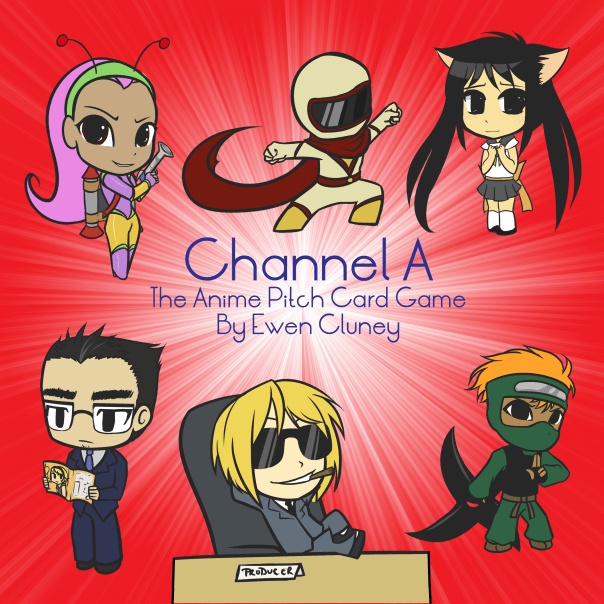
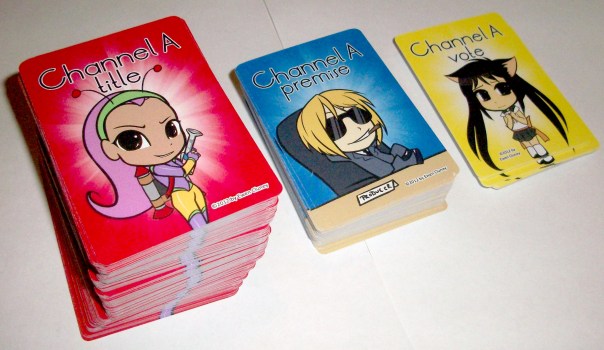
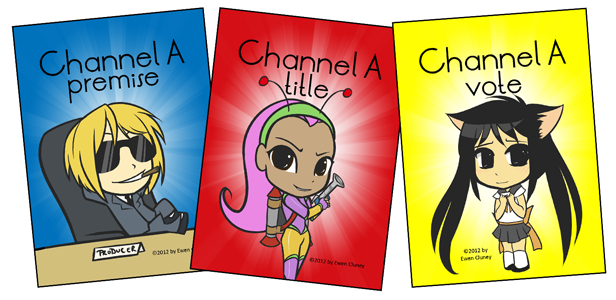
Channel A is now available for purchase through The Game Crafter for $35 plus shipping. I’m calling this the “OAV Edition,” the idea being that there’s a progression from manga (the black and white PNP version) to a short OAV series to a full TV anime series. I’m hoping to do proper release by way of a non-POD printing to get the price down, but the OAV Edition is available for the people who want the game right now. The set comes in one of their basic game boxes (which admittedly isn’t great for storing lots of cards), and includes 200 Title Cards, 80 Premise Cards, and 30 Vote Cards, plus a printout of the rules.

As mentioned in my last post, I also put together two expansions–Channel A: Second Season and A-Soft–which I’ve also made available, for $15 each. Second Season is a set of 108 new Title Cards, while A-Soft has 68 Title Cards and a set of 40 “Genre Cards” to make the game about pitching video games instead of anime.

Channel A
Channel A: Second Season
Channel A: A-Soft

From here I’m going to be aiming to publish a more professional version of Channel A, either by way of a Kickstarter or maybe through a board game publisher if I can find one that would be a good fit. In either case this will be after even more playtesting and getting a proper graphic designer (most likely Clay Gardner) to improve on my design work. I’ll be making very little money from the OAV Edition, so if you order it you should do so because it’s a game you can’t wait to play. (It is IMHO a really fun game though!) If you just want money to flow my way (some people have said as much, which is flattering to say the least), the eventual more professional version will be a better way to accomplish that because margins and stuff. (Though sharing the game with lots of people will help me out in the long run too.)

More on Magical Burst

The other day someone on 4chan’s /tg/ board pointed people to Carly Ho’s Magical Burst character generator, the result being a rather glorious thread where people used the generator and interpreted the results. I wouldn’t even know where to begin pointing out the amazing stuff in the thread, but this was suitably funny and twisted:

Onigawara Yuri
Pretty Strawberry Lovely Yuri

>Already feeling that pain in my legs, better check my blood sugar.

What kind of girl are you?
Sickly Victim

>Eh. Guess I SHOULD check that blood sugar alright. And stop with the strawberries – it fucks with the chemo.

What convinced you to make a contract?
I realized I’m tired of feeling helpless.

>What, no deep spiritual satisfaction in sitting in that hospital bed being miserable?

What is your wish?
I wish I could be my old self again.

> I assume that she’s referring to the self that has a good chance of living to adulthood.

Weapon
Dagger

>Damn, bitch is hardcore.

Magical Element
Radiation

>SEE HOW YOU LIKE CANCER

Magical Power
Analysis
By magically analyzing things you can discover secrets, and locate weaknesses.

>Say, you seem to have a genetic predisposition to developing leukemia, don’t you?

Costume Elements
Omega

>DOOM AND GLOOM, I TELL YOU. DOOM AND FUCKING GLOOM

Crisis
I’m hopelessly attracted to someone I probably shouldn’t be.

>But… sempai… we’re both girls, right?…

More creepy lesbian carcinogenic goodness!

And that’s just the tip of the iceberg. Anyway, with NaNoWriMo coming up I’ve been trying to shift out of card game mode, and this inspired me to get back into Magical Burst. It’s incredibly gratifying to see people not only enjoying but being creative with something I made. The magical girl creation tables are this mass of cliches and strangeness, and at times the random results come together in the most amazing ways, doubly so when people as creative as some of the /tg/ posters are the ones interpreting the results.

One thing about me is that I have a tendency to hyper-focus on one creative project or area, and the amount of time I’ve been putting into Channel A and related projects is kind of ludicrous. I have a thing I do where I carry around a notebook to write down whatever comes to mind, and then I’ll periodically write down a list of all my projects. I never leave Magical Burst off the list,[1] but I think I had put out of my mind how messed up it was. I tend towards a very shiny aesthetic, but I also go to some pretty dark places sometimes. Going back to that place was a little bit of a journey, and I had to put on some Nine Inch Nails to set the right mood. (Did I mention that the sample youma in the book are going to be based on the 14 tracks of “The Downward Spiral”?)

I don’t have much of anything to report in terms of changes to the game that I haven’t talked about before, basically because I got stalled and am picking up where I left off, with a bunch of things pretty well planned out but not implemented yet. Today working on Magical Burst was pretty much the extent of my productivity,[2] and most of that was tweaking and expanding the text and working on filling out some tables that were incomplete. Entirely too much of my life is about filling out tables and similar lists of discrete items these days. But anyway. One of the major things I’m trying to work on is more procedural clarity, especially when it comes to setting up a campaign. It’s one of those things where RPGs habitually leave you to muddle through yourself, and I know I appreciate it when a game gives advice on how to achieve its intended tone, especially when its something like this where you have to work at it.[3]

I did already finish up the Instant Magical Girl section (here’s an example of it in action), which now covers pretty much everything for character creation, including a new table for rolling up finishing attack names. It would be hard to pick a favorite from the tables, but the Crisis table is definitely up there. “Crisis” is basically my word of choice for what Ron Edwards called a “Kicker” in Sorcerer, and the table is appropriately full of stuff a character can’t ignore. To me that’s the essence of what makes Magical Burst–and Madoka Magica–so compelling.

Update Stuff


[1]I’ll do that sometimes with, say, Tokyo Heroes. That’s a game I sincerely do want to work on again some day, but that I’ve pushed so far on the back burner that it’s fallen back behind the stove.

[2]Unless you count making a batch of “slutty brownies.”

[3]Like its source material, Magical Burst is meant to have a heavy, oppressive atmosphere and be about characters dealing with some really scary shit. It’s been my experience that that’s exactly the kind of thing that gamers have a natural tendency to use humor and generally step out of character in order to back away from. I really want someone to formally study this phenomenon, but that would require the kind of people who have the expertise and funding to care about tabletop RPGs.

Channel A Update

Channel A is just sort of rocketing forward, in part by virtue of it being fun and relatively easy to work on and a low-commitment game to playtest.

I put together a prototype with Photoshop and got it printed through The Game Crafter. I’m not a pro designer by any means, but sometimes I forget just how much of that sort of thing I learned in college.[1] I had been thinking in terms of it being an entirely temporary thing before Clay made the real cards, but people’s reactions to the prototype have been so good that it’s going to at least be a a starting point. Of course, one of the things I had to do was to make sure I was using fonts I could actually use, which meant a lot of checking, replacing (FontSquirrel is amazing by the way), and a few purchases/donations. In the future I’m going to try to keep the number of fonts I used on any given project in the single digits, because wow. =_= Making lots of little logos was kind of fun, but drags on after a while.

Overall TGC’s backend for putting games together is excellent. It has a lot of touches that make perfect sense, but which it would be entirely too easy for a system without the same care to leave out. For example, when you make a deck of cards you can upload a back and then batch upload the files for the faces. Being able to do the cards in individual files (rather than having to put together sheets of 18) is a godsend too. Proofing is a little time-consuming if you have lots of cards, though it’s really good for spotting potential problems with things where the cutting is more involved, like tuck boxes. The big stumbling block for me is the price, and I’m going to have to find other avenues if I’m going to sell it seriously.

The one big change I made to the rules is in how scoring works. The voting card system works pretty well, but it’s easy to get ties, especially if you have a smaller group of players. When playing with with Ben Lehman and Sushu and Jono Xia (and Jono had some kind words about it afterwards), Ben came up with the idea of breaking ties by making a hand of one O and the rest Xs and letting tied players pick at random until someone gets an O and wins the round. In the middle of the night I hit on the idea of making an uncontested win worth 2 points and a tie worth 1 point. I really like this solution for a variety of reasons. In particular, it’s quick and it just feels more fair.

Because I’m insane and have a streak of creative masochism, I’m already working on two expansions. Each one will be 108 cards in a tuck box, and I got Dawn to do two more pieces of art to go with them.

  • Second Season: This is a collection of 108 extra Title Cards. 25 of these are new “Star Cards,” which let you put in any one word from a category (flowers, fruit, mythic creatures, types of songs/poems, etc.)
  • A-Soft: This gives you a variant game about pitching video games instead of anime. It includes 40 Genre Cards (that cover different video game genres) and 68 video game themed Title Cards.

I have enough leftover ideas for Title Cards to get a good start on a third expansion, plus I have an idea for an expansion called “Japanimation Fever” or some such aimed at the style of anime parodies as done by people who know text to nothing about anime,[2] but I’m mostly shelving Channel A so I can get other stuff done.

Right now the plan is to put the game and the two expansions up for sale on TGC, mainly for some friends who want sets to take to conventions and such. The quality you get from TGC is pretty good, but it’s in the nature of POD card printing that it’s going to be a bit expensive to print 310 cards. I’m thinking about an eventual Kickstarter or otherwise doing a proper print run to sell (and thereby get the cost below $35 for a base set and $15 for the expansions), but that’s a ways off, and I need to get Golden Sky Stories dealt with first. I’m also going to put together an update PNP version of Channel A, since the philosophy of having a free basic version and a spiffy commercial version seems to work pretty well.[3]

[1]Also, I know Japanese! :V
[2]Though I’m not really sure how to put myself into that mentality anymore, apart from mentioning tentacles a lot.
[3]Also, check out Jens Alfke’s set for printing on Avery perforated cards.

Studio B PNP Prototype

As usual I’m screaming through this stuff, making a thing and flinging it onto the internet. Studio B is a variant/reskin of Channel A, but for American B-movies instead of anime. I’m specifically going for the kind of stuff that came out of the drive-in culture that sprang up because of the removal of film-making restrictions in 1948, the cheesy black and white stuff like Robot Monster, Teenagers From Outer Space, and Plan 9 From Outer Space.[1] The rules are pretty much the same as Channel A, though the part about being able to add simple articles (of, the, etc.) is going to be much more important.

Studio B Print and Play Prototype PDF

Anyway, I also have some news about Channel A. I decided to make a fancier prototype for further testing, so I assembled the necessary files in Photoshop to get it printed through The Game Crafter. I just put in the order last night, so we’ll see how it goes. Their backend for assembling a game is actually really good overall, though I do wish the proofing process was more efficient. POD printing for 310 cards makes it pretty expensive, but I’m thinking I’ll make it publicly available since some friends have expressed interest in getting sets to play at anime cons and such. And thus I lament that I’m at this point in developing the game when the convention season is pretty much over.

I’m reasonably happy with what I was able to produce on my own,[2] but for the final version I’m hoping to hire Clay Gardner to do proper graphic design. He’s done a ton of amazing work for Minion Games, not to mention Golden Sky Stories. And now that I think I’ve gotten that out of my system for now, back to working on RPG stuff!

[1]Though I’m definitely going to do an expansion for mixing in 80s cheese. I’m thinking of calling it “Studio Z.”

[2]Sometimes I forget just how much stuff about Photoshop and whatnot I learned in college. I’m definitely not a pro, but at least I have some idea what I’m doing.

Dragon World Hack v0.2

I’ve posted about it a good amount already, but Dragon World is my 90s comedy fantasy anime hack for Apocalypse World, a very silly fantasy game. Dragon Half and Slayers are major inspirations, but just about every fantasy anime I’ve ever seen figures into it a bit, along with Discworld and the sillier parts of every D&D campaign I’ve ever been in.

This is the “Hack” version of the game, so to play you’ll need to have a copy of Apocalypse World, or at least a good knowledge of how AW works.

Here are the major changes I’ve made from the previous version:

  1. Leveling Up: I replaced marking experience with leveling up, which characters can simply do once per session between scenes.
  2. Guts Points: PCs now have Guts points that they can spend to avoid Falling Down (or to affect die rolls), but every time they do they have to make a roll to avoid having a Stress Explosion.
  3. Wealth: The group shares a special Wealth stat that can fluctuate up or down, and which they get to roll on when they buy stuff.
  4. Story Threads: Instead of connections/History, PCs now have Story Threads, which encompass other PCs as well as other story elements. These don’t have mechanical significance, but they do create relationships and story hooks.
  5. Setting Ideas: I filled out my initial section of NPC and setting ideas.

Dragon World Hack 0.2 PDF
Dragon World Reference & Class Sheets PDF

Yaruki Zero Podcast #19: Back in Action

If you know me at all, you know that I’m really random about when I get inspired to actually do things, such that I jump from project to project all the time. The other day I got inspired to revive my project to do an iRiff of Final Fantasy VII: Advent Children, which in turn led me to get some better recording gear, which in turn inspired me to get back into podcasting. This first new episode is a recap of what I’ve been up to in terms of my own game design and translation projects. There’s quite a bit to cover. I started using Audacity (which is quite good), and didn’t feel like messing around trying to get the music in this time around, so for better or for worse this episode is an hour of just my voice.

Yaruki Zero Podcast #19 (62 minutes, 16 seconds)

Very awesome caricature of Ewen courtesy of the talented C. Ellis.

Guardians of Order

Although it goes without saying, mixing RPG chocolate and anime peanut butter has been a major passion of mine since forever. The first RPG I ever played was Palladium’s Robotech game, before I even knew what anime (or “Japanimation”) was, and when I did get into anime proper in high school I was relentlessly trying to find ways to combine them. I’ve largely been dissatisfied with the anime-inspired RPGs that are available, and my career as a designer (and translator) of RPGs has largely been a succession of attempts to rectify the situation in different ways. As a consequence, it kind of goes without saying that I have strong opinions on Guardians of Order. A random forum post inspired me to write at length about the company and my experiences with them and their products. As I clean out my house preparing to move, I keep running into stuff from my past that many people seem to have forgotten about, that is slipping into obscurity. (For example, the DVDs of the original Tenchi Muyo! OAVs are really hard to find.) I don’t think Guardians of Order has been forgotten, at least not yet, but as someone closely following the scene at the time there are a lot of little things I remember that might help form a clearer overall picture. This is going to be kind of long and a little rambly. Kind of ranty too.

My first encounter with GoO was in the late 90s when I stumbled across the original gray Big Eyes Small Mouth book at a local game store. That store is now long gone, and the mall where it was has since remodeled and generally become very trendy. The book had the original GoO logo, the one with what looked kind of like Akane from Ranma ½ on a unicorn or something, that later went through a few iterations before the final griffin/shield/maple leaf logo. (MacKinnon is proudly Canadian, which matters to the story a lot more than it probably should.) Since most of my experience with RPGs up until then had been with Palladium, Toon, White Wolf, and to a lesser extent GURPS, my prior gaming experience hadn’t prepared me for this style game. What I know now that I wish I’d known then is that BESM is the creation of a hardcore Amber Diceless fan, and Mark C. MacKinnon essentially meant the rules to be a guideline and a set of tools you could fall back on when your freeform role-play left questions unanswered. From the direction that the game went from that gray book, it’s eminently clear that MacKinnon didn’t really realize that that was what made his game worthwhile, and so he failed to articulate it to anyone. I certainly didn’t know what to do with a game where the cyborg attribute’s description simply said it would give you a small/moderate/large “advantage” (not a game term, just something vaguely advantageous). Even so, BESM became the standard in anime-inspired role-playing games, and GoO began producing supplements and licensed games. For their original works they made good use of art from talented fan artists (with a few missteps), and by and large their books were very pretty. I complain a lot about anime-inspired artwork in RPGs, but for the most part the folks at GoO got it in a way that very few RPG publishers ever have.
Continue reading Guardians of Order

Dragon World: Moar Stuff

And now even more blather about Dragon World.

Guts and Falling Down
My major new innovation is what I’m tentatively calling “Guts points.” The idea is that players have these points that they can spend to avoid falling down (and for things like enhancing die rolls), but any time you do you have to roll with Sanity, and on a failure you have something like a Maid RPG style Stress Explosion.

Dram/Plot/Story/Fate/whatever points aren’t a bad mechanic, but I think they tend to be bland too, and they would feel doubly so next to the level of flavor you get in a typical AW-derived game. I like what I have so far with Guts points for how they have obvious risks and feed back into the fiction in an interesting way.

Advancement
In recent years I’ve had mixed feelings about advancement and rewards in RPGs in general. On the one hand people do genuinely just plain enjoy getting and using shiny new things for their characters, but on the other hand it can create weird incentives and makes the game that much harder to design for. There’s also stuff like how, much as I enjoy D&D4e, some improvements are in an important illusory. You gain more HP with each level, and +1 to just about every die roll at every even-numbered level, but level-appropriate monsters tend to grow at a comparable rate.[1] One of the many, many brilliant things about the Sacred BBQ RPG is that hit points and accuracy are static and super-simple, and leveling up simply gives you more and better powers to use.

Anyway, I mentioned in my last post how the default Apocalypse World advancement rules are a very poor fit for my gaming group. For Dragon World players will simply get to “gain a level” once per session. This has to be between scenes, and it nets the character a Guts point and an AW-style advancement. With D&D4e in particular my friends and I have found levels to be first and foremost a pacing mechanism, and actual experience points are more important as a way to budget balanced encounters than as a thing to hand out to PCs, since it’s easier and equally effective for the DM to just periodically tell the players to level up. That way the DM is basically saying, “Okay, now it’s time for you guys to do Level X stuff.” I’ve never really liked having individual characters advance at different rates, and tying it to character advancement is, at least for my group, much too strong of an incentive.

Story Threads
I basically tossed out the AW Hx/History mechanic because I find it fiddly and misplaced in Dragon World. But what I love about it is that it creates a story and history between characters, so I’m keeping some semblance of that even if it doesn’t have mechanical force behind it. One thing I’ve been thinking about (and ranting about on Twitter a bit) is that part of why RPGs have traditionally allowed for the risk of death is that they’ve also traditionally been poor at providing tools to help come up with other things that can be at stake. At one extreme there’s old-school D&D where your starting character is, like, a guy with a sword and no particular connection to the world. At the other extreme is something like the Smallville RPG, where PCs basically only die if the player allows it, but they’re bursting with connections and affiliations, and the GM/Watchtower’s main job is to mess with those.

My idea for Dragon World is to take the History concept and extend it a bit beyond History/Connections, though not as crazy as Smallville’s Pathways system, because while there’s a lot to like about Pathways, I really don’t want to have character creation take a full session. The concept I’m going off of is to have something like the Bonds in Dungeon World (where you fill in the blanks of sentences with names), except that the players come up with a short list of NPCs and other elements that can also go into the blanks. This is going to be a fair amount of work of course, and I’m finding that the stuff I wrote for connections/Hx feels a little weak sauce for “story threads.” So, that’s another thing I get to rewrite 11 times over.

Space! Wanna go to space!
Yet another idea that’s been floating around my head that I won’t be actually getting into any time soon is to basically make a sci-fi version of Dragon World, in the vein of stuff like Vandread, Irresponsible Captain Tylor, Tenchi Muyou!, Space Pirate Mito, etc. (Also maybe a little bit of Ryo Kamiya’s Infinite Universe mini-RPG, though that one is ludicrously over the top.) It would of course face the issue that sci-fi doesn’t have nearly as many clear cliches as D&D-ish fantasy, plus I think I’d have to address vehicle combat in some way. I definitely want to give it a name that doesn’t quite make sense, like Universe World or Galaxy World.

Also, I’m looking forward to making a “space cat princess” class that’s a cross between Eris from Asobi ni Iku yo! and Di Gi Charat.

[1]On the other hand everyone concerned tends to forget that you really don’t have to use level-appropriate challenges all the time in 4e. One of the coolest things in the Dark Sun campaign I ran was the PCs escaping with a paragon-tier monster in the form of a skill challenge.