Category Archives: projects

Slime Quest Thoughts

Lately I’ve been poking at Slime Quest a bit, and it has me really wanting to get into working on it in earnest. Of course, I have a bunch of stuff I need to get sorted out for Star Line Publishing, the Golden Sky Stories Kickstarter, and Raspberry Heaven. Still, I want to do a blog post to blather a bit about Slime Quest, which will probably include some stuff I’ve posted about before.

Slime Story is an idea I came up with around 2006, a world like ours except with the addition of magical portals spitting out MMO style monsters that people have taken to hunting for fun and profit. In some parts of the world corporations or warlords control the portals for the marvelously useful bits of monsters, but in suburban America monster hunting is mostly something teenagers do for fun. The system, which I think of as the “Slime Engine,”[1] owes a lot to Japanese tabletop RPGs like Arianrhod and Meikyuu Kingdom, plus a bit of Dungeons & Dragons and a drop of Apocalypse World. Making an anime fantasy game with the same rules was a pretty natural thing to do (and if I ever develop both enough you can be that the mystery of the portals in Slime Story will have something to do with the Slime Quest setting), but because it forces me to make the math a bit more rigorous I may end up finishing it first.
Continue reading Slime Quest Thoughts

Raspberry Heaven Practice Test

I made some interesting contacts and it looks like the RPG app project is definitely going to go forward in some form. As I mentioned before, I decided to have my first RPG app also finally realize the Raspberry Heaven project I started some time ago, a game for slice of life stories about high school girls in the vein of Azumanga Daioh and Hidamari Sketch. The prior versions never quite worked out, and the RPG app is going to follow my prior intention to restructure the game with some vital inspiration from Fiasco.

Raspberry Heaven Practice Test” is my analog proof of concept for the eventual app version of the game. Because the actual app will take advantage of the ability to automate stuff that would be awkward for people to do, this is necessarily simplified in some places, but shows the basic chassis of the game and how I envision its gameplay working. If you’re interested in this project, please take a look and let me know what you think. To play you’ll want to print up the included reference sheets and have a pack of regular playing cards.

Download Raspberry Heaven Practice Test PDF

RPG App Brainstorming: Raspberry Heaven

The “How Not to Run a Game Business” blog by Gau/Fugaros from the Something Awful forum has been an interesting and controversial thing. I don’t agree with everything he says of course[1], but from what I know about things I agree with him more than not. Earlier this month he put on a “Brain Full of Games” contest, asking people to submit 250-word synopses of game ideas that could be game-changers. That’s a tall order no matter what, but I submitted my “RPG in an app” idea (outlined in greater but messier detail in an earlier blog post) to the contest. I was pretty confident that I was on to something with the idea, but I was still pleasantly surprised that I was one of the two co-winners. After checking out this blog he went as far as to put up another post and say of me “He likes good games and makes good games. That’s not strictly relevant, but it makes me happy.” and call me a “good-game broseph.” There’s going to be a $10 prize (woo), but the real prize will be actually doing something with this idea.

All of which has me much more inspired to work on the project for real even though I have way too many projects going on. (And as a consequence I’m writing this blog post of about 1400 words and throwing it out onto the internet, cuz that’s how I roll.) I initially had lots of ideas about what to do in terms of the format, but was totally drawing a blank about the subject matter of a game. When I sat down and brainstormed some ideas, Raspberry Heaven jumped to the top of the list. If you haven’t been following this blog, like, forever, it’s a game I’ve been failing to design for years now, inspired by slice of life schoolgirl anime like Azumanga Daioh and Hidamari Sketch. (And it’s one of the reasons I have such a ginormous collection of 4-koma manga.) Twice I built a complete game and decided that it was completely wrong, though for different reasons each time. It’s probably not the most marketable possible RPG app subject matter,[2] but it’s what excites me to the point where ideas for how to make it work are making it hard to sleep, so it’s where I want to be creatively at least.

The game will have a cast of pre-made characters, which aim to be very distinct and iconic in their personalities and looks. I’m thinking 5 or 6 schoolgirls, though I may make them American instead of Japanese for more accessibility and such. My current list of archetypes goes tsundere, space cadet, jock, beauty (I’m thinking of Miyuki from Lucky Star and maybe Hiro from Hidamari Sketch), quiet girl (something like Tooru from A Channel), and spazzy fangirl. The game would have a little “encyclopedia” thing with brief, digestible info about the characters and such that you can bring up at any time, and if you have the app but you’re not the one running the main game you can take advantage of the encyclopedia should you get lost.

When you start playing, each player picks a character and enters their own name for future reference (so if Mike is playing Rose[3], Mike’s name will show up next to her icon to help you remember). If you’re not sure what to pick there’ll be a Random button to let the game pick randomly for you, which will be a thing through most of the choices the game presents. When that’s done, you do the setup for the episode, picking out or randomly determining the general situation you’ll be dealing with. The app could also use the phone’s calendar and weather report to help decide, suggesting nearby holidays as well as characters’ birthdays and such.

The basic structure of the game I’m envisioning is kind of like Fiasco, where players take turns framing scenes in which you mainly do freeform role-play. The game suggests scene elements based on the episode setup, the characters, and what elements have been in prior scenes. I’m thinking it would be neat to have something or other that the scene framer could trigger once per scene or some such, though I don’t yet have any idea what that would be. At the end of a scene you pass the phone on to the next person (determined by volunteer or at random, and someone who hasn’t gone in the current round of scenes) and they evaluate your scene’s outcome for your character. They do this by moving around a couple of sliders (that say between things like “Fun” and “Annoying”) that the game puts in semi-randomly based on the scene’s subject matter and the character.
I’m thinking a standard Raspberry Heaven session would consist of 4 acts, with each player doing one brief scene in the first three acts, and then the aftermath is the third act. That may be too much, and I may take advantage of software and behind the scene calculations to smooth out how you apportion scene framing and evaluations (and perhaps have the app ask for additional evaluations where necessary). That way it can do a much better job of scaling the experience to the amount of time you actually have to play, which is kind of awesome when I think about it. In the final evaluation the game will take the scene evaluations and put them together, with each character having different evaluations weighted differently depending on their personalities, and then you do a short conclusion. I’d like to give the game something to help encourage multi-session play too, but right now I’m not sure how to go about it. Apps can store new data of course, but I worry about how to go about giving players the ability to satisfactorily back up/recreate said data.

The big question is how to go about designing, prototyping, and testing the game from here, since the software aspect invokes new complications I have little to no experience with. I have two friends who are programmers, but neither of them has any experience making mobile apps, and neither of them currently has a Mac for that matter.[4]. I’m probably going to have to get a very simple prototype done as a basic Windows program so I can test it to make sure the actual game design is sound. From there we have the issues of interface design and artwork. I’ll want to have artwork of the characters for a splash screen, for character profiles, and icons to use liberally to keep the images of the characters in the players’ minds. As for the interface design, I happen to know a great graphic designer in Clay Gardner, but I think I’ll have to read up on the subject all the same.

What’s really interesting to me about all this is how easy it is to think of things where letting a computer handle things lets the game be complicated behind the scenes in ways that would be difficult to handle elegantly using paper, dice, and human brains. I’ve got all these ideas for stuff based on random numbers (which always wouldn’t come from number ranges that fit into neat die types), big tables of story elements, dynamically adjusting probabilities, and so on less than 24 hours after seriously starting brainstorming for this project. That’s partly because the period of my life when I was trying (and miserably failing) to learn programming and the more recent time when I’ve started to kinda sorta understand game design have no overlap whatsoever. It presents a whole new set of freedoms and limitations, which I find just fascinating.

[1]This is especially true of the “Stop. Making. Games.” post, though I would agree with a milder version along the lines of “Stop making games that have already been made many times over.”

[2]“He also likes anime. A lot. A very, very lot.” –Gau (Guilty as charged.) On the other hand once the app is done it should be fairly easy to adapt the same framework to other subject matter. I’d like to do something more in the style of an American sitcom (one of the more clever ones like How I Met Your Mother or Community that is), and something with a very strong genre fiction element of some kind. I’ve been wanting to do something about the everyday lives of students at a magic school or magic shop for a while now, for example. OTOH I do want to try designing an RPG app with some kind of combat involved.

[3]I have a character I’ve been wanting to use in something for ages named Rose Valentine, a brave and good-natured heroine type character (who happens to have four older brothers who all but live in a karate dojo). Not sure if she’ll actually make it into this game though. Were you thinking of Rose Lalonde from Homestuck? A Homestuck-ish reality-bending pixel art thing is on my list of other possible RPG app ideas.

[4]I do want to do an Android version (though I don’t have any access to an Android phone at the moment), and possibly some kind of web app. Where we’d actually start will heavily depend on what’s most feasible.


Golden Sky Stories Update: Meet the Henge

This is going to be the first of a series of posts previewing various elements of Golden Sky Stories leading up to the Kickstarter and then the full launch. I don’t have much new stuff to talk about on that front just yet, but we are indeed on track so far. I’m also in the process of putting together a free replay, and we’ve now set up a GSS Facebook page too.

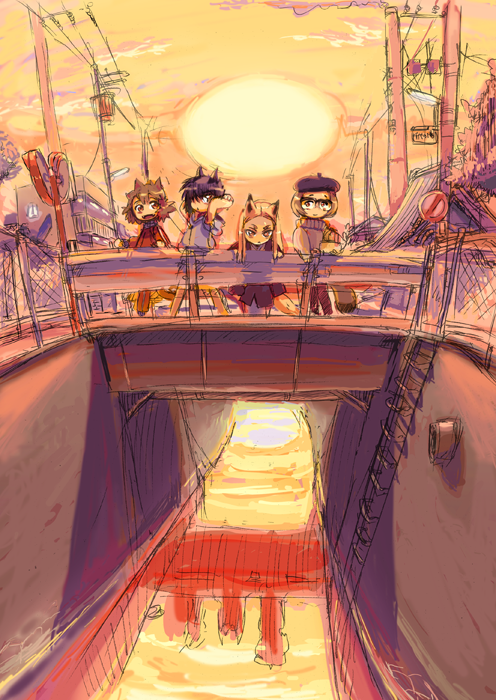
The stars of Golden Sky Stories are henge, animals with a bit of magical power that lets them take human form and do a few other nifty things. They are animals by default, and staying in human form takes a little effort. On the other hand, they can use human speech even while in animal form, though this does carry the risk of scaring humans away. Each henge has only one human form (though raccoon dogs can also copy specific people they know), which will appear between 8 and 18 years old. The artwork in the book shows them with their ears and tails showing (or wings in Sarah’s case); they can hide these to look completely human, but it takes more effort. The book will introduce you to six representative henge, though of course in the game you can make your character quite different.

Suzune Hachiman is a fox henge. Although she looks like a young girl, she’s actually over 300 years old, and maybe a bit stiff and prideful in her age. Despite looking like young girl, she dresses in a formal kimono and talks like a stuffy old woman. Of the henge, foxes are the closest to local gods, and there’s a shrine to Suzune in town that provides her with offerings of food and money. She has many magical powers, and is well acquainted with the local gods around town.

Riko is a raccoon dog henge. Raccoon dogs (also known as tanuki) are a species of canines found in some parts of Asia, and like the raccoon dogs of myth, Riko can transform herself into all sorts of things. She can become a copy of someone she knows, or turn into a giant monster or an object. She’s a bit of a klutz too, though she has a knack for using her clumsiness to lighten the mood. Riko is fairly young, but raccoon dog henge can life for a century or more.
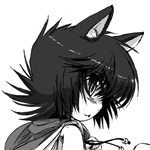
Kuromu is a cat henge, and a stray black cat. She doesn’t mind when people give her food, but she prefers to just do whatever she wants. Japan has lots of myths about cats turning into monsters, and Kuromu is not a fan of them. Cat henge aren’t monsters, just clever, sleek, and all-around awesome animals. They do however have many powers that let them move about unseen, and they have a unique ability to look into someone’s heart and see what they’re thinking.

Koro is a dog henge. She’s actually someone’s pet, and to her the collar she wears is a treasured reminder of someone she loves. She loves to play and make friends, and she can be very protective of those she cares about. Dog henge have powers that let them protect, reassure, and comfort people around them. For Koro this is a natural fit, since she’s thoroughly good-natured and earnest. She also has plenty of dog foibles, including a tendency to chase her own tail. She’s sure she’ll catch it some day though.

Amami is a rabbit henge. Despite being so young, she’s already become very concerned about her appearance, and puts a lot of effort into making sure she’s dressed fashionably. Like most rabbit henge, she just hates being alone, so she’s constantly pestering people to play and spend time with her. Rabbit henge are good at drawing others to them, and they have a few magical powers that might come from the rabbit in the moon. A rabbit can make mochi to give as gifts, and every once in a while she can call upon the light of the moon to let people become animals and vice versa.

Sarah is a bird henge, a yellow canary. Birds spend much of their lives in the sky, hearing the songs of the wind, and the world of the ground is strange to them. Sarah sometimes seems barely aware of the world around her, but this is because she can hear the wind and everything it whispers. Her powers let her fly and hear the wind, and even give wings to someone else. Like a lot of birds, she has keen eyes but also has a hard time seeing at night (which by the way is an optional weakness that I don’t recommend if your game takes place at night).
A Note on Name Origins
In Japanese Riko is written phonetically (リコ), but it’s derived from taking an alternate reading of the character for tanuki (狸) and adding the character for child (子; commonly used in female names). The Kuro in Kuromu means “black,” and “koro” can mean “pebble.” Sarah’s name was written as Sera (セラ) in Japanese because Kamiya chose the name based on the Serra Angel card in Magic: The Gathering.

Yuuyake Koyake/Golden Sky Stories is Coming!

If you’ve been following this blog, noticing my forum posts, or talking to me in person, chances are you saw this coming.

Star Line Publishing is a joint publishing venture between me and my longtime friend Mike Stevens (with a few other people lending a hand), and I am very, very happy to announce that Star Line Publishing’s first big release will Golden Sky Stories, an English version of Yuuyake Koyake, a tabletop role-playing game by Ryo Kamiya, the designer of Maid: The Role-Playing Game.

Golden Sky Stories is a heartwarming role-playing game. Players take on the role of henge (pronounced “hen-gay,” like a chicken that’s happy, not a Celtic monument), animals with just a little bit of magical power, including the ability to temporarily take on human form. They live in a little town in rural Japan, where they help ordinary people solve problems and become friends. This is not a game that will replace all of your other games, but it’s a game you can turn to as a change of pace, to go somewhere warm and safe. It is a diceless, resource-based game, and it’s meant for game sessions to last between 45 minutes and two hours.

For Maid RPG we crammed three books worth of material into one volume, but for GSS we’re starting with a thorough and careful translation of the 120-page core rulebook. It introduces the base rules of the game, lets you play as six different kinds of henge (foxes, raccoon dogs, cats, dogs, rabbits, and birds), and includes a replay, NPCs with story hooks, two scenarios, and a guide to Hitotsuna Town. We’re aiming for a very faithful translation, and the only notable change will be the addition of several pages of cultural notes. The original Japanese version has three very excellent supplements (plus a doujin supplement for, of all things, Touhou), but the main book is wonderfully complete by itself. We very much want to put out the other material, to tell the full story of Hitotsuna Town and give you many other new kinds of characters to play and meet, but one thing at a time.

For various reasons it’s taken some considerable time to sort everything out enough to go public, so as of this announcement we’ve already been working hard on this project for some time. We aren’t yet ready to set a firm release date, but things are actually pretty far along. The actual translation and editing are already done, and our layout guy (Clay Gardner, creator of OVA) has already gotten started. We expect the book to be a little over 120 pages, and it will feature fantastic art by Ike, who has since gone on to find success with an excellent manga called Nekomusume Michikusa Nikki (Catgirl’s Wayside Grass Diary).

As with Maid RPG, I’ll be posting up previews with tantalizing details about the game and its workings leading up to the actual release. I’ll be writing about the setting, the game’s workings, and what you can expect when we do finally release the supplements in English.

If you would like to help make Golden Sky Stories a reality, we’re planning to do a Kickstarter to raise money for the first print run. We believe this is a wonderfully unique game, and we hope you’ll help us spread the word!

Retailers, distributors, and anyone else interested in this game are welcome to contact us at info@starlinepublishing.com.

A Further Update on Magical Burst

I think I’ve finally reached a point where I have a good roadmap for where to go from here with Magical Burst. Future iterations are going to be much more about refining what’s already there instead of ripping stuff out or bolting new things on.

After talking to a group of guys who’ve been playing MB on IRC a ton, I’ve realized that I’m not quite as dissatisfied with the combat system as I thought. It definitely needs refinement–youma are still much too easy to kill for example, and lots of people find specific crunchy bits unclear–but the foundation seems pretty sound. One thing I am going to add is an (optional) thing for narrating details much like in Wushu, as part of the general action resolution rules. I realized it could fit nicely into the existing game, and is easy to skip if that’s what you’d prefer.

I think moves and normal attributes just need general rejiggering. Some attributes are under-utilized, or very easy to under-utilize depending on how you play your character, and some moves (especially Sorcery) just need to be fixed up. I’ve just barely started working on this part, so while it’ll follow the same general concept, I can’t say how it’ll go exactly.

Feedback from playtesters has led me to reevaluate how Fallout will work. The IRC group strongly prefers for the GM to tailor fallout to the circumstances, which is totally the kind of awesome thing you think of while playing the game. I had originally intended for Fallout to purposely be senseless and random, but I think explicitly stating that fallout can be more deterministic and tailored will help encourage better play. With Changes in particular there’s the problem that it’s too easy for a random Change to be something a character can brush off.

The whole thing about Changes dovetails into the matter of what for lack of an established term I’ll call “character safety.” Magical Burst isn’t a very lethal game, but Changes can “damage” your character concept. I wonder if the fact that some people have expressed concern over that sort of thing is a difference in subcultures, but regardless it’s something to at least address in the text. I suspect that relatively few indie RPG types would be too concerned about character safety, whereas from what I’ve heard of the freeform RP scene it’s of paramount importance to some people. I think this is another thing to address textually rather than mechanically, both because it’s a social contract issue and because it’s trivially easy to (for example) re-roll a random Change that a player finds particularly problematic.

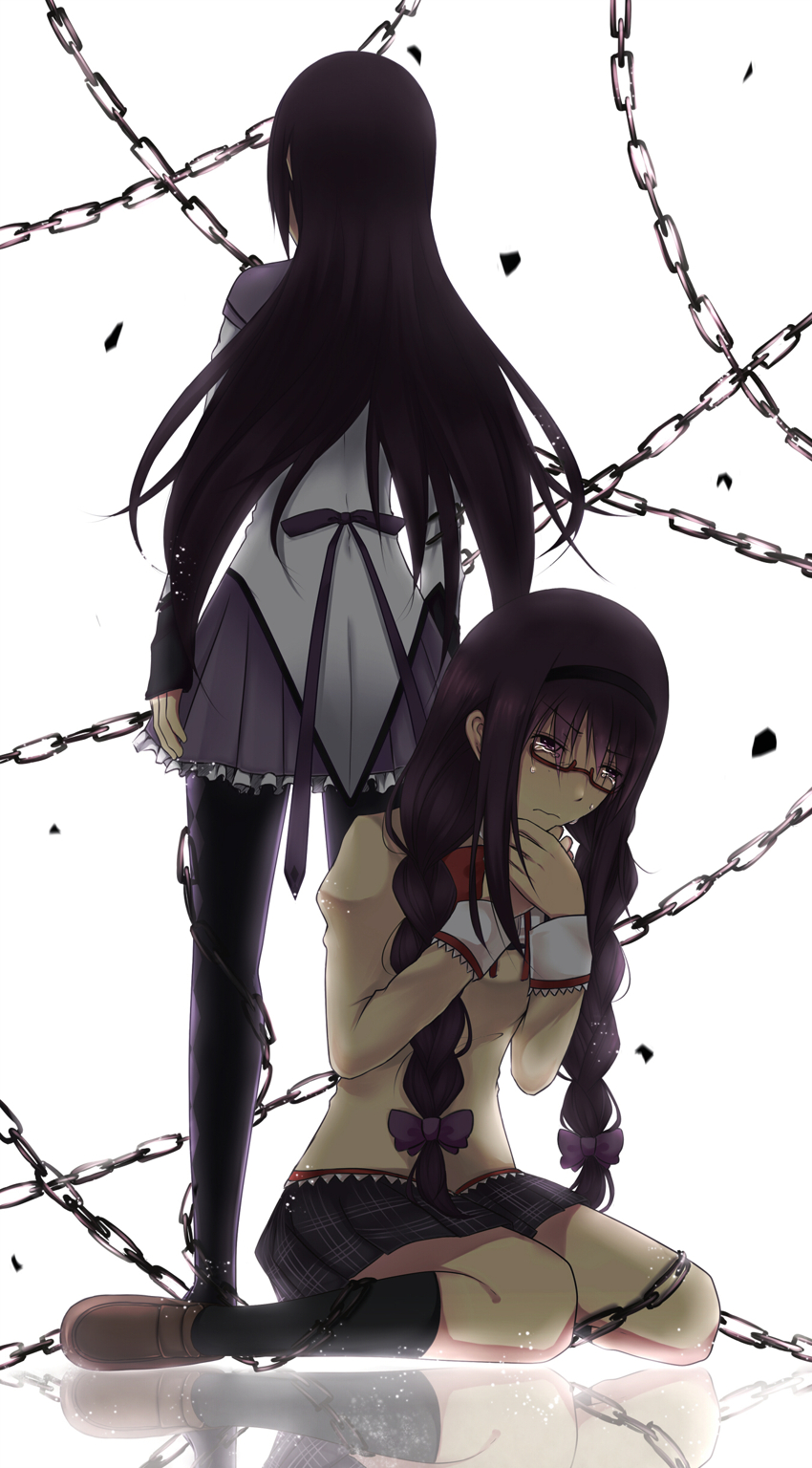
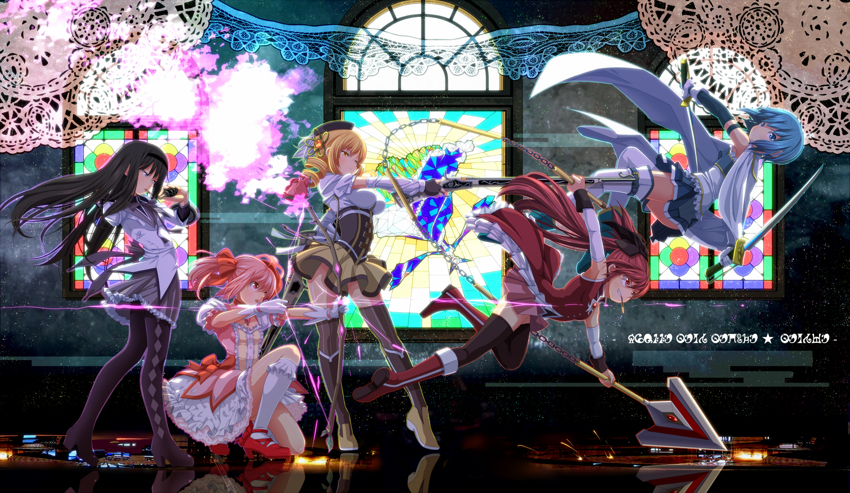
I’m also working on reorganizing and rewriting the text to better reflect the intended style of play and hopefully to be more accessible. I think the thing I was groping towards with Secrets was along the lines of the Bangs in Sorcerer, stuff that forces the PCs to react. Secrets, the presence of a youma, and Fallout are all ultimately aimed at pushing the story around. Madoka Magica basically runs on a succession of shocks as the characters learn what’s really going on and struggle to cope with its implications. That’s something I’ve done informally as a GM before, and I think that a big part of why the playtest I ran was kind of flat was that I didn’t particularly try to make the shocks happen.

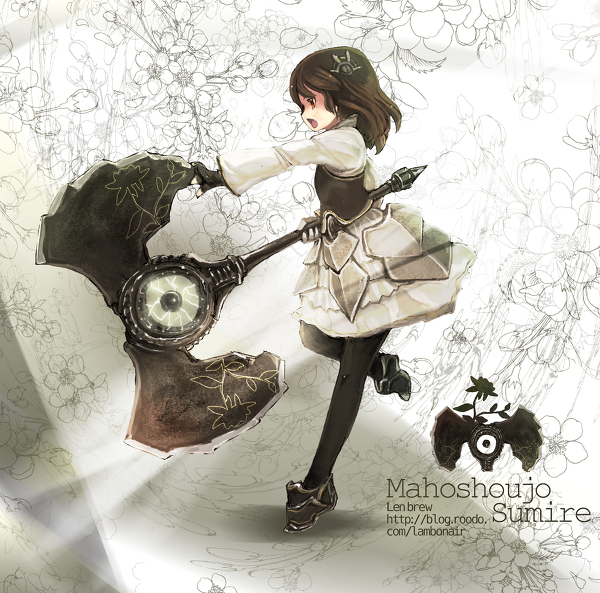
You may have seen the picture of a Magical Burst character named Sumire by a very talented Taiwanese artist who goes by Len. His Pixiv gallery has tons of impressive artwork of his RPG characters (going by his artwork he seems to play a lot of GURPS and a fair amount of D&D), and he’s part of the group that’s doing a Chinese translation of the game. Torbadomy got in touch with me the other day, and it’s worked out that Len is going to be lending his considerable talents to producing artwork for Magical Burst.

Magical burst – Sumire by Len on pixiv

I derive far more amusement from meduca meguca than I really should, and I’m planning to write up something called “meguca borsht,” though I realized it’ll be surprisingly hard to do on purpose. I think it’ll look something like D02: Know No Limit though.

Another Magical Burst Update

I’m still just amazed at how far Magical Burst has gone already as an unfinished free PDF. I think some of that is that there’s a very solid niche of anime fans who want RPGs of stuff that the RPG industry just doesn’t understand or cover. It’s not hard to find forum threads where people are trying to start up a magical girl game, but pre-Cel*Style it feels like with a couple exceptions the RPG industry’s forays into anime have basically been BESM and mecha stuff. I think it really lends credence to my contention that anime inspiration is vastly under-utilized in tabletop RPGs, and too many of the efforts that have been made have been tone deaf about anime as seen by people who actually care about and understand it. I don’t know how the numbers really line up, but if there can be a Leverage RPG, there sure as hell can be a Madoka Magica RPG.

Although I do want to make a pretty book out of Magical Burst (and try to capture some of the amazing artistic style of Madoka Magica’s witches and such), I’ve decided I’m also going to take a cue from Christian Griffen’s Anima Prime and keep having a free version of the game available. If I’m going to be spending money getting lots of art and such done I will need to make some amount of money from the whole thing, but I’m realizing that getting the game into people’s hands is the more important thing. In that respect this is a really successful game already, and it’s given me a lot to think about with regard to how I pursue RPG design in the future. I tossed up a rough draft with parts that make me wince (though I like to think it has some good ideas in it regardless), and it’s getting tons of actual play, with people invariably pitching it as a Madoka game. Also, with people already doing things like adapting the rules for Persona[1] I most definitely want to encourage hacking.

I’m reminded of something I once said at a panel, which is that the guy who’s always hiding his game and making people sign NDAs and getting copyright paperwork done and stuff doesn’t usually produce anything worthwhile, while the guy who’s running around showing his game to people and thereby making it better is much more likely to have a great game in the end. Now that I think about it, that’s something I need to try to live up to more. Certainly Magical Burst wouldn’t be anywhere near as far along without all the feedback I’ve gotten.

The other day Ryan Macklin put up a blog post titled “Action Sequences are Conversations,” which I think points at the heart of where I’ve been dissatisfied with the combat system in Magical Burst. In dealing with fight scenes in RPGs in general I’ve often felt trapped between the extremes of a tactical sub-game (which is what I have in place right now) and noodly stuff that takes a lot of GM and player finesse to actually work well. I do enjoy throwing down with some D&D4e[2], but I feel that tactical combat just isn’t the right fit for a game like Magical Burst where the point is to build up to a certain melodramatic mood. Ryan Macklin’s post is about having action sequences be a conversation with rules that serve to moderate that conversation, and I think that’s the mental model I was missing while trying to grope towards what I want out of battles in Magical Burst. I want the conversation to be the primary thing, and for this game I don’t want a fight breaking out to yank you out of the normal flow of conversation. I think that’s what I wanted to do all along, but I didn’t know how to articulate it, much less design it. I don’t know how these ideas will really shake out, especially since when I try to figure stuff out in my head every time I move one part of the rules a bunch of others start to shift and look precarious. The fourth draft may end up looking pretty different, but then I’m realizing that that’s just how I design games.

Today I’m starting re-watching Madoka Magica to try to get a better feel for how the action flows. Reading Macklin’s ideas for Gun n Fuck I knew specific ideas inspired by Jason Statham movies weren’t what I needed. I want something that gets people narrating stuff like Mami going to town with her magical flintlock rifles or Kyouko’s spear splintering the concrete. Over on Google+ Ben Wright pointed out that the flow of action in Hong Kong movies bears very little resemblance to the turn-taking that’s all but universal in RPGs. I don’t know if I have the design chops to make that notion a part of Magical Burst, but I think it rings true in how fights typically work in anime too. Engaging an opponent means more than just taking a potshot at them, and characters don’t always get a chance to act, especially if they’re fighting an overwhelming opponent. I’m not yet sure what this is all going to look like, but I think fights in Madoka Magica have a rather small number of exchanges to them, and are present exactly as much as needed to drive the story.

Also on my to-do list is to formulate better advice and play procedures to help give the game the kind of mood and style it calls for. In large part that means the GM needs to come up with different story elements to use to mess with the PCs, and put them in at the right pace, in a manner very much like Kickers and Bangs.

So, that’s where I’m at right now. I’m getting really excited about this game all over again, and I’m about ready to dive back into intensive design work.

[1]Persona seems to be another one of those properties where a solid tabletop RPG is something of a holy grail for a whole lot of people, with or without the serial numbers filed off. (And now I move “Finally play Persona 3” up a bit on my to-do list…)

[2]And it’s the kind of thing I aspire to create myself with Slime Story/Quest. I could probably write a whole other blog post on why I like 4e’s combat despite not liking most board games or war games, but in short I think that both the “no winners and losers” thing and putting the “game” part into the context of an ongoing story are vitally important to me.

A Small Update

I’ve kind of been all over the place lately, and getting creatively obsessed with different things at different times. I’ve done three playtest sessions of Dragon World (it’s getting there), then got into working on my UFO Girl novel, then started having a creative crisis over Neko Machi, then we went through a bit of a shakeup at work, and now I have a cold. I’ve been meaning to record and post up a solo podcast for ages now, and thinking of trying to do them as kind of a regular thing. Somehow I haven’t been able to find the time to even get started, and with this cold it’s not gonna happen this weekend.

Kin-Yoobi Con
I had a booth at Kin-Yoobi Con, and sold Neko Machi mini-comics and buttons, plus Maid RPG. It taught me some interesting lessons about the anime crowd, most notably that when it comes to art those folks gravitate much more strongly to characters they already know. I’m wondering if there’s a way to use that kind of appeal for RPGs but on the level of fan art seen at the artists alley at an anime convention.

Mascot-tan
A while back I had an idea to do new games based on the Maid RPG rules, which I would call the M.A.I.D. (Maniacs’ Asymmetrical Interactive Delusion) Engine. I decided to start working on a new version of Mascot-tan that’s basically a Maid RPG hack. So far it’s sticking fairly close to the basic Maid RPG rules, the main difference being that (by default) the group rolls and agrees on one mascot theme (bands, fighter jets, game consoles, RPGs, whatever), rolls up random stuff for their characters, and then each player picks which specific thing their character is a mascots of. Also, I started writing up new tables for most everything from scratch. Funnily enough even for anime maids I’d end up changing some things if I were to write up a Special Qualities table today, on account of anime has generated new kinds of cliches since Maid RPG’s original publication in Japan.

There’s also something else cooking for Maid RPG. :3

Ambitions
I want to bring Magical Burst or Dragon World to fruition in the next 6 months or so. Lately I’ve had kind of a love-hate thing going with Magical Burst, so it’s been hard to muster up the desire to actually look at it, but I have gotten some more feedback. (Plus I’m not good at balancing creative projects. I tend to work on one thing to the exclusion of others.)

Shout Outs

  • With Neko Machi I have the privilege of collaborating with C. Ellis, a woman who is very dedicated to creating comics. She’s doing a webcomic of her own (We’re All Star Children), is a contributor to the Womanthology project (which looks all kinds of amazing), and does plenty more stuff besides. I really do know a lot of amazing people these days, and she’s high on the list.
  • A while ago I translated a short story for Kizuna: Fiction For Japan, a charity fiction anthology for Japan tsunami relief, and it’s now available as a Kindle e-book.

Entanglements

My gaming group recently finished up a short campaign that started in the Smallville RPG and finished in Primetime Adventures. I enjoyed both games a whole lot, though I think PTA was the better fit for us. There are a lot of neat things about Smallville, but the thing that benefited our game the most was the Pathways character creation/relationship map system. I’m sure we still would’ve had fun, but I think the game wouldn’t have been quite so good without that sprawling relationship map.

I wanted to be able to put that kind of nifty stuff into other games, so I ended up writing up this thing called “Entanglements.” It’s essentially a genericized version of Pathways, with a few new elements I thought would be neat, plus some suggestions for using it with specific games. I haven’t actually tried it out yet, but I want to, especially for the next time I’m starting up a campaign of a game like D&D that has minimal built-in support for such things. So, this is a rough draft, and I eventually want to do a finalized version with an extended example and maybe an illustration or two. I might even get into more copious examples and d66 tables eventually, but we’ll see.

Update (2/1/2012): I made some smallish changes to Entanglements based on trying it out for a Wushu game a while back (which was tons of fun, but exposed a few things that needed refinement). I also added some stuff about group setting creation and expanded the section on using Entanglements with specific RPGs.

Download Entanglements (PDF)

Magical Burst 3rd Draft

Update: The 4th draft is here now. Seriously. OMG.

It’s a little overdue, but here’s the new draft of Magical Burst. I’m not totally happy with it, but some things have definitely improved.

  • Added a set of Normal Attributes and Apocalypse World style moves. These definitely need some work before they’re fully ready, and they may have been muddled by the fact that I didn’t do the AW thing where only players roll dice. On the plus side, they rather eloquently dealt with certain things.
  • Made some refinements to the relationship rules, notably in how new relationships are formed (they effectively start with 2 Strain, so starting a new relationship isn’t better than fixing an old one) and how they’re used (I scaled back the benefits of sacrificing them, so that it’s not better than taking Overcharge).
  • I reworked the Change tables so that each attribute has a full d66 table. To do that I dropped the notion that Heart and Fury changes are mostly mental.
  • I changed the youma creation rules to make them scale to the number of magical girls they’re fighting. The idea seems sound, but it needs a little more work. I think I didn’t take magical girls’ special attacks into account, and was a little too stingy with the special boss powers the youma get.
  • Added a set of variant rules to for making the game more closely based on Madoka Magica to the appendix.

A few weeks ago I did my first playtest, which was kind of mixed, though heat and allergies did play a role in that. I’ve also been playtesting Dragon World, which has been a lot of fun, but has driven home the point that getting the moves right is really important. I need work more on how to better handle the investigation part of the game (which is my un-favorite and which I may need to find a way to sidestep or something). I also had this notion of having players take turns framing scenes, and it needs to either get developed more fully or be dropped from the game. I’m also not really happy with how the combat system has been playing out (even if I do like how the youma design system is going), and I may try to rethink it from the ground up again.

A couple of other random things I’m thinking about:

  • Tables/whatever for the origins and motivations of youma.
  • Making the magical girls just start with relationships to one another automatically. Also, clearer guidelines for adding new PCs after the game has started.
  • A turn marker that you move along the action cards in combat. It’s surprisingly easy to lose track of stuff.

In any case, this is where I start really seriously looking for feedback and generally trying to finish a damn game for once.

Magical Burst 3rd Draft
Magical Burst Character Sheet
Magical Burst Battle Cards
Magical Burst Overcharge Tokens