Category Archives: musings

Game Designer Needs Playtesting Badly

I’ve come to the conclusion that I need to look beyond my regular gaming group to get playtesting done. Don’t get me wrong, the friends I play with are awesome, but with difficulties with scheduling and sometimes a lack of enthusiasm in general, I’ve had a hell of a time getting more than two or three playtest sessions done in a year, and that’s nowhere near enough for whipping a game into shape. Although I’m still going to keep gaming and where possible playtesting with the usual suspects, I’m also going to start trying to run online playtests via Skype and IRC, and solicit external playtests as well. (Also, any advice for online play in general?)

The upshot of all this is that if you, one of my dear readers, is interested in playtesting one my games, with me online (I’m in the Pacific time zone BTW) or on your own, do let me know. I need to do playtests of both the games I’ve been designing–Adventures of the Space Patrol, Slime Story, and Raspberry Heaven (though the latter too will take some ingenuity to play online)–and some as yet undisclosed games I’ve translated and am working towards publishing. I’m also definitely willing to reciprocate with playtesting, though my ability to organize my own in-person playtest sessions is severely limited as I said.

Update: Thank you for the advice and volunteers! I’m going to work on getting the various games fully ready to playtest, pulling together the means to actually play online (Raspberry Heaven and Slime Story will require doing something clever with VASSAL or similar, and most of the games I need to test will require some kind of dice bot), and advertising in some other places to pull together at least one or two more people to form an online playtest group.

A Small Update

I haven’t been doing quite as much on the RPG front the past few weeks because I’ve had a lot of other distractions.

Yuuyake Koyake Mail
Today two new Yuuyake Koyake books came in the mail. Kore Kara no Michi (“The Road From Here”) has rules for playing as humans, as promised. Interestingly, they do have Powers, but almost all of them have a cost of 0. There are also 3 pages of Weakness/Additional Power pairs for humans. The Touhou Yuuyake Koyake book has around 80 pages of replays, which apparently has Riko (the raccoon dog girl from YK) visiting Gensoukyou. The rules section has two new character types–shrine maidens and fairies–and also, intriguingly, four pages of powers followed by two pages of weaknesses for “Gensoukyou Residents.” It has writeups for several Touhou characters, and it’s interesting that several of them list more than one character type, like Reisen’s statblock says “Rabbit + Visitor.”

42457957-c36944d558e89f25f1c6ba494bc10cf7.4afc97d3-full

Slime Story Playtest
I’m planning to run my first Slime Story playtest this Sunday. I’ll have quite a bit to say about it later.

NaNoWriMo
I’m doing NaNoWriMo again this year, working on an oddity called “UFO Girl” that I’ve wanted to do for ages. I’m a bit behind right now though.

kitty_shockNeko Machi: A Webcomic
Way back in early 2003 I started a webcomic called Neko Machi (“Cat Town”), about a bunch of catgirls in high school, loosely based on me and my friends. It went on pretty regularly for 3 or 4 years, but I had to stop after a while. I’ve now enlisted my friend C. Ellis to handle the art side of things for a resurrected and reinvented Neko Machi. We’re off to a rocky start in some ways, but I’m really excited to be doing it again. The tools are vastly better than they were 6 years ago, and my writing has improved, and I get to work with a very talented artist this time around. There’s been some talk on Story Games about what indie RPGs can learn from webcomics, and I’m definitely looking forward to seeing where we can go with marketing this comic and what I might glean from the experience for RPGs. (I definitely smell a podcast topic…)

Anime Fans and RPGs

LOS ANGELES, CA - JULY 02:  Nathan Smith looks...
Image by Getty Images via Daylife

Recently Jake Richmond, Ben Lehman, and some other story gamers from the area went to Kumoricon (a local anime con with attendance of a bit under 5,000) to run various anime-themed RPGs. Ben and Jake have both posted about their experiences, and they’re encouraging to say the least. Between them they ran seven different sessions of a wide range of games–the Atarashi Games line, plus Bliss Stage and Maid RPG–and all were a resounding success. At a relatively small con, and with minimal promotion for their anime RPG track, they still had sessions overflowing with enthusiastic players. Not only that, but these folks were in many ways more open-minded than typical tabletop RPG players. No one was turning their noses up at playing anime maids or Japanese schoolgirls, or at having sexual content in Bliss Stage, much less getting turned off by anime/manga style art.

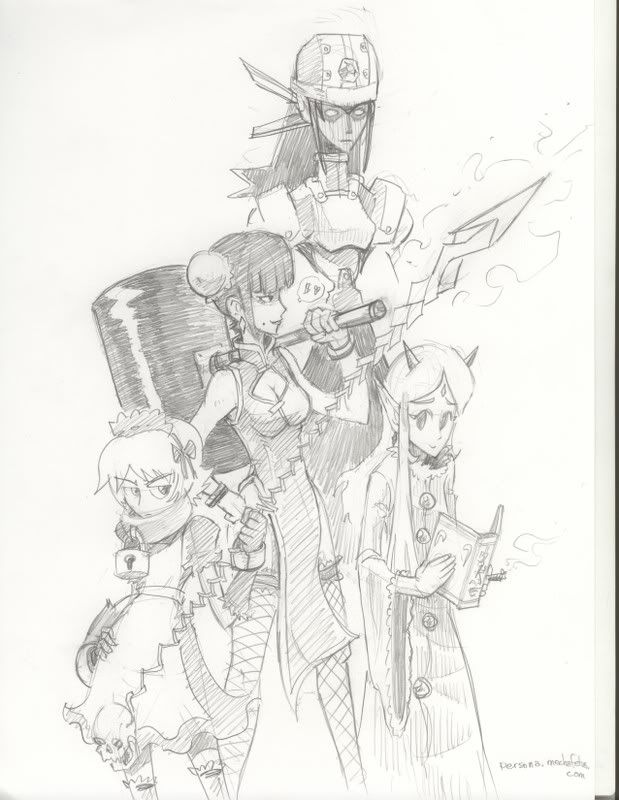
I haven’t been nearly as ambitious as those folks, but I did run sessions of Maid RPG at FanimeCon and Anime Expo last year, and they were likewise met with enthusiasm. At Fanime, even the guys who came off at first as being run of the mill D&D players jumped into playing maids without any hesitation. One gentleman was already a fan with a copy of the book who’d been talking it up on DeviantArt, and a couple more went ahead and ordered the book online before the con was even over. At Anime Expo I got an enthusiastic group, a first-time role-player, and one guy even went so far as to commission Persona to do a sketch of the PCs.

Interactivity at Anime Cons
There are a lot of different things at work here, which I’m trying to unravel a little. There is a very definite overlap between RPG and anime fandoms, but as is often the case, gamers on the whole are very mixed (and in some cases outright hostile) in terms of their opinions of anime. No game can please everyone of course, but while anime art is a turn-off to many gamers, good anime art is a huge draw for anime fans. Most cons have an Artists Alley where artists have tables to sell prints and commissions and such, and they’re generally packed. At conventions especially, anime fans are always looking for things to do. Every anime con has a big schedule of anime showings, but apart from stuff like the AMV contest, Anime Hell, etc. that you can’t get off of BitTorrent, they aren’t the real draw. Things like karaoke contests, maid cafes, panels, workshops, and, yes, tabletop gaming rooms, are what get people interested.

One major issue I’m pondering in all this is how to go about making things happen. Running games is relatively easy, though even where an anime con has a bustling tabletop gaming room, it’s likely to be dominated by CCG tournaments. The folks who ran games at Kumoricon lamented that they could’ve easily sold 10 or 20 copies of each game if they’d had them, but for the larger cons a dealers room booth costs something like $600 to $1,000. For a smaller con it’d be closer to $200, though I’m not entirely sure how the costs would line up with the money made in either case. I do have a contact with a local anime store that goes to what seems like every con ever (“Didn’t I see you last week in California? Why are you in Texas?”), but I’m not sure that having some Maid RPG books getting lost in a sea of plushies and trading figures would be all that effective. On the other hand, it might be possible to persuade a con to let people sell self-published RPG books through Artist’s Alley, which is dramatically cheaper, but not something I would expect to be able to do consistently, depending on each con’s policies and the attitude of whoever’s running their Artist’s Alley.

Expanding to Other Realms
This is also just one example of how RPGs can potentially reach a new (and more targeted) audience. People were also running games at PAX, and I can’t really think of a nerdy subculture that doesn’t have at least some room for tabletop gaming. The only thing that makes anime fandom a bit different is that in terms of published RPGs it’s one of the more underserved, especially considering just how big it is. Companies are having a hard time monetizing the actual anime content–not a few DVD publishers have closed their doors over the past few years–but sales of just about everything else to do with anime are still relatively strong (even if the state of the economy has been a problem for those dealers like everyone else).

Although this goes without saying, I’m talking about small press/indie RPG stuff here too. I would be more than a little surprised to hear that anime RPGs are catching on so much that Wizards of the Coast needs to take notice, but as I’ve said before, if Maid RPG is any indication, by small press standards a good anime-themed RPG can be a resounding success. Maid RPG’s sales have been competitive with the very top tier of indie RPGs, on par with the likes of Vincent Baker and Evil Hat. While it does have its share of adherents from among the indie gaming crowd, I highly doubt it would’ve been so successful without the anime fandom demographic. On the other hand, that makes me a little nervous in that without anything resembling a marketing plan we’ve still had a hell of a time keeping Maid RPG in stock. While turning a profit, however modest, is nice, not being able to consistently get the books to people who want them just bugs me, and I don’t really feel I have the tools to properly gauge the extent to which addressing this new fanbase will elevate demand. Being able to print books in greater volume has benefits for everyone involved of course (cheaper per-unit cost, and at a certain point traditional rather than POD printing becomes more feasible), but the up-front investment from the publisher can still get impractically large. I know Gregor Hutton has said that it was basically a financially fortunate situation that let him print enough copies of 3:16 to meet the unexpectedly high demand.

Conclusion
Regardless, I definitely intend to work more on promoting the RPGs I like through anime conventions. At the very least, I know for sure that the con closest to me (FanimeCon) has an ambitious tabletop gaming department as a decent number of role-players. Admittedly, my skills and personality are better suited to the writing/translating side of things, but wherever one falls in the equation, there could be exciting times ahead.

In any case, in the near future I’m going to be recording a podcast with Jake Richmond to discuss these issues, his experiences at Kumoricon, and more.

Reblog this post [with Zemanta]

Analog DLC?

The Halo 2 Downloader, featuring its first fou...
Image via Wikipedia

This started as an offhand comment on Twitter, which ballooned into a discussion (even though Twitter isn’t a good medium for discussion), so I’m expanding it into a blog post to unpack some. In video games downloadable content (or DLC) has become at turns a buzzword, a thing fans demand, and a source of controversy. It’s getting to be a pretty common thing, though it’s obvious that some developers are better than others at figuring out what the heck to do with the possibilities it affords. I’m wondering if RPGs could benefit from something resembling video game DLC. Needless to say, this line of discussion presupposes that someone is actually going to do it right, providing useful, quality content at a reasonable price, without gimping the primary product. And we’re talking about something at a scale where it would in fact be different from merely offering sourcebooks and adventure modules, since the RPG industry is already well-acquainted with that (and in a sense was way ahead of video games).

boxluminesLIVESo, the idea is to do “micro-supplements” for an RPG, preferably electronic. This probably makes more sense for a game that has relatively little supplemental material in the first place, since it can actually stand out more from the rest of the product line. If Wizards of the Coast releases a new race as a $3 PDF, it’s going to get lost in the shuffle of their dozens of hardback supplements and monthly truckload of D&D Insider content (which is more the niche something like a single race fills in their business), but if an indie publisher does one or two of these, they could be the one or two supplemental things that exist for the game in total. On the one hand, supplements inevitably sell less than core rulebooks, but on the other hand a PDF micro-supplement that costs $4 or less is squarely in impulse buy range, gives the customer nigh-instant gratification (rather than waiting for shipping or making a trip to a store), and doesn’t take a huge investment on the part of the publisher to create. Although Microsoft’s implementation hasn’t been perfect, part of the success of their “marketplace” stuff is simply that you can buy stuff using your Xbox 360 controller sitting on a couch, and use it right away. Now all three major game consoles have that going for them.

apelord-150One Bad Egg‘s 4e micro-supplements range from about $2.49 to $8.99, with the right amount of heft for the price, and really distinctive content for a game with minimal third-party support. Ronin Arts literally has over 200 PDF products out there, and they have dozens of d20 OGL PDFs for sale, starting at $1.50. I don’t know all that much about Ronin Arts’ offerings, but OBE seems to be the #1 producer of 3rd-Party D&D4e content, and their stuff stands out both in terms of quality (with Green Ronin and others skipping 4e, a lot of the other GSL offerings are the kind of stuff that remind me of the lameness of the 3e OGL glut[1]) and creativity (since they’ve tended towards a very gonzo pulp flavor of D&D).

1847-thumb100It would also be a mistake to assume this only applies to things that cost money. 3:16 has two free supplements as part of free electronic magazines (the Collective Endeavor Journal and Page XX), and it’s not hard to see how this both gets 3:16 fans looking at the magazine and gets the people reading the magazine for other things looking at 3:16. Likewise (although I wish we could’ve gotten it out sooner) the free bonus scenarios for Maid RPG hopefully are not only letting people who have the game do a little more with it, but also letting people who don’t have it get a taste of what it’s like. (Which comes back to the whole thing about selling an experience we talked about in the last podcast.)

Now, the flipside to all that is that with both video game DLC and RPG micro-supplements people have generally had a hard time figuring out what the hell they were doing. Video game DLC has at times included unbridled attempts to squeeze more money out of gamers (such as charging to unlock content already on the disc), or just kind of lame and slow to come along (anyone remember the map packs for Unreal Championship?). Mongoose’s “Power Classes” pamphlets likewise seem to have gotten onto FLGS shelves only to be greeted with an emphatic (and probably well-deserved) “meh.” Content needs to be compelling to the user/customer, no matter what format you’re offering it in. If it’s crappy, or for a game they’ve already moved on from, no one’s going to be interested, but that’s just common sense.

coverDaughterOfNexusWhite Wolf is in fact doing something in the way of mini-supplements with their “Storytelling Adventure System.”[2] These are very much like adventure modules for their various games, but they’re sold as inexpensive PDFs (ranging from $1.49 to $8.99, but $6.99 seems to be the standard price). This isn’t quite what I’ve been blathering about here, but it’s interesting in its own right in that it’s something of a solution to the question of how publishers can continue to offer actual adventure scenarios. Good pre-written adventures are very useful to the people playing the games, but their profitability is not generally commensurate with that. WotC’s solution to this is elaborate modules with glossy color maps (which are useful in general for D&D) that list for $24.95. If the Amazon book sales rankings are any indication, these do indeed sell an order of magnitude less than core products, to say nothing of the Player’s Handbook, but they are apparently selling enough to justify their continued publication. Of course, especially for something like Exalted (which has fewer tangible components to pack in), it makes sense for the players to have an adventure be a PDF you can print out, run, and recycle afterward (or just keep on a laptop, with no need for a hardcopy).

Mouse HengeThe thing that probably best exemplifies what I’m getting at here is, unsurprisingly, from Ryo Kamiya. Tsugihagi Honbo occasionally does very short doujinshi things for 100 yen, and one of them had rules for creating mouse henge in Yuuyake Koyake. This involves a mere 4 pages of material in all (with one illustration) and while the game doesn’t need a seventh type of henge, adding in mice adds some really interesting new possibilities to the game. As a huge fan of Yuuyake Koyake and something of a completist, it bugs me a little that I don’t have a copy. ^_^; Although Tsugihagi does these on paper, particularly in the American market it’d make more sense to have something like that be a PDF.

Anyway, I’m not really going anywhere in particular with this, just throwing out an idea and places it might lead.

[1]I do really like Alea Publishing Group’s Feudal Characters: Noble though.
[2]There’s also something called ExXxalted: Scroll of Swallowed Darkness that costs 99 cents for the full version, but we won’t dwell on it.

Reblog this post [with Zemanta]

Revenge of the Random Thoughts

Deep Blue Sea
The blue ocean strategy podcast is taking a bit longer to put together than I had hoped, in part because, when it comes down to it, it’s potentially a very broad topic. The thread I started over at Story Games has generated over 80 posts over the course of two weeks, and produced some very interesting discussion, that has in turn helped me better figure out what to do with the podcast. In particular, I think that while RPGs have done a lot of innovation in terms of what the medium can do, there hasn’t been nearly as much innovation in how people market and sell those games. (Though needless to say, design and marketing can and probably should inform one another.)

Four Ee
D&D4e is a great game for campaigns, but it’s really not that great for one-shots. I’ve yet to play in a con game that didn’t run for 6 or 7 hours, even with the party focusing on getting through the encounters. A 4e character has enough of a learning curve that it’s not worth playing one for just one session.

I got a copy of the new Eberron Player’s Guide, mainly because I wanted to see what 4e could do with a fantasy setting less generic than Forgotten Realms, though frankly it’s not quite wacky enough for my tastes, which makes me want to get around to working on the Nine Towers setting I’d tentatively started a while back.

Potential Spaces
At Webstock 09, Ze Frank gave a talk on “Potential Spaces”. Although he’s a very talented guy himself, where he really shines is his ability to create spaces for people to contribute, and over the course of his 50-minute talk he gives several fascinating (and uplifting!) examples. Early on in the video he also talks about the relationship between the rules of a game and what actually happens, and this is something every game designer should be thinking about.

Dragon Oracle
As kind of a short side project I’ve started trying to design a (non-collectible) card-based RPG. It’s a simple fantasy game, tentatively titled Dragon Oracle. I’m trying to stick to using two decks of 54 cards (a Hero Deck for the players and a Dragon Deck for the GM/Dragon Master) and as few other materials as possible (which is why it wound up being non-random), though I ended up having to allow for simple character sheets. The number of cards limits the number of classes for the base Hero Deck to 3, which will be Fighter, Mage, and either Thief or Acolyte (priest/cleric). I’m not sure where I’m going with this. If it works out exceptionally well I may see about POD printing through Guild of Blades, or try submitting it to game publishers, but it may just wind up as a free PDF, if that. Right now it’s kind of stalled, partly because of the dilemma over class choices (though I’m leaning towards putting in the thief and letting the mage heal a bit, so it could be Fighting/Magic/Trickery rather than Fighting/Magic [arcane]/Magic [holy]).

Sunset +3
Over on the Sunset Games blog they’ve posted up an announcement and cover image for the third and final Yuuyake Koyake supplement, Kore Kara no Michi (“The Road From Here”), which as I understand it will be about playing as humans. Ike‘s art is awesome as ever.

Slime Story
I haven’t been getting much done on Slime Story, but I did get the commissioned art for the game’s archetypes:
Karate Star (Matt)
Suburban Ninja (Phoebe)
Joe Hunter (Doug)
Custom Character (Rita)
Dedicated Archer (Christine)
Nerdy Alchemist (Kenny)
Monster Lover (Kelly)

Dragon Ball Zeeeee
I have a vague notion of trying to put together a DBZ game loosely based on the Budokai Tenkaichi (or “Sparking!” in Japan) video game series.

Blue Ocean Thoughts: Sell Me On…

My friend Jon is really big on Blue Ocean Strategy, a book and business methodology based around expanding from a saturated market into new territory in new and innovative ways. I’ve been thinking about different ways that RPGs might find a blue ocean (Story Games thread here), and I’ll be bringing Jon on board for a podcast about it in the near future, but right now I want to talk a bit about some tangential stuff that came from the book’s chapter called “Build Execution into Strategy”. This is not as relevant to exploring the potential of blue ocean strategies in RPGs, but very, very relevant to how I’ve been trying (and too often, failing) to sell my friends on trying out different games.

5c4e117254b88649498a07cb548b774d

However awesome an idea seems to you, you have to demonstrate its merits to the other people involved. This is common sense, but it’s entirely too easy to get too wrapped up in your own ideas and forget. The book talks about a concept called “Fair Process” at length, and it’s the main focus of this blog post. Fair process aimed at gaining trust within an organization to carry out the kind of radical changes necessary for a blue ocean strategy, but I think the ideas here are applicable to most anything where you’re trying to introduce something new to a group, whether a massive company or a little gaming group. The stakes aren’t as high as for factory workers fearing that the new reorganization will cost them their jobs, but that doesn’t excuse laziness about the presentation.

With Mouse Guard, I basically made the mistake of throwing the rulebook at my friends and saying “This game is awesome! Read it so we can play.” I’m a voracious reader when the mood takes me, and my relationship with RPGs and not a few other things basically starts with sitting down and reading a book as a matter of course, to the point where it’s easy for me to forget that not everyone is like that. I’m sure somewhere there’s a group where everyone would dutifully sit down and read a 320-page book cover-to-cover when someone asks, but I don’t know those guys. Likewise, my verbal presentation of the game was… let’s say muddled and leave it at that. Some people no doubt do fantastic presentations of the games they want to play as a matter of course, but perhaps because of my orientation towards reading I apparently needed it spelled out for me by a book to really get it.

“Fair Process” is the idea that even if the outcome is going to be fair, people will be far more willing to accept it if they see the process leading up to it also fair. A reorganization scheme that will ultimately benefit employees can be met with outright hostility if a company doesn’t communicate what it’s doing. There may be times when you can slide by (as I managed to do with 3:16), but needless to say relying on luck isn’t a winning strategy. The book outlines what it calls the “Three E Principles of Fair Process”, all of which are necessary to create a perception of fair process to get people on board.

  1. Engagement: Everyone involved should have the chance to discuss and debate the merits of the new thing. This improves the quality of your ideas, and makes everyone better thinkers about these things. While it’s nice if people are open-minded about trying new things, if you can’t overcome objections and concerns about it, there’s obviously something lacking somewhere. The burden of proof is on the person who wants something new. Also, engagement helps people feel that they’re being valued in the process, even if the ultimate decision doesn’t go their way.
  2. Explanation: The people involved need to know what the heck is going on. In an RPG group that means clearly explaining what kind of game we want to play, and giving an accurate picture of how it works. What kind of game are we dealing with? What kind of rules does it use? What materials are required?
  3. Expectation Clarity: Once you know what you’re doing, people need to know very clearly what will be expected of them. In an RPG this means things like what kind of time commitment is required, what kind of character to make, what kind of role-play to mentally prepare for, etc.

Setting aside the marketing jargon stuff, the point is that from here on out I’m going to consciously try to have a much clearer and more deliberate approach to introducing new games to my gaming group.

Yaruki Zero Podcast #8: Subcultural Contexts

ykz_008

In this episode I talk about the referential nature of geek subcultures, and how that affects and can be used by role-playing games. Nerds naturally reference stuff, and use that to communicate better by generating a shared subculture. The question is, how can RPGs take full advantage of that, in both play and design? This is another solo episode, because in some ways I like doing those better, despite the fact that it’s harder to come up with good topics for them.

Yaruki Zero Podcast #8 (42 minutes, 17 seconds)

Show Notes

  1. Introduction
  2. Intertextuality of Geek Subcultures
  3. Big Setting Games
  4. Otaku Culture
  5. Using and Creating Subcultural Contexts

This podcast uses selections from the song “Click Click” by Grünemusik, available for free from Jamendo.com. If you like the song, consider buying some CDs from Nankado’s website.

Very awesome caricature of Ewen courtesy of the talented C. Ellis.

somerights20en

Yaruki Zero Podcast #7: Random Thoughts

ykz_007
In this episode I talk briefly about a variety of different topics that have been on my mind.

  1. PDFs and Piracy
  2. Randomness and Cinematic Role-Playing
  3. Oban Star-Racers
  4. Grognardia: Genre Bending
  5. Raspberry Heaven Design Notes
  6. The “Pink Panther” is what you get when you put a scoop of strawberry ice cream into lemon-lime soda.

Yaruki Zero Podcast #7 (32 minutes, 26 seconds)

Next Time
I haven’t decided what to do next. ^_^;

This podcast uses selections from the song “Click Click” by Grünemusik, available for free from Jamendo.com. If you like the song, consider buying some CDs from Nankado’s website.

Very awesome caricature of Ewen (with his mascot character Kurumi) courtesy of the talented C. Ellis.

somerights20en

Maid RPG Update: Maid Books For You, Master!

0bee8087335b035e867bb91f52c701f4

I know a lot of people have been anxious to get their hands on a hard copy of Maid RPG. Well, the wait is just about over. Maid RPG is now back in stock at Indie Press Revolution! This is the revised version, with all the same content, but lots of corrections and implemented errata.

A quick reminder, if you bought the PDF from IPR, you should be able to download the PDF of the new version by logging in to your account, and if you bought it from the Maid RPG website before we started selling through IPR, you should’ve received an e-mail with a new download link from us. Any questions? Feel free to contact us!

Thoughts on Podcast #1

On the whole I would cautiously call my first attempt at podcasting a success. Granted, I think maybe six people actually listened to it, most of whom are my friends, but then the first one wasn’t terribly relevant to anyone who isn’t already familiar with my stuff. And, I haven’t made any real effort to advertise it at all except for mentioning it on Twitter and my LiveJournal, something I won’t get into doing until I’m more confident that this will be a regular thing. It was fun and not too terribly time-consuming to do, and after listening to the result a couple times, I think I’m off to a good start. One listener even complimented my voice. O_o

I’m going to sit down and do some planning before I get too carried away, not to mention get some advice from the very small number of people I know who actually do media type stuff. Removing some of the sources of distracting noises (Trillian and my squeaky chair) will help, and I need to look into music for bumpers (I’m thinking of using this song; nice and relaxing) and some other things.

I don’t really want to commit to having a regular “broadcast partner”, but I definitely do want to get other people to join in and talk about stuff. I like being able to babble on by myself without any worries about the logistics of assembling multiple people, and no matter what I’ll be doing that at least part of the time, even if I’m not confident about keeping up with the Paul Tevises of the podcasting world (in terms of being a good solo podcaster). On the other hand, I’m very interested in talking to people with different perspectives on gaming. Of course, whether in person or over Skype, I need to work out the technical stuff for actually doing that, and recruit people to talk to.

Some tentative ideas for future shows:

  • Anime and RPGs. A solo show where I blather on about the intersection of Japanese animation and role-playing games.
  • My group’s experiences with D&D4e.
  • Something about how RPGs have changed over time.
  • Maid RPG. A lengthy discussion of the game, ideally involving Andy K.
  • Japanese TRPGs. A long discussion of the Japanese tabletop scene. Again, getting Andy involved would be essential.
  • I want to talk to my friend Tim about the freeform role-playing scene that flourished at his middle school.
  • Likewise, I want to talk to Guy about the gaming scene in Israel, and how he interfaces with the online RP scene.