Yearly Archives: 2011

Magical Burst: Getting Started

This is an idea I’ve had for some time, though it just coalesced into something I think I can really make work. I’ve been fascinated by magical girl anime for entirely too long, but it’s a genre that cried out to be satirized and subverted. Some might remember how way back when I made a campaign setting called Magical World, a contemporary setting with a dangerous excess of Sailor Moon style magical girls, heavily inspired by the Magical Girl Hunters improfanfic. Later on I had the idea of doing an updated version, titled Magical Burst, which would incorporate Maid RPG style randomness and Superflat insanity, but I didn’t get very far with it.
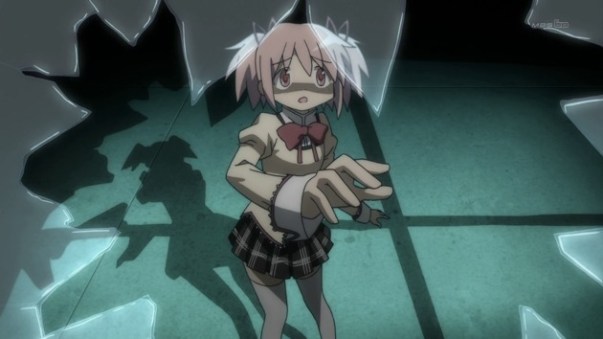
What has me so incredibly inspired is a new anime series called Puella Magi Madoka Magica. It’s a magical girl series from Akiyuki Shinbo, the prolific anime director known for series like Hidamari Sketch, Sayounara Zetsubou-sensei, and many others. (It also doesn’t hurt that the character designs are by Ume Aoki and the music by Yuki Kajiura.) Lyrical Nanoha challenged some of the conventions of magical girl anime–such as by having the protagonist actually sit down and talk to her mother about what she’s doing–but Madoka Magica is the dark magical girl series I’ve been wanting for a long time. It is a series where death is a very real danger, where the desires of adolescent girls are dangerously magnified by magic, and where the forces they’ve aligned themselves with are not so benevolent as they might seem.

Then I stumbled across the TV tropes page on the series, and it turns out that the main writer is Gen Urobuchi. The staff had tried to keep his role a secret as long as they could. Why? Well, in the postface of the first Fate/Zero book he wrote he said, “I am full of hatred towards men’s so-called happiness, and had to push the characters I poured my heart out to create into the abyss of tragedy…” The series is about halfway through its 12-episode run, and it seems like it’s going to get even darker, which is saying something.

This new attempt at Magical Burst incorporates many of my own ideas–too many for it to be Madoka Magica with the serial numbers filed off–and is meant to be fundamentally a game about fighting youma and the unwanted consequences of doing so. The game is shaping up to be sort of like a magical girl version of Don’t Rest Your Head (“Don’t Rest Your Wand”), though quite a few other elements have made their way into the rules, including a D66 table of random magical mutations.

I think the major thing that has me really wanting to realize this game is that it has the potential to create intense stories that really push characters to their limits, all wrapped up in an anime genre I find fascinating. One of the strengths of the magical girl genre is that it thematically works around a feminine coming of age process, and when you stop sanitizing that in the manner of Sailor Moon and Tokyo Mew Mew you’re quickly reminded that girls can be pretty amazingly vicious. (Of course, that’s half the premise of Panty Explosion.) I also love how Madoka Magica emphasizes the unnaturalness of magic. One thing about Sorcerer that never came across to me until I listened to the Canon Puncture Game Advocates episode about it is that it’s assumed that your PCs have managed to do something that violates the nature of normal reality. While in other settings there’s fertile ground for magic as something well understood, the consequences of exposing magic to a world completely and utterly unprepared for it are fascinating.

Anyway, I just wanted to throw that out there. The actual game should be fairly short and simple, so hopefully it should hold my attention long enough to at least let me finish a full first draft. I’m still digesting Ben Lehman’s (unusually) lengthy essay on playtesting (especially since I barely read it an hour ago), but the main thing I’m taking away from it is I need to be much more rigorous and dedicated than I have been about design.

Role-Play This! A Certain Scientific Railgun

I haven’t done a “Role-Play This!” thing in forever, but I got inspired all of a sudden.

What Is It?
A Certain Magical Index is a series of light novels that has been adapted into an anime series. It takes place in the Academy City, a cutting edge city of mostly students, constructed to instruct people in the use of special powers. Index presents a dichotomy between the world of science (which includes special powers) and the hidden world of magic, which actually exist in a delicate balance of power.

One of the most popular characters from Index is Misaka Mikoto, a Level 5 power-user (which is as high as the power scale goes) with an exceptional talent for generating and manipulating electricity. She can do a tremendous variety of things with her power, but her signature move is to create magnetic fields to propel a coin at supersonic speeds, hence her being nicknamed “the Railgun.” A Certain Scientific Railgun is a spinoff series that stars Mikoto and delves deeper into the lives of Academy City students.

Why’s It Awesome?
Railgun is unusual among anime in that it both develops an interesting setting and tells a good story. It takes place in a near-future setting that presents “super powers” as a phenomenon that science (mostly) understands, and uses that in lots of interesting ways, both in terms of cool sci-fi stuff and how it affects the characters. The Academy City has both the Anti-Skills (a paramilitary force for dealing with dangerous power-users) and Judgment (a group of students that assist with law enforcement as well as everyday problems), not to mention plenty of people who resent the prestige that high-level power-users seemingly have handed to them on a silver platter. There are also hidden conspiracies, strange technologies that affect power-users, and memorably insane villains.

In Railgun especially this is all conveyed with a bunch of fun, likable characters. Mikoto is joined by her roommate/stalker Kuroko, who also has a scarily effective teleportation power, and Ruiko and Kazari, who remind us that not everyone in Academy City has spectacular special powers, however much they might wish for them.

Gaming It
The setting of the Academy City seems all but made for role-playing. It has a population of 2.3 million, of which 80% are students hoping to develop their special powers, so it’s not the slightest bit implausible to introduce new characters with their own powers.

My #1 pick for an existing RPG to use would be Smallville. With its relationship mechanics and orientation towards melodrama, it needs little or no changes to work for the Index/Railgun setting. It even allows for powered and non-powered PCs to exist side-by-side, so characters like Ruiko (who has no powers at all) and Kazari (whose power is inconsequential) are easy to put alongside Mikoto and Kuroko. About the only things I would change would be more flavor, specifically that while characters might have more than one power in game terms, for the purposes of the story they should have only one (“Dual Skills” are only a hypothetical thing in the setting) and that characters without powers in game terms can have a small, mostly useless power for flavor if they really want (again, like Kazari).

For a more traditional approach, most any superheroes RPG worth its salt should be able to represent the kinds of powers seen in Railgun just fine. (And frankly I’m kind of surprised that the anime characters page of Surbrook’s Stuff doesn’t have any Hero System writeups for Index/Railgun characters.) Hero System, Mutants & Masterminds, Truth & Justice, and so on should work without too much effort.

Yaruki Zero Podcast #16: Steven Savage

Yaruki Zero Podcast #16 (24 minutes, 48 seconds)

This episode presents a succinct but interesting interview with Steven Savage, the man behind both Seventh Sanctum and Fan To Pro. In the interview, Steven talks first about the Seventh Sanctum generators site and his philosophies of how randomness can inform creativity, and then about how RPG gamers can leverage the things their hobby involves into career stuff.

This is my first time recording a podcast with a guest in the same room (using my little Sony digital recorder), so there’s a little bit of background noise here and there, but I think it turned out surprisingly good considering.

This podcast uses selections from the song “Time Machine” by To-den from the Grünemusik album of the same name, available for free from Jamendo.com. If you like the song, consider buying some CDs from Nankado’s website or via Jamendo.

Very awesome caricature of Ewen courtesy of the talented C. Ellis.

GET PARSELY: Adventures With Text and Maybe Pictures

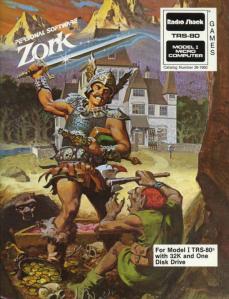
Thanks to Parsely I’ve been really interested in text adventure games/interactive fiction of late. I’m currently playing the original Zork and generally trying to digest what implications IF might have for tabletop RPGs.[1] RPGs can use some visual elements during play, but as with text adventures, we often only convey images during play through descriptive words. On the other hand when you look at the packaging of any given Infocom game, it’s full of visual stuff to excite the player, to a degree that contemporary video games very rarely bother with. They even went so far as to include “feelies,” weird little props to enhance the experience. (Leather Goddesses of Phobos even had a scratch and sniff card with different scents that came up during the game.)

As video games started to become able to have some semblance of visuals, there was still a certain imaginative leap asked of the players. Game publishers usually had a professional illustrator do a painting that conveyed the general feel of the game, and even when, say, Nintendo, used pixel art on game covers, they still had more detailed art in the game manuals. There’s definitely a parallel to RPGs, which can have all kinds of illustrations to put you into the right mood, but ultimately consist of setting info, game rules, etc. and aren’t a visual medium per se. There might be some times when you can point to the professionally-done fantasy art in a D&D book and relate it to something in your campaign, but chances are the price tag for artwork of that caliber for your own characters will be out of your reach.

From the NES Metroid manual

Pixel Art
What’s rather interesting is how the role of pixel art has changed. The so-called “AAA” video game titles use 3D graphics and aspire to something like photorealism, and genres that were traditionally all sprite-based (shmups, fighting games, platformers, etc.) have come to use 3D polygons too. These days pixel art pretty much only comes up as an artistic choice, which in turn means that it’s more likely to be used in a stylish indie computer game (or by the likes of Paul Robertson), than to suffer the mediocrity of the kinds of games that keep the Angry Video Game Nerd raging away.

In an important sense we’ve more recently reached a point where pixel art is normally the proper visuals ans seldom winds up a rough representation of what the designer wants to communicate. Some of it is no doubt nostalgia, but I would like to see pixel art make its way into tabletop games more. As far as I know Jonathan Walton is the only one who’s really been experimenting with this kind of thing (check out the cover of Super Suit). Not unlike with Blowback‘s brilliantly effective use of photography (a mixture of stock and original), pixel art won’t work for every game of course, but as I’ve started looking into commissioning pixel art I’ve found that the artists on DeviantArt who do it don’t charge very much, plus there are quite a few free pixel fonts out there. I’m definitely going to be experimenting with this kind of thing whenever I finally put together a Parsely game of my own[2] (and I may even mess around with ASCII art a bit too).

A Side of Parsely
Parsely[3] is much more interesting than it might appear on the surface. It might be a bit of a stretch to call it an RPG, but it’s definitely an analogue RPG-ish thing played by people. While the layout of rooms and how things work within a given Parsely game is tightly restricted (almost comically so; there’s exactly one way to get past the orge), reading any given Parsely game you’ll find there are places where the Parser/GM must, at a minimum, think up how to explain what happens on the fly, and while you could give obtuse computer-like responses to things not already covered by the game (“That sentence isn’t one I recognize.”), players will inevitably come up with commands that are eminently plausible even in the absurd, constrained world of a text adventure (“Kiss the princess.”)

While Action Castle is a sort of medieval mini-Zork, Jared gets into trying an assortment of different things in the successive Parsely games. In some (Spooky Manor and Pumpkin Town) characters can turn into different forms with different abilities, for example, and Space Station makes use of a stopwatch. There’s also the concept of “Microgreens,” super-short Parsely games of 1-3 rooms, of which Flaming Goat is the only specimen so far. (Update: Scratch that; Jared posted up a second one, Blackboard Jungle.) Just as people have done all kinds of strange things with the medium of text adventures–from Infocom’s more experimental titles to the avant-garde efforts of the IF hobby scene–there is tremendous room for trying out different kinds of things.

The Parsely game I’ve started working on is called Miyuki Kobayakawa’s Doki-Doki Adventure, and aside from using pixel art and having the conceit of a setting inspired a bit by Paul Robertson and Takashi Murakami, it’s going to have an event that changes the nature of the locations in the game. I’m also contemplating a game based off of the webcomic I write for, where you switch between different cast members to resolve all of their various little quandaries.

[1]Also, I’ve been reading Twisty Little Passages, which is highly informative but also in an extremely academic style.
[2]I’m also contemplating trying out Inform 7 to make an electronic version once it’s done.
[3]Which BTW is now available in PDF; 99 cents per game.

Fiasco: Super Kart Party 3 Plus!

I figured I might as well post this up rather than waiting. It’s yet another Fiasco playset, and hopefully my last one for a while (for one thing I need to find time to actually play these things).

Super Kart Party 3 Plus! is about video game testers at Nakatomi Games. Not only do they have the shitty grunt job of the industry, but it’s crunch time on an utterly idiotic, hopeless, terrible game (from which the playset gets its title) that upper management will not let go under any circumstances.

I wrote it as a birthday present for a longtime friend who’s worked as a game tester for a number of years, so a substantial portion of it is based on the various stories he’s told me. Like Liquidation, I based it more off of real life stuff, so it’s hard to recommend viewing material, but jPod and maybe Grandma’s Boy come to mind, and Once Upon Atari and this Destructoid article could be good sources of ideas.

Download Super Kart Party 3 Plus! PDF

Fiasco: The Knights of Light

Yes, another Fiasco playset. I have another in progress too, though I’m trying to get started on a Parsely game too.

This one is about the members of a small local guild in an extremely popular MMORPG. It is of course heavily inspired by The Guild. It couldn’t really find any other works about MMO players, but a Google search for “guild drama” provided plenty more inspiration, specially the Drama Mamas column on WoW Insider.

The playset is a little bit non-standard in that (1) when setting up a scene you declare whether it’s IRL or online (so there can be scenes entirely in the game, or that consist of narrating angry forum posts), and (2) I’ve replaced the Locations table with an Events one (which if you’re feeling adventurous you can also use during the Tilt).

The Knights of Light Fiasco Playset (PDF)

Fiasco: Liquidation

Liquidation is my second attempt at a Fiasco playset. Crossings is a big chain of big bookstores (get it?!) that has just filed for bankruptcy. With the clock ticking on the local store’s inevitable closing, the employees and regular customers are scrambling to get the best deals (or steals), resolve their grudges, or just get their lives in order before the store’s doors close permanently.

I couldn’t really come up with a “Movie Night” section for this one, because it’s mostly based on real experiences, my own and those of friends who’ve worked in retail, exaggerated (in some places more than others) to make for a good Fiasco.

Liquidation (PDF) Download