Tag Archives: Dungeons & Dragons

An Oral History of D&D Discussion Online

There are plenty of things that annoy me about how RPGs in general and D&D particular are discussed online, from edition warring nonsense to the notion that D&D is THE RPG because I can’t find anyone to play other games because D&D is THE RPG. Lately I keep feeling like I’m the only one who remembers anything about how things went over the past 15 or so years of online discussions. A lot of new concepts have entered the discussion, including the stuff the OSR has championed, that have vastly altered the discourse.

T$R
In the mid to late 90s I saw some discussions on BBSes, usenet, and finally the web, though in my family we were lagging a bit behind in computer technology. Lots of people played and liked D&D (and made fan material and netbooks and such for it), but the overall consensus seemed to be that it was a game for mindless hack and slash. It was the arrogant, brainless, undeserving 800-pound gorilla, and thank god the likes of White Wolf, Steve Jackson Games, Chaosium, Palladium, etc. were giving us games with some room for actual role-playing or something. While people would sometimes cite D&D sessions without any die rolling, from what I saw the standard rebuttal from D&D fans was simply, “But we like dungeon crawls!” This was actually my first exposure to what would become the “badwrongfun” meme, and it really changed how I looked at RPGs, for the better. This was also the time when TSR was the great villain of the industry, even in the eyes of many people who liked D&D, with constant complaints about the company’s money-grubbing business practices and penchant for shutting down unauthorized fan activities. Some people accuse Wizards of the Coast of putting profit motive first today, but that minority is nothing compared to how just about everyone could type “T$R” with the dollar sign with a straight face and no fear of even being criticized for it. (“Micro$oft” has gone out of style too, come to think of it.)
Continue reading An Oral History of D&D Discussion Online

Fifth Edition

I’m really not sure what to think of the announcement of a new edition of Dungeons & Dragons being in the pipeline. That’s partly because there’s relatively little information to go on in the first place, so it’s a bit early to do much in the way of prognostication. This blog posts is thus mostly going to be about my reaction and other people’s reactions, and my reactions to other people’s reactions.
Continue reading Fifth Edition

Thoughts on Alignments

The recent spate of Story Games threads about d20 have got me thinking a bit about alignments. Alignments in RPGs are a weird thing. They’re a defining feature of the #1 RPG, but they’re fairly rare in the range of RPGs that have been published. And like a lot of things in D&D, they’ve become a fixture of the game while kind of losing sight of the way they were originally intended, much less the source material that Gygax and company pulled the concept from.

D&D style alignments are rather awkward when it comes to describing morality per se. I know in playing D&D I’ve ended up making lots of True Neutral/Unaligned characters, and for certain D&D haters love to harp on it as one of the game’s flaws. While the 9-point alignment system is okay for describing characters in terms of how they relate to a society, it gets weird when you consider clashes with other societies. Will a Lawful Good paladin have a problem with slaying orc women and children, who his Detect Alignment power tells him are objectively Evil?

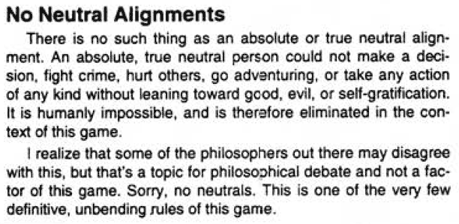
Another place I ran into some conundrums with alignment was in the various Palladium games. Palladium has of course clung to an alignment system that started with AD&D’s and went into something more to Kevin Siembieda’s liking, including the “No Neutrals” rant based on the idea that a True Neutral character would just stand there[1]. To be fair, neutral alignment was rather vague until D&D 3rd Edition or so, but it’s nonetheless weird to see rants against aspects of AD&D 1st Edition as recently as a new Robotech RPG published in 2008. This in turn led to animals being True Neutral in D&D (which made perfect sense to me; ethics are a matter for the sentient) and if I remember correctly Unprincipled or Anarchist in Palladium. It also didn’t allow for characters with different ethics depending on who they were dealing with. At one point I was writing up a race of tiger aliens (closely based on the Kzin), who would be perfectly good (Principled or Scrupulous) to each other, but treated those not of their own species as non-entities, utterly unworthy of respect. I ended up giving them a good alignment with a parenthetical, though I was maybe 15 years old when I was writing that. It might seem like an unlikely quandary, but in real life every people wants to believe they’re good, and it seems like there’s a constant struggle to own the meaning of “good” in the first place.

Hear that? An UNBENDING rule! Also, the XP and level system I use is extremely realistic an practical.

Pre-AD&D, alignment was inspired by the works of Michael Moorcock and Poul Anderson, and were limited to Lawful, Neutral, and Chaotic. More importantly, these reflected cosmic affiliations rather than moral leanings per se. That makes them less constrictive on character motive, and easier to relate to the setting. It’s less the difference between being nice or mean, and more like the difference between being Alliance or Horde. Adding the Good-Evil axis complicates this, but thinking of alignment as an affiliation lets Alignment Language make some small amount of sense. Planescape was probably the best D&D campaign setting for this, since everyone was a short jaunt away from the Outer Planes, which were manifestations of the alignments in the same way that the elemental planes represented the building blocks of the physical world. Truly being Lawful Good makes more sense if Tyr’s domain of Lawful Goodness is a place you can just go out and visit.

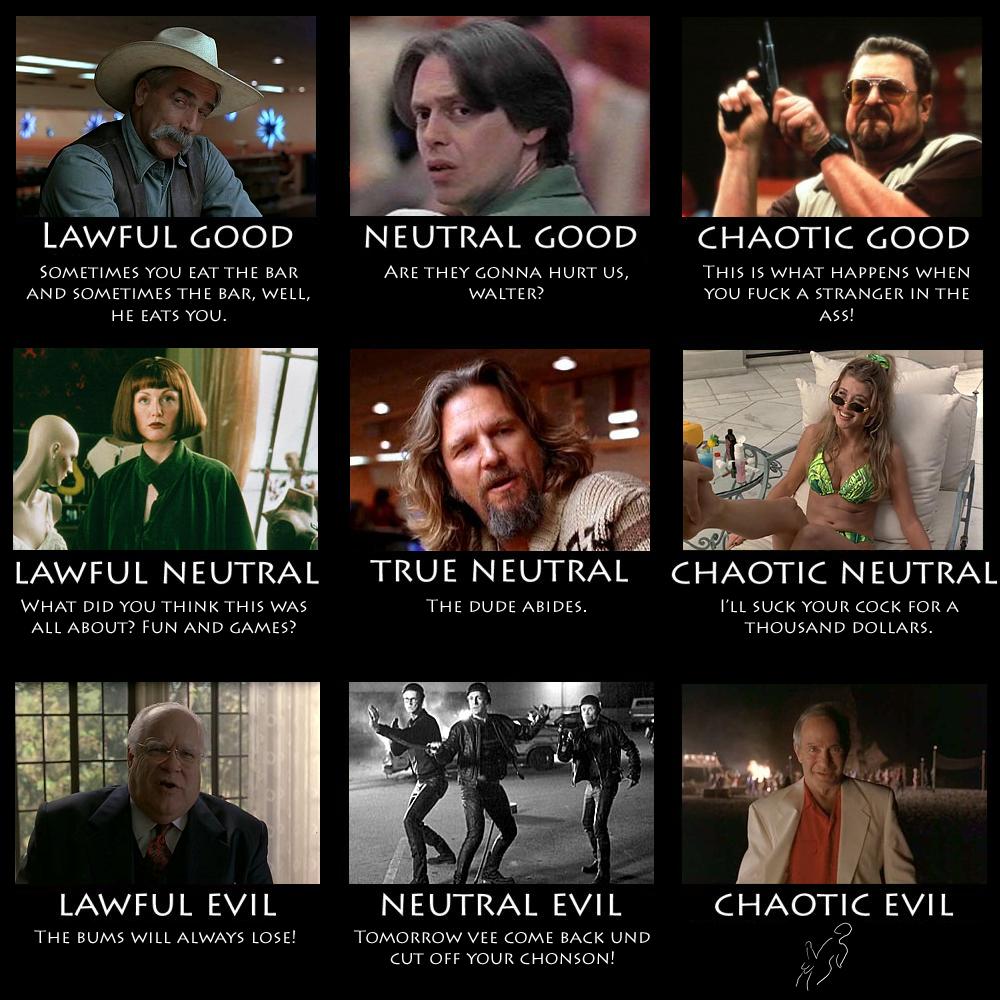
I don’t know that I want to be so overwhelmingly negative about alignments, but I do think that to the extent that the concept has merit, it hasn’t really been used to its full potential. Online conversations about old-school D&D too often seem to treat alignment as an excuse for DMs to dole out XP penalties, while in the more recent edition wars there seem to be a lot of complaints about how 4th Edition has deprived DMs of the ability to rob paladins of their powers[2]. I still like the various D&D approaches better than the Palladium approach of copying and pasting the same ranty alignment rules from a few decades ago into every single game, regardless of genre[3]. While alignments can sometimes produce interesting questions (and some amusing image memes), without giving it some cosmic significance or otherwise going beyond what they have been I feel like the whole concept can’t compare to good Aspects, Beliefs, Instincts, Values, Relationships, etc. in terms of informing how RPG characters relate to the world.

[1]Though amusingly, Erick Wujcik’s Mystic China (one of the few Palladium books I’ve kept) adds a Taoist alignment.

[2]Which strikes me as a little weird. Even if it’s not an assumption of the rules, when you have settings like Forgotten Realms where the gods are a little too involved in mortal affairs, a paladin who goes against his religious principles could have much worse things to worry about than whether or not he can still lay on hands.

[3]And I hate to sound quite so negative about Palladium (I had a lot of fun with their games in high school), but the treatment of alignments are a prime example of how the Megaversal system rules have basically been frozen in time since the early 80s.

A Strategy Guide For D&D

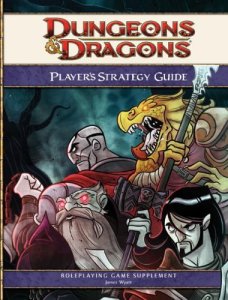
I recently picked up a copy of the D&D Player’s Strategy Guide from a local used bookstore. I wouldn’t have bought it normally, but it was relatively cheap and I had some leftover store credit that I’d been hanging on to for the better part of a year.

Unsurprisingly, some people have balked at the very idea of a “strategy guide” for an RPG. I had figured I wouldn’t need it much myself because I have so much experience with the game already. I was right–two years of playing a game will do that–but there’s an awful lot of stuff in the book I wish someone had spelled out for me from the get-go. 4E is a sufficiently complex system that it has a distinct learning curve, and this is a book that can help smooth that out for new players by explaining all kinds of stuff that the rulebooks either leave out (and that most RPG rulebooks would leave out) or only mention in passing. It’s common sense to focus fire and eliminate individual enemies as quickly as possible[1], but the Strategy Guide goes to the trouble of illustrating how big of a difference it can make with diagrams and everything.

The book covers a whole range of topics, including character building, party composition, tactics, role-playing, and some of the social stuff (including a section titled simply “Don’t Be A Jerk”). It’s all grounded in a very solid understanding of how the game works and what it can do, so that players can skip over some of the trial and error (emphasis on the “error” part) that we went through in the first year or so of playing 4E. If we’d had a better idea how to play defenders, or just how much it would cost us not to have a leader in the party, we might’ve done things very differently, and altogether better.

The thing about D&D in particular is that while it draws on various kinds of fantasy literature, it was always its own thing. In some ways this was a limitation of the designers’ understanding of this new “role-playing game” insanity they’d devised, and in other ways it was likely deliberate. Certainly when fans asked questions about why the game wouldn’t allow for a given element from Lord of the Rings or some other beloved fantasy title[2], Gygax’s usual answer was that it was a game first and foremost. While D&D started off culling ideas from fiction, it gradually became more and more about itself, I think in part because that’s all that its rules could really effectively provide.

I think that explains why works of fiction based off of D&D are at their best when they reflect what goes on at a typical gaming table. Typical D&D novels come off as stilted, and struggle to find the happy medium between slavish adherence to what the rules can do and getting into stuff the game inherently can’t do justice. That’s where the new D&D comics from IDW and even stuff like The Gamers really shine. The fun of D&D is less in Aragorn reclaiming the throne of Gondor, and more in the silly bickering and strange accidents that happen along the way (which makes movie Gimli the most D&D-like character in the whole of Middle Earth).

What I like most about the Player’s Strategy Guide is that it’s unabashedly situated in the same realm as D&D actual play rather than wishful thinking about such. It has lots of pragmatic advice about how to get what you really want out of the game, both from a social perspective and in terms of working the rules and building characters, and it’s written in a friendly tone, with cute little cartoons that lighten the mood and call to mind the ones in the AD&D1e Dungeon Master’s Guide.

[1]That’s a tactical thing so basic you can pick it up from the original 8-bit Final Fantasy.

[2]Dragon Magazine once published stats for Conan. Very few of his ability scores were below 20. You know that guy in the books you love so much that inspired you to play this game? Your guy will never, ever be as bad-ass as him.

Slime Quest and Essentials and Stuff

On the whole I don’t think all that highly of either ranting on the internet or creating in response to perceived flaws in something. For example Houses of the Blooded (while not to my personal tastes) sounds a lot cooler when you sell it on its own merits instead of on the ways it’s not like D&D. On the other hand I really want to have a fantasy RPG of my very own, something just right for me and my friends. Slime Quest, my planned fantasy spinoff of Slime Story, is looking like it might just be that game some day, which has me really excited to make it happen. There are a lot of reasons why I want this, including but definitely not limited to the things I do and don’t like about 4E and the subcultural baggage that it comes with.

I probably shouldn’t bother with online forums, at least not quite so much as I have been lately. D&D Essentials (along with the interview with Mike Mearls that appeared in The Escapist) has revived the nonsense we had to put up with surrounding 4E before and after its release a couple years ago. This time around there are at least far fewer factually incorrect complaints about 4E (in 2008 those accounted for something like half or maybe even two-thirds of what I saw). People are at least arguing based mostly on actual reality. On the other hand, the identity politics side of things is alive and well, not to mention I still feel like a huge portion of complaints against 4E read like reasons to drop D&D entirely, and especially 3.x. It’s weird to complain about tieflings and dragonborn when you’re playing a game where half-dragons are not unknown, it’s weird to complain about classes being too rigid when you can play a game without any classes at all (i.e., one of the vast majority of RPGs that aren’t D&D), and it’s odd to say 4E doesn’t encourage role-playing enough when D&D was pretty much only the best system available for role-playing during a brief period in the 70s when it had no competitors. While it’s low on my list of reasons for working on Slime Quest, part of me does want to proudly display a middle digit and proclaim that I have my own awesome fantasy game to play.

I have said that I design games that I want to play with my friends, and I’ve realized that this isn’t always true. In fact some of the games I want to make have a sort of distantly hypothetical audience; I’m not sure if I can actually pull together a group that would play Raspberry Heaven the way I meant it to be played, for example. Slime Quest on the other hand looks like it would be more or less perfect for that group, because it’s going to build on what we like about 4E and hopefully avoid some of its problems. 4E has been a big hit among us, even with the people who weren’t the slightest bit interested in D&D before that. For my part I always liked the bizarre worlds of D&D (especially Planescape), but the actual game never became anything like what I wanted to play until 4E. 1E (which I stumbled across at the local used bookstore) was just strange to me, 2E was intriguing but nonsensical, and 3E we tried out and got tired of after a while.

4E clicked for us in a lot of different ways. It’s like D&D, only your characters have something of the heroic stamina that you would actually expect a fantasy adventurer to have. Old-school D&D is great as a game about a bunch of nobodies struggling to survive in a very dangerous world and eventually making something of themselves. It’s not as great as the game about fantasy heroes it sometimes claimed to be. In 4E, first-level characters, while nowhere near immortal[1], aren’t disposable weaklings, and recovering from getting hurt[2] doesn’t require weeks of healing or a literal miracle from a deity. The MMO players in our group like the optimization and tactical combat, while the non-MMO players like the awesome fantasy settings and can enjoy the tactical aspect of the game without feeling like total failures for not putting double-digit hours into character optimization. That’s not to say I’ve been totally satisfied with the game, but on the whole it’s been head and shoulders above most of the other games we’ve tried long-term, particularly in terms of the actual rules contributing to our fun.

The major things I want to keep from 4E is the interesting tactical combat and characters with clear roles and interesting in-game abilities. However, I want to make the tactical combats a bit simpler and quicker, and I want the game to encourage role-playing and characters with some personality. The former is pretty easy, and in Slime Story I already have the makings of the combat system I want. The latter will be trickier (especially in terms of marrying it to a game with tactical combat), and I’m still in the process of working out how to go about it. I don’t really find complaints about “dissociated mechanics” to be terribly compelling, least of all coming from people who like older versions of D&D, but one way or another I do feel that I want to make a game that’s a bit better at generating interesting stories at the table.

There has also been some talk of the new D&D being less about the influences that lie at the game’s original roots. Gary Gygax originally made the game a mishmash of all his favorite sword and sorcery novels–Conan, Dying Earth, and so forth–and grudgingly added Tolkien stuff in later at his friends’ insistence. It seems like in an important sense D&D stopped being about that stuff and started being more about itself and its spinoff novels[3], to the point where I’d welcome some video game influence simply because it would make the game’s fiction a bit less incestuous. But then the thing is that in the case of the people I play with, influences culled from novels are basically irrelevant to most of the group. References to Conan only hold sway if they fall into the most memorable bits of the movies (“Hear the lamentations of their women!”), and the likes of Jack Vance are off the radar entirely. In stark contrast to that, video games and anime are what we’re all about. Concepts culled from Final Fantasy or Dragon Quest are much more recognizable to us than ones drawn from the works of J.R.R. Tolkien or Robert E. Howard. Slime Quest is going to be unapologetically getting inspiration from anime and video games.

The setting of Slime Quest (the continent of Galania) isn’t going to be anything astonishing, but I do like having the opportunity to do some stuff that the official and implied D&D settings largely avoid, both in terms of cultural issues and simple surface stuff. Religion is a prime example of this. While religion is ubiquitous in D&D settings, it tends to be a vague polytheism, with plenty of meddling gods (and until relatively recently full game stats for them), but very little sense of what kinds of practices these religions involve or how they fit into people’s daily lives. Although I’m not going to make such things central to Slime Quest, it isn’t going to totally ignore them either. Galania is home to both a monotheistic religion (the Church of the One God) and animist/shamanism religion, which have been forced to more or less coexist for pragmatic reasons (for now). It’s also got firearms, trains, airships, a postal service, and some other nifty stuff. (Also, an organization called the Happy Slime Club.)

[1]As we very quickly found out when we first started playing and those kobold slingers really messed us up. 30 hp goes by a lot faster than you’d think.

[2]Or rather, recovering from losing HP, which can at (vague, undefined) times represent mere fatigue rather than injury.

[3]One really wonders how much the ranger class’ design has been informed by a need to make Drizzt a viable character.

In Other News
I got Apocalypse World in print from the FLGS, though I’m still reading through it. The writing style is very Vincent Baker, though it’s weird to get 300 pages of it at once. I also got the PDF manual of FreeMarket, but haven’t had a chance to do more than skim it a little bit. The good news is that if I really wanted to I could put together the materials to play without too much difficulty, which is fortunate considering I really can’t afford the $75+s/h for the boxed set. A friend picked up some RPG stuff for me from Japan last month… hopefully we’ll actually get a chance to meet up in person before too long.
Revenge of the Random Thoughts

Deep Blue Sea
The blue ocean strategy podcast is taking a bit longer to put together than I had hoped, in part because, when it comes down to it, it’s potentially a very broad topic. The thread I started over at Story Games has generated over 80 posts over the course of two weeks, and produced some very interesting discussion, that has in turn helped me better figure out what to do with the podcast. In particular, I think that while RPGs have done a lot of innovation in terms of what the medium can do, there hasn’t been nearly as much innovation in how people market and sell those games. (Though needless to say, design and marketing can and probably should inform one another.)

Four Ee
D&D4e is a great game for campaigns, but it’s really not that great for one-shots. I’ve yet to play in a con game that didn’t run for 6 or 7 hours, even with the party focusing on getting through the encounters. A 4e character has enough of a learning curve that it’s not worth playing one for just one session.

I got a copy of the new Eberron Player’s Guide, mainly because I wanted to see what 4e could do with a fantasy setting less generic than Forgotten Realms, though frankly it’s not quite wacky enough for my tastes, which makes me want to get around to working on the Nine Towers setting I’d tentatively started a while back.

Potential Spaces
At Webstock 09, Ze Frank gave a talk on “Potential Spaces”. Although he’s a very talented guy himself, where he really shines is his ability to create spaces for people to contribute, and over the course of his 50-minute talk he gives several fascinating (and uplifting!) examples. Early on in the video he also talks about the relationship between the rules of a game and what actually happens, and this is something every game designer should be thinking about.

Dragon Oracle
As kind of a short side project I’ve started trying to design a (non-collectible) card-based RPG. It’s a simple fantasy game, tentatively titled Dragon Oracle. I’m trying to stick to using two decks of 54 cards (a Hero Deck for the players and a Dragon Deck for the GM/Dragon Master) and as few other materials as possible (which is why it wound up being non-random), though I ended up having to allow for simple character sheets. The number of cards limits the number of classes for the base Hero Deck to 3, which will be Fighter, Mage, and either Thief or Acolyte (priest/cleric). I’m not sure where I’m going with this. If it works out exceptionally well I may see about POD printing through Guild of Blades, or try submitting it to game publishers, but it may just wind up as a free PDF, if that. Right now it’s kind of stalled, partly because of the dilemma over class choices (though I’m leaning towards putting in the thief and letting the mage heal a bit, so it could be Fighting/Magic/Trickery rather than Fighting/Magic [arcane]/Magic [holy]).

Sunset +3
Over on the Sunset Games blog they’ve posted up an announcement and cover image for the third and final Yuuyake Koyake supplement, Kore Kara no Michi (“The Road From Here”), which as I understand it will be about playing as humans. Ike‘s art is awesome as ever.

Slime Story
I haven’t been getting much done on Slime Story, but I did get the commissioned art for the game’s archetypes:
Karate Star (Matt)
Suburban Ninja (Phoebe)
Joe Hunter (Doug)
Custom Character (Rita)
Dedicated Archer (Christine)
Nerdy Alchemist (Kenny)
Monster Lover (Kelly)

Dragon Ball Zeeeee
I have a vague notion of trying to put together a DBZ game loosely based on the Budokai Tenkaichi (or “Sparking!” in Japan) video game series.

D&D Race: The Wild Folk (v2)

ruin_explorers

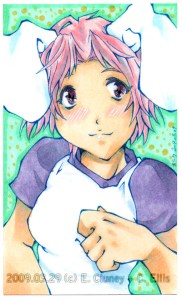
A while ago I posted up my first draft of a new D&D4e race called the “wild folk”. Earlier this week I went crazy working on them more, and came up with a revised version, thanks in part to feedback from folks at RPG.net, and my local friends. I got inspired to do all this because one of my friends is running a one-off 4e game and out of the blue he offered to let me play as one, something I wouldn’t have been bold enough to ask for, but wasn’t about to turn down.

The wild folk are basically a mishmash of races and characters from several different Japanese games. In particular, the Varna from Arianrhod, the weird tribes from the Grandia games, Fam from Ruin Explorers (pictured above), and to a lesser extent some of the part-animal races from Final Fantasy, all became part of it. They’re also a way to play a catgirl in D&D, and I wouldn’t really fault any DM that doesn’t want to use them in his or her campaign. On the plus side, I did some interesting things with their culture, and they have a vivaciousness and optimism that seems to be lacking in the existing D&D races.

I’ve put together an excessively complete write-up, basically the equivalent of a Dragon Magazine race article, plus monster stats. I’m pretty happy with the actual race write-up and the feats. The paragon paths probably need more polish, and the monster stats are… passable at best.

Wild Folk (Beta v2) PDF

Just for fun, I’ve also started statting up the Tabbit race from Sword World 2.0 (little rabbit people who excel at magic), and making a maid class (loosely based on Maid RPG). It’s going to be a quirky defender with some leader elements, and designing it is going to be a total bitch to do.

Octavia!

Every now and then I come up with a character that really strikes a chord and becomes something of an obsession. Octavia, my D&D character (a human warlord and Cormyr noblewoman, currently has the Invulnerable Coat of Arnd) is one of those. Hence, I commissioned a plush of her:

Octavia Plush by Squisherific

Update: The Octavia plush arrived in person; unveiling photos here.

Update 2: Here’s Adam’s artwork of her, which happened to arrive on the same day as the plushie!
octaviafinish

Dungeons & Dragons 4th Edition Cards

4e_character_02_edit

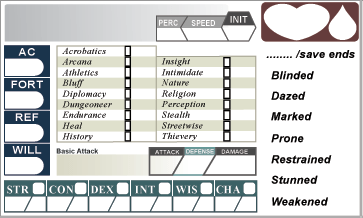
My friend Tim has been very ambitious about making neat stuff for our D&D4e game. With his permission I’m posting up the character and monster cards we’ve been using for it. Both of these are basically cheat sheets for the Dungeon Master to use, to keep track of initiative and other stuff.

Tim’s D&D 4e Character Cards (pdf)
Tim’s D&D 4e Monster Cards (pdf)

  • The PDFs are editable. You can print them out and write by hand, or type/copy and paste the requisite info.
  • The heart- and teardrop-shaped areas are for HP and Bloodied values, respectively.
  • The right side of each card lists off different status effects. You can put a paperclip on the corresponding spot to keep track of statuses.
  • On the character cards’ attribute area, the small square is for the base score, and the other two spaces are for the modifier and the modifier with 1/2 Level added, respectively.