Dragon World: Monsterhearts Lessons

Monsterhearts is one of those things that doesn’t necessarily interest me personally, but where I think it’s awesome that such a thing can exist. It’s an Apocalypse World hack that turns it into a teen paranormal romance game, and does a damn good job of it. It’s a genre that’s easy to make fun of–it’s aimed at women, Twilight is a seminal entry, it’s overdone to the point of getting its own shelf at bookstores–but Joe Macdalno unironically embraces it. I don’t know that it’s a game I’d want to play, but the Skins and Moves point to amazing things happening in it. The Mortal character is basically Bella Swan, and it gives you the tools to explore everything that’s messed up about that, including the things Stephenie Meyer isn’t talented enough to get into. Practically every character type makes me want to see/read something with them. “Twilight, but well-done and the boyfriend is a demon” could be amazing. (I also want a Twilight parody where the Bella type girl has a whole reverse harem of supernatural boys, but that’s neither here nor there.)
The other thing about Monsterhearts is that it really makes the framework of Apocalypse World its own. Dragon World has suffered in some places because I stuck too close to AW, whereas Monsterhearts embraces basic AW exactly as much as it needs to and no more. For example, aside from their sheer flavor, one of the things I like about the Skins in Monsterhearts is how they’re simpler in certain places. Each has only one set of stats (you get to add +1 to any one stat, which reminds me a lot of how certain Japanese TRPGs work), and the range of advancement options always include 2 slots for skin moves, 2 slots for moves from other skins, 1 gang, and a +1 to each of the four stats. Calling them something as simple and evocative as “Skins” is a nice little touch too. Even though I have a million other things to work on, reading Monsterhearts set wheels turning on Dragon World, hence this post.

I’ve done a fair amount of playtesting of Dragon World, and it’s right at that point where I know I’m onto something, but it needs work. I’ve also found that for me at least 3 players is the sweet spot, and 5-6 players is too many. I don’t know how it stacks up with other AW-derived games, but I’ve found that Dragon World requires a certain amount of GM attention per player, especially in terms of making their Temptations and Heart’s Desire relevant.

One of the biggest things I want to change is how character advancement works. Apocalypse World’s experience rules just plain don’t work well for my group. Highlighting stats is easy to forget, and it creates perverse incentives that lead to players trying to spam relevant moves. Monsterhearts includes the “Singleton Rule,” which says that you can’t mark experience from a given move or stat more than once per scene. While I like that idea–and will likely use it as a house rule any time I run AW or its progeny–for Dragon World I’m still planning to just drop the experience marking concept entirely and have players get one advancement per session. There are some other moving parts that tie into marking experience (like History), but after looking at Monsterhearts I’m feeling a lot more confident about slicing things out.
Relationship mechanics are one of those things that are very appealing for certain kinds of games, but a bit difficult to get right. Monsterhearts’ “Strings” system is note-perfect for the particular game. Strings are a currency you gain per character, and you can spend them to get an advantage over someone. Relationship mechanics have the issue that it can be hard to make them able to keep up with what’s going on in role-play, and Strings are ephemeral in just the right way, so that they don’t seem like they’d be trying to dictate or play catch-up with how characters relate to each other except insofar as they convey a very visceral advantage. This is definitely going to influence Slime Story whenever I get back into working on it. As for Dragon World, I’m thinking that while connections are awesome for developing the characters’ stories, the game doesn’t have any great need to assign a number to them. For DW’s source material I think helping or hindering others should work a little differently, and doesn’t really tie into relationships per se.

One of the big things in Dragon World that needs work is Falling Down. Not unlike Toon (or Teenagers From Outer Space), damaged characters are temporarily, comically incapacitated. The difference is that in Dragon World I made it binary–either you stay up or you Fall Down–with the caveat that for powerful enemies you need some kind of MacGuffin to make them Fall Down. As currently written, there’s the issue that PCs can be very resistant to falling down, but when they do fall down it kind of sucks because the player can’t participate in the game until the next scene, and they had no control over it. For a while I’ve been thinking about adding some kind of currency that players can spend to avoid Falling Down, and in turn I’ve been thinking that it would be very genre-appropriate for it to be easier or cheaper to avoid Falling Down by having some kind of freakout (not unlike a Maid RPG Stress Explosion) instead. I’m not sure what to call said currency, but it could well have other uses, and of course interact with certain moves. I definitely want to put a cap on how many a character can accumulate in order to prevent hoarding.
This is in addition to the stuff I was already looking into, notably story moves (a kind of temporary and sometimes detrimental move representing a story element like a curse or a certain situation) and an abstract wealth system aimed at getting PCs into trouble. I’ve also been working on an assortment of NPCs and setting elements, and trying to generally make the text better. I definitely needed a little extra distance from the text to come back to it fresh, and I can see the cracks a lot more clearly now. On the other hand this is a game I really want to play, because if I can pull it off it’ll be bursting with bright, silly fun.

Channel A: Progress Made

I now have a few playtests of Channel A under my belt, and I’ve made a few refinements. The biggest and quickest of these was letting the Producer draw a hand of 5 Premise Cards and pick two. After that, I’ve got a lot of things where I have a ton of options and it’s hard to discern which is the best.

One rather interesting thing I found out recently was the story of The Big Idea, a game originally from Cheapass Games that Funforge later re-released. Not unlike Channel A, a major part of the game is putting cards with words together to make something, in the case of TBI a silly invention. I’d played the Cheapass Games version with my brother-in-law (the one who has a wall of board games), and I hadn’t known that the newer version, along with non-cheapass production values, simplified the rules considerably. The game originally had an “investment” phase where players put currency towards different inventions, rolled dice, and got dividends if the investment/die roll worked out. The new version cuts out the investment phase entirely, making it into even more of a party game. (Is there a term specifically for card/board games that revolve around using the components to springboard into saying stuff?) It has an extra set of scoring cards, so that each player has blank cards and a medal card to hand out, face down, and that’s the extent of the evaluation/scoring mechanism.

The article also mentions that Apples to Apples was more complex before its publication, and I think that’s a good lesson to take working on this game. It’s easy and tempting to add more complexity to Channel A, say a thing where you see how your series fares on TV, but I’m increasingly sure that what I need to do is refine the core of the gameplay I already have. Aside from expanding and refining the decks,[1] the big thing I’m considering is whether to stick with the Producer setup or make what I currently have as the “Anime by Committee” variant rule (which coincidentally is closer to The Big Idea) into the default. I made a set of Voting Cards to try out the TBI method, though on paper it strikes me as a little cumbersome. I’ve updated the rules with that and some other ideas, and there’s a PDF below. I have entirely too many ideas for new Title Cards and Premise Cards, but I’ll get into that stuff later.

Voting Cards PDF
Channel A Rules (Alpha 2)
Bonus Title Cards

Update: I made a Channel A page and posted up another revised set.

My friend Suichi made a rather interesting observation about me as a designer, which is that where he thinks in terms of numbers and hard mechanics, I tend to think more in terms of the human interactions and how they shape the game. It’s why I came up with a game like Channel A where he never would have. I think I play RPGs for the interaction and in-the-moment creativity as given a springboard by the rules, which goes a long way towards explaining why the card games I really like, and the one I’m designing, are basically just vehicles for that.

…Though if you get all the expansions you can call it “11 Wonders.”

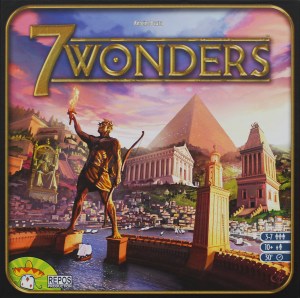
Last week I got together with some friends for what turned out to be an afternoon of board gaming. We played Cards Against Humanity, playtested Channel A, and then played 7 Wonders. It was really, really strange playing a Euro board game on the heels of CAH and CA, since we went from “Make an anime about vampires racing!” to “So I need to spend 2 Gold to buy lumber from Aaron.” It was very much the polar opposite, a thoroughly mechanistic if incredibly well-designed game, and in the Ewen/Suichi dichotomy definitely more of a Suichi type game.

[1]There’s also the possibility of later reskinning the game to have it be for video games or American cartoons, though I don’t know of anything with titles quite as over the top as anime.

Channel A: Alpha Prototype

To say that I’ve been inspired lately would be an understatement. The day after I posted up my Cards Against Humanity expansions, I thought about what I would do in the way of a friendlier original card game in the same general “using cards to make jokes” kind of style. The premise that resulted is a game I’m tentatively calling “Channel A” where you assemble cards to make titles of anime series.

One player is the Producer, and he or she plays two Premise Cards, with things like “School Romance” and “Giant Robots Fighting.” The other players each have 10 Title Cards, which have bits of anime titles like Perfect, EX, Penguin, Galaxy, etc. Each player tries to assemble an anime title from the cards and give a brief pitch for a series with that title that fits the Producer’s premise. The Producer picks a winner for that round, and then you rotate Producers and keep going.

It’s admittedly a bit derivative–it came from this fury of inspiration from CAH and there’s some of The Big Idea in there too–but I’m okay with that for my first attempt at card game design ever. I don’t know if I’ll make a habit out of it, but I’m definitely jazzed about this particular game.

For the initial prototype print and play version I used 2″x2″ cards like CAH, mostly because printing 20 cards per page makes life easier. Yesterday I roped some friends into a playtest with just the Title Cards (on account of I hadn’t finished the Premise Cards), and it was a lot of fun. I’m also tempted to start recording sessions to preserve some of the nifty ideas it produces.

Channel A (Alpha Prototype) PDF Download

Update: Some more on the game, including revised rules, in this blog post.

Update Again: I made a Channel A page and posted up another revised set.

If you want to make a deck, get the PDF printed on heavy cardstock and carefully cut out the cards. You can get a clear plastic box to keep them in at places like The Container Store or Tap Plastics. I’m looking for feedback both on how it plays and on elements to include in the cards (and the cards’ contents are just the sort of thing where I expect plenty of people to have opinions on what I’ve left out).

Happy Games

Lately there’s been some discussion of some pretty awful stuff that happens in the RPG scene, to the point where I get genuinely tempted to distance myself from the whole thing. I’ve been working on a blog post trying to address some of the awfulness, but it’s long and depressing and given the kinds of discussion that sort of thing can attract I’m not sure I can really handle it at the moment.[1]

Right now I want to blog about something more pleasant. I want to talk about happy, pleasant RPGs. It can be frustrating to try to talk to people about these kinds of things, and I see two major reasons. One is that violence is so ingrained into RPGs that many people just can’t even comprehend how you could have one without it, much less how it could be fun. The other is that I’ve found that any time you propose doing something unconventional in an RPG design, people act as though you’re demanding that the entire hobby should be that way from now on. I’m very big on variety, and while I’ve been involved in some very memorable long-term campaigns, to me the sheer variety of games available is one of the best things about the RPG scene we have today. When I say I want to see heartwarming, non-violent RPGs, I’m saying so from personal experiences that show to me that they can be great, and I mean I want to see them alongside all kinds of other games.

I’ve had direct experience with four such games–Golden Sky Stories, Raspberry Heaven, Clover, and Adventures of the Space Patrol[2]–which is probably a lot more than most people.


Continue reading Happy Games

Cards Against Humanity

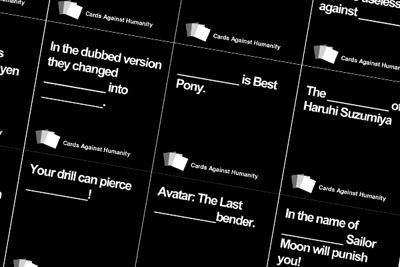
I don’t normally go in for card or board games, but Cards Against Humanity works entirely too well for me. It’s basically Apples to Apples with weird and twisted shit on the cards. One person plays a question card, everyone else plays an answer card, the first person picks their favorite, the person who played the favorite card gets a point, repeat.

A few hours after playing the first time I hit on the idea of making my own expansion full of stuff from anime fandom called “Weeaboo Bullshit.” The next day I started working on it, and also came up with another expansion of RPG stuff called “Grognards Against Humanity.” These only really work if you know their respective fandoms reasonably well (the Grognards set will make the most sense if you follow grognards.txt and RPGnet in-jokes), though the official CAH sets also have some specific/topical stuff in them.[1] Cards Against Humanity is recommended for ages 17+, and I tried to keep in the general spirit of that, so the Weeaboo expansion especially has some… unsavory stuff in it. At some point I might have to see about making a friendlier card game in the general CAH/Apples to Apples/Dixit/Once Upon a Time style, more about laughter and creativity than game mechanics.

CAH’s First Expansion has 100 cards, but each of my expansions has 108 cards, basically because I want to get full-sized versions printed for myself to go with the set I got from Amazon, and most POD printers do cards in increments of 18. The particular Creative Commons license they used means I can’t sell them, but whenever I get around to getting those ready I’ll post up the files so you can get your own made if you want. OTOH the CC license means you can do whatever you like with my cards too, as long as it’s non-commercial and you give credit.[2]

Here are the PDFs. They’re in the same format as the print and play version from the CAH website; follow the instructions on the first page of that one to print these.

Weeaboo Bullshit PDF
Grognards Against Humanity PDF

I also put together a set of tiff files for getting the cards printed via Superior POD so that they match the commercially available CAH set. Go to their Poker Size Custom Card Decks page and upload the tiff files (there are instructions in the rar file). Each 108-card expansion will cost $9.24 plus (rather expensive) shipping. I’m pretty happy with the results (you can see some photos here), though now my CAH mega-set (with the two official expansions and my two expansions) is about 1,000 cards.

Weeaboo Bullshit/Grognards Against Humanity tiff Files

Also, here are some other CAH resources:

[1]OpalCat’s page linked below suggests an optional rule that you can discard a card you don’t understand, but only after reading it aloud to the rest of the group.

[2]Speaking of credit, Clay Gardner gave some nice suggestions as I was finishing up the Grognards set.

D&D4e: The Blaster Wizard

“So what do you do?”
“I blast things with magic.”
“And?”
“Sometimes I blast them even harder.”
“…And?”
“Once in a while I blast them twice.”
“…You’re hired.

This started out as kind of a joke, but I took it all the way to fruition (or a first draft at least) for the fun of it. The D&D Next playtest spurred discussion about the merits of the super-simple fighter whose mechanical options seem to come down to “It hit it with my sword” fighting alongside a wizard with dozens of spells. More than once people have half-jokingly suggested a wizard who just zaps things, and I finally decided to make a 4E Essentials wizard subclass that is basically a magical version of the Slayer fighter. Then, after I’d gotten a good chunk of it done, I found out that the Elementalist sorcerer in Heroes of the Elemental Chaos was a lot like that.[1] I decided to finish it anyway, but to go even simpler and drop the stances I’d been planning to put in. I also realized just how inefficient the original Essentials class format is, so in terms of format this wound up being a hybrid of 3.5 and 4e. The end result is all of 2 pages, though that’s partly because I cheated a little and just gave the class wizard utility powers. It’s kind of a dumb joke, so although I made a reasonable effort to color inside the lines, I won’t promise it’ll work as-is.

Blaster Wizard (PDF)

While looking for a Touhou picture to go with this post[2] I also realized that at some point I’d like to play a magic user who specializes in assaulting foes with energy in dazzling colors. (Marisa would’ve been better to illustrate that than Reimu, but I don’t have all day to dig through Safebooru.) In 4e terms that would probably be some kind of sorcerer, maybe a chaos sorcerer, though I don’t know that I’ll have an opportunity to play 4e proper again any time soon.

[1]To my irritation this is easy to miss, as there’s just the one sentence about it, which appears after a paragraph about how the elementalist uses the standard PHB style class progression table and can take other sorcerer powers from PHB2 and Arcane Power. (But apart from that HotEC is one of the best 4e books yet, as is Heroes of the Feywild.)

[2]It being a series of shmups, basically every character in Touhou is a blasty type magic user of some kind or other.

Divine Machine

Divine Machine is the name of a setting I came up with for a what became a long-running campaign using OVA: Open Versatile Anime, if a campaign that ended on kind of a sour note because of things like my shortcomings as a GM at the time. Even so, I really like the setting that came out of it, and I definitely want to do something with it again. Like Beyond Otaku Dreams it’s another project I’m not going to get into any time soon, but which I feel like blathering about a bit on my blog.

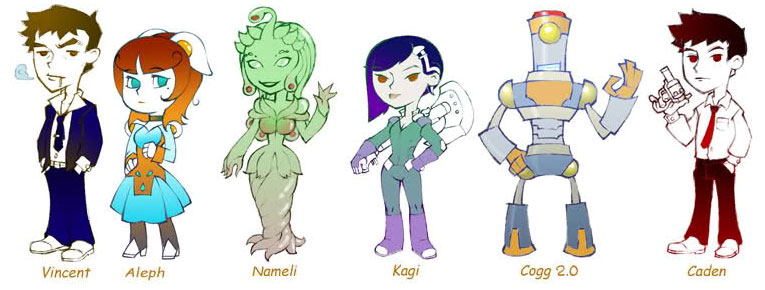
Most of the main cast of the original Divine Machine campaign; a guy who manifests different powers in each dimension, a girl who’s also a giant robot, a sentient plant and thief, a gray-skinned girl who can unlock anything, a modular robot, and a magic gunslinger/detective. Not Pictured: an anthro dog scientist/soldier, a Catholic priest with holy magic, a deranged goddess, the ship’s computer, and an obnoxious little demon girl.

At the heart of the multiverse is the Divine Machine, a great mechanism that takes up an entire universe, its parts made of solid information, where godlike beings create and shepherd entire universes. Magic is real, but it’s ultimately a way of accessing the Divine Machine in limited ways, and not available in all universes. The multiverse is home to a number of interdimensional nations, notably the Northstar Alliance (an interstellar civilization that expanded to be an interdimensional one, and which uses magic-tech kind of like the TSAB in Lyrical Nanoha), the Ix (terrible xenocidal cyborgs, which are kinda like Daleks), and the Holy Velkan Empire (expansionist mage supremacist religious fanatics). Looking back at my notes on the campaign, there was just a ton of really neat stuff in it that I’d like to do something with.

The huge campaign I ran before that was Star Sorcerer (which I’d toyed with renaming Ether Star or some such), which took place in an interstellar civilization that had rediscovered magic and refined it into “ether science” that in turn was behind a lot of their technology, including most of their faster than light travel and communications. I actually made some of the Star Sorcerer characters a key part of the Divine Machine campaign as part of an overall pattern of dropping characters from other things in now and then. Although I’d always intended for the Northstar Alliance to use magic-tech, if I do a full Divine Machine RPG I’ll definitely fold the Galaxy Alliance from Star Sorcerer into it, since they feel a bit redundant when they’re side by side.

Maya, an obnoxious little demon girl.

The big question is how the heck to make some kind of actual game out of it, especially given that I’ve made such a ludicrously broad setting. I’ll most likely have the game concentrate on some kind of elite troubleshooting squads from the Northstar Alliance, but that still means I need a game that can encompass a very wide range of characters and situations. At some point I’d like to make an RPG along the lines of one of F.E.A.R.’s SRS games (Alshard and its relatives), but that would let me make maybe a dozen solid archetypes through a lot of work. Right now I’m envisioning something in the general orbit of FATE, PDQ, and Cortex+, explicitly including a story mapping mechanic a la Pathways and Entanglements. Defining things in more narrative terms makes it easier to cover more ground without a ridiculous amount of design work, plus I’ve found that games like Spirit of the Century and Marvel Heroic Roleplaying are a lot closer to the type of game I really wanted all along than OVA[1]. I really need rules that can gracefully scale from a fistfight to literally universe-shaking conflicts. I can see the overall shape of the game in very general terms, but it’s going to be a while before I can really make time to properly work on it.

[1]OVA is great if it’s the kind of game you do want, and I’m not just saying that because I’m friends with Clay. I always say it’s the game that BESM was trying to be but never quite pulled off.

Magical Burst Update Number Whatever

Even though I have like a zillion other things to do, I got inspired to put in some more work on Magical Burst, which I’m sure a lot of you will be glad to hear. I have no ETA on when the next draft will be ready, but I’m in the thick of things working on it in any case. This post is a series of disconnected paragraphs on some of the different bits I’m working on.

I mentioned it in my last post on the game, but one of the big things I’m doing is more clearly writing out the procedures of play, which I think is really important. The big thing that I’ve kind of been groping towards is that the game and its source material are driven by “shocks.” In Madoka Magica the narrative has a constant escalation of shocking revelations, and in Magical Burst a lot of the rules are ultimately an engine for delivering similar kinds of shocks. I want to make it crystal clear in the text that this is the GM’s key tool for making things happen in the game. A whole lot of RPGs leave that kind of thing to trial and error, but I’m aiming for a fairly specific play style. There’s also the part about how my first playtest was kind of flat and I think not pushing the shocks was partly to blame.

In the 3rd draft I added Apocalypse World style moves to the game, especially for non-magical stuff. I did so kind of thoughtlessly, and now that I have some more experience with Apocalypse World (and Dragon World) I have a better idea what it is about the game that does and doesn’t work for me and the friends I play with.[1] The big problem I’ve had with moves is that players tend to want to treat moves as push buttons rather than role-playing towards them first. (Doubly so for moves that use a highlighted stat.) My solution is to treat moves a bit more as a thing the GM brings to bear, and to remove them from the player reference sheets. Moves don’t have to be secret from the players, but I do think the game could work better if the moves weren’t staring the players in the face the whole time. I’m also going to be rewriting them a bit to better fit this GM-oriented approach. I pared down the Normal Attributes to Charm, Insight, and Tenacity too, and let players assign points for them (but with fewer points and lower values than Magical Attributes). I still need to dig into moves and such to get a better feel for them though.

My philosophy for revising the rules for youma this time around is basically, “Make them fucking MEAN, and scale back later if need be.” My experience and pretty much all of the feedback I’ve gotten so far as been to the effect that as written youma tend to get wiped out pretty quickly, which isn’t anything like what I’d intended. It’s surprisingly hard to make good “boss monsters” (or solos in D&D4e parlance) that can effectively fight a full team of PCs, and I think that for the purposes of designing such enemies I need to ignore some of the kind of advice that I think of as good sense in other circumstances, like being stingy with extra actions in a combat round.

I renamed Appendix 1 to “Instant Magical Girl,” and I’m working on expanding the tables enough to make it possible to generate a completely random magical girl. I had intended for it to be more of an optional thing for people to turn to when they’re stumped, but it’s pretty clear it’s become core to how a lot of people play the game. The folks from the Empire Tabletop podcast (who previously did Maid RPG) did a Magical Burst AP episode, and their attitude was basically, “Why would you ever NOT make a character randomly?” For attributes I’m working on a d66 table that gets you one of 36 sets of attributes, and I rearranged the tables so that they follow the same steps as the character creation rules. When I mentioned that I want someone to make an online random magical girl generator on Twitter I got three replies almost immediately, so it’s pretty much guaranteed to be a thing that will happen. I may try to get the youma rules to the point where you can generate one totally at random too.

Update: Carly M. Ho put together a great little Magical Burst character generator!

Update Again: And then she went on to make a Youma Generator and a Tsukaima Generator!

I have a rough outline for a Magical Burst novel about Yuna and Makoto (from the intro comic script), though I’m struggling a bit figuring out how to get started and how to find the right tone. (Watching Brick the other day has me wanting to explore a stark noir style.) I like the idea of making it a tie-in with the game with game stats and info for the characters and such in the back, but first I have to, you know, write a novel and make it not suck. I’m actually worse at finishing novels than I am at games, if you can believe that.

I just finished re-reading Planet Guardian, a manga which hardly anyone but me seems to know. (Even scanlations haven’t gotten past chapter 2.) It doesn’t have all that much influence on Magical Burst, but I like it a lot nonetheless. The main character is Koyuki Kisaragi, a girl who got magical girl powers from a little critter named Pirosuke. Five years later there’s been no sign of the alien criminals that were supposed to show up, and Koyuki just wants to study hard and get a cushy government job (and Pirosuke has gotten so fat that he’s spherical). When the first bad guy shows up, Koyuki goes to fight it only after massive badgering from her brother Itsuki, who berates her for failing to be a properly cute magical girl like in anime. When another magical girl shows up it’s Ririka Saotome (real name: Yoshiko Yamada), an abject psycho whose desire to be the center of attention is potent enough to break the fourth wall at times. There’s also a boy named Shizuku, who treats being a Guardian as a serious duty, at least once he gets over his older sister’s attempts to dress him up in weird outfits. The story is kind of random and aimless, but I really like the differing attitudes towards being a magical girl (or boy) on display, as well as how Koyuki’s attitude evolves over the course of the story as she starts to take the responsibility of protecting the world seriously. But anyway. I may see about ordering the Madoka Magica novel, though it’s apparently over 500 pages.

[1]AW style experience tracking pretty much just fails for us, though that’s more relevant for Dragon World. It’s also related to enough other things that rejiggering the rules to work differently in Dragon World is going to be… interesting.

Beyond Otaku Dreams

I had yet another idea for a game. Not that I’m going to do much with it any time soon.

I recently went to FanimeCon, a local anime convention. I’ve watched Fanime grow from a meeting of multiple anime clubs at a community college to one of the bigger anime conventions in the U.S., and if I’m honest, for me it had a sweet spot in the late 90s that it’s left far behind. But there are about 20,000 people who think it’s worthwhile, and a lot of them seem to love it without reservation. Even so, there’s been drama among my friends at cons, and every now and then I’ve caught a glimpse of someone in real pain and wished I could do something. I feel like narratives about fandom tend to be either too sanitized or too cruel, presenting either an idealized vision of fandom or painting an entire swath of people as obnoxious and worthless. In real life, in my reality, anime fans are just people. They can be amazing as well as horrible, but most of all they never stop being human.

Another thing I’ve been wanting to put into some kind of creative project of some kind is the idea of otaku whose delusions take on a life of their own, who live somewhere between worlds of dream and reality. A character might have a perfect dream companion, an imaginary lair to retreat to, or special powers they wield in their world of delusion, which reveal things about them. Their delusions sometimes go out of control, sometimes intersect and combine in ways that should be impossible, and occasionally leak into normal reality. Lately I’ve been really enjoying Akibaranger, a parody/spinoff sentai series where the heroes’ battles take place in a shared delusion, at least at first, distracting them from their real-life troubles. The way they’re so conscious of sentai tropes adds a certain charm too, especially when things don’t line up with their expectations.

I’d had the idea to do a game like this before, but I think it was missing the pathos, the uncompromising human drama. The desire to escape from reality is at its most poignant when you have something to escape from. I also want it to be about people who do have a chance at redemption, who can overcome the issues that drag them down. Maybe it’s my way of telling people that there’s still hope. There was a thing called Densha Otoko (it started out as a forum thread and went on to be in a ton of different media) about a hopeless otaku who through happenstance made contact with a normal woman by saving her from a drunkard’s harassment on a train. The thing that bugged me (and I think a lot of people) about it was how he had to completely leave his fandom behind and force himself to be “normal.”[1] Real life experience tells me that you don’t quit your obsessions cold turkey, but rather find ways to make them grow up along with you.[2] You can change for the better without having to not be yourself.

I haven’t gotten very far with this game, and I don’t intend to until I’ve got some other things dealt with (Golden Sky Stories and Magical Burst). What I do know is that it will be something like an otaku version of Don’t Rest Your Head, one of those indie games with baroque mechanics that feed interesting stuff into the story.

[1]This assessment of the story may be a bit flawed because I never got around to finishing the Densha Otoko TV drama, but let’s ignore that because my version illustrates the point that comes next really well. OTOH the series’ opening was fantastic, a sendup to the Daicon IV opening animation.

[2]Personally I’m still working on it, but I’m getting there. I think.

Golden Sky Stories Update: Progress and Bonuses

I figure we’re a bit overdue for an update on what’s going on with Golden Sky Stories, so here goes. Right now the plan is to launch the GSS Kickstarter on the heels of Tenra Bansho Zero‘s Kickstarter. Assuming Andy and Luke keep on schedule, that means we should be launching the GSS Kickstarter around the end of June. That means we have a couple more months, and we’ll be using that time to get everything in order so that when we do our own Kickstarter we’ll be that much more able to get everything out to everyone without undue delay.

Slow and Steady Does the Layout
The graphic designer for Golden Sky Stories is none other than Clay Gardner. He is the designer of OVA: Open Versatile Anime, and has done graphic design work for a huge variety of projects, including several games from Minion Games. The original Japanese version of Golden Sky Stories was already a feast for the eyes, but Clay is using his graphic design skills to add another layer of polish all the same. He recently put up a blog post where he shows off what he’s doing with the power descriptions for rabbit henge. Clay’s currently about halfway done with the layout, and I’m really liking how it’s looking so far.

Something Fishy
A while ago I hit on the idea of making a new, original character type for GSS as a Kickstarter reward. Ben Lehman (who you may know from games like Polaris and Bliss Stage) stepped up and offered to try his hand. About a day later he sent me his first draft of a writeup for fish henge. We’ll be doing some refinements between now and the Kickstarter of course, but Ben’s writeup is already wonderfully whimsical and mythical. It’s a bit of an “advanced” character type that’ll be a little tricky to play.

I’ve also been working on a writeup for “pony henge,” which are indeed partly inspired by My Little Pony: Friendship Is Magic, albeit with plenty of elements inspired by reading up on horses on Wikipedia. Looking up idioms/cliches about an animal is a great way to come up with powers for henge by the way. I’m still working out what exactly to do with these new writeups, but at present I’m thinking of having the fish henge be a Kickstarter exclusive and having the pony henge be a freebie.