Retail Magic Design Journal 1

I’ve been making good progress on the aforementioned Retail Magic RPG (though the Yaruki Zero book is still eating up a lot of my free time). Kamiya was amenable to the idea and and even impressed with the draft of the character creation rules I showed him, so it looks like I don’t have to worry about whether the project is feasible on that front.

The PC (employee) creation rules are done, though I need to take some time to refine the selection of Special Qualities. There are a few things I copied over from my draft of Mascot-tan that I should probably revise or remove, and possibly a few things I need to add. I also finished the boss and store creation rules, though that went faster because I decided not to write up a separate Special Qualities table for bosses. I had fun making the store creation tables a bit more expansive than the mansion creation tables in Maid RPG, so you roll for the store’s appearance, location, specialty, and special features. Let’s give those a try:

Alyssa Foxtail
Attributes: Athletics 2, Cunning 0, Guts 3, Luck 2, Presence 0, Skill 3
Boss Type: Obsessed Artisan
Boss Assets: Magical Power, Property
Favorite Employee Type: Weirdo
Boss Special Qualities: Fox Ears, Overactive Imagination
Stress Explosion: Making Corny Jokes/Punning
Colors: Hair: Gold, Eyes: Silver, Outfit: Red and Yellow
Stress Limit: 30

Alyssa is one of the fox people of the eastern forests. She started Fox Hunt Specialties because the only thing she could do to earn a living was to harness her innate magical talent. Although she looks fairly attractive, in a disheveled kind of way, she’s actually kind of annoying and unsocial, and tends to neglect her employees.

Fox Hunt Specialties
Store Appearance: Eccentric Construction
Store Colors: Teal and Violet
Store Location: Magical Mobility
Store Specialty: Material Components
Store Special Features: Arcade Game, Dimensional Interior

Alyssa’s store is the result of building a hut out of discarded glass bottles and then attaching a pocket dimension to the entrance. The store’s exterior is about the size of a small phone booth, but the interior is a full-sized store, with countless racks of merchandise, including an impressive collection of spell components in mason jars behind the counter. The dimensional enchantments on it are a little bit unstable though, and the store has a way of jumping around the city at random. A brief trip to Earth resulted in a Simpsons arcade game machine being delivered to the store by accident, and Alyssa was able to bind an electricity elemental to power it.

I’m also working on a d666 item table, though writing up 216 items is going to take quite a while. There are only so many zany D&D items to borrow from. I’m planning to take after the original Japanese Maid RPG rulebook and include two scenarios and a replay, though I need to get a bit further along before I can make those. I’m also contemplating hiring Sue-chan to do the artwork, since I think her style would mesh pretty well with the overall feel of the game.

Since so many of the people interested in the game have expressed interest, I’m also putting together a chapter for putting Retail Magic into a modern/urban fantasy setting, which is turning out to be roughly the same setting as Magic School Diaries. I’m still working out what actual new material it’ll require, but right now the “Memos from Corporate” table is shaping up to be my favorite part of it.

The big thing that has me stumped is how to approach doing commerce rules. It makes perfect sense to have optional rules for handling running the store’s business, but I don’t even know where to begin. Also, owing to the choice of rules systems, this will be one of my rare non-open designs, but I will be looking for people to do outside playtesting rather than posting it online.

2012 in Review

Apparently it’s going to be a regular thing that I write a year in review blog post (with some images pulled from safebooru). Overall I’d say it was a good year for me as a writer and designer, and a so-so year in terms of actual gaming. Where last year I was in a really memorable Smallville/PTA game, this year nothing quite gelled that well. We had some fun with a retro space opera game done in FATE, played a bit of GSS, did a good amount of Dragon World, and did a heck of a lot of Channel A playtesting.

sample_e47568dd14de864269edf683ffada49a9c158071

One of the biggest developments for me as a gamer was that I discovered I love talky, creative party card games. I tried Cards Against Humanity for the first time, then in short order I got my own copy and made my own expansions. By and large I’m not a big fan of board games, but I found that I really like when they have some element of socialization or creativity as a core activity. I went on to design two card games of my own, Channel A and i.hate.everyone.

Although I did a good amount of work on Magical Burst, in 2012 the big winners for me were Dragon World and Channel A. I posted up versions 0.1 and 0.2 of the Dragon World Hack, and got in a dozen or so game sessions. Although it has a ways to go before it’ll be ready for publication, I did make some considerable improvements, and Monsterhearts inspired me to do a better job of making the AW rules my own. Channel A came into being in a rush of inspiration. It was sufficiently simple and on-target that it was relatively easy to get in enough playtesting to refine it with unusual speed. I went as far as to put together a color prototype for printing through The Game Crafter, and after another round of refinements made it available for purchase. There’s some really exciting stuff cooking with Channel A, but nothing I’m quite ready to talk about publicly just yet.

During the last few months of 2012 I was unusually prolific in how much I wrote. In October I made some more progress with the next draft of Magical Burst, in November I wrote the first draft of a Magical Burst novel, and in December I started on Magic School Diaries, Retail Magic, and a new version of Peerless Food Fighters, AND wrote the first draft of the Yaruki Zero book. Magic School Diaries is a solo RPG that will work as a sort of guided writing exercise, where you play a student at a modern-day school of magic, kind of like Harry Potter with a mix of American and anime sensibilities. Retail Magic is a game where you play employees at a magic item shop in a fantasy world, and will use the Maid RPG rules. I conceived of it basically because I wanted to share the awesomeness of the Maid rules with people who can’t handle playing maids, but it’s also a game concept I’ve been wanting to do something with for many years. I posted up a first draft of the new Peerless Food Fighters the other day, but it has major design flaws that I need to address before I do anything more with it.

62259f505f796e4abcdca65880a1a17a7ef0752e

Of the blog posts I did this year, two were fairly large and substantial. One was a lengthy overview of the rise and fall of Guardians of Order. My interest in mixing anime and RPGs made GoO’s products and history stand out in my mind, and not for the first or last time I wrote a history, from my own point of view, of something few people have really written about. I also wrote a long post called “The Assumptions,” where I outlined what I felt were the overriding cliches and assumptions of RPGs, and discussed how and why we should be breaking those a bit more than we are. That kind of writing is what led me to start putting together a book titled Yaruki Zero: Collected Thoughts on Role-Playing Games. I had started with the idea of simply collecting some blog posts, but I very quickly found myself doing major revisions and writing a huge amount of new material (some of which I’m going to be posting up here). I’m currently in the process of finishing up the second draft before I send it to a for-reals editor (an acquaintance named Ellen Marlowe), and just yesterday my friend C. Ellis sent me a sketch of the cover I hired her to do for it. At the rate it’s going I’ll launch the book (through places like Lulu, CreateSpace, the Kindle store, etc.) in a few months.

Golden Sky Stories has been dragging on for a while now. It’s no Tenra Bansho Zero, but it’s certainly taking a lot longer than anyone concerned would prefer. A lot of that has to do with my business partner having a rough time with his employment situation, though I won’t pretend we’ve been going at full steam like maybe we should have. The good news is that the layout is about 99.9% done, we already put out a free preview replay, and we’ve got a bunch of really neat bonus material lined up. My latest e-mail exchange with Kamiya brought news that there are two more new character types we’ll be able to do in English. We’re hoping to get the Kickstarter moving in the next couple months, but it depends a lot on how Real Life decides to treat us.

Ewen’s Game Design Advice

I finished my first draft of the aforementioned Yaruki Zero book and have been working on finishing up the second before I send it to an editor. I ended up writing quite a bit of new material for the book, and I thought I’d post a few selections. The one person who commented on my post about the book was M. Joukamaa, who expressed interest in stuff on how I approach GMing and game design. This is what I wrote about the latter. I got inspired to post it because on Saturday I tried to run a playtest of Peerless Food Fighters and it didn’t work at all, in large part because of a massive failure of the stuff I talk about under “Perspectives.” (I also started working on Magical Burst again by the way, though we’ll see how that turns out.)

I don’t think of myself as being an ace game designer or anything, but I do occasionally manage to put together something that people like. I believe that RPGs can be just about anything, and that pretty much nothing should be off limits. There are considerations for good taste and common decency, but that’s about it. As discussed in my “The Assumptions” post a while back, there are an awful lot of things that people needlessly (in my opinion) assume are necessary for a proper RPG, but then the “RPG” label isn’t the important part in the first place. If people tell you that through using cards and such you’ve made a board game instead of an RPG, your response should be, “But is it a good game?”

Game design, at least the way I do it, is such an idiosyncratic, unpredictable process that there can be no step-by-step guide. Instead I’m going to lay out some of the major ideas and principles that help me make games.

Your Game Is Not a Book
I can’t take credit for the pithy phrase in the heading above—it came from a post Tyler Tinsey made in a thread on Story Games—but it’s a point that bears repeating. These days the vast majority of RPGs come to you in the form of a book, but the book is not the game per se, just the means of conveying it to people. The book can be a vitally important artifact for the process of playing the game, but the game itself is first and foremost an activity that happens between people.

I have a habit of treating an RPG as something of a writing project. I’ll fritter away hours writing up setting details or general advice, sometimes while neglecting more important aspects of the game. This can be good when it lets me keep up some momentum on the overall project, but it can result in a game that’s over-written. And besides, if the design part isn’t there I’m going to end up obviating some of that text I wrote anyway.

A certain amount of reading can be reasonable or even desirable, and there are plenty of people who engage in a sub-hobby of RPG books as reading material. However, as the designer of a game your first allegiance has to be to creating a game that plays smoothly. That means that the game information that people need in order to play needs to be easy to learn and reference. That doesn’t mean an RPG has to be simple, but it should be simple for the human being at the table to find the information they need very quickly. The playbooks in Apocalypse World are one rather brilliant solution to this, as they present the player with virtually all of the player-oriented rules in the game, including everything specific to their chosen character type, in one little pamphlet.

On Collaboration and Feedback
One time a friend asked me, “Do you even like brainstorming?” At the time I didn’t even understand the question. My idea of brainstorming is the thing where I sit down by myself with a pen and notebook and think and write stuff down until I have enough ideas to go on. My friend’s idea of brainstorming is hanging out with some friends and letting the ideas fly, and I’ve never been as avid a participant as perhaps he’d like. This is because I’m an introvert, and for the most part I’m a solitary creator. When I have a vision, I sit down and do stuff until I get to where I either finish it, can’t proceed without help, or just give up. When I do get feedback from people, I find it needs a huge amount of filtering, a process of separating the rare nuggets of gold from the rest. Feedback is an important tool, especially feedback informed by direct experience with the game, but like all tools it only has certain uses.

Other people create differently, and ultimately you need to find what works for you. Once you figure out the right way for you to create things, do that without hesitation or remorse. If you’re like me, what you need to do is buckle down and just start writing something. If you’re more like my friend, you need to find people you can talk to, and share your ideas and difficulties freely.

Know Your Limits
Sometimes I come up with this amazing idea that I just can’t seem to get anywhere with. Experience has taught me that there are times when the best thing to do is to shelve a project, play lots of games, and come back to it once I’ve grown into the person who can make it work.

Open Design
I favor a very open approach to game design. I blather about whatever project I’m working on in blog posts and tweets, and the moment I have a workable draft I usually toss it up on my blog for the world to see. Somehow or other I’ve gotten to a point where some people actually pay attention when I post something, and a lot of that is a result of years of tossing stuff out there to see what happens. Some stuff flies under the radar, and other stuff just explodes. I can never tell which will be which, though stuff that fits some frantic need for a game in the vein of a popular anime certainly seems to do the trick.

For a long time there have been people who were totally paranoid about protecting their creations, who go to the trouble of filing patents and copyrights in case someone tries to steal their ideas. There may well be something somewhere where that happens, but if you’re making an RPG, you have a lot more to gain from sharing what you do. Chances are you’re not going to make much money from an RPG in the first place, and to the extent that you can, building up goodwill through open design, receptiveness to feedback, and so on can give you a huge boost. If you just have to put it in cynical terms, it’s advance marketing and market research for when you eventually turn the game into a product.

Just Plain Role-Playing
I try to avoid concerning myself with definitions of what is and isn’t a “role-playing game,” in part because it’s rare for people to propose definitions without having a game in mind that they want to exclude. That said, I think that if you’re trying to design an RPG, that essential act of taking on the role of a character and expressing their thoughts and actions is a vital part of what distinguishes an RPG from other kinds of games. Players don’t necessarily have to be climbing deep inside their characters’ heads to play an RPG, but the element of human interaction needs to be there. It’s also an incredibly powerful, fundamental tool for the game designer.

Whether you take an immersive approach or more of a collaborative storytelling approach, novice and veteran players alike tend to catch on pretty quickly.[1] Some RPGs are free-form role-playing with some important touches of rules (like Seasons), while others are more like board games with some role-playing elements (like Peerless Food Fighters). Whatever your approach, the role-playing part should be important and consequential.

I try to avoid rules that bypass role-playing and especially rules that dictate role-playing. Players usually have a better idea how their character should react than the GM, the game designer, or the clockwork of the game rules. On the other hand, I love RPG rules that react to role-playing and give players incentives. Compelling an aspect in FATE is a perfect example of this. If the GM feels an aspect should lead a character to something disadvantageous, the player has a choice between either going with it and getting a Fate Point, or overcoming it by paying a Fate Point. There’s a strong incentive to go with the compel, but the player nonetheless has a choice.

The Negative Space Principle
There’s a school of thought that whatever an RPG is fundamentally about, you should have a stat for it. If your post-apocalyptic game is about hope, there should be a space on the character sheet that says “Hope.” I would dial that back a couple steps and said that if the game is about hope, you should ask yourself why it is you don’t have a Hope stat. Your answer might simply be, “Oh yeah, I should try that,” but there is also what I call the “negative space principle” of game design. Sometimes what isn’t in the game is as important as what is. That’s especially true when you have some element that you don’t want to be in the game too much.

Ryo Kamiya’s game Golden Sky Stories is aimed at heartwarming, non-violent play. There are a lot of reasons why it works, but one of them is the nature of the combat system, or lack thereof. In earlier drafts of the game he’d tried out an approach intended to emulate fairy tales, where having the right preparation or MacGuffin could grant a massive advantage. In the final game however, there is no actual combat system. There’s a section on “quarrelling,” which warns that fighting is something you really mustn’t do, but reluctantly says that you can have a fight a contested check. Whoever gets the higher total wins, and the fight is over. Where most RPGs put a significant amount of the page count towards detailed combat rules, GSS presents a single rule that’s rather boring to engage and doesn’t have any lasting mechanical effects. “You won. He’s kind of bruised and crying. Now what? You big meanie.”

Another important aspect of RPGs to consider is that there is a large body of conventions that are vital to how the game functions, but that we usually don’t think of as rules per se. In a traditional RPG there’s a Game Master who has final authority over making rulings, controls NPCs, and so forth. Those things are actually more important to the game than whether you roll 1d20 or 3d6, so much so that people can and do role-play with nothing but guiding conventions. These things are not off-limits to a game designer, but the more you change the base formula, the more likely you are to have to explain things in detail.

Ben Lehman’s game Polaris is an ideal example of this. You have four players, and when your protagonist is active, the other players each take up a specific slice of what would normally be the GM’s role. The overall rules of the game are fairly simple, and the setting is unusual but does not take up an undue amount of space. What brings Polaris as a book up to the scale of a typical indie RPG is that it has to explain its unconventional procedures for apportioning roles, using key phrases, and resolving conflicts.

Perspectives
To me one of the biggest hurdles in design is the matter of perspective. A player and a GM can have very different perspectives on a game, and the game designer has a third perspective that differs even more. To a player a list of powers is a thing where they’ll get to look through, pick a handful for their character, and then try to put those to good use during the game. For a GM the same list is something three or more other people will be picking from and using against obstacles that the GM puts together. For the game designer, the same list can become a chore where you’ve got to, say, fill up a table of 20 powers, and can we please just finish this I want to go to sleep.

It’s not easy to flip your own perspective around, but it’s important. Players vary in what they want out of the game of course, but in my experience most people want their characters to be effective at what they want to do. People will make decisions accordingly, which usually means picking out abilities that strike whatever they consider the right balance between effectiveness and achieving the desired aesthetic, and carefully shepherding whatever resources the game gives them.

This is an area where the designers of D&D 4th Edition by and large knew what they were doing. By creating At-Will, Encounter, and Daily powers, they carefully channeled players’ tendencies towards the kind of combats they wanted the game to have. Encounter powers give you some tricks that you have generally no reason not to pull out during any given battle but can’t abuse the entire time, while Daily powers give you the big guns to pull out when you feel you need it. Where they fell short was with things like the ranger’s “Twin Strike” At-Will power (which is so overwhelmingly good that in the long run it outclasses a lot of Encounter powers), and rituals (for which the cost in gold pieces is often too much of a disincentive).

Where the F*** Do Ideas Come From?
It’s a cliché that writers hate it when people ask where they get their ideas. The only real answer to that question is “Everything.” Everything you experience, whether firsthand or vicariously through any number of forms of entertainment or socialization can potentially be the spark that sets off an amazing game idea. Try to pay attention to life in general, no matter how mundane.

I get a lot of ideas for games from other media, especially anime. While it’s important to not lose sight of the fact that you’re designing an RPG, I reject the notion that RPGs are so separate from other narrative forms that they have nothing to offer. I think a significant portion of the more interesting developments in RPGs of the past decade or came from a desire to figure out how to make an RPG out of a work in another medium.

Just Make Something
Don’t ask for permission before you start, don’t even ask for forgiveness after you’re done. Don’t think about where it will fit into the marketplace, or what competition you’ll have. Think about what moves you, and get to work already. A lot of people never create anything because they’re waiting for someone to give them permission. The people who get things done are the people who just make something and run with it. I didn’t ask anyone if this book would be a good idea. I just did it. And then kept doing it, in an obsessive plunge that filled up over 60,000 words in a matter of weeks.


[1]Although novice players sometimes need someone to teach them the difference between role-playing a character and helping tell a story, and veteran gamers are sometimes too set in their ways to get into games with more of a storytelling approach.

Peerless Food Fighters 2.0 (PNP)

Peerless Food Fighters! was the first Kyawaii RPG I did, way back in 2008. It was a GM-less little thing about fighting waitresses, with Noodle Fighter Miki a major inspiration. When I took it into my head to try to make an RPG with board game style presentation, PFF was the first one to come to mind. It was already kind of mechanistic and board-game-like in its design, and in terms of its basic design this new version isn’t all that different. The major thing I did was to go completely crazy with cards, plus implementing the “dueling” concept that came out of the time I played the Kyawaii version with some friends. It involves a grand total of 110 cards, spread across four different varieties that serve different purposes. I got about $6 worth of generic board game components (12 pawns, 6 poker chips, 6 card stands) to complete the set, though if you’re crafty you could find some printable pawns and such.

PFF-Characters

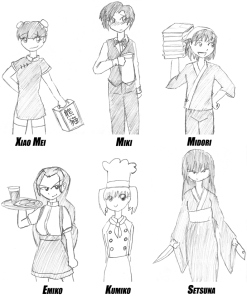
I’m rather inordinately fond of the approach of having a set of pre-made, color-coded PCs. I’m planning to commission some better artwork done so that I can replace my kind of lame attempts at drawing the characters, though I have to hold off a little on spending that money. Using colors and symbols was generally interesting to me, and the Noun Project and Game Icons were invaluable for getting icons for the attributes/card suits.

The Fate Deck wound up being one of the more interesting parts of the game. I decided to replace the six-sided dice from the game with a deck of cards, which in turn led me to add more and more interesting information to the cards. About half have game effects, and the other half have flavor to influence role-playing. They also have suits that match the attributes, which figures into the flavoring and effects, as well as adding a small bonus if your chosen attribute matches.

Peerless Food Fighters 2.0 PDF

The game’s gotten zero testing, though I’m hoping to give it a try pretty soon.

Another Project: Retail Magic

After about 2½ weeks I finished the first draft of the Yaruki Zero book, which weighs in at a bit over 60,000 words. It’s like I got up to a certain speed with my writing and can’t slow down. Right now I’m having some friends look it over before I start on a second draft.

In the meantime, I got inspired to start on another new project. I’ve been wanting to do a new game using the rules of Maid RPG for ages now; I even came up with the idea to call the rules the M.A.I.D. (Maniacs Asymmetrical Interactive Delusion) Engine. I want to do this partly because it’s just something fun, and partly so the people put off by the maids might give the same rules a chance with subject matter that won’t freak them out so much. My attempt to make a new version of Mascot-tan didn’t work out basically because gijinka characters don’t mesh with random chargen at all. I may take another stab at it once I rethink the character creation rules, but a recent bit of renewed hysteria about Maid RPG got me thinking about it again.

My first idea was to do a game in the vein of Urusei Yatsura, about human and alien teenagers in everyday life. Except I don’t really want to rewrite Teenagers From Outer Space. My second idea, and the one I latched onto, was to make a game where you play the employees at a magic item shop in a fantasy setting. It’s something I’ve been wanting to do for years–I ran a game with the same concept using Risus a couple times–but the moment I allowed the possibility of using the Maid RPG rules for it, it made entirely too much sense. Characters can be random and zany on the level of Dragon Half, and the store setup naturally gives you an authority figure NPC like in Maid RPG. I’m still working out what other kinds of rules I want to put into the game though. I’m definitely putting in a d666 random item table, and rules for generating a boss and a shop. On the other hand while it seems natural if not inevitable to put in some kind of basic rules for doing business, I’m not sure of the right way to do it, especially since it needs to mesh with Maid RPG type craziness. (Also, I need to sit down and play Recettear, since I’ve had it on Steam for a year now and everyone who hears about the concept says, “Hey! A Recettear RPG! Awesome!”)

I very quickly settled on the name “Retail Magic” (if you’re picking up an element of deep sarcasm, it’s because that’s what I intended), and since I had a good chunk of my attempt at a new Mascot-tan written up, it’s not so long a journey to a functional rules draft.

One of the things that’s changed between 2008 and now is that I started working in the video game industry as a localization editor, and that helped me shed a tendency to be overly literal in how I translate things. There are an awful lot of things in Maid RPG that today I would word differently, both to better fit American standards (it would’ve been trivially easy to change the “Lolita” Maid Type to “Cute”) and for simple clarity (like renaming “Spirit” to “Stress Limit,” which succinctly tells you what it does). Putting together my own game text from the ground up lets me get everything just how I want it, and lets me keep a close eye on content without having to rewrite or outright excise a bunch of stuff from an original version.

Since I finished the first draft of the employee creation rules (minus descriptions of some of the traits), let’s give them a test drive.

Angelina (Age 24)
Attributes: Athletics 3, Cunning 1, Guts 3, Luck 3, Presence 1, Skill 0
Employee Types: Adventurer, Weirdo
Employee Special Qualities: Pet (albino falcon), Eye Patch
Employee Roots: Under a Curse
Employee Weapon: Holy Magic
Stress Explosion: Hiding in a Box
Colors: Hair: Wine, Eyes: Amber, Outfit: Beige and Off-White
Stress Limit: 30
Starting Favor: 0

Angelina is a former cleric who lost her eye in battle against the Dark Lord’s forces. She works in the store solely because she fell under a curse that makes it so she can’t leave. She’s been adventuring so long that she doesn’t quite know how to relate to normal people anymore, and when things get to be too much she tends to hide in a box until it goes away.

So yeah, I think I’m on the right track. :3

Update: Here’s a few more attempts at making characters.

i.hate.everyone

Not too long ago I was in contact with a game publisher who was interested in a game in the general style of Cards Against Humanity, a tasteless drinking game type of thing. I got a good start designing and testing such a game, but the publisher went with something else. I don’t bear them any ill will (I will admit to being disappointed), but I like the game I created enough to want to share it. I may eventually pursue publication, but I have enough other projects going on that without a publisher lined up I’m going to shelve it for the time being.

i.hate.everyone is a game of social media whoring. It follows the query/response from a card format of Apples to Apples and CAH, but everyone plays a response, and everyone votes by giving a Like token to the player whose response they liked best. Cards can also have special effects, ranging from reading cards in a French accent to various shenanigans with the cards. For me and my friends the silliness with drawing and discarding cards fixes the single biggest issue with the game’s predecessors, namely the tendency to get stuck with a lousy hand.

I picked the name “i.hate.everyone” partly because I feel it conveys about the right sentiment, and partly because it leaves it wide open for expansions and alternate versions called “i.hate.[something].” I already started on one called i.hate.fandom, which was the game I was kinda sorta thinking about doing before the aforementioned publisher came into the picture.

To play you’ll need to print out the cards on cardstock, preferably with a different color for the Status Cards, and you’ll need a decent supply of tokens of some kind. I find bingo chips or sorting chips work well, but pretty much anything will do as long as you have at least 100 or so. You can also pretty seamlessly shuffle them in with the print and play version of CAH if you want.

Players: 3-8
Play Time: 30+ minutes
Recommended for Ages 17+

i.hate.everyone Rules PDF
i.hate.everyone Status Cards PDF
i.hate.everyone Comment Cards PDF

Yaruki Zero: The Book

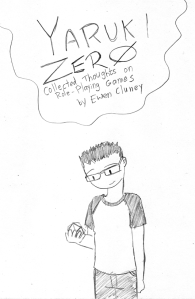
ykz_ewenI started up a new project, because I just don’t have enough or something. This is going to be a distillation of the better parts of this blog, with revised and expanded versions of some of the better blog posts, plus a couple of my better mini-RPGs, adaptations of certain podcast episodes, and a fair amount of new material. At present it’s going to have chapters on:
  • Thoughts on RPGs
  • Dungeons & Dragons
  • Geekdom
  • Anime and RPGs
  • Games and Pieces of Games

It’s ended up involving quite a bit more original writing than I’d originally intended, and the final product is probably going to be in the realm of 150 to 200 pages. It’s kind of striking how different writing for a book (which is supposed to have some amount of permanence) is compared to writing for a blog (which is a lot more in the moment, at least the way I do it). Once I finish writing the book and get some editing done, it’s going up on Lulu and some other e-publishing venues, which will hopefully teach me how to do that sort of thing so I’ll be ready for more serious, less niche projects. What you see to the right is my rough concept sketch for the cover, though I definitely didn’t capture the “it’s the last day of the con leave me alone I want to go home shut up” feeling I’m going for. It’s probably not going to have too many pictures, though I’ll fit a few in where I can.

One interesting thing that’s emerging from working on the book is that it’s in part a memoir of my life as an RPG guy. The Walking Eye just posted up a fascinating two-part podcast episode with Ron Edwards (of Forge fame) and Victor Raymond (an OSR guy), and I was really struck by Ron’s statement that the history of RPGs is hard to chart, and there are a lot of very personal narratives to capture. Although I never played with (or even met) Gary Gygax or Dave Arneson, I have my own distinct set of experiences, and my own slice of RPG history that’s not quite like anyone else’s (including stuff like putting out the first Japanese TRPG released in English).

With all of that said, I have a question to pose to the people reading this: What would you like to see in the book? Are there any blog posts you think I especially need to include, or other topics I ought to write new material about?

Golden Sky Stories Replay: The Broken Window

Golden Sky Stories is taking even longer than the overly long time it had been taking, mainly on account of Real Life being difficult for us. I’m hoping to finally launch the Kickstarter in early 2013. The layout is now just about done barring a couple of tiny corrections, and we’re close to getting the math lined up for the Kickstarter. In the meantime I’ve got a little treat for anyone who’s been interested in learning more about the game.

The Broken Window” is a Golden Sky Stories replay made from a recording of a game session I ran for some friends a few years back. I put it together in order to give readers some idea of what a typical session is like, though GSS is quite unlike a typical RPG in many ways. The PDF has original art by Sue-chan, layout by Clay Gardner, and copious footnotes to help you understand what’s going on. The story is about how a broken window ultimately led to new friendships.

Download “The Broken Window” (PDF)

tanuki2

An Aside on Writing Replays
This was the first time I typed up a replay. I don’t know that I’ll make a habit of making them (if nothing else in subsequent attempts to record game sessions I started feeling like having a recorder was kind of a jinx or something), but it was an interesting experience all the same. It wasn’t as painstaking and irritating as the transcriptions I did for a linguistics class that one time, but it really exposed the differences between spoken and written language. In face-to-face role-playing we really do use inflection and gesture a lot, things that are hard to capture in writing. This was that much more of a problem because I was trying to transcribe a 2-year-old audio recording. There were times when one of my friends would say something like, “And then I go boop!” and me from 2 years ago totally understood, but in the present I had to guess. It may be our Northern California dialect, but we also say “okay” and “like” a whole lot, and it’s only really obvious when I’m trying to transcribe stuff and every line seems to start with “Okay,” and include an unnecessary “like.” It was a lot of work to type up, but not too bad, especially since the entire recording was only 90 minutes. After doing this, I think I’d like to see more replays in general, because they force you to engage role-playing in a different way, especially if you’re the one doing the writing.

The Assumptions

I had originally been planning to take this and turn it into a podcast, but I’m still having trouble finding the time to do that sort of thing, and with this post already mostly written up I decided to finish and post it. It touches on a lot of stuff I’ve been blogging and tweeting about of late.

One thing that’s been on my mind a lot about tabletop RPGs is that there is a set of assumptions deeply ingrained into how people typically approach the hobby. For the most part these are things that are harmless in and of themselves, and in fact making their opposites the norm would be a terrible idea. However, I think the way people are so attached to them, so willing to assume that they’re absolutely necessary, is harmful to the hobby. All of this comes with the caveat that I’m in part reacting to people on RPG forums, and that’s an environment where a small number of very loud people can create the impression that their view is more widespread than it actually is.

You Don’t Need to Explain Stuff

There’s a ton of stuff in RPGs that’s left unsaid, and which people expect to be left unsaid. At the furthest extreme you have games with rules for character creation, skill checks, and combat, and pretty much nothing else. Compare that to a game like Polaris where the text outlines a very clear set of procedures of play, or games like Mouse Guard or Apocalypse World that function more traditionally but explain the designers’ best practices much more clearly. In the Japanese TRPG scene, where publishers know they can’t count on the “oral tradition” of gaming, they developed replays to better communicate how a game session flows, and for a lot of people Fiasco is vastly more comprehensible because Jason put a replay in the book.

I think of the things I’m going to bring up here this is going to be one of the hardest to properly address, because it’s difficult to step back and think about this sort of thing. It’s very ingrained in gamer culture that there are some things we expect everyone to just sort of muddle through, and at times the Forge’s exhortation to stop and examine what goes on at the gaming table has been met with out-and-out hostility. Some people have also reacted badly to how Apocalypse World so clearly lays out the canon method of being a GM/MC in it. (Though in AW’s case we are talking about one of the few games that includes a chapter on how to radically hack it.) To the extent that that’s simply based on how Vincent happened to phrase it, personally I’m aiming to use more accommodating language in my own games (“This is what I think is the best way to run Magical Burst, but of course you can do whatever works for you.”), but personally I just can’t find fault in a game giving clear advice on its own best practices.

This is also one of the areas where RPGs definitely lose out to the better board games and video games. A typical tabletop RPG dumps an awful lot of options and parts on the table and expects you to more or less figure them out before you really start playing. RPGs that have any kind of incremental teaching approach (again, Joel Shempert’s thing about “fluency play”) are very hard to come by. Even a small amount of gradation can go a long way towards making a game accessible.
Continue reading The Assumptions

Board Games and RPGs / Peerless Food Fighters

Of late I’ve been thinking a lot about board games and what RPGs can learn from them. I’ve said before that I’m not generally much for board games, but it’s hard to look at them and not admire the production values and sophistication. I started a thread on Story Games, which turned up some very interesting points that are very hard to ignore. I also hit on a game I want to put together as a sort of proof of concept, a new version of Peerless Food Fighters.

A lot of the stuff I’ve been able to properly wrap my head around has had to do with presentation, with product design. The thing about the traditional RPG format is that it has tremendous flexibility, longevity, and economy, but it achieves those things by way of sacrificing presentation, teachability, and ease of use. When you buy an RPG you get a book, and that’s it. You have to dig through and absorb an enormous amount of text before you even get started, you have to provide all of the other materials yourself, and you have to do a lot of work to prepare and get everything together, often making a lot of decisions you can’t fully understand until you get well into the game. You get stuff out of the deal–I wouldn’t for a moment suggest tossing out traditional RPGs–but here’s yet another avenue for trying things out and creating something new with its own distinct merits. The better board games do a really good job of easing you in to learning how to play. I recently tried playing Space Alert with some friends, and the game is impressive for how it sets up a series of tutorials that gradually add more of the full game’s mechanics. That’s especially important for Space Alert, which expects you to work your way up to being able to use the cards and such to plan out all of your moves over the course of 10 minutes, and then resolve them all once the recording ends.

AssortedMeeplesOriginal1a

The best pithy one-liner from the SG thread is from TylerT, and it goes, “Your game is not a book.” This is true no matter what kind of tabletop game you’re talking about. Even if the book is the whole of the presentation, the actual game is what happens at the table, and the book is the means of teaching it. Board games can be really good at putting game content into easily digestible chunks, while many RPGs subject you to a huge infodump before you even start playing. This is an instance where for example Apocalypse World, with its playbooks and such, really shines, especially on the players’ side of things. My recent forays into card games have been really interesting just for how it’s become a routine thing that for a game I’ll have a Word doc of the rules and an Excel spreadsheet of cards, often with the latter having more text overall.

Board games are also free to be much narrower in scope than RPGs typically are. That’s another one of those things where I wouldn’t want every RPG to be that way, but I would like it to be a viable choice. Going back to the thread, one person pointed out that for example wargamers are really big on putting together elaborate terrain, but they have one battlefield for a given hours-long game session, and wouldn’t put up with having to set up a single-use battlefield and minis for many small battles the way you do if you use miniatures in D&D. Chris Engle‘s Engle Matrix Games are RPGs with small, simple boards, providing a map element that’s self-contained and manageable. Somehow people act like it’s just totally unthinkable to have an RPG with any real limitations on the scope of the game. Looking at some of the board games that have entered my life lately, there have been things like Space Alert (where you play the crew of a Sitting Duck class spaceship for 10 minutes as it records data and you push buttons to try to fend off alien attackers) and Red November (gnomes try to survive in their deathtrap of a submarine until help arrives). I like the idea of RPGs that in essence give you a recipe for something with the scope of a movie and let you go at it with little to no preparation. (Though I have found that the more complex board games are like RPGs in that they run a hell of a lot smoother if someone has read the rulebook over in advance.) The next step up from there in variability is something like Fiasco, where in a sense there are dozens and dozens of downloadable “boards” to play with.

There’s also some stuff to do with how the actual gameplay is structured that I need to dig into more. Here are a few snippets to chew over:

  • Make losing fun.
  • Balance cooperation and competition.
  • Structure gameplay so that you need to watch closely while other players are acting.
  • Emergent rather than front-loaded complexity.
  • Emphasis on building up things.
  • Toys/tactile elements are fun!
  • Small social footprint.

miki

A big part of why Peerless Food Fighters so readily came to mind in terms of being an RPG with board game type presentation was that it was already one of the more board game-like RPGs I’ve done in terms of its mechanics. Even so, going all-out with that type of presentation has been really interesting. Like my dalliances with designing an RPG in the form of a smartphone app (and I really do need to get more work done with Raspberry Heaven), it opens up a whole different set of options and constraints. I’ve taken to calling it a “role-playing board game,” which I think sums up what’s going to be in the box pretty well. Stuff that I would ordinarily have in the form of Yet Another D66 Table instead becomes a small deck of cards. Looking at board game components is also just way more fun than it has any right to be, and I end up wondering what I could do in the way of an RPG that uses things like colored plastic rocketships and various types of meeples. Since I’m aiming to do it through The Game Crafter, their available selection of components is influencing some of my choices. One interesting but subtle things is that since I want to have clear color coding for the six pre-made characters and I want to have colored card stands for the character cards, I’m limited to the six colors they have the stands in (red, blue, black, white, yellow, and green). I think that actually made the character designs a little better, since it forced me to have more realistic colors, and avoid the obvious choices like having one character be mostly pink.

As I write this I’m planning for PFF to have:

  • Event Deck (which provides situations for scenes)
  • Complications Deck
  • Fate Deck (a 32-card deck that’s like a paper d6 peppered with special effects)
  • Score Board
  • Map
  • 6 Character Cards (w/card stands)
  • Pawns (for use on both the score board and the map)
  • Applause Tokens (which will probably the least changed element from the old version)

The rules booklet will be an important part of how you learn the game, but thinner than in a lot of Fantasy Flight’s games. I do think the way I’ve set it up potentially lessens the impact of the role-playing aspect, but it also focuses it, so that you’ll hardly ever want for ideas for what to do.

The essential practical stumbling block for hybridizing board games and RPGs is cost. You don’t normally manufacture board games in quantities of less than 1,000, and for an independently published RPG that would involve some unwarranted optimism. For that reason I’m pretty sure the new PFF is going to be more of a proof of concept, with a print and play prototype and maybe a Game Crafter version with little to no profit margin. Outside the unlikely event that PFF takes off beyond all expectations, on a commercial level this is going to be more of a trial run for something more mainstream (the cynic in me is whispering about Cthulhu here) and more ambitious.