Golden Sky Stories Kickstarter

I probably should take some time to mention here that the Golden Sky Stories Kickstarter has launched at long last. We’ve been just totally blown away by the level of support we’ve gotten, and while we were confident we would get funded, it’s massively exceeded our expectations, blowing through $18,000 worth of stretch goals in about a day and a half. Or to put it in perspective, we’re neck and neck with Evil Hat’s Fate Dice Kickstarter.[1]

GSS Book Mockup

You can read about GSS in more detail on the Kickstarter page and its updates and comments. Right now we’re in the process of working out additional rewards and stretch goals and some other issues, and we’ll be doing a major update soon. The whole thing’s been really emotional for me–including a hefty, powerful dose of stress if I’m perfectly honest[2]–but also unbelievably gratifying. We worked really hard on this–and we have a good deal more hard work ahead of us–and people are responding far more than we’d dared to hope.

(Also, I just got interviewed for an episode of The Jennisodes, though it’ll be a few weeks before that episode goes live.)


[1]Also well worth your time if you do anything that uses Fudge Dice, though the Fudge Dice Infusion KS is the one that needs some backer love if it’s going to succeed. Also, I think I might be one of the very few people on the planet who actually has too many Fudge dice already, as I have two GM packs from Grey Ghost, the wizard set from Evil Hat, and four red runic Fudge dice from Q-Workshop.

[2]Some time in June or July I’m going to place an order for 2,000+ books. And those books are going to have to go somewhere, and at current count a lot of them are going to have to go to about 700 separate people.

Tsugihagi Honpo: An Innovator

Ryo Kamiya, the designer of Maid RPG and Golden Sky Stories (and a few other games) is one of the major people behind an independent game publishing company called Tsugihagi Honpo.[1] I wanted to take a little time to talk about what they’ve been up to, because they’ve been doing some pretty amazing things that could help expand, improve, and enliven the TRPG scene in Japan.

E-Books
Japan is far behind the West in terms of the adoption of e-books. The patterns of tech adoption by the Japanese tend to be different in really fascinating ways, sometimes cultural and sometimes pragmatic. They can be way ahead of the U.S. (as was the case with cell phones) or oddly far behind (I’ve heard that many Japanese companies still make extensive use of fax machines instead of email). While devices like tablets are hugely popular and the Amazon Kindle is indeed available in Japan, the selection of e-books available for purchase is relatively small. There may be a cultural tendency to prefer physical artifacts over digital downloads, but the real issue is with the publishing industry. Japan is one of the more literate societies on the planet, but traditional publishers are incredibly set in their ways, and have largely refused to seriously consider releasing their properties as e-books. There’s an attitude that piracy isn’t merely a concern, but something to be absolutely avoided at all costs. This is largely true of tabletop RPGs as much as novels, partly I suppose because it’s simply not the standard overall, and partly because a surprising number of TRPG publishers are actually small subsets of large, traditional publishing houses.

On the other hand there is a flourishing doujinshi scene that produces a massive volume of fan works. TRPGs are only a small part of that, but given that the heart of the doujin scene is a convention that attracts about half a million people, that small part still produces a lot of interesting material. There’s even some electronic publishing going on, through sites like DLSite and Melon Books, which is where you’ll find the very few Japanese TRPGs available in PDF form. Tsugihagi has a few available (including the English version of Maid RPG), and there are some other games like Giant Allege and Machine Makers, plus replays and some other material for existing games. More recently, Ken Akamatsu’s site J-Comi started offering some older TRPG material for free.

mzl.cmacpaka.480x480-75

Tsugihagi went so far as to make their own PDF reader app for iPad, Narabete Reader, which allows you to view two different PDFs simultaneously. Of course, in their Narabete Reader FAQ they resort to mentioning that PDFs are common for American RPGs, because Japanese RPG PDFs are so hard to come by. Needless to say I’m hoping that TRPG PDFs take off, though that’s partly just because even with the added hoops of buying through a Japanese site, getting files from DLSite is a heck of a lot easier and cheaper than special ordering a book from Japan.

Nechronica Miniatures
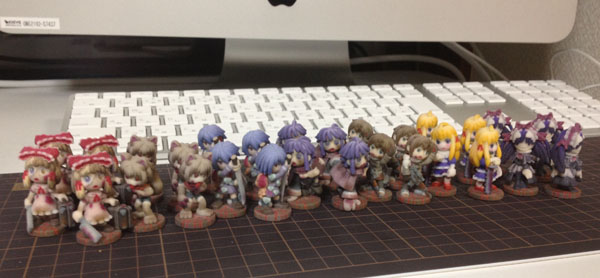
3D printing is a technology that has some major implications for tabletop gaming, as it has the potential to massively boost the variety of physical artifacts that people can affordably produce in small numbers. Right now making miniatures is getting more attainable–there have been countless very successful Kickstarters for miniatures games–but it’s still something that involves tens of thousands of dollars. 3D printing has the potential to let projects be on as small a scale as you want. Shapeways is already providing a Lulu-style POD service for 3D-printed objects, but I was rather excited when I found out that Tsugihagi is offering a set of Nechronica miniatures. They’re not cheap, and they have the “fuzzy” look of the current generation of color 3D printing, but it’s also the first instance I know of of a game publisher doing an official 3D printed accessory.
IMG_0752

TRPG Publishing Workshop
Another pretty amazing thing they’re doing is the “Tsugihagi School” workshop. They charge 2800 yen for an all-day program of seminars on desktop publishing and game design. In the U.S. we’ve done plenty of convention panels and podcasts about this kind of thing, and there have been a few convention workshops here and there, but I don’t think I’ve ever heard of anything quite like this. That it’s something viable in a paid workshop format is I suspect in part a result of Japan being much smaller than the U.S. It’s taking place in Saitama, which is part of the Tokyo metropolitan area, and while it’s hardly in everyone’s back yard, a larger portion of the potential audience can get there on the train than would be the case for a similar event in any given U.S. city.

Online Play
Also of interest is how the workshop includes a session solely dedicated to talking about online role-playing. From what I can gather, this is becoming a major trend in Japanese TRPGs. The term オンラインセッション/online session gets shortened to オンセ/onse, and there are dedicated platforms for it, like Dodontof. This is of particular interest for Tsugihagi since one of their games is extremely adult in nature and probably not something a lot of people would want to play face-to-face. Online RPG play isn’t at all unusual in the U.S., but with rare exceptions (like Code of Unaris) it’s very rare for publishers to address it in any meaningful way.[2] Dedicating time and energy to looking at ways to design games that are better for online play is genuinely a really cool thing, and something I hope we’ll see more of.


[1]Which literally translates to something like “Patchwork Book Shop,” but in English they call themselves “PatchWorks.”

[2]I don’t have a lot of experience with playing RPGs online, but it’s definitely something I want to address in my own games.

D&D 4E’s Influences and Problems

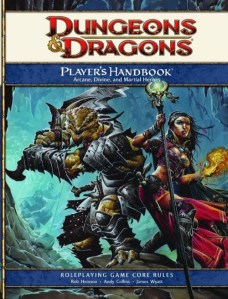
WOC2173672_500Strap in, it’s another meandering post about D&D!
When people talk about what influenced 4E, the first thing most people bring up is MMORPGs, especially World of Warcraft. It got turned into a catch phrase by 4E’s haters, and was routinely used without supplying any context that would give you a clue as to why it was a bad thing (or even a thing that mattered one way or the other). That it draws some ideas from MMOs is undeniable, though it’s also pretty clear that they carefully adapted those ideas to the medium at hand, which is why (for example) 4E’s Defenders are very different from a typical MMO Tank role. (They have to be in a game that doesn’t have any kind of aggro mechanic.) Although hardly anyone noticed, another thing that the designers have explicitly said they looked at was European board games, which is where for example a lot of the razor-sharp turn-handling mechanics came from. Mike Mearls and some of the other designers are also sports fans, and a lot of elements of 4E, especially with martial characters, make vastly more sense when you explain them in terms of basketball. Some people will rail about fighter marks being “mind control,” but sports fans seem to instantly grasp what defender marks represent if you explain it in terms of how defense works in basketball. A few times people have also tried to bring GNS theory into the list of influences, good or bad, and while Mearls and company were definitely aware of Forge theory and such, the rigor and focus of the design had so many other sources that I think it could have easily come about if the same team had never once heard of the Forge.

The one huge, glaring thing that routinely gets left out of discussions of 4E’s influences is D&D 3.5. Late in 3.5’s life people were exploring the limits of the system in ways they hadn’t quite done before. This was when terms like CoDzilla and Pun-Pun became widely known, and the D&D team, being the foremost group of people who were working on D&D as their actual profession full time, had to be listening to what the fanbase was saying. Not listening was one of 90s TSR’s biggest mistakes after all, and WotC launched their D&D venture with the aim of paying attention to what their fans wanted. 4E’s downright obsessive focus on game balance is clearly a reaction to the massive imbalances that character optimizers were able to unearth in 3.5. Charop still exists in 4E, but it’s nowhere close to the same level, and more importantly outside of extreme charop the difference in performance between a suboptimal and optimal character isn’t so massive as to totally obviate the suboptimal character. As someone with limited experience with 3.x and very extensive experience with 4E, whenever I looked through 3.5 books I was always struck by just how much wound up being familiar. The differences are considerable and important, but 4E is nonetheless a game that could only have come from people totally submerged in D&D 3.5 and the fandom around it. 4E is the game for which the Tome of Battle and Star Wars Saga Edition were intermediate steps, and which compared to any non-D&D game is pretty obviously an offshoot of the lineage that 3rd Edition started. To me it’s a reminder of the level of myopia that focusing too much on D&D alone can cause us.
Continue reading D&D 4E’s Influences and Problems

Channel A is Funded!

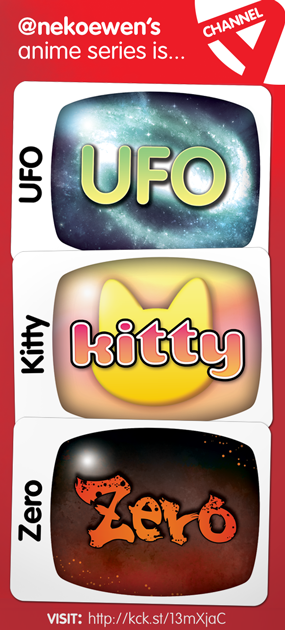
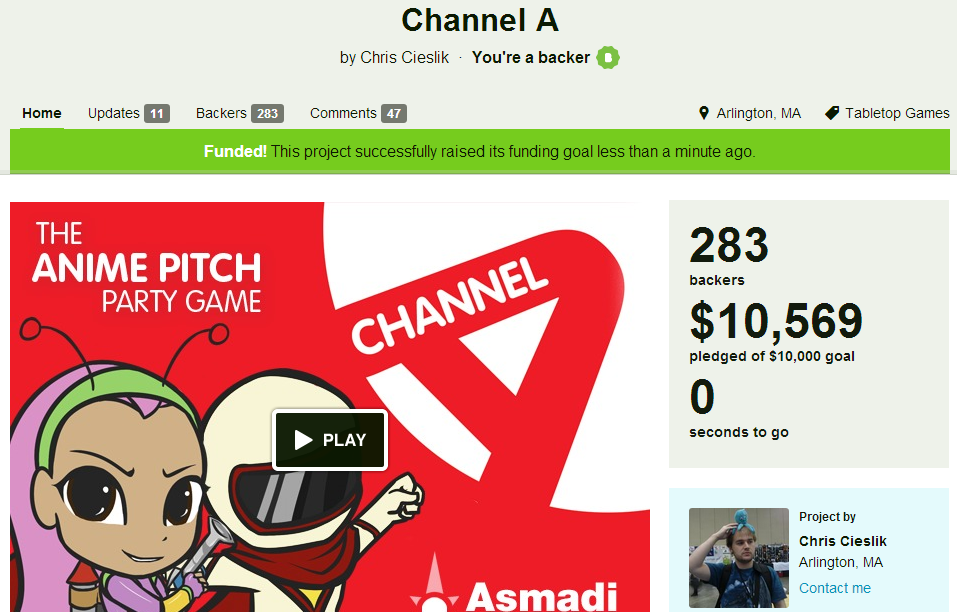
BF-w7lCCEAAHVT2It would be a bit much to try to make some kind of Easter metaphor, but some time within the final 24 hours of the Kickstarter, Channel A hit its funding goal of $10,000. It wasn’t looking good for a while there, but things really turned around when the creator of Superfight!, another promising party game (there wound up being like four party games kickstarted at the same time), was kind enough to give a shout-out to Channel A to his 1,200+ backers. It’s normal for a Kickstarter to lag in the middle and pick up towards the end, but the difference before and after that Superfight! update is night and day, so that game’s team has my gratitude. That Asmadi Games added some new reward levels with some promotional items and such from their prior titles definitely helped us ride off of that boost, as did some targeted promotion.

I’m really grateful to everyone who made it happen. To everyone who pledged, to the people around the world who pledged despite paying insane amounts for shipping, to all the friends and family who pledged to support me, to all the friends who helped playtest the game and make it as good as it is, to Chris Cieslik for publishing and believing in the game in the first place, to Mike Stevens (my RPG publishing partner in crime) who did such a great job demoing it, to Clay for making the game look just gorgeous, to Dawn for providing great art and signing up to do even more for our Director’s Pack backers, to everyone who helped spread the word on Twitter/Tumblr/Facebook/G+/forums/blogs/etc., and I’m sure I’m leaving someone out but you get the idea.

finishedSome people pledged simply because they came across a game that they felt they’d enjoy. Some people because they’ve enjoyed Asmadi Games’ other offerings. Some were my friends and family and other people supporting the game on general principle even if they might not play it much. A few people said they were fans of my work, which to me is the most amazing thing. I’ve been making and posting gaming stuff for ages now, and it seems like I’m finally hitting critical mass and getting somewhere. I mean, I made a game that got over $10,000 in Kickstarter pledges, and there were actually a few people to whom my weirdly pronounced name was a selling point. I can’t even wrap my head around that, and I guess mostly I’m just glad people are enjoying this stuff I make.

Of course, this is an important milestone for Channel A, but it’s more a beginning than anything. Chris is aiming to have the first production run of the game ready in time to sell at Anime Boston (and if things work out I may be able to sell it at FanimeCon, which is that same weekend), which will mark the beginning of the convention season, during which Asmadi Games will be aggressively promoting the game. It’ll also be going into retail distribution, so I’m looking forward to seeing it show up at local game stores. And of course there’s the matter of getting into working on expansions, for which I already have far too many ideas.

With this, and the Yaruki Zero book, and the Golden Sky Stories Kickstarter coming up terrifyingly fast, I think I’m going to remember 2013 as the year that all my messing around with making games finally bore fruit, the year things really began.

Thank you, everyone. :)

Arianrhod 2E: The Focus System

ara2e_jyoruI wound up getting a copy of the Advanced Rulebook (上級ルールブック) for Arianrhod 2nd Edition, F.E.A.R.’s dungeon fantasy RPG with an anime/JRPG style. The book includes advanced classes (that characters can take at level 10), prestige classes, new skills for the base classes, items, guild skills, monsters, traps, dungeon objects, and optional rules. The thing in it that I found the most interesting is what the designers call the Focus System (FS for short). The Focus System is something a lot like Skill Challenges in D&D4E, but better in pretty much every way. There’s even an FS Check Management Sheet, which isn’t quite as insane as it might look. It has spaces for three FS checks, and F.E.A.R. is just really big on making sheets for things.
An FS check goes in rounds, and one of the neat things about it is that you can have an FS check going at the same time as combat. Making a check for the FS uses your main action, so you have to choose between that and attacking. During the FS check a character can make Progress Checks or Assistance Checks. A Progress Check is a check[1] on the attribute (or other appropriate check) determined by the FS check’s specifications, and you gain or lose Progress Points according to your margin of success, anywhere from -2 to +4 (with a special bonus of +1d6 plus 1 per die that rolled a 6 on a Critical), and your ultimate goal is to accumulate enough Progress Points to complete the FS check. However, an FS check has a limit on how many characters can make Progress Checks per round (2-4 in the examples), so other characters can make Assistance Checks during the initiative phase, and if successful they give a +2 bonus to another character. A typical FS check needs 10 to 20 Progress Points to proceed (10 in most of the examples), but the PCs have a limited number of rounds to pull it off (in the included examples 3-5 rounds). When you design an FS check, you take the preferred number of participants times the number of rounds to determine the Progress Point objective.

Events are the other major thing that make an FS check more interesting. These trigger based on how many Progress Points the PCs have gained, usually around one event per 3 Progress Points (paced so you get one every 1-2 rounds). Events can change what stat you need to make a check with, alter the difficulty you have to beat, or also affect the FC check’s end conditions (giving you more or fewer rounds to complete it say). The book has 5 full writeups of example FC checks, and one of these is for disarming a particularly complex trap. It starts with Trap Removal checks (a special Thief skill, based on Dexterity), then the difficulty drops as you start to understand the trap, then thwarting a mechanism requires Strength checks, and finally at the end you’re left with the choice of the red wire or blue wire, and you need to make a Luck check. If the PCs get enough Progress Points at once to trigger multiple events, you take the most recent check requirements and retain things like modifiers to difficulty numbers from intermediate events.

If the PCs get enough Progress Points in time, they’ll succeed and get an XP reward at the end of the game session. The text also notes that you can have competitive FS checks basically by having two groups doing the same FS check in parallel and competing to be the first to get the required number of Progress Points.

That’s the basics in a nutshell. I find it pretty fascinating both as a game mechanic and for the simple fact that I don’t think I’ve ever seen this kind of thing from a Japanese TRPG before. I don’t know whether D&D4e played into its design (the Arianrhod 2E Advanced Rulebook did come out in 2011, and 4e is available in Japanese), but conflict resolution mechanics are about as nonexistent as GM-less RPGs there. Needless to say I want to use some ideas from the Focus System in Slime Quest’s Challenge system, though I think my take on it will have some elements of the Mouse Guard RPG as well. There’s a lot of interesting things in Japanese TRPG design, but sometimes there’s a certain rigidity at least in the rules as written, which shows here in how Progress Checks involve predetermined attributes and strategies. I’d much rather just ask the players how they’re tackling the problem and have that then play into the rules. On the other hand it’s substantially more developed than D&D4e’s Skill Challenges, and if I was going to run a 4e game I’d put together a houserule for improved SCs drawing from the FS check rules.


[1]In Arianrhod you make a basic check by rolling 2d6 and adding your attribute’s modifier (which is 1/3 of the base attribute number, and typically in the low single digits to start with). Snake eyes is a Fumble, and box cars is a Critical. The game doesn’t have “skills” in the Western RPG sense, but certain classes can have abilities that let them make special kinds of checks such as trap-finding or alchemy.

More on Channel A

As I write this the Channel A Kickstarter is nearing the halfway point funding-wise. It’s still achievable, but things will need to pick up a bit. On the plus side, Asmadi is fully committed to making the game happen regardless. Either way, I’m really grateful for all the support we’ve gotten.

One thing that’s been on my mind lately with Channel A is how it’s in some ways a result of my involvement with Maid RPG. I’ve become increasingly interested in “interpreted chaos,” where random elements form a picture and it’s up to you to complete it. Rolling up a Maid RPG character gives you a lot of information, but it leaves a lot open too. If (as is becoming my cliche example) you roll a chainsaw-wielding cyborg mermaid who became a maid for bridal training, you still have an awful lot to work out yourself in terms of personality, history, and so on. What makes it so interesting is just how much of a boost that kind of randomness can give. Creative constraints make creating easier, whereas a blank page can be pretty amazingly hard to turn into something. Without all the Title and Premise Cards, all of Channel A could fit onto an index card, but instead of the amazing results it does produce, even from people who aren’t usually given over to creativity, you’d probably end up with a lot more of people staring at each other.

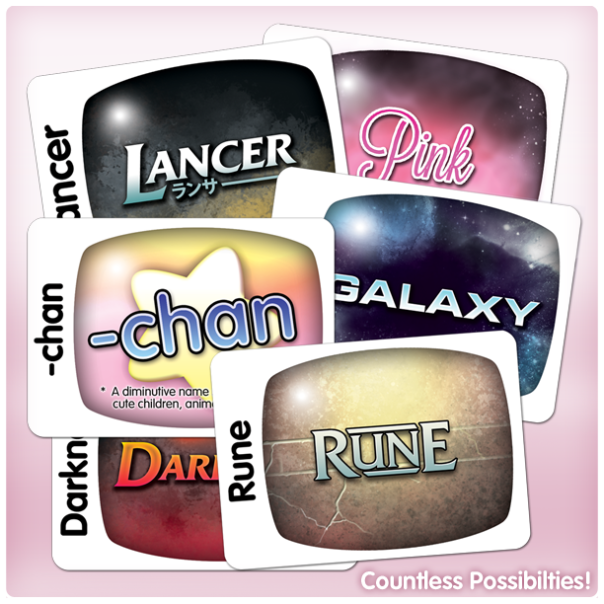
I’ve posted up some photos of my Game Crafter prototype (the “OAV Edition,”) before, and now I can show off some of the designs for the final version with Clay Gardner’s fantastic graphic design work. While my own work is at least non-terrible, I’m still really happy to have Clay on the project. Collaborating with people can have difficulties no matter how well-meaning you are, and Clay has a certain knack for not only getting what I want, but doing the stuff I didn’t know I wanted. Below are some of the revamped Title Cards he did:

channel a cards

The Future!
Needless to say I’ve been prematurely thinking about possible expansions, because that’s how I roll. The ridiculously easy thing (on my end at least) is adding new Title Cards. (It’s quite a bit harder to come up with new Premise Cards though.) Looking at my files and doing some math, I literally have about 350 extra Title Card ideas. Some people are inevitably going to want some more (and suggest title words I haven’t included), and I don’t mind giving it to them. On the other hand I don’t want to just go crazy making new Title Cards; I’d like to try some things that mix up the gameplay a bit.

  • Chaos Blitz would be a set of “Chaos Cards” that mess around with the rules each round, ranging from funny accents to instituting rules variants. It’s kind of like what I was doing with the special actions on cards in i.hate.everyone.
  • I have a few different ideas for themes for expansions that are mostly Title Cards. The one I especially want to do would be called something like “Japanimation Fever,” and purposely be a collection of stuff aimed at bad Western imitations of anime. The mascot/chibi character for that would be a catgirl with cyan hair, with the most overdone, busy design possible.
  • I had the idea for “Star Cards,” Title Cards that let you drop in anything from a given category (fruits, planets, numbers, etc), but in play they fell a bit flat. The notable exception was the “Duplicate” Star Card, which put in another of the word before it (so you could change “Love Revolution” to “Love Love Revolution,” say), and I’m interested in playing around with similar elements.
  • Another of my experiments that still needs work is A-Soft, which rewords the game to be about pitching video games, and comes with a deck of 40 “Genre Cards” that list different kind of video games (dating sim, FPS, RPG, etc.). It seems to work okay so far, but I definitely need to refine it and nail down the rules more.
  • A few times people have suggested some kind of bidding/business type mechanic. That’s a strong candidate for an expansion, though with the game as it is now you could pretty much take a Channel A set and use it with the rules for the old Cheapass Games edition of The Big Idea with no particular changes. Making something similar that’s reasonably easy to manufacture (instead of asking players to provide play money, chips in six different colors, and a d6 themselves), fun to play, and distinct from TBI will be a major challenge.
  • Another random idea I had was a “Q&A” expansion where you can play something more in the vein of Cards Against Humanity, using Channel A cards to answer questions/fill in the blanks.
  • Since Asmadi Games is publishing Channel A, I’d like to try making some kind of crossover thing with We Didn’t Playtest This At All (though Chris already has “We Didn’t Playtest This Channel At All” among the Channel A stretch goals). I’m not sure how to approach that myself, and I think I need to start getting more into WDPTAA to really figure it out.
  • Blank cards are a definite possibility too. It’s not the kind of thing I would readily think of (being the guy who gets to decide what goes on the professionally made cards), but Chris has told me that people have asked for it. Hell, last year at APE some friends of mine who had a booth got a bunch of index cards and markers and improvised their own deck. Not unlike with my RPG stuff, I’d like to see what people could come up with.

Another random thing is that I’d like to do something with the chibi art from the game. There are the 8 characters I commissioned Dawn to do, and if the Kickstarter goes through there’s be several more for people who pledged at the $65 level (16 so far!), which could make for a really awesome poster or T-shirt.

D&D Next and Slime Quest

For some reason I started paying attention to D&D Next again, and every time that happens I end up getting inspired to work on Slime Quest, my fantasy heartbreaker project. The big thing is that the status of the warlord class in Next is iffy at best, and I consider the warlord to be easily one of the very best new things in 4e, one of the few new things it added that was missing all along. If I find D&D Next palatable and if it has an open license I might see about making a warlord class (and I doubt I’d be anywhere close to the only one making the attempt), but right now I’m finding Slime Quest much more exciting.

I’m increasingly of the opinion that D&D4e was a good start, but needed some considerable refinement to get where it needed to go. It has a lot of vociferous critics who have an uncanny ability to totally miss its actual flaws, things that never got addressed, or that got addressed in a questionable way (Weapon Expertise feats as a fix to PCs attack values being insufficient for example). A true 4.5 Edition could have refined 4e into the game they’d been groping towards, though I’m not confident that Wizards of the Coast circa 2012 was actually equipped to do so. (I’m still struck by how much better the 13th Age playtest doc was compared to Next’s.) In my current push on Slime Quest I’m trying to pay close attention to those kinds of things and find solutions. I feel like for every good new idea (like advantage and disadvantage) Next has ten things where they’re feeling in terror from the progress that 4e made, all while ignoring its real mistakes. Of course, with Slime Quest I don’t have to worry about keeping D&D fans happy. If anything I need to do something different to differentiate the game from a zillion other fantasy RPGs, even when I’m specifically aiming to do something evolutionary rather than revolutionary.
Continue reading D&D Next and Slime Quest

Adventures in Self-Publishing

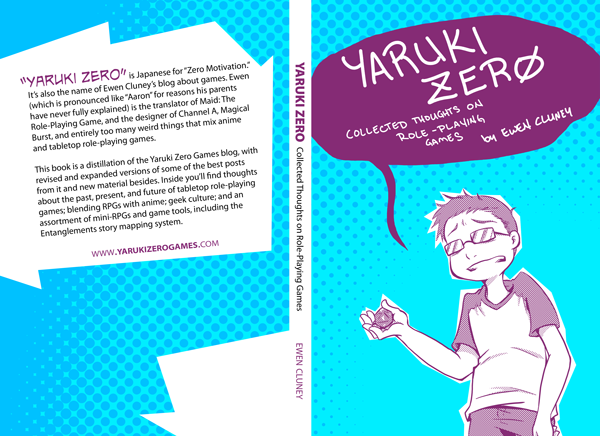
ykz_cover_previewThe Yaruki Zero book is both a thing I wanted to write and kind of an experiment in learning self-publishing for other, more serious projects. The plan was to put the book up on just about every POD and ebook sales service around, and this is a rather long and detailed journal of what I went through to make it happen, both for my own reference and to help anyone else who’s thinking of trying this stuff out. Later on I’ll see about putting together a follow-up post on how things are working out 6 months or so down the line. If you’re interested in the actual book, check out the Yaruki Zero: The Book page for links to all of the places I have it available for purchase.

Production
I started on the book in mid-January, and had the first draft more or less finished after about a month. That was mixture of copying over existing work and just plain putting most of my free time into writing. I got C. Ellis to do up artwork for the cover, Clay Gardner to do graphic design for the cover, and Ellen Marlow to edit the manuscript. (Also, about half a dozen other people read it over and offered feedback.) Each of these was pretty straightforward, especially since the people I was working with really get my general sensibility. I’ve collaborated on a bunch of stuff with C. Ellis before, Clay just has a way of not only reading my mind but coming up with the stuff I didn’t know I want, and Ellen’s fandom and writing sensibilities line up with mine quite well.

For this book’s interior I decided to keep the layout pretty simple, and just did it up in Word with some use of fonts and such to make it a little fancier. I’ve never been able to figure InDesign out myself, but while Word produces reasonably okay layouts, there are certain things where it just kind of loses its mind. Thankfully I wasn’t trying to do, say, multiple columns for this project. The big thing that I managed to fall afoul of was getting the margins right. Being inexperienced with doing stuff for actual books, it hadn’t occurred to me that the inside margin would need to be wider so that the printed material wouldn’t disappear into the binding. With POD you’re much more beholden to the printer’s specifications,[1] so it pays to read those carefully (though it wouldn’t hurt for them to make those a little clearer than they are). That was how the page count of the book jumped up to 217, and I wound up doing a bunch of small tweaks to fix things.
Continue reading Adventures in Self-Publishing

Channel A Kickstarter!

pic1088575_mdI’ve got some really, really big news. Channel A has a publisher! Specifically, Asmadi Games, which is probably best known for We Didn’t Playtest This At All, but has put out a number of other games, including 2010 Golden Geek Award winner Innovation. It’s difficult to find a publisher willing to take on a project in general, and there aren’t too many board game publishers that really know anime either, but Chris Cieslik (the main guy behind Asmadi) has been great to work with and gets what I’m trying to do with Channel A. (The publisher of Whack a Catgirl definitely knows more about anime than your average board game publisher.) He’s also highly dedicated, and you can expect to see him and his cohorts from Foam Brain Games offering Channel A at quite a few conventions.

Asmadi has just launched a Kickstarter to fund Channel A too! The base goal is $10,000 to cover an initial print run, but we’ve got a bunch of bonuses and stretch goals lined up. Also, if you’d like to try a demo before the Kickstarter ends, Chris & co. will be at TotalCon, Genericon, MomoCon, WPI Gaming Weekend, and PAX East running demos. If you’d just like a quick look at what the game is like, the Kickstarter video does an excellent job of showing a typical round of Channel A.

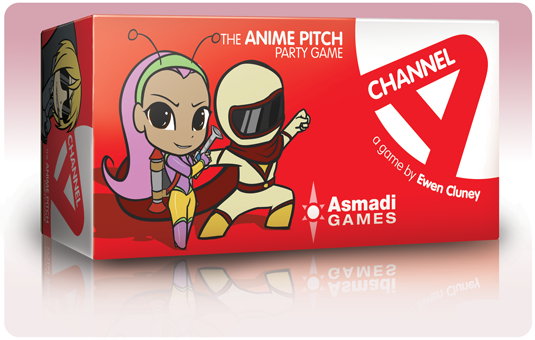
ChannelA-Box3D-FinalThe new “TV Series Edition” of Channel A will feature new title cards and premise cards, a spiffy box that actually fits the cards properly, and a total of 300 cards (maybe more depending on stretch goals and such), all for a mere $25. Chris managed to innovate a new scoring system that doesn’t require voting cards (see the video for a demonstration), so this new version will feature additional premise cards and title cards. Clay Gardner is updating the look of the game too, so you can expect the kind of slick design work he’s provided for Minion Games products like The Manhattan Project and Tahiti (not to mention his excellent layout work for Golden Sky Stories). The Kickstarter features some other goodies, including buttons, custom chibi characters, and the chance to get a custom fake DVD case for your own made-up anime series, complete with a theme song!

This also means that I’ll be discontinuing the “OAV Edition” from The Game Crafter. It was always meant to be an interim thing until I did exactly what we’re doing now, though needless to say I’m grateful to the six people who bought it. The free Manga Edition will still be available, though it will continue to be a basic, no-frills version of the game.

Retail Magic Design Journal 2

Last night I ran my first Retail Magic playtest, and it went really well. Granted at this stage it’s basically a reskinned Maid RPG, but as my attempt at using those rules for a new version of Mascot-tan demonstrated, that wouldn’t have been a guarantee of success. For the game I rolled up a store I named Vanderveldt Bros., originally under the control of two archmages, but since they died (most likely at each other’s hands) their nephew Eric Vanderveldt (a talented young mage but largely clueless about business) inherited the store. Over the course of the game Axebeard (a female dwarf) held an interview that led to Red Maj (a little girl) being hired, while Wyrmsbane (a shiftless loser dressed as a wizard) slacked off. There was a bit of flailing around dealing with customers, missionaries, and so on before it turned out an ancient dragon was coming to burninate the city, and they had to gather the ingredients for a ritual in order to weaken the dragon enough to defeat it. It was fun, and very silly. It also felt a whole lot like Maid RPG at a magic shop, but then that was kind of the idea.

One thing I’m thinking about is writing a bit about how to approach playing the game. I have enough experience with running Maid RPG that I think I could put together some useful advice. I just discovered Craig Judd’s blog The Game Mechanic, where he just put up three posts about his experiences with Maid RPG as the first of his experiments with expanding his RPG horizons. It’s really interesting to read about someone else struggling to figure out how to play the game and ultimately finding their own style, which is apparently considerably more serious than mine. It’s going to be a challenge to find the right midpoint between offering advice while making it clear that people can do what they want, but I think very worthwhile. It’s probably going to end up looking a lot like the advice I wrote for Dragon World.

I came up with a small innovation, albeit one that gives me a lot of work to do. The idea is to have a d666 table that is in essence a set of six d66 tables with different themes. I’m doing this with the item table, which has different general types of items so that you can just make a d666 roll for any old kind of item, or make a d66 roll specifically for a cursed item or an outworld artifact. I’m also thinking of doing this with the random event tables, which will both give the game enough random events to hold up to more play, and provide event tables for more themes.

872d9f3650150323bb6a09da803d4c1dbfa4b6db

I finally started playing Recettear, which I’m enjoying a lot so far, plus it helped me figure out a general approach for putting together the “commerce rules” for Retail Magic. Assuming I can put together something workable, I think “store management” is going to be its own style of play, distinct from random event-driven, favor race, etc. Recettear, like a lot of Japanese simulation video games, uses a concept of “turns,” during which the player has a budget of actions they can take to try to pursue their goals. The system I’m thinking of will be a bit more abstract, without manually doing the haggling of every sale like in Recettear. I’m still in the earliest stages of designing it, and we’ll have to see how it works out.

A while ago I stumbled across Norm Feuti’s book Pretending You Care: The Retail Employee Handbook. He’s the creator of a comic strip called Retail, about the staff of a department store and the shit they have to deal with. It draws on his 15 years of experience working at various stores, and Pretending You Care is a more direct distillation of that experience, full of stuff that I wish I’d known during the one retail job I’ve had. It’s kind of depressing to read–and retail has if anything gotten a bit worse since the book came out in 2007–but it’s giving me plenty of ideas as I re-read it.

Anyway, that’s about where I am with the project. My next step is to basically write more material–items, events, etc.–and try them out. Although it’s getting way ahead of myself, I’m also thinking a bit about possible supplements. I don’t want to get quite as out of control as Maid RPG did, but producing stuff like, say, a collection of scenarios with some accompanying rules material could be interesting. For that matter a friend of mine had an idea for a hack that would basically be a zany fantasy version of Community.