Category Archives: projects

Magical Burst 2013

Needing to step away from Beyond Otaku Dreams, I ended up getting back into Magical Burst. (Also, making some notes for the alternate settings for Golden Sky Stories.) Getting away from Magical Burst (I was last seriously trying to work on it in October of last year) was apparently the right thing to do, because I feel like I’m coming at it with fresh eyes, and making some important changes that feel just plain refreshing.
sample_e264e3c732772bb289d3605e58a37cac7a01509a

One thing that’s been on my mind lately, something that I think not very many people would be in a position to notice, is how different designing and translating games are. As a translator I get very intimate with the actual text of the game. While I don’t remember every word of Golden Sky Stories, I’m exceedingly familiar with the contours of the text, with what goes in what sections. In contrast, when I have my game designer hat on I have an image of the rules in my head, and it’s a struggle to update the text to fit that image as it changes over time. Last month I had a bunch of ideas for Magical Burst (while I was at an anime convention as it happened), and coming back to the actual text is weird because the game in my head has changed so much from what’s in the Word doc. It feels weird that I come across references to relationships taking Strain when in my head I have the much more straightforward system of them having levels that can be gained or lost.[1]

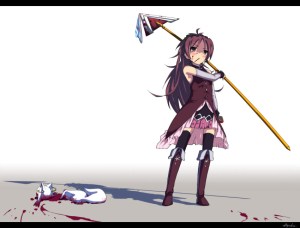
The single biggest thing is that I’m significantly reworking certain key aspects of combat. I decided to implement a “Battlefield” system inspired by Nechronica and Meikyuu Kingdom, basically because it’s something I really, really like. I was never quite happy with the combat system in Magical Burst before, and this gives me a place to implement one of my favorite new game mechanics to come along in a while. I had been thinking of trying an Engagement system like in Arianrhod and 13th Age, but I find the Battlefield map approach far more interesting, and easier and more fun to hang mechanics off of. (It’ll also be a bit of a trial run for implementing a similar system in Slime Quest, which is going to be an altogether more involved project.) I’ve talked about it at great length before, but the core concept is that combat takes place on a semi-abstract map with a small number of positions/areas arranged in a line, and stuff like range and movement is in terms of this set of positions. This provides a potentially fun element of tactical combat while vastly reducing the overhead of having map-based combat at the table.[2]

I also decided to make Magical Attribute assignments semi-permanent. I never really liked the concept of swapping them around on the fly, and it was really an attempt to solve a problem (how to go about tying Heart, Fury, and Magic stats to something meaningful) rather than something I like on its own merits. I’m changing it so that you can rearrange them only when you take certain advancement options. This in turn reverberated through a bunch of other elements of the system, so that it was no longer necessary to have the rule that no two Magical Attributes could have the same value, and didn’t make sense to have relationships follow those types. (And the concept of Fury relationships was throwing people off anyway.)
85c94f7a3f61908afdec54c6067201ad42d8293e

That’s in addition to the other stuff I was talking about previously with specializations (which give characters more special abilities to emphasize Attack, Defense, or Support), and making Magical Effects into Magical Talents, of which there are a lot more available. One of the things I really like about Magical Burst overall is that it puts my diverse RPG inspirations on full display all at once. It’s traditional, hippie, and Japanese all at once, combining elements of games like D&D, Don’t Rest Your Head, Nechronica, Smallville, and Apocalypse World. The tactical combat aspect might seem a weird approach to the game, but it’s making me a lot more excited to play it.

At this point I’m thinking I’d like to make it a goal to finally publish Magical Burst in about a year or so, though of course I don’t expect life to be so straightforward. The part about how I want the tie-in novel to be ready is going to be a big deal, since that thing is still a first draft and needs a ton of work. On the other hand a new draft of the rules shouldn’t be *too* far off, and I intend to keep a free version available regardless.


[1]The main inspiration for this was the fan-made “Magical Burst ReWrite,” which I’m trying to borrow ideas from (there are several that are too good to pass up!) without plagiarizing.

[2]One of the issues with the 3rd and 4th Editions of D&D is that while doing stuff with a grid can be a lot of fun, you have to put a lot of effort into what is normally a single-use set piece to make it that way. A Battlefield map is both totally reusable and relatively easy to customize (just attach special effects to certain positions).
More on Beyond Otaku Dreams

I have a ton of different things I need to work on, including getting more done with the Golden Sky Stories Kickstarter (though at this point a lot of that is waiting for people to get back to me), making progress on Magical Burst, and I’ll stop there because I could easily do a whole post just on neglected projects. One that’s been on my mind a lot lately, that keeps popping up in my thoughts even when I don’t intend it to, is Beyond Otaku Dreams. I talked a bit about the idea in a previous post, but recent experiences have helped me solidify the concept a bit more, and really zero in on the heart of what I want it to be about.

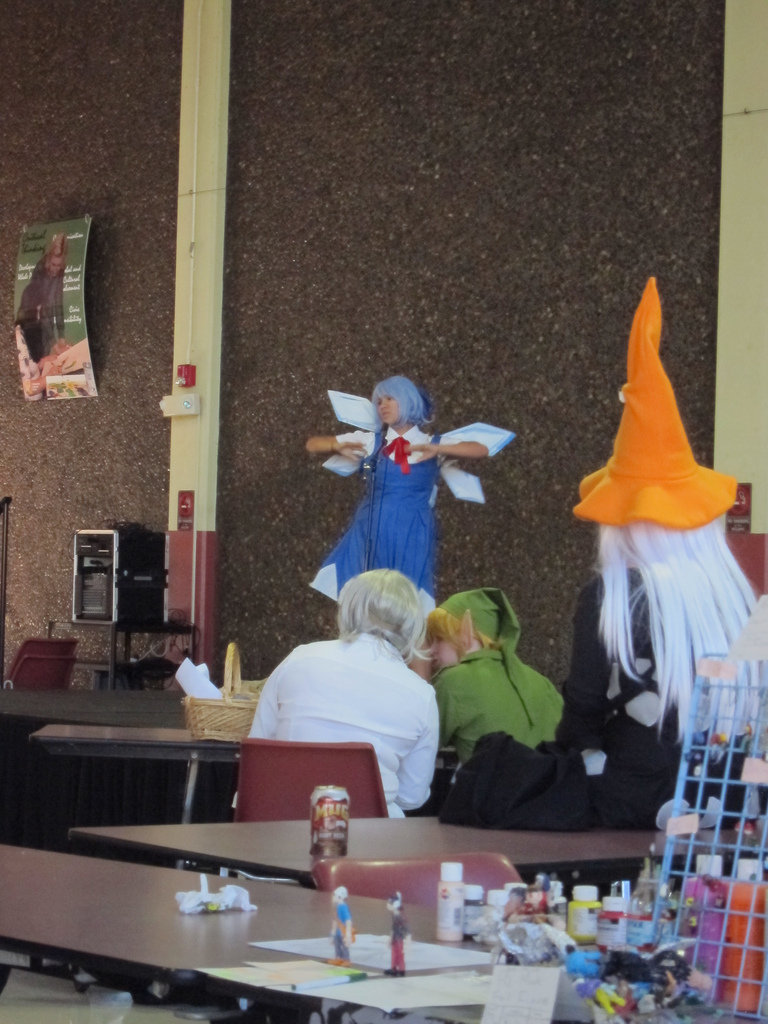
For a long time I’ve wanted to make something about anime fans who see into another reality, a “dream layer” superimposed on the world, where they interact with beloved characters and fight spectacular battles while the rest of the world assumes they must be insane. I had a lot of ideas for a novel, and later for an RPG, but neither ever quite came together. Then last year I went to FanimeCon, and I saw the most amazing scene. The Jesus freaks with signs were protesting the terrible circumstance of people having fun, and a bunch of fans were counter-protesting and generally jeering the shouty Christian guys. One guy was playing Final Fantasy music on a saxophone. And while all that was going on, there was an ambulance, and they were loading a girl in full costume, in a powder blue wig, on a stretcher. My FanimeCon 2012 story was mainly about how I bought some stuff in the dealers room, hung out with my friends Jono and Sushu, and wound up playing Jenga with some random people in the gaming area. Someone else’s story was about how a friend who’d worked very hard on a costume had left the con in an ambulance. It reminded me of all the things I’ve seen at cons over the years, covering every hue in the spectrum of human emotions. I’ve seen raucous joy, but also deep anguish, paralyzing shame, perfect religious serenity, and a million other things. Anime fandom has its good and bad points, but it is above all very human. I realized that my game needed to be about that above all else.

4671812308_3dddf8ff23_b

More recently I went to Anime Conji, a small anime con in San Diego. It was kind of a shock to be so suddenly and thoroughly immersed in the anime con culture, and it reminded me of the sheer intensity of the experience. I can’t speak with authority on how anime fans behave in real life (I remember how my friends and I were in high school…), but it always feels like people are letting out things they have to keep in most of the time. There’s also a sort of ritualistic aspect of anime cons, and people create new patterns of group behavior that you don’t really see anywhere else. One really striking example is that if someone is wearing a costume, it’s apparently perfectly acceptable to just sort of yell the name of the character at them. Chatting with my friend Guy Shalev about the ritual nature of anime fandom made me realize how important, how immediate the convention experience could be. I realized that I should frame my game around characters going to a convention. The sheer intensity, the amplitude of hope, the collision of reality and delusion, make it the perfect setting for stories about both the humanity of anime fans and about the line between dreams and reality getting blurry.

(The other thing at Anime Conji was that I saw a panel put on by Chocolate Covered Cosplay about taking your fandom passions and making a living off of them. It would not have occurred to me that cosplay could also lead to a career in modeling–cosplay isn’t something I’ve ever been seriously involved with–but they’re apparently way ahead of me when it comes to being anime fans boldly realizing their potential.)

Narratives about and discussions of anime fandom tend to be either highly idealized or treat fans as human garbage. There are academic articles that go on about how amazing and post-modern otaku are, and blog posts griping about how obnoxious they are. Beyond Otaku Dreams is in part me planting a flag in the neglected middle ground, the place where anime fans are human beings with both problems and potential. It’s become a rather personal work (insofar as an RPG can be personal), based much more on my own experiences than references to works of fiction. I have a hard time thinking of many RPGs that quite have that kind of origin (maybe some Jeepform or Norwegian Style games?). I don’t think that makes it better, but it definitely makes it that much more something I want to bring to fruition. It also means that there’s almost zero inspirational material to look at (Akibaranger and Dramacon are probably the closest), which is liberating in a way.

6017620796_9cce30bda9_b

The game that’s just starting to form in my head has some bits of Don’t Rest Your Head, Fiasco, and Polaris (plus a tiny bit of Maid RPG and a few other things). It’s definitely leaning towards the GM-less shared storytelling activity side of things. Like Fiasco it’ll be aimed more at one-shots, but since the characters will tend to survive and become better people, it’ll lend itself to doing “sequel” sessions where you revisit them at the con the following year (or maybe have them going to an even bigger con, or even an event in Japan), learning what new challenges they’re facing. It’s not going to be a game with a lot of numbers–I’m thinking the main thing will be a dynamic of Hope, Trauma, and Delusion[1]–and the more important part of character creation will be a series of DRYH-like questions, including things like “What is your obsession?” and “What do you hate about yourself?” The game would play out in a series of acts and scenes. Acts get random events from tables to shake things up, and scenes will involve stuff based on a character’s answers to the questions. Over the course of the game the situation with dreams intruding into waking hours explodes and climaxes, and then each character gets an epilogue partly based on their numerical scores. Or something like that.

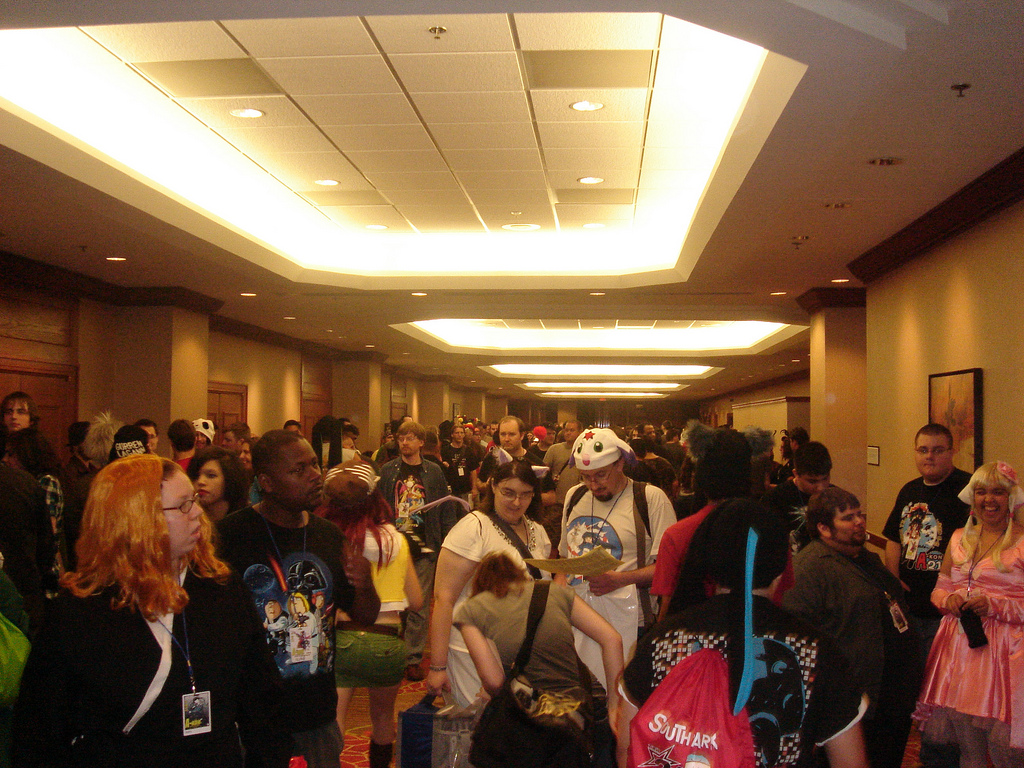
One thing I’ve decided about the end product is that I want the visuals in the book to be mostly or entirely actual photos of cosplayers and convention stuff (kinda like what I put in this post but, you know, all-around better). I love artwork, and I love working with artists, but a lot of the most important parts of this game are about reality, and I want to reflect that visually. I know there are some stock photos I can use–there are a good number of cosplay photos available that way–but it’ll be interesting figuring out how to do the rest, to capture the feel of Artists Alley and a the masquerade and such. The decision to use photos may in turn lead me to have the book be in color (and maybe formatted more like a convention program guide?[2]), though of course that’s getting way ahead of things.

Update (4/30/2013): A conversation with a friend about the game led to kind of an interesting idea. One of the challenges with Beyond Otaku Dreams is helping create something of an anime convention feel even when the players are potentially in a plain, quiet room at someone’s house. Some of the things you can do go a bit outside the scope of the RPG. The Ambiance app provides sound loops for things like a convention hall or manga cafe for example, there’s stuff like having props around (I want to make convention badges, and I’d love to play with someone in full costume), and of course you could just play the game at an anime con. My main idea for helping with that on the game design end is a step just before character creation called “the buzz,” where the group puts together a list of anime titles[3] that everyone in the play group is reasonably familiar with, with the option to put in some made-up ones (say if you just had a memorable game of Channel A?). I think part of the appeal of going to an anime con is entering a special space where your arcane knowledge temporarily becomes shared knowledge, but in my experience even good friends don’t necessarily have quite the same canon of anime series, so I think establishing a baseline for the game will go a long way towards helping players emphasize what they do share. The Buzz should then influence (but not dictate) some elements of characters; if you want your character to be obsessed with a specific anime character, it’ll potentially be more effective to go for one from a series listed in the Buzz. The Buzz will probably also include some elements of the convention itself, like notable guests or events. It would be pretty natural to have a character obsessed with the new anime series Kaiser Bunny Legend[4] and then have the creator of KBL as a guest at the con who plays a role in the story as an NPC.


[1]Specifically “delusion” as a translation of the Japanese word mousou (妄想) as used by otaku, referring to a kind of deliberate, flagrant rejection of reality in favor of self-indulgent fantasies.

[2]Except it would show up on time instead of halfway through the thing. :rimshot:

[3]And other works that fit into the general zeitgeist; putting Idol Master or Homestuck into this list would be fine.

[4]Which is straight from a Channel A playtest, though some day I want to write that story. A group of doujin artists find themselves in a colorful world of magic where imagination has power, so as creative types they find they have all sorts of magical powers. One guy finds his mascot character, a fanservice bunny girl, comes to life. She in turn accidentally takes up the Kaiser Gauntlet, and thus must become the hero who saves the world. With that as a backdrop, the story is really about their relationship and how it changes as she gradually transforms from a fairly shallow character into a complex human being. But anyway.

Golden Sky Stories Kickstarter

I probably should take some time to mention here that the Golden Sky Stories Kickstarter has launched at long last. We’ve been just totally blown away by the level of support we’ve gotten, and while we were confident we would get funded, it’s massively exceeded our expectations, blowing through $18,000 worth of stretch goals in about a day and a half. Or to put it in perspective, we’re neck and neck with Evil Hat’s Fate Dice Kickstarter.[1]

GSS Book Mockup

You can read about GSS in more detail on the Kickstarter page and its updates and comments. Right now we’re in the process of working out additional rewards and stretch goals and some other issues, and we’ll be doing a major update soon. The whole thing’s been really emotional for me–including a hefty, powerful dose of stress if I’m perfectly honest[2]–but also unbelievably gratifying. We worked really hard on this–and we have a good deal more hard work ahead of us–and people are responding far more than we’d dared to hope.

(Also, I just got interviewed for an episode of The Jennisodes, though it’ll be a few weeks before that episode goes live.)


[1]Also well worth your time if you do anything that uses Fudge Dice, though the Fudge Dice Infusion KS is the one that needs some backer love if it’s going to succeed. Also, I think I might be one of the very few people on the planet who actually has too many Fudge dice already, as I have two GM packs from Grey Ghost, the wizard set from Evil Hat, and four red runic Fudge dice from Q-Workshop.

[2]Some time in June or July I’m going to place an order for 2,000+ books. And those books are going to have to go somewhere, and at current count a lot of them are going to have to go to about 700 separate people.

Adventures in Self-Publishing

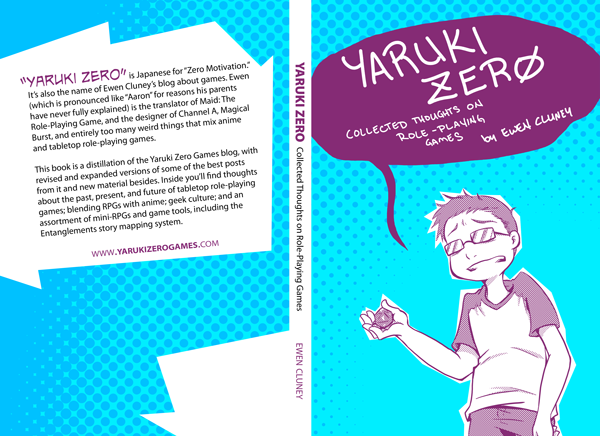
ykz_cover_previewThe Yaruki Zero book is both a thing I wanted to write and kind of an experiment in learning self-publishing for other, more serious projects. The plan was to put the book up on just about every POD and ebook sales service around, and this is a rather long and detailed journal of what I went through to make it happen, both for my own reference and to help anyone else who’s thinking of trying this stuff out. Later on I’ll see about putting together a follow-up post on how things are working out 6 months or so down the line. If you’re interested in the actual book, check out the Yaruki Zero: The Book page for links to all of the places I have it available for purchase.

Production
I started on the book in mid-January, and had the first draft more or less finished after about a month. That was mixture of copying over existing work and just plain putting most of my free time into writing. I got C. Ellis to do up artwork for the cover, Clay Gardner to do graphic design for the cover, and Ellen Marlow to edit the manuscript. (Also, about half a dozen other people read it over and offered feedback.) Each of these was pretty straightforward, especially since the people I was working with really get my general sensibility. I’ve collaborated on a bunch of stuff with C. Ellis before, Clay just has a way of not only reading my mind but coming up with the stuff I didn’t know I want, and Ellen’s fandom and writing sensibilities line up with mine quite well.

For this book’s interior I decided to keep the layout pretty simple, and just did it up in Word with some use of fonts and such to make it a little fancier. I’ve never been able to figure InDesign out myself, but while Word produces reasonably okay layouts, there are certain things where it just kind of loses its mind. Thankfully I wasn’t trying to do, say, multiple columns for this project. The big thing that I managed to fall afoul of was getting the margins right. Being inexperienced with doing stuff for actual books, it hadn’t occurred to me that the inside margin would need to be wider so that the printed material wouldn’t disappear into the binding. With POD you’re much more beholden to the printer’s specifications,[1] so it pays to read those carefully (though it wouldn’t hurt for them to make those a little clearer than they are). That was how the page count of the book jumped up to 217, and I wound up doing a bunch of small tweaks to fix things.
Continue reading Adventures in Self-Publishing

Retail Magic Design Journal 1

I’ve been making good progress on the aforementioned Retail Magic RPG (though the Yaruki Zero book is still eating up a lot of my free time). Kamiya was amenable to the idea and and even impressed with the draft of the character creation rules I showed him, so it looks like I don’t have to worry about whether the project is feasible on that front.

The PC (employee) creation rules are done, though I need to take some time to refine the selection of Special Qualities. There are a few things I copied over from my draft of Mascot-tan that I should probably revise or remove, and possibly a few things I need to add. I also finished the boss and store creation rules, though that went faster because I decided not to write up a separate Special Qualities table for bosses. I had fun making the store creation tables a bit more expansive than the mansion creation tables in Maid RPG, so you roll for the store’s appearance, location, specialty, and special features. Let’s give those a try:

Alyssa Foxtail
Attributes: Athletics 2, Cunning 0, Guts 3, Luck 2, Presence 0, Skill 3
Boss Type: Obsessed Artisan
Boss Assets: Magical Power, Property
Favorite Employee Type: Weirdo
Boss Special Qualities: Fox Ears, Overactive Imagination
Stress Explosion: Making Corny Jokes/Punning
Colors: Hair: Gold, Eyes: Silver, Outfit: Red and Yellow
Stress Limit: 30

Alyssa is one of the fox people of the eastern forests. She started Fox Hunt Specialties because the only thing she could do to earn a living was to harness her innate magical talent. Although she looks fairly attractive, in a disheveled kind of way, she’s actually kind of annoying and unsocial, and tends to neglect her employees.

Fox Hunt Specialties
Store Appearance: Eccentric Construction
Store Colors: Teal and Violet
Store Location: Magical Mobility
Store Specialty: Material Components
Store Special Features: Arcade Game, Dimensional Interior

Alyssa’s store is the result of building a hut out of discarded glass bottles and then attaching a pocket dimension to the entrance. The store’s exterior is about the size of a small phone booth, but the interior is a full-sized store, with countless racks of merchandise, including an impressive collection of spell components in mason jars behind the counter. The dimensional enchantments on it are a little bit unstable though, and the store has a way of jumping around the city at random. A brief trip to Earth resulted in a Simpsons arcade game machine being delivered to the store by accident, and Alyssa was able to bind an electricity elemental to power it.

I’m also working on a d666 item table, though writing up 216 items is going to take quite a while. There are only so many zany D&D items to borrow from. I’m planning to take after the original Japanese Maid RPG rulebook and include two scenarios and a replay, though I need to get a bit further along before I can make those. I’m also contemplating hiring Sue-chan to do the artwork, since I think her style would mesh pretty well with the overall feel of the game.

Since so many of the people interested in the game have expressed interest, I’m also putting together a chapter for putting Retail Magic into a modern/urban fantasy setting, which is turning out to be roughly the same setting as Magic School Diaries. I’m still working out what actual new material it’ll require, but right now the “Memos from Corporate” table is shaping up to be my favorite part of it.

The big thing that has me stumped is how to approach doing commerce rules. It makes perfect sense to have optional rules for handling running the store’s business, but I don’t even know where to begin. Also, owing to the choice of rules systems, this will be one of my rare non-open designs, but I will be looking for people to do outside playtesting rather than posting it online.

Another Project: Retail Magic

After about 2½ weeks I finished the first draft of the Yaruki Zero book, which weighs in at a bit over 60,000 words. It’s like I got up to a certain speed with my writing and can’t slow down. Right now I’m having some friends look it over before I start on a second draft.

In the meantime, I got inspired to start on another new project. I’ve been wanting to do a new game using the rules of Maid RPG for ages now; I even came up with the idea to call the rules the M.A.I.D. (Maniacs Asymmetrical Interactive Delusion) Engine. I want to do this partly because it’s just something fun, and partly so the people put off by the maids might give the same rules a chance with subject matter that won’t freak them out so much. My attempt to make a new version of Mascot-tan didn’t work out basically because gijinka characters don’t mesh with random chargen at all. I may take another stab at it once I rethink the character creation rules, but a recent bit of renewed hysteria about Maid RPG got me thinking about it again.

My first idea was to do a game in the vein of Urusei Yatsura, about human and alien teenagers in everyday life. Except I don’t really want to rewrite Teenagers From Outer Space. My second idea, and the one I latched onto, was to make a game where you play the employees at a magic item shop in a fantasy setting. It’s something I’ve been wanting to do for years–I ran a game with the same concept using Risus a couple times–but the moment I allowed the possibility of using the Maid RPG rules for it, it made entirely too much sense. Characters can be random and zany on the level of Dragon Half, and the store setup naturally gives you an authority figure NPC like in Maid RPG. I’m still working out what other kinds of rules I want to put into the game though. I’m definitely putting in a d666 random item table, and rules for generating a boss and a shop. On the other hand while it seems natural if not inevitable to put in some kind of basic rules for doing business, I’m not sure of the right way to do it, especially since it needs to mesh with Maid RPG type craziness. (Also, I need to sit down and play Recettear, since I’ve had it on Steam for a year now and everyone who hears about the concept says, “Hey! A Recettear RPG! Awesome!”)

I very quickly settled on the name “Retail Magic” (if you’re picking up an element of deep sarcasm, it’s because that’s what I intended), and since I had a good chunk of my attempt at a new Mascot-tan written up, it’s not so long a journey to a functional rules draft.

One of the things that’s changed between 2008 and now is that I started working in the video game industry as a localization editor, and that helped me shed a tendency to be overly literal in how I translate things. There are an awful lot of things in Maid RPG that today I would word differently, both to better fit American standards (it would’ve been trivially easy to change the “Lolita” Maid Type to “Cute”) and for simple clarity (like renaming “Spirit” to “Stress Limit,” which succinctly tells you what it does). Putting together my own game text from the ground up lets me get everything just how I want it, and lets me keep a close eye on content without having to rewrite or outright excise a bunch of stuff from an original version.

Since I finished the first draft of the employee creation rules (minus descriptions of some of the traits), let’s give them a test drive.

Angelina (Age 24)
Attributes: Athletics 3, Cunning 1, Guts 3, Luck 3, Presence 1, Skill 0
Employee Types: Adventurer, Weirdo
Employee Special Qualities: Pet (albino falcon), Eye Patch
Employee Roots: Under a Curse
Employee Weapon: Holy Magic
Stress Explosion: Hiding in a Box
Colors: Hair: Wine, Eyes: Amber, Outfit: Beige and Off-White
Stress Limit: 30
Starting Favor: 0

Angelina is a former cleric who lost her eye in battle against the Dark Lord’s forces. She works in the store solely because she fell under a curse that makes it so she can’t leave. She’s been adventuring so long that she doesn’t quite know how to relate to normal people anymore, and when things get to be too much she tends to hide in a box until it goes away.

So yeah, I think I’m on the right track. :3

Update: Here’s a few more attempts at making characters.

Yaruki Zero: The Book

ykz_ewenI started up a new project, because I just don’t have enough or something. This is going to be a distillation of the better parts of this blog, with revised and expanded versions of some of the better blog posts, plus a couple of my better mini-RPGs, adaptations of certain podcast episodes, and a fair amount of new material. At present it’s going to have chapters on:
  • Thoughts on RPGs
  • Dungeons & Dragons
  • Geekdom
  • Anime and RPGs
  • Games and Pieces of Games

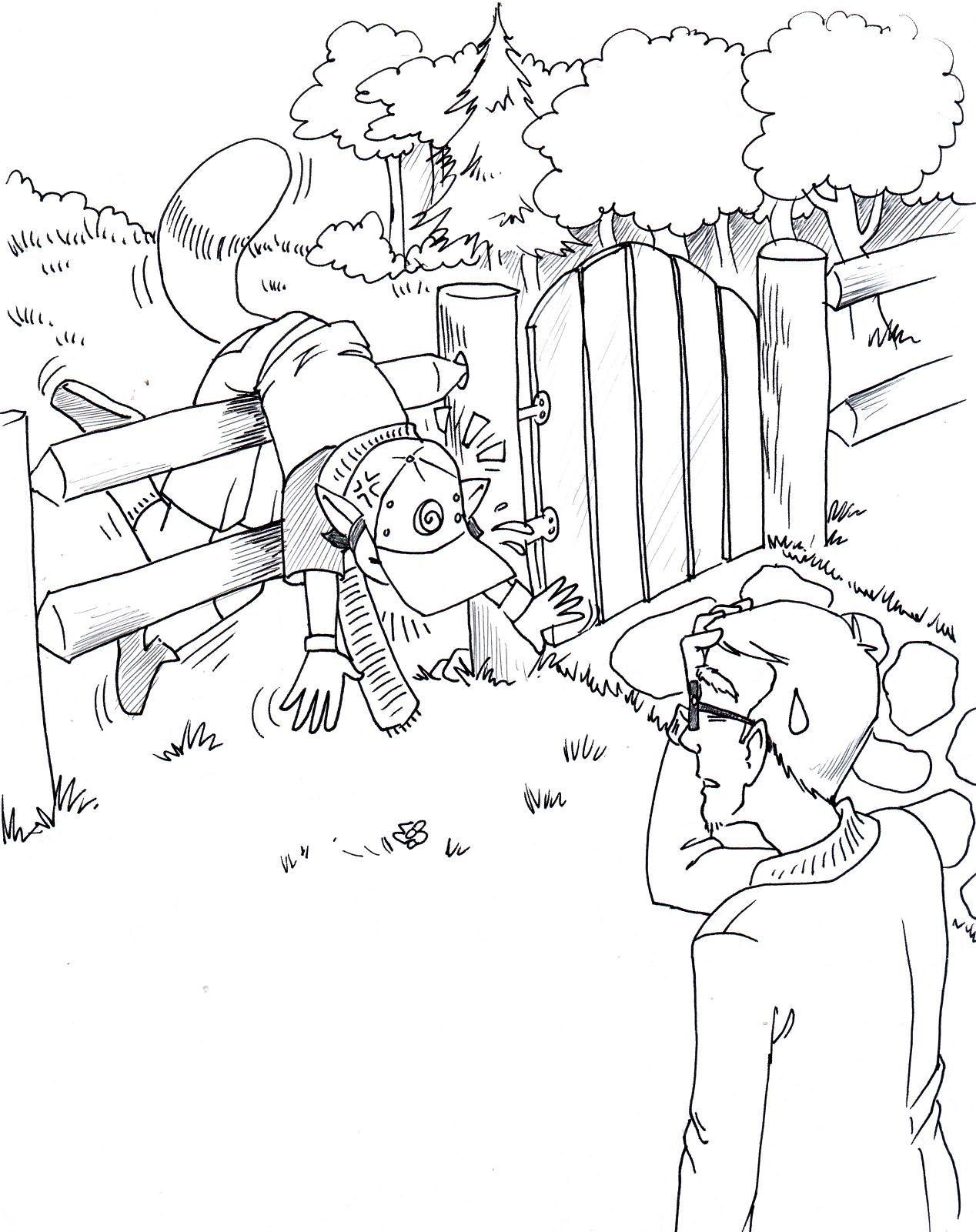
It’s ended up involving quite a bit more original writing than I’d originally intended, and the final product is probably going to be in the realm of 150 to 200 pages. It’s kind of striking how different writing for a book (which is supposed to have some amount of permanence) is compared to writing for a blog (which is a lot more in the moment, at least the way I do it). Once I finish writing the book and get some editing done, it’s going up on Lulu and some other e-publishing venues, which will hopefully teach me how to do that sort of thing so I’ll be ready for more serious, less niche projects. What you see to the right is my rough concept sketch for the cover, though I definitely didn’t capture the “it’s the last day of the con leave me alone I want to go home shut up” feeling I’m going for. It’s probably not going to have too many pictures, though I’ll fit a few in where I can.

One interesting thing that’s emerging from working on the book is that it’s in part a memoir of my life as an RPG guy. The Walking Eye just posted up a fascinating two-part podcast episode with Ron Edwards (of Forge fame) and Victor Raymond (an OSR guy), and I was really struck by Ron’s statement that the history of RPGs is hard to chart, and there are a lot of very personal narratives to capture. Although I never played with (or even met) Gary Gygax or Dave Arneson, I have my own distinct set of experiences, and my own slice of RPG history that’s not quite like anyone else’s (including stuff like putting out the first Japanese TRPG released in English).

With all of that said, I have a question to pose to the people reading this: What would you like to see in the book? Are there any blog posts you think I especially need to include, or other topics I ought to write new material about?

Golden Sky Stories Replay: The Broken Window

Golden Sky Stories is taking even longer than the overly long time it had been taking, mainly on account of Real Life being difficult for us. I’m hoping to finally launch the Kickstarter in early 2013. The layout is now just about done barring a couple of tiny corrections, and we’re close to getting the math lined up for the Kickstarter. In the meantime I’ve got a little treat for anyone who’s been interested in learning more about the game.

The Broken Window” is a Golden Sky Stories replay made from a recording of a game session I ran for some friends a few years back. I put it together in order to give readers some idea of what a typical session is like, though GSS is quite unlike a typical RPG in many ways. The PDF has original art by Sue-chan, layout by Clay Gardner, and copious footnotes to help you understand what’s going on. The story is about how a broken window ultimately led to new friendships.

Download “The Broken Window” (PDF)

tanuki2

An Aside on Writing Replays
This was the first time I typed up a replay. I don’t know that I’ll make a habit of making them (if nothing else in subsequent attempts to record game sessions I started feeling like having a recorder was kind of a jinx or something), but it was an interesting experience all the same. It wasn’t as painstaking and irritating as the transcriptions I did for a linguistics class that one time, but it really exposed the differences between spoken and written language. In face-to-face role-playing we really do use inflection and gesture a lot, things that are hard to capture in writing. This was that much more of a problem because I was trying to transcribe a 2-year-old audio recording. There were times when one of my friends would say something like, “And then I go boop!” and me from 2 years ago totally understood, but in the present I had to guess. It may be our Northern California dialect, but we also say “okay” and “like” a whole lot, and it’s only really obvious when I’m trying to transcribe stuff and every line seems to start with “Okay,” and include an unnecessary “like.” It was a lot of work to type up, but not too bad, especially since the entire recording was only 90 minutes. After doing this, I think I’d like to see more replays in general, because they force you to engage role-playing in a different way, especially if you’re the one doing the writing.

Board Games and RPGs / Peerless Food Fighters

Of late I’ve been thinking a lot about board games and what RPGs can learn from them. I’ve said before that I’m not generally much for board games, but it’s hard to look at them and not admire the production values and sophistication. I started a thread on Story Games, which turned up some very interesting points that are very hard to ignore. I also hit on a game I want to put together as a sort of proof of concept, a new version of Peerless Food Fighters.

A lot of the stuff I’ve been able to properly wrap my head around has had to do with presentation, with product design. The thing about the traditional RPG format is that it has tremendous flexibility, longevity, and economy, but it achieves those things by way of sacrificing presentation, teachability, and ease of use. When you buy an RPG you get a book, and that’s it. You have to dig through and absorb an enormous amount of text before you even get started, you have to provide all of the other materials yourself, and you have to do a lot of work to prepare and get everything together, often making a lot of decisions you can’t fully understand until you get well into the game. You get stuff out of the deal–I wouldn’t for a moment suggest tossing out traditional RPGs–but here’s yet another avenue for trying things out and creating something new with its own distinct merits. The better board games do a really good job of easing you in to learning how to play. I recently tried playing Space Alert with some friends, and the game is impressive for how it sets up a series of tutorials that gradually add more of the full game’s mechanics. That’s especially important for Space Alert, which expects you to work your way up to being able to use the cards and such to plan out all of your moves over the course of 10 minutes, and then resolve them all once the recording ends.

AssortedMeeplesOriginal1a

The best pithy one-liner from the SG thread is from TylerT, and it goes, “Your game is not a book.” This is true no matter what kind of tabletop game you’re talking about. Even if the book is the whole of the presentation, the actual game is what happens at the table, and the book is the means of teaching it. Board games can be really good at putting game content into easily digestible chunks, while many RPGs subject you to a huge infodump before you even start playing. This is an instance where for example Apocalypse World, with its playbooks and such, really shines, especially on the players’ side of things. My recent forays into card games have been really interesting just for how it’s become a routine thing that for a game I’ll have a Word doc of the rules and an Excel spreadsheet of cards, often with the latter having more text overall.

Board games are also free to be much narrower in scope than RPGs typically are. That’s another one of those things where I wouldn’t want every RPG to be that way, but I would like it to be a viable choice. Going back to the thread, one person pointed out that for example wargamers are really big on putting together elaborate terrain, but they have one battlefield for a given hours-long game session, and wouldn’t put up with having to set up a single-use battlefield and minis for many small battles the way you do if you use miniatures in D&D. Chris Engle‘s Engle Matrix Games are RPGs with small, simple boards, providing a map element that’s self-contained and manageable. Somehow people act like it’s just totally unthinkable to have an RPG with any real limitations on the scope of the game. Looking at some of the board games that have entered my life lately, there have been things like Space Alert (where you play the crew of a Sitting Duck class spaceship for 10 minutes as it records data and you push buttons to try to fend off alien attackers) and Red November (gnomes try to survive in their deathtrap of a submarine until help arrives). I like the idea of RPGs that in essence give you a recipe for something with the scope of a movie and let you go at it with little to no preparation. (Though I have found that the more complex board games are like RPGs in that they run a hell of a lot smoother if someone has read the rulebook over in advance.) The next step up from there in variability is something like Fiasco, where in a sense there are dozens and dozens of downloadable “boards” to play with.

There’s also some stuff to do with how the actual gameplay is structured that I need to dig into more. Here are a few snippets to chew over:

  • Make losing fun.
  • Balance cooperation and competition.
  • Structure gameplay so that you need to watch closely while other players are acting.
  • Emergent rather than front-loaded complexity.
  • Emphasis on building up things.
  • Toys/tactile elements are fun!
  • Small social footprint.

miki

A big part of why Peerless Food Fighters so readily came to mind in terms of being an RPG with board game type presentation was that it was already one of the more board game-like RPGs I’ve done in terms of its mechanics. Even so, going all-out with that type of presentation has been really interesting. Like my dalliances with designing an RPG in the form of a smartphone app (and I really do need to get more work done with Raspberry Heaven), it opens up a whole different set of options and constraints. I’ve taken to calling it a “role-playing board game,” which I think sums up what’s going to be in the box pretty well. Stuff that I would ordinarily have in the form of Yet Another D66 Table instead becomes a small deck of cards. Looking at board game components is also just way more fun than it has any right to be, and I end up wondering what I could do in the way of an RPG that uses things like colored plastic rocketships and various types of meeples. Since I’m aiming to do it through The Game Crafter, their available selection of components is influencing some of my choices. One interesting but subtle things is that since I want to have clear color coding for the six pre-made characters and I want to have colored card stands for the character cards, I’m limited to the six colors they have the stands in (red, blue, black, white, yellow, and green). I think that actually made the character designs a little better, since it forced me to have more realistic colors, and avoid the obvious choices like having one character be mostly pink.

As I write this I’m planning for PFF to have:

  • Event Deck (which provides situations for scenes)
  • Complications Deck
  • Fate Deck (a 32-card deck that’s like a paper d6 peppered with special effects)
  • Score Board
  • Map
  • 6 Character Cards (w/card stands)
  • Pawns (for use on both the score board and the map)
  • Applause Tokens (which will probably the least changed element from the old version)

The rules booklet will be an important part of how you learn the game, but thinner than in a lot of Fantasy Flight’s games. I do think the way I’ve set it up potentially lessens the impact of the role-playing aspect, but it also focuses it, so that you’ll hardly ever want for ideas for what to do.

The essential practical stumbling block for hybridizing board games and RPGs is cost. You don’t normally manufacture board games in quantities of less than 1,000, and for an independently published RPG that would involve some unwarranted optimism. For that reason I’m pretty sure the new PFF is going to be more of a proof of concept, with a print and play prototype and maybe a Game Crafter version with little to no profit margin. Outside the unlikely event that PFF takes off beyond all expectations, on a commercial level this is going to be more of a trial run for something more mainstream (the cynic in me is whispering about Cthulhu here) and more ambitious.

Magical Burst Development Stuff

I had kind of hoped that my next post about Magical Burst would be the release of the next version, but I’ve wound up setting myself up with a lot of work to do before it’ll be ready.

One thing I’m doing is a lot of writing in general, filling in advice and even setting information in more detail. I’m trying to better articulate the aesthetic for magic and the youma for example. In Madoka Magica, it’s as though characters don’t have spells so much has colors of paint they can use to scribble all over reality. Mami uses magical flintlock rifles, but that goes anywhere from hauling out a single one to making about a dozen appear to creating a giant cannon version for her finisher. I also want to dig into the characterization of the youma a bit more, about how destructive they are emotionally.[1] I’m also filling out tables of Secrets and Youma Motivations, and I expanded the magical girl costume tables. More importantly, I’m trying to properly clarify and nail down a lot of things that had been entirely too vague in previous versions of the game, like running out of resolve, stealing Oblivion Seeds, when Fallout kicks in, etc. There’s also the stuff with Shocks that I mentioned previously.

I have quite a bit to do in the way of digging into the actual rules. Overall I’m doing more refinement and less adding novel elements, but there are a couple key things I’m now planning to add.

Looking at one of the /tg/ threads I found out about someone’s “Magical Burst ReWrite Edition.” I don’t want to steal from it, but I do really like their idea of giving magical girls different specializations similar to D&D4e’s roles. I myself like games that give characters a decent amount of mechanical differentiation, so I’m hoping to pursue this route, though I’m not totally sure what I want the specializations to be.

That dovetails into some stuff I’m doing tinkering with the combat mechanics. I’m adding something like the Movement and Engagement rules that have appeared in numerous F.E.A.R. games. I really like semi-abstract movement and positioning type rules, but for Magical Burst I need them to be a bit more fluid than the Meikyuu Kingdom style battlefield concept allows, on account of magical girls can potentially do so many different kinds of things with magic, including the most outlandish modes of movement. (It also gives me an excuse to get printable cardstock magical girl and youma minis made.) 13th Age does have something kind of similar to this, though without the “engagement” vocabulary. I think it does a good job of creating a distinction between melee and ranged combat,[2] which I’m hoping will make magical battles a little less like a series of attack rolls. I also like it for how it gives me some more things to hang crunchy bits on, and I think it’s going to be really helpful in terms of the aforementioned specializations.

With NaNoWriMo I’ve tended to go to extremes of not trying or cranking out the requisite 50,000 words, if just barely in time for the end of November. This year I had originally been planning on trying to do a sci-fi comedy story (“Tiny Aliens”), but with magical girls on the brain I decided to make an attempt at the Magical Burst novel I’ve been wanted to do, Magical Girl Radiant Yuna. (Which will indeed concern the same Yuna and Makoto from the intro comic script.) If I manage to do NaNoWriMo it’s going to put work on the game itself on hold throughout November, but it’ll be a strong step towards getting the one tie-in thing I really wanted to do for it. As I mentioned earlier, I want the novel to have full game stats and such for the relevant characters in an appendix in the back.

Another really cool thing that a fan did was Rabbit Eclair went and made a magical cipher. Madoka Magica makes extensive use of a special “rune” alphabet, which fans managed to deciper despite the text spanning English, Japanese, and German (with many quotes from Faust) and three different variant fonts, and I really want the final Magical Burst book to have a similar magical script of its own. I hadn’t been able to find anything quite right, but the “Magical Burstnary” is just about perfect. (Plus it obliquely fits what I want to do with the backstory for the novel.)

Update: NaNoWriMo has begin! I put up a blog post about it on Studio UFO (my non-RPG blog site), and you can check my progress on my NaNo profile.


[1]I based the sample tsukaima in the book on the Seven Deadly Sins, and I was looking for a comparable theme for the youma. I wound up going with basing them off of the tracks of Nine Inch Nails’ “The Downward Spiral.” I’ve been wanting to do something with the pictures that album puts in my head for ages now, though I never would have guessed that I’d find the perfect place to do so in a magical girl RPG.

[2]That also means players need to decide if their Magical Weapons are melee or ranged, which in turn leads to the realization that it’s rather arbitrary. You could have a magical girl who magically throws swords instead of doing actual melee combat with them, and if your Magical Weapon is a car or tea set you can potentially go either way.