Magical girls get to wield magic powers, to fight to protect the people they care about. You’ve seen it in your favorite anime shows again and again, and when a real talking bunny came to you it seemed like a great idea. But somehow those shows never mentioned the cost. They don’t talk about how keeping a secret eats you up inside. About how some magical girls get killed fighting monsters. About how magic can have consequences.
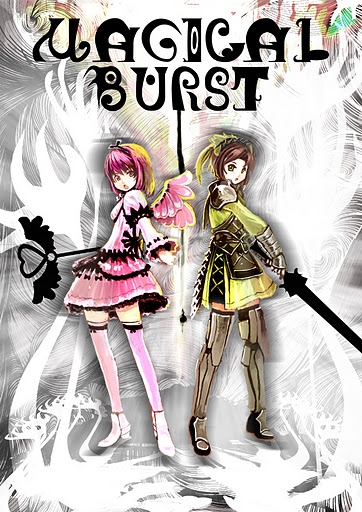
Magical Burst is a role-playing game about a different kind of magical girls.
Players: Recommended for 1 Game Master and 2-5 Players, Age 16+ Play Time: One or more sessions of 3-5 hours Materials Required: Paper, pencils, six-sided dice, and pawns or miniatures
It took far too long, but the fourth draft of Magical Burst is here. Seriously. It’s happening. This in turn is a step towards finalizing and publishing the game, which will hopefully take a lot less than the 3 years it took to go from the 3rd draft to the 4th. In the time since I started working on Magical Burst, Madoka Magica ended and then got a trio of movies, Sailor Moon is making a major comeback, and I got Channel A and Golden Sky Stories published. Magical Burst has evolved considerably as a game, but it’s much closer to being the game I want it to be, a hybrid of my eccentric gaming and aesthetic influences, and generally something no one but me would’ve made.
The biggest change is the implementation of a tactical combat system inspired by Meikyuu Kingdom with bits of D&D4e and a few other games. It’s still serves the same fundamental purpose of generating Overcharge to fuel the story, but it’s a more detailed system, and it in turn involves a considerable number of character trait selections and such. Although the fundamental concepts are about where I want them, it’s in the nature of such things that there’s a whole lot that will need to be examined and tested. Also, a friend of mine is working on an online character generator thing, so that will be exciting and coming soon.
This version is not completely there yet, but it is a functional game that I’m going to be developing more as I playtest and get feedback and such. There will be future versions, but they’ll be 4.1 and so on rather than a “5th Draft.” I’ve done some playtesting, but there’s still a lot more to do before the game is fully ready. I want to further refine the youma rules, and I’m wondering if the rules for Fallout and for setting up relationships need some more work. Still, the things I’m happy with outnumber the things I’m unhappy with. In any case, here are the PDFs:
I already started working a little bit on the follow-up, Most of My Friends Are Potential Supervillains (Subtitle: A Book of Humor, Almanackery, and Darkness), which will cover such diverse topics as villainy, board games, sports, more Secrets of Silicon Valley, places I have never been, and possibly that mini choose your own adventure thing I never finished for the first book.
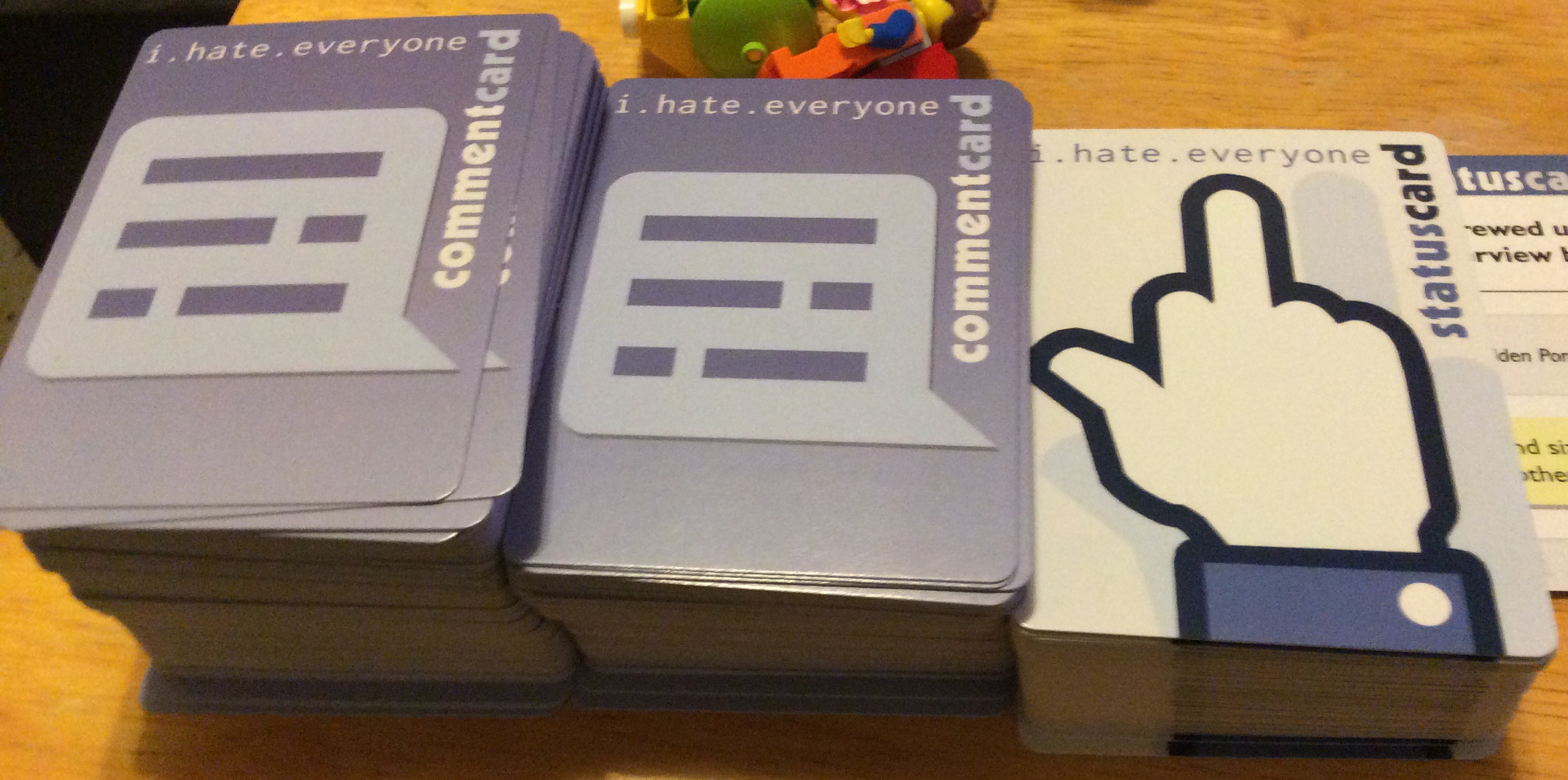
i.hate.everyone My weird tasteless party card game, i.hate.everyone, is up for sale on DriveThruCards. Since it’s print on demand and the came has 380 cards, it’s pricier than I’d like, but them’s the breaks. I got Clay to do graphic design for the fronts and backs of cards, and I used InDesign’s Data Merge feature (following Daniel Solis’ great tutorials on the subject) to automatically slot the text into the cards. I currently have two core sets: i.hate.everyone (the normal version), and i.hate.fandom (the geeky version). I also made free print-and-play versions of both, and they’re in the little 2″x2″ format so you can shuffle them into your homemade CAH set if you really want too.
For now the plan is to keep doing it as a POD (with free PNP) thing, and to expand and experiment. Professional publication is a possibility, but it’s not something I’m going to actively pursue until I get several other projects out of the way.
Golden Sky Stories
On the general GSS front, apart from a tiny handful of lingering shipping issues, I’m first and foremost trying to wrangle the remaining PDF material, while my business partner Mike is working on going to local conventions and looking for interesting new avenues to sell the book and otherwise reach people.
The big thing that will doubtless make some non-backers happy is that we’re actively working on getting a bundle of stretch goal material ready for retail sales. I decided to combine the five new character types, two of the scenarios, Allen Varney’s “Henge Sweets” piece, and the two prose stories into a PDF product called “The Colors of the Sky.” The quantity of material puts it about on par with the Japanese GSS supplements. Other stretch goal material will depend on when it’s done and what form it makes sense to put it into.
I also got back into translating the remaining supplements. I’d gotten a good amount done (including the Elder Henge rules), but between Hitotsuna Komichi and Kore Kara no Michi there’s five or so scenarios, a replay, another character type (a more detailed writeup for humans), and some stories that recount the history of Hitotsuna Town. (Which is really interesting so far, but also a lot of work to translate.) I already finished translating Mononoke Koyake a while ago, but editing is taking time.
Fantasy Friends
The big new thing I did with Fantasy Friends was to finish up the set of 36 magic items (enough to fill a d66 table). Making magic items for GSS was a major challenge both because I was breaking new ground with the system, and because through fiction and RPGs magic items that aren’t meant to cause harm in some way are the exception to the rule. I went through all 1600 pages of the AD&D Encyclopedia Magica books,[1] the GURPS Magic Items books, and lots and lots of Wikipedia pages. The big thing I started doing that created more work for me but also made the whole thing better overall was to include a few Story Fragments with each one. The easier those flowed, the more sure I was that I had a promising idea for an item.
I’ve also found an artist for the book. I’ve already sent him a set of instructions and sketches for the designs for the six signature characters, and I’m hoping he can give Fantasy Friends its own distinct feel, a little different from core GSS, but still just as heartwarming.
For Faerie Skies meanwhile I’ve mainly been doing some tweaks, especially those based on backers’ feedback on making its depiction of the English countryside a bit more authentic (but still idealized and idyllic, and taking a few liberties with the mythology). We’re still trying to find a suitable artist; if you know (or are) an artist who might be a good fit please feed free to contact us.
Magical Burst The fourth draft is nearly ready for release. I decided I wanted to do some playtesting first, and this turned out to be the right idea, since I found several small but important changes to make. One of the smallest in terms of the word count involved but big in terms of its impact on play was that instead of players being able to take up to 3 Overcharge to get extra dice on every magical roll, I turned that ability into a “Boost” move that’s limited to 3 times per scene. Giving everyone so many second chances was cumbersome in play, and limiting how often a player can use it seems to be a good way to keep that element without making it so overwhelming. The youma rules still need some more work too, mainly in figuring out how to give them abilities that are both interesting and make them into good “boss” enemies.
Surprising no one, the most recent additions is yet another table, for stock NPC archetypes to use when setting up relationships. I’m also putting in a series of “strategy guide” sections, with tips to help players better understand the whys and hows of the rules, and play more effectively. That covers a variety of topics, including stuff on how to more easily keep track of stuff at the table. One thing I came up with is that since the game uses the Marvel Heroic style initiative system (where the current person passes initiative off to someone else), I started giving each player an “action token” (and as many tokens as the youma has actions per round for it), which they turn in when they take a turn, so that it becomes much easier to keep track of who has and hasn’t gone.[2]
This will easily be the biggest revision to the game, but it’s also much closer to being the game I want it to be. The game has enough subtleties and moving parts that need fine-tuning that it’ll need some fairly intensive playtesting to fully finish it, but I’m hoping to complete it and in 2015 make it Star Line Publishing’s first fully original RPG.
[1]In PDF form. I’m tempted to see about getting the actual printed books, but (1) they’re not cheap these days, and (2) I really have way too much stuff and I’m trying to at least get more digital rather than physical stuff.
[2]The lack of thought about that kind of thing is one of my big criticisms of D&D4e, which I otherwise like a lot.
I’m getting fairly close to finishing the 4th draft of Magical Burst, which as I said will hopefully be the last major revision before publication. Naturally when I could’ve been working on it I instead blathered for 1600 or so words about working on it.
Thematic Stuff
One thing that’s been on my mind a bit lately is the thematic underpinnings of magical girl anime. Anime is a weirdly skewed window into a particular culture, and magical girl anime straddles at least two distinct segments of that culture. There’s magical girl stuff aimed at little girls, which is more likely to have women in creative roles, but at the same time is extremely mainstream. Sailor Moon was the queen (and in some ways the originator) of this phenomenon, though Precure pretty clearly holds the crown right now (at least until Sailor Moon Crystal starts up). There’s also magical girl stuff aimed at adult male otaku, and while Madoka Magica is unusually restrained in a lot of ways (nary a panty shot to be seen for one thing), it’s still mainly a show very much by and for men. Where the show displays a lot of restraint, the merchandise and the fandom certainly don’t, and if for some reason you decide you want plastic figures of the characters in swimsuits, there’s official merchandise for you.
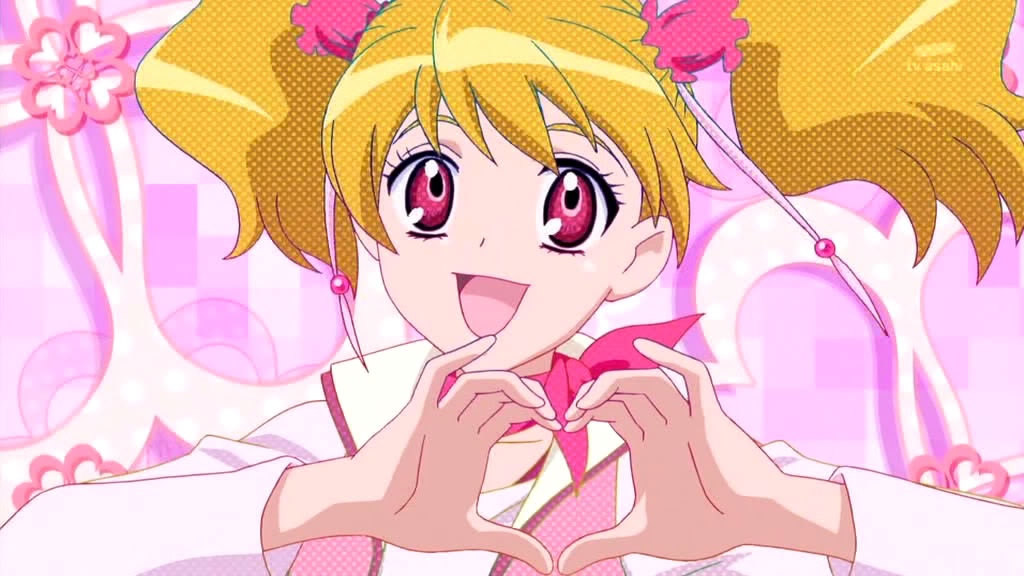
The shows aimed at girls are hard for me to fully take in. They present a lot of ideas about femininity, and those are grounded in a foreign culture and put through the filter of a show for little girls to watch in the morning. The actual style of storytelling is in my experience pretty similar to sentai shows, with the bad guys doing stuff that twists a characters’ desires in order to do evil. In magical girl anime stereotypically girly stuff like clothes and jewelry and dancing can be the focus a lot of the time, but they’ll also feature things like chess tournaments and martial arts where it fits the characters. Sailor Moon has the brainy Sailor Mercury and the tomboy Sailor Jupiter among the heroines, for example. As Lauren Faust put it, “There’s more than one way to be a girl.” Magical girl anime for girls tends to treat femininity as a virtue, but it presents many different kinds of femininity. It also has an aspirational streak, showing the characters striving for various notions of happiness and success. Sometimes this comes off as shallow and materialistic, and other times it can be pleasantly altruistic or otherwise noble.[1] I’m reminded of the thing that being girly isn’t anti-feminist, only the notion that all girls must be that way rather than being free to choose.
Her name is literally “Love.” Not “ai,” but the word “Love” in English.
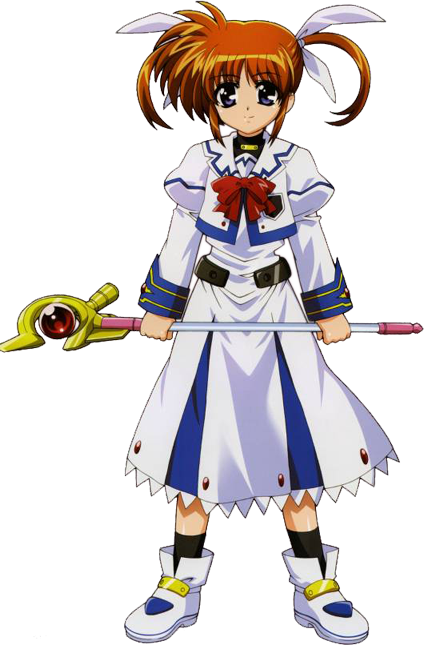
The issues with male-oriented magical girl shows are more apparent in titles like Lyrical Nanoha and Fate/kaleid liner Prisma Ilya, which although not without substance, have some pretty gross male-oriented fanservice at times, compounded by rather young characters. The stories tend to have very little to do with femininity, and instead play out a lot more like other genres of anime. Nanoha has a female protagonist and most of the major characters are also female, but in a lot of ways it’s more like an unusually succinct shounen fighting series. There’s a greater than usual emphasis on themes of friendship in Nanoha, but then that’s true of, say, One Piece as well. Friendship and striving to accomplish things and so on are really important values in Japanese culture, and very popular among boys.
Magical Burst belongs to the Madoka camp more than the Precure camp. For starters, the game is by an adult male designer, and if I were going to make a game aimed at anything like the girl-oriented magical girl anime and its original target audience, it’d look very different.[2] I’m certainly not going to put deliberate fanservice into the game, but I have no illusions about what gender the majority of the audience is going to be. It’s also an RPG, which means that a certain portion of the thematic content comes from how the particular gaming group comes at it.
I also took some influence from Superflat. Superflat is an art movement from Japan that’s a bit pretentious and hard to explain, but the core of it is exposing the absurdity of certain aspects of Japanese culture, in particular expressions of powerlessness and the lack of distinction between product art and fine art. As a result, Superflat art shows include a lot of outright bizarre stuff that uses imagery from anime and such. Magical Burst’s use of a zillion d66 tables that put a kaleidoscope of weird images and tropes in front of you is very much from Maid RPG, and even more so Magical Burst asks you to take a disparate mass of images and try to make some sense out of it. Although it doesn’t perfectly line up with Madoka Magica (on purpose), I want it to help foster some of the feeling of strangeness I and doubtless many others felt in the first episode when Madoka and Sayka find themselves inside a witch’s barrier. Looking at my introduction to the setting I see a lot of stuff about alienation, about lacking answers, which I think has a bit to do with how I feel about real life. So there’s that.
The world is a vast place, but although mankind as always told stories of magic, to their tribes, to themselves, to the night sky, men have never held it in their grasp. Magic is real even so. Magic is dangerous and terrible and beautiful. Magic is our only weapon against magic. Perhaps someday the world will forgive you for using it, but for now it hates you for it, hates your good intentions as well as your base desires. That is the world you will live in, a magical world.
Rules Stuff
On the design front, I wound up doing some major streamlining of the Fallout rules. Naturally this involved making a bunch more tables, since among other things I decided to make d66 tables for the two levels of Distortion type fallout. (My favorite particular entry being “Small candies rain down from the sky.”) A big part of the point of having tables is to provide inspiration so that you’re less likely to get stuck trying to think of something on the fly, so it made sense to have tables rather than just giving a handful of examples. It was really fun to come up with Magic distortions, and very difficult to come up with ones for Heart and Fury that would be impactful but not too out there. That also means that so far the game is up to about thirty d66 tables in it. So yeah. I also revamped the Change tables, trying to keep them from being overt fetish fuel, overly contextual, or any number of other problems. They’re still really out there, but hopefully better overall. I’m definitely liking how the Fallout rules are looking in general.
The three Specializations and the related Magical Talents are now done, albeit in a first draft kind of way. The Witch, which specializes in Attack, was probably the easiest to design, since “does more damage” is a pretty simple thing to accomplish. For the Knight (Defense) I really want to make sure such characters can be active enough to be fun to play, and absolutely not MMO tanks. For the Priestess (Support), D&D4e’s leader classes provide a lot of inspiration, though there’s also potential for doing some interesting things that are specific to this game, like playing around with Overcharge. I want the roles to be relatively flexible, with the ability to do some stuff outside your specialization’s role. The Priestess has a better healing talent, but anyone can get a healing talent, for example.
The big thing I’m trying to figure out right now is how to work the Sorcery rules, which essentially means coming up with an improvised magic system (or a stunting system if you prefer). The core idea at the moment is simply that you make a Support challenge with a target number depending on the effect you want, plus some stuff to make your life interesting if you fail or don’t succeed quite enough. Threading the needle of making something that can cover a huge variety of possible magic effects without being too complicated is proving a really interesting challenge.
It’s hard to say how soon I’ll get it done–I certainly don’t have any shortage of other things I need to get done, not to mention my day job having some tumult–but assuming I can untangle the remaining knots there’s not too much left to do. From there I’m hoping to launch into some pretty intensive playtesting, because I feel like I need to really learn the ins and outs of the system I’ve made, make some important refinements, and collect and communicate knowledge of how to play. Also, it’ll motivate me to get back into role-playing proper, which I haven’t been doing anywhere near as much as I’d like due to scheduling issues.
[1]Sentai shows are very similar to magical girl anime in this respect, which makes sense since they’re the early morning show for boys. Some day I really need to finish my Tokyo Heroes RPG, which covers both sentai and Sailor Moon style magical girls.
[2]My friend Aaron Smith is in fact working on a game aimed at more traditional magical girls, and it’s looking quite good and totally different from Magical Burst.
Time for an update on where I’m at with card game projects, notably i.hate.everyone and a new magical girl battle card game. (Did that get your attention?)
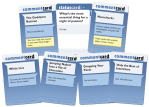
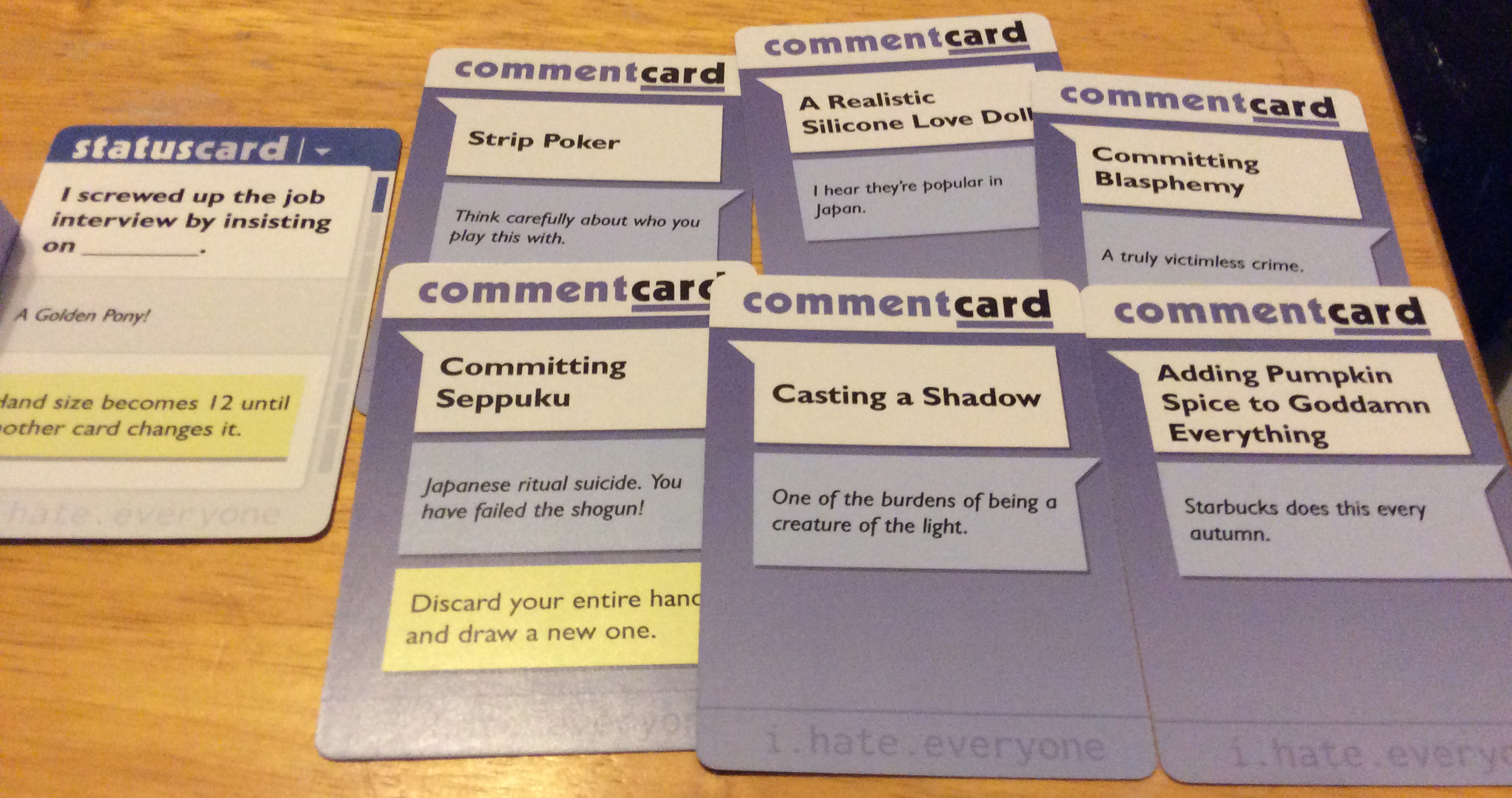
A little while back Clay did the graphic design for fancy i.hate.everyone cards, and I got a prototype made through DriveThruCards. Daniel Solis’ card design tutorial covers using the Data Merge feature in InDesign to automatically slot text into a card template, which made the whole thing much easier and generally more bearable to do, though I find InDesign bizarre and infuriating for all sorts of things. (It’s really, really weird to me that Adobe apparently doesn’t think anyone would want to import a Photoshop file into InDesign without completely flattening it.) Anyway, the results were pretty excellent all around,[1] and i.h.e is becoming the time-wasting card game of choice with me and my friends. I had upped the number of cards with special effects to about 1 in 4, and all the shenanigans with drawing, discarding, and trading cards were a lot of fun. I’m also very happy with the quality of printing from DTC, though a game with 380 cards is less than optimum both in terms of pricing and the fact that they don’t currently sell boxes that hold that many (though when I corresponded with Brian via email he said that’s something they’re working on.) Anyway, here’s a look at the cards!
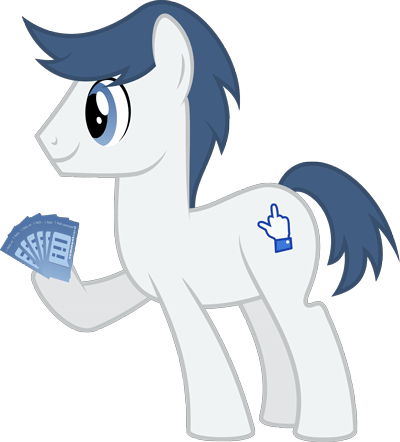
Right now the plan is to tweak things a little bit, and then start sales of both i.hate.everyone and i.hate.fandom through DriveThruCards. I’ve also already started on the first expansion, i.hate.bronies, which is indeed My Little Pony themed and weird and terrible and I already commissioned a pony mascot for it named Flippy.
Anyway, setting that aside, playing a bunch of Hearthstone (Blizzard’s new freemium online Warcraft tie-in CCG) put the idea of making some kind of battle card game thing into my head. Which I think is a good thing because I really should branch out beyond goofy stuff with words on cards. I specifically want to do something non-collectible (not that a CCG would be practical anyway) partly because losing solely because the opponent has more time and money and thus just inherently better cards is my least favorite part of playing Hearthstone. (And I really don’t remember it being that pronounced when I was playing Magic in high school.) Looking for an actual theme, I hit on the idea of doing a game about magical girls fighting, and thus a Magical Burst tie in was entirely natural, so the game I’m working on is tentatively titled “Magical Arena.”
I wound up messing around with various card games a bit, notably the new Adventure Time Card Wars game (which is really weird) and the WCW Nitro TCG (which some of my friends got way into because it was cheap, and which is way more clever than anyone would ever suspect), and I still can’t wrap my head around Weiss Schwarz (but there are some broad ideas in it that seem neat). The game that started forming in my head was a weird hybrid of Nitro, the plot system from Shinobigami, and a few other random things, and I’m already barreling towards having a playable prototype. It’ll also involve an Overcharge Deck, which gives you random effects if you try to push yourself too hard in one turn.
I’ve also been getting quite a bit done with Magical Burst proper, and I’ll be posting an update on that soon.
[1]When I playtested it with some friends earlier this week I was informed that the cards smell like porno mags, which I guess is appropriate.
The other day I brought my prototype of i.hate.everyone along when I went to hang out with some friends, kind of on a whim and kind of because it’s so much lighter than my Cards Against Humanity set.[1] That in turn led to me getting inspired to work on i.h.e more, and in particular to try to finish up a functional prototype of i.hate.fandom, the geeky alternate set I’d started working on a while back. My experience with creating cards on geeky subjects for CAH was that it was very easy to come up with cards that made sense to me but were alien to a lot of my friends, which was part of the inspiration for having flavor text (a la Apples to Apples) in i.h.e, though it was a lot less necessary for general stuff than for geeky stuff (hence the ones in i.h.e wound up being more of an avenue for sarcastic jokes). Limiting the selection to stuff that was reasonably widely known also made it harder to come up with geeky cards, though I did finally manage to put together an initial set, if one that overdoes certain topics.
I posted the current prototype of i.hate.everyone ages ago (some of the more topical cards feel out of date; Tebowing isn’t exactly making headlines these days). The rules are so far unchanged from then, but here are the current decks for i.hate.fandom. I make these decks by printing the Status Cards on yellow cardstock and the Comment Cards on white cardstock, since otherwise they’d be hard to distinguish.
I also finally got around to playing We Didn’t Playtest This At All, a silly party game from Asmadi Games. It turns nonsensical, pointless, time-wasting gameplay into an artform. To get the full effect you have to play several games, during which players will routinely be made to lose by random card effects. What pushes it into Japanese game show territory is things like how certain cards make you not use certain pronouns (even when they appear on cards!). At one point two of my friends were in a duel where they couldn’t use I, me, my, you, your, they, or their, and resorted to silent pantomime to play out the rest of the game. I want to keep the effects in i.h.e a bit less crazy (less “you lose,” more “discard a card” or “lose 1 Like”), but having random constraints on what players are allowed to do can have amazing results and generally help a game live up to being a “party” game. It’s also the main thing that keeps i.h.e from just being a CAH clone, so I want it to be interesting and prevalent in play.
Presently my plan for i.h.e is to make it into a series of DriveThruCards products, with both full, independently playable base sets (the core i.hate.everyone plus i.hate.fandom being the first of these), and mini-expansions that I can easily create and keep topical. Like a lot of other similar games, making new content is basically a matter of putting text on cards, and POD will let me make all kinds of weird little sets for very specific groups if I want, and pretty quickly too. I asked Clay Gardner to make card designs for me, since this will be fronts and backs for two types of cards and nothing else, rather than the logo-making nightmares of Channel A. With some playtesting I should be ready to move to the “fancy prototype” stage fairly soon.
[1]Which is partly my own fault for insisting on getting all of the expansions, plus Crabs Adjust Humidity, plus making some cards of my own.
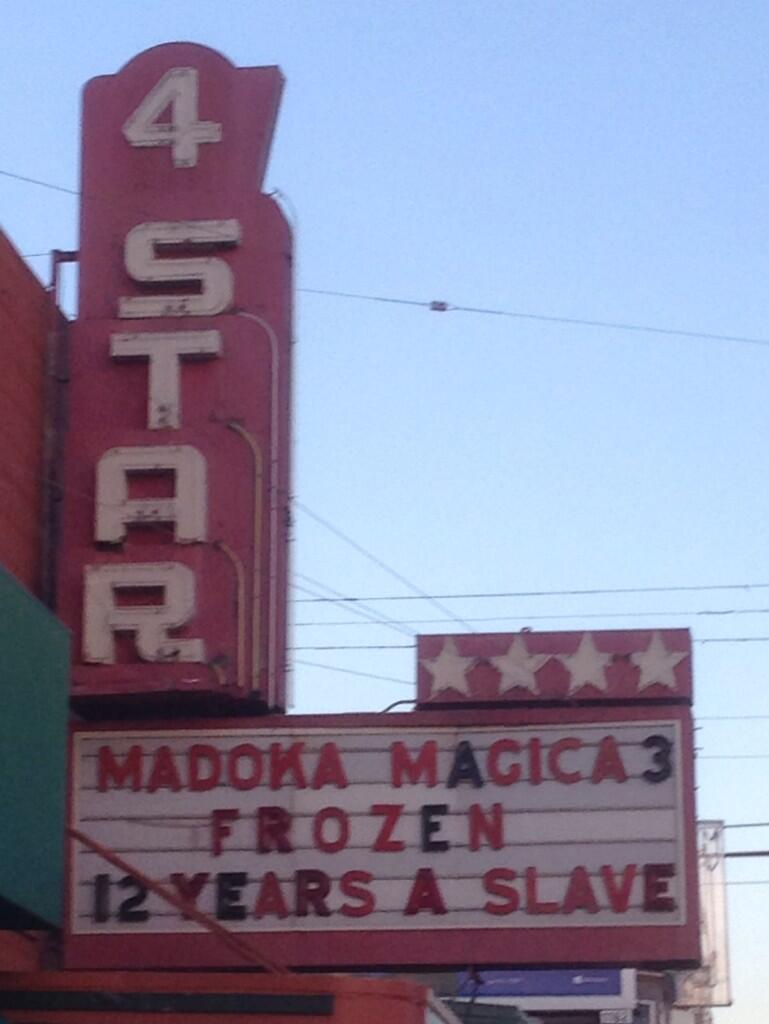
The other day I got to be one of the very few people outside Japan to see the third Madoka Magica movie. It was at a crappy little theater in San Francisco, and we got to wait in the cold until 15 minutes before the showing started. On the other hand we actually got to see it. When they had the double feature of the first two movies they had about two showings total here, which sold out before I could get a ticket. Madoka Magica has always been the kind of show that’s hard to talk about without giving spoilers, and short of watching a fansubbed camrip, most people aren’t going to get to see it until some time after the eventual DVD/Blu-ray release, so I won’t go into detail about it except to say that it was quite good, but really, really weird, and I think it will be very controversial in the fandom.
Although I haven’t really had time to actually work on Magical Burst, watching the movie did give me some ideas, and inspired me to start watching more magical girl anime, which in turn gave me other ideas, so at the rate I’m going I’ll hopefully get back into working on it before long. As much as I liked the third Madoka movie, I feel like it helped me mentally decouple Magical Burst from the franchise a bit more, so that I can look at other magical girl titles more clearly and openly. Although Madoka was a prime source of inspiration, MB was always its own thing in many very important ways, especially with the central conceit of Overcharge and Fallout, which is both very important to how MB works and very different from Madoka Magica. In particular I’ve been watching Day Break Illusion, Fate Kaleid Liner Prisma Ilya, Fresh Pretty Cure, and the live-action Sailor Moon series. These haven’t really inspired me to change Magical Burst rules-wise, but they have definitely got me thinking about the genre quite a bit more.
I also ended up having a pretty solid idea for what I want to do for a “Magical Burst Companion” book to eventually follow the core rulebook. This is me getting way ahead of myself as usual, but it helps to have some kind of outlet for concepts that are extraneous to the core project, provided they don’t get totally out of hand. There are several possible alternate takes on magical girls that would make interesting rules options. I want to do something with a dark take on the reincarnation element in Sailor Moon, both as a rules option and in a story. Fate Kaleid Liner Prisma Ilya also presents the idea of magical girls having cards they can swap out to get different magical abilities (and of course there’s Card Captor Sakura). Pretear presents a variation on that concept where the different powers come from different people, but using them means risking those people’s lives. A “corruption” system more in line with Madoka Magica could make a nice replacement for Overcharge and Fallout.
The other major part of the Companion would be a set of three alternate settings, which use the same basic rules (with some key changes) to tell some very different sorts of stories.
Angel Project has heroines who wear skimpy sci-fi power suits (as seen in Galaxy Fraulein Yuna and a few others) and fight the forces of darkness and occasionally each other. Taking a cue from the Yuna PC Engine games, the setting involves destinations like the Water Planet and the Fancy Planet.
Helix Academy is about students at a school for people with special powers, heavily inspired by A Certain Scientific Railgun. I’m not sure how I would really approach this one yet, but I’d like to try something along the lines of Adventure Planning Service’s Elysion RPG, where you have to manage your schedule and take turns doing different things towards your goals.
Zero Hour would basically be Persona with the serial numbers filed off, concerning people with special Avatars that give them powers they can use to fight threats to humanity in the un-time. And now that I think about it, the time management type system would be pretty appropriate for this one too.
Anyway, I just wanted to share where I’m at with Magical Burst. I’m thinking over the course of 2014 I want to make a push to complete the new revision, do a bunch of playtesting and refinement, and then move towards publishing it by 2015. And from there avoid having quite so ridiculously long development cycles for my games.
I had started writing a design journal post about Fantasy Friends, and then I realized I had made such a post before and I was mostly rehashing stuff I’d already written about. In a way that kind of typifies a lot of what’s been going on with me in terms of game design: there are a lot of things I have more or less figured out in my head but still need to finish doing the actual writing and such. I think that has a lot to do with the Golden Sky Stories Kickstarter eating up so much of my time, but the good news is that for the purposes of the actual shipping of physical goods part my own work is very nearly done. All of the many physical items are variously already at the warehouse, on their way to the warehouse, or will be going to the warehouse once printing is done. All that’s left for me is to post some updates and handle letting backers update their mailing addresses when the time comes. After that we still want to get the remaining PDF stuff done in a reasonable amount of time, but it’s not going to be nearly as much pressure. Anyway, I decided to write a blog post about what I’ve been generally working on.
Friday Knights
One of my major projects right now is Friday Knights, a playset for the currently-Kickstarting Costume Fairy Adventures RPG, the inaugural product from David J. Prokopetz’s Penguin King Games. The game is about cute fairies who wear costumes that give them magical powers (there’s a deck of costume cards) and how they generally get into trouble. I’m writing a scenario/playset where your fairies wind up in a house where there’s a D&D game going on. I’ve made a good start on it, but there’s plenty of writing left to do.
Adventures of the Space Patrol
The other day while googling to see what people were saying about Golden Sky Stories I came across something that gave me pause. Someone had pointed out that in describing the Space Agents I had portrayed the male characters in a variety of ways, but managed to talk about pretty much all of the female characters in terms of being young and pretty. I’ve generally been trying to be better about inclusiveness and diversity, both to better serve my audience and to challenge myself to break dumb cliches, so it caught me off guard that I’d managed to do such a thing without even realizing it. On the plus side, that promptly gave me the idea to make Billy Smith’s mother a playable character, which is a dynamic that you pretty much never see in RPGs. Generally tweaking and playing around with the other characters is also going on my to-do list for the next revision of the game, whenever I can make time for it.
I’m also planning to include more robust rules for creating original characters. While I like having premade ones in many different ways, it seems pretty clear that a big chunk of the RPG audience wants the ability to make solid original characters. I also picked up the Fate System Toolkit. It’s packed with all sorts of ideas, but the one that interests me most is Conditions, though I’m not at all sure whether they’re really the way to go. Something to experiment with in playtesting.
Magical Burst
A few people have been asking about Magical Burst. It’s another one of those projects where I’ve pretty much figured out what I want to do, but need to find the time to actually do it. That puts it pretty much at the top of my list of things to do when GSS isn’t eating up quite so much of my life. I also need to find time to sit down and watch more of the magical girl anime that’s come out (the Madoka movies, Day Break Illusion, Fate/kaleid liner Prisma Illya, and I’m sure I’m missing something). Of my many neglected projects Magical Burst is easily the one I most want to make happen, and a Kickstarter is a very distinct possibility once I get the rules nailed down. (Though after my experiences with GSS, I’m definitely going to keep extras and stretch goals on a tight leash next time around.) As I mentioned before I want to continue having a free version of Magical Burst available, something along the lines of how Anima Prime has a no-frills free version and a fancy book with illustrations and such.
Other Stuff
I haven’t gotten around to posting it, but I did a revision of America’s Next Top Reality Show, making it so that each card has two title words, plus a demographic listed between. That way the game has 144 title words out of a 72-card deck, and doesn’t need for the players to have dice on hand. The game is working pretty well, though it has a very different energy from Channel A, plus we tend to feel kinda dirty after playing it, in a way that doesn’t happen even with Cards Against Humanity. ANTRS parodies something really prevalent in our culture right now, and potentially in a pretty cutting way, since sometimes it does feel like reality shows use some kind of randomizer.
Fighting Fighters Coliseum is the title I’m tentatively giving to a game that’s going to be a kind of successor to Channel A, still a party game, but with a little bit more in the way of rules. The idea is that instead of titles, you assemble your final attack name from words on cards. The game would also have a set of character cards, which double as both player avatars and opponents, with different special abilities for both. There’s still some details to work out, but putting together a list of words from special attacks was pretty much just a matter of culling through lists of such.
Something’s going to be happening with Maid RPG soon. Nothing earth-shattering, but something. I should be revealing it in about a month or so.
The other day I sent the first draft of Faerie Skies out to backers, along with a request for fans who are from the UK (or just knowledgeable about it) to offer feedback on how I portrayed the English countryside. Thankfully it looks like it’s mostly small details that I missed, and not anything really huge or offensive.[1] As I said in the backer update I’m more of an anglophile than the average American, but I’ve nonetheless lived in California my whole life. On the other hand I’m definitely going to take some liberties with fairy lore, just as Kamiya did with Japanese myths. This is partly because I basically have to make something that works with the GSS rules, and partly just to better fit with what I think would be more fun. Faerie Skies is going to need some fine-tuning and some more playtesting and such, but in the meantime I’ve been working on Fantasy Friends, mainly because being productive helps me not be crazy anxious about the whole Kickstarter thing.
Looking through old Monster Manuals (and the Fiend Folio and Monstrous Compendium and such) for monster ideas was kind of daunting. In AD&D1e the monsters are for the most part terribly vicious things, many of which basically exist because an evil wizard figured out a demented new way to kill incautious adventurers. WotC’s takes on D&D focused that much more on monsters that you fight, and at times it seems to be full of angry, spiky, glowing things, especially in the higher-numbered books. Navigating the game towards having friendly versions of beholders and gelatinous cubes make sense feels a bit daunting, since unlike with more classic mythical creatures the D&D monsters have very seldom been made friendly. (Rusty and Co. is pretty fun though.) Fox spirits could be downright terrifying in Asian myths,[2] and the old, unvarnished fairy lore reads like a long list of things to stay away from if you want to stay alive, but the works of fiction around them make them relatively easy to picture as friendly. (And with fairies, the friendly modern version is now more prevalent, so there’s a lot more about happy pixies and elves and a lot less about Jenny Greenteeth eating children.) In GSS, the henge’s self introductions usually address the myths about them, and in some cases they “debunk” the myths. This is especially true of Kuromu the cat henge, who wholly rejects the veracity of folk tales about bakeneko and nekomata and such.
I realized that for the creatures I want to put into Fantasy Friends I essentially need to carry out this same process, though I have to start a little further back as it were. Under the influence of anime and Discworld and such (plus looking at real life), I hit on the tack that in this fantasy world most beings basically just want to live their lives, and it’s mostly politics, ignorance, and misunderstandings that keep them apart. Without that Dark Lord jerk mucking things up, the so-called Forces of Darkness would just be people (with a rather broad definition of people) being more or less decent to each other. For people in an unremarkable little village, the sight of a beholder or whatever is still quite a shock, but ultimately coexisting is better than fighting for everyone involved.
From WotC’s Monster Slayers kids version of D&DI also ended up using Mononoke Koyake as my template for how to approach the new set of character types. In MK, each character type has a whole two extra pages that lay out basic info on the character type, eight or so possible reskins, the rules for how they transform, and advice on naming. This was basically the only way to even make a dent in the possibilities presented by “monsters from D&D and similar fantasy works.” I had considered doing something like this for Faerie Skies, but found that it didn’t really feel necessary, as the different types of fae didn’t lend themselves to there being too many sub-types. For D&D-type monsters on the other hand I ended up with things like an Aberration character type, which covers beholders, rust monsters, chimeras, and so forth. The others are Constructs, Dragons, Elementals, Shapeshifters, and Slimes. Some of these can be quite powerful in D&D terms, but then this is where the way that GSS operates somewhat orthogonally to typical RPG concerns is very helpful. In GSS’ later supplements there are new character types like the Elder Henge that have some very potent powers (snake henge actually have some powers that affect time!), but a power that costs a full 20 points of Wonder is unlikely to be usable until the story is winding down in the first place. And perhaps more importantly, when the final objective is to help people and heal relationships and such, special powers only go so far in the first place. I’ve seen Powers like Peek Into Hearts undo a GSS scenario’s Gordian knot, while flashier powers go unused.
One thing I’m adding in that’s pretty much new for GSS is magic items. In game terms these would basically be a “container” for 1-2 Powers and possibly a Weakness, and in story terms they’d essentially be a plot element roughly on the level of an NPC. Characters wouldn’t just own random magic items, but an item could play an important role in the story. Very much like with Faerie Skies, I’m rounding out the book with a sample town (“Grassdale”), some story seeds, and some new NPCs. So far the NPCs are basically just the archetypes that a fantasy town calls for, such as the priest, innkeeper, and hedge wizard, not to mention adventurers.
Overall it’s kind of surprising how different an energy this project has from Faerie Skies. Fantasy Friends is RPG-style fantasy, and while there are some tropes I want to hit, I’m basically making stuff up, whereas for Faerie Skies I culled through about a dozen different books for reference, from classic literature to recent RPGs. Not having to worry about getting a real-life culture right is also rather freeing. The tricky part is the volume of stuff I have to tease out to create a GSS character type. For fairies coming up with 12 powers and 6 weaknesses was basically a matter of digging until I found enough ideas in fairy lore, while D&D monster writeups tend to have relatively few things that can work as GSS-style powers, and in many cases not a lot of other source material on account of having come from the game with little to no basis in myth. Fantasy Friends also feels a lot more like I’m subverting a genre.[3] Taking something with violence at its core–in some cases so much so that it can obscure everything else–and making a nonviolent heartwarming version is challenging yet oddly appealing. Anyway, I should actually get something done instead of sitting here blogging about it, so I’ll stop here.
[1]People do seem to take the names of British pubs very seriously, though I assume that’s in part because British pub names are awesome.
[2]This is especially true of the Korean version, the kumiho.
[3]Though with this and Retail Magic and Dragon World that seems to be becoming a pattern with me.
It’s been a while since I did anything new with Adventures of the Space Patrol, but I’ve always been fond of the game. It’s got some of the heartwarming fun of Golden Sky Stories, and not unlike GSS it has its own aesthetic, not quite like other entries in the same genre.
I originally designed the game as a very simple custom build of Fate. When I started working on it, Spirit of the Century was the definitive version of Fate, and Awesome Adventures was the about the only simpler version out there. I really like the core concepts of Fate, but these days I’m generally not a fan of 300-page RPG rulebooks. There are also issues like how SotC gave characters a full TEN Aspects, which to my mind is about three times too many. I saw an awesome rules-light game lurking inside of Fate, and Space Patrol was in part my best attempt at creating that. More recently, Evil Hat had their explosively popular Fate Core Kickstarter. Along with a zillion other things, it brought Fate Accelerated Edition into the world. There was suddenly a 48-page version of Fate (available in print for a mere $5), which kept the essence of Fate and included the slick refinements of Fate Core.
You can probably see where this is going, but it was pretty much a no-brainer to revise Space Patrol to take full advantage of FAE. The way it handles the four actions, the rules for challenges/contests/conflicts, and so on do a lot to address the few things about my game that I had been trying to figure out how to smooth over. With OGL and Creative Commons licensing options, readily available SRDs, and the Fate Core Glyphs font, Evil Hat has made Fate pretty awesome to use from a publishing standpoint. Otherwise I didn’t change Space Patrol all that much. I tweaked a few things here and there (like making it so the GM just gets a flat 10 Atom Points per episode), adjusted some things to fit the new rules, and added a new character to the lineup (Cosmo the Wonder Dog). I also finished up the two sample scenarios I’d been planning to write. It’s all very first draft, but it should be totally playable. I’m hoping to get in some playtesting before too long, and to more thoroughly read Fate Core with an eye for finding elements to adapt to Space Patrol.
Me being the way I am I’m thinking about possibly doing a Kickstarter for it at some point. It’d have to wait until a lot more Golden Sky Stories stuff is out of the way, and if I do it I’m definitely going to keep it a lot simpler and sleeker than what we did with GSS. Also, I’m looking forward to having the excuse to get a bunch of cute, stylish retro sci-fi art done.
Anyway, without further ado, here is the current playtest draft PDF:
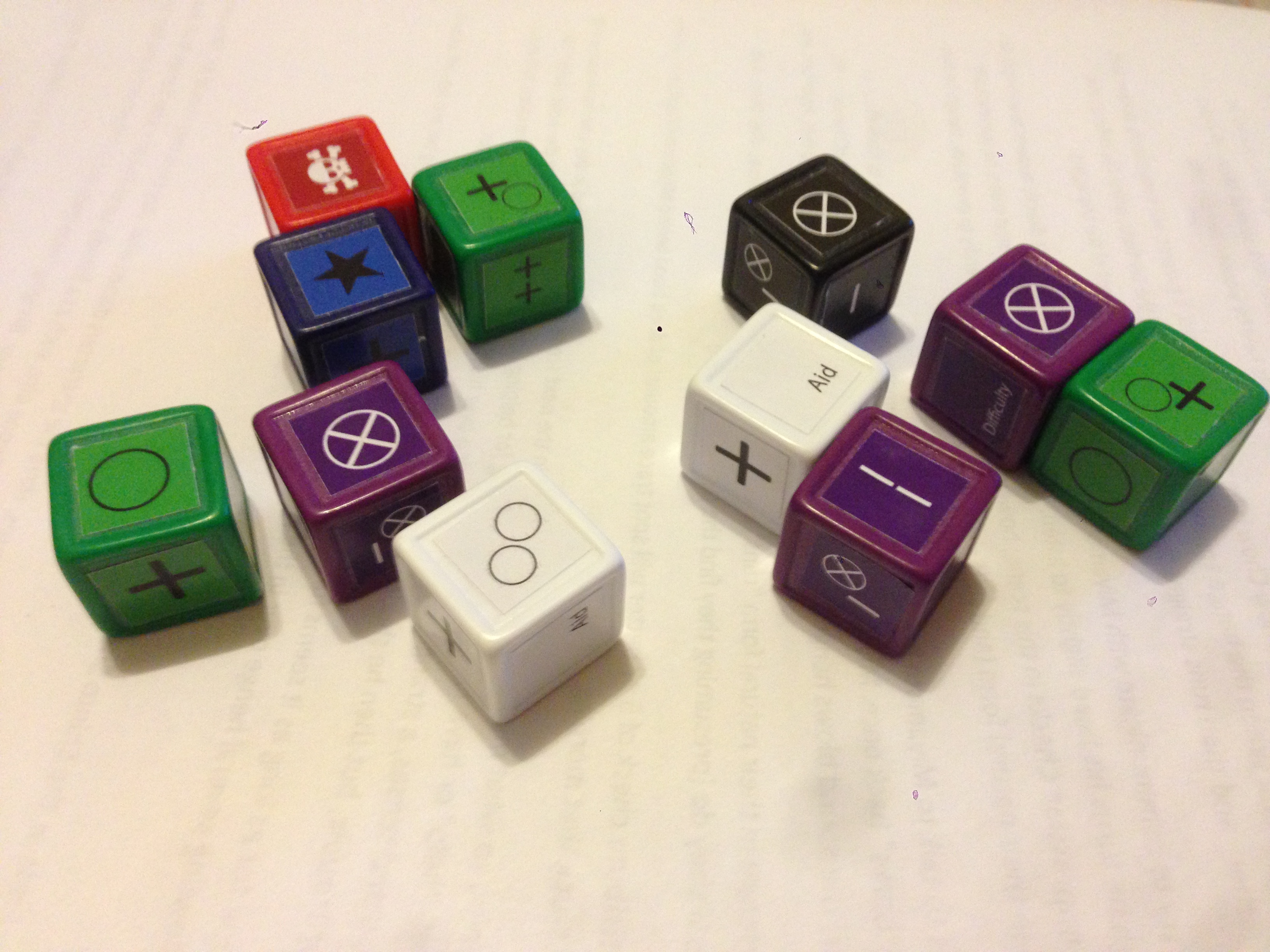
A while ago I tried out the Star Wars: Edge of the Empire Beginner Game, and a while before that I tried out WFRP3e too. Warhammer was downright overwhelming for its preponderance of board game style components, more in line with one of FFG’s Lovecraftian board games than any prior RPG, but as unconventional as it was, I really liked the dice mechanic. The basic idea is that you roll a pool of various types of special dice representing different factors in the game, including not only your character’s abilities, but the difficulties you’re facing as well. The dice have different symbols that you use to figure out the outcome of the roll, with a number of possible side effects. The Star Wars game presents a more refined version of that. The selection of symbols and dice is a little simpler, and it has this nice aspect where the more potent dice have more sides. (The Star Wars symbols aren’t quite as intuitive as the Warhammer ones though.) Apart from those dice and some Star Wars flavor, Edge of the Empire is basically just a fairly solid, rules-medium traditional RPG.
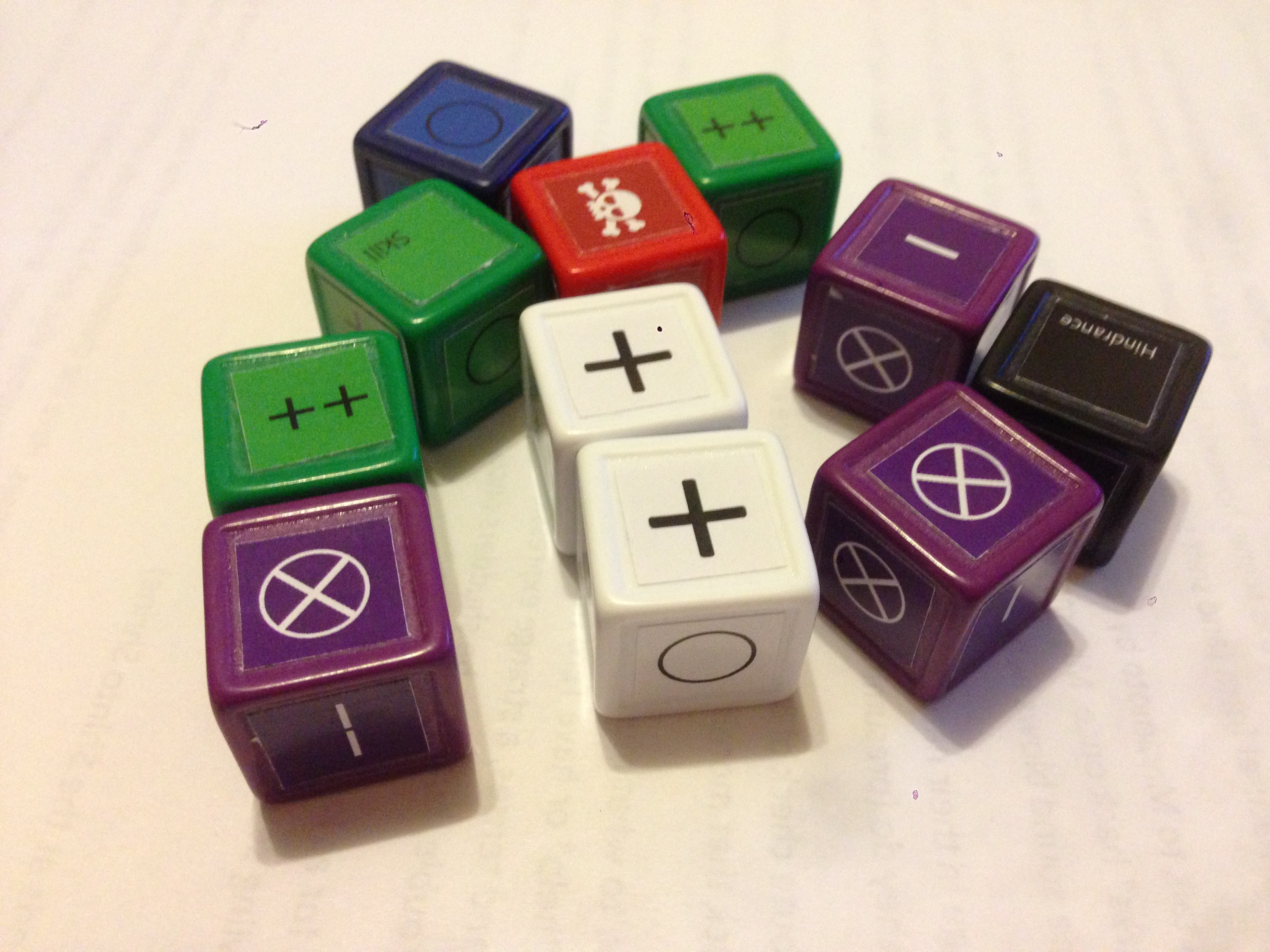
For a while I’ve been wanting to put together my own genericized version of this style of dice, and I finally sat down and did just that. I call these “Destiny Dice” (like they’re some weird, elaborate cousin of Fate dice). I don’t really expect to establish a new standard, not even on the level of Fudge/Fate dice, but I do expect to make something that’ll at least be fun for me to play with. For practical reasons, at least for this initial iteration, I’m using only six-sided dice. Chessex charges by the side for custom dice, which makes prototyping a bunch of dice where every side is custom prohibitively expensive. Q-Workshop also does custom dice, but they want fancy designs and the it’s not really at that stage yet. But what I can do is get blank six-sided dice and custom-printed stickers from The Game Crafter. I stuck pretty close to the Edge of the Empire version otherwise, so the dice produce both Successes/Failures and Advantage/Disadvantage, plus the occasional Hope and Despair symbol. Success/Failure determines whether a given task succeeds, while Advantage/Disadvantage lets other good or bad things potentially spin off from it (the simplest being mechanical stuff like giving an ally a bonus die), and Hope/Despair is basically a more potent version of Advantage/Disadvantage.
In order to actually have a system to play it with, I put together a hack of Fate Accelerated. With the new Fate Core the Evil Hat team has done an incredible job of refining the Fate rules, and with FAE they’ve really distilled the essence of it down to the sleek little game that’s been buried inside of Fate’s usual bricklike books all along. This is going to necessarily change the feel of the game a bit. For more rolls than not you’re going to be figuring out how to spend the Advantage/Disadvantage symbols that come up, plus Aspects aren’t quite as powerful as in standard Fate. I’m thinking I’ll make the dice available for purchase through TGC in case anyone is interested in trying it themselves (and willing to spend an hour or so applying stickers to dice), but not until I’ve done some playtesting and refined the whole thing a bit in terms of both game design and graphic design. In the meantime here’s what I have so far for the rules:
![IWantToBeAnAwesomeRobot[smallpdf.com]](https://yarukizerogames.com/wp-content/uploads/2014/03/iwanttobeanawesomerobotsmallpdf-com.png?w=100&h=150)

![IMG_0981[1]](https://yarukizerogames.com/wp-content/uploads/2014/02/img_09811.jpg)
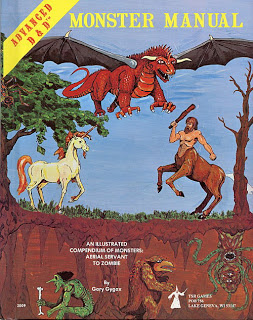 Looking through old Monster Manuals (and the Fiend Folio and Monstrous Compendium and such) for monster ideas was kind of daunting. In AD&D1e the monsters are for the most part terribly vicious things, many of which basically exist because an evil wizard figured out a demented new way to kill incautious adventurers. WotC’s takes on D&D focused that much more on monsters that you fight, and at times it seems to be full of angry, spiky, glowing things, especially in the higher-numbered books. Navigating the game towards having friendly versions of beholders and gelatinous cubes make sense feels a bit daunting, since unlike with more classic mythical creatures the D&D monsters have very seldom been made friendly. (
 Yaruki Zero Games