Category Archives: games

Not About Maids

Illustration of Rita by Sue-chan (www.sue-chan.com)

Time to post about some non-Maid stuff for a change.

I Design Too!
“This guy always has all the best ‘let’s smoke some peyote and watch anime’ ideas.”
— Eero Tuovinen

I haven’t gotten a whole lot done in terms of designing my own games of late, so I’m trying to make a conscientious effort to actually get some goddamn work done, and maybe even bring one or two to fruition. Raspberry Heaven is by far the most promising of my game projects, and the one that had probably my single most successful playtest session ever. I’ve already done some fine-tuning since then, and right now it basically needs more writing, testing, and tuning.

I’m also getting more seriously started on Slime Story, hence I started a thread on the Forge about it (which is where the above quote comes from). The thread explains what the game is about (and I’ve posted here about it before), and the game is basically at this point where I have a good idea what I want it to do, but I’m still trying to work out how.

Playing Games
My group is currently doing two different campaigns. There’s my Divine Machine campaign, which runs on OVA because it seemed the best system I had on hand that could handle all the crazy stuff I wanted to do (though now the scale of events is kind of pushing past what even it can handle), and which is barreling towards its conclusion. I’m kind of starting to wish I had a game that could mechanically handle an epic struggle against a sentient nanotech menace that threatens the entire multiverse…

We also finished our second adventure (fourth session) of D&D 4th Edition. Our characters reached level 2, and we’re generally playing the game more like a well-oiled machine, rather than looking up and arguing about the rules every 5 minutes.

Much as I’m enjoying both of these, I’m kind of looking forward to Divine Machine ending and/or D&D going on hiatus, because I’m increasingly wanting to shift away from long-term play and also to jump headlong into playing more of my accumulated indie games (plus playtesting my own stuff, and playing some of the stuff I’ve translated). In particular, I want to clean up Raspberry Heaven a bit and run a playtest, give Yuuyake Koyake another go with different local friends, and try out Monsters! Monsters!. I also want to play 3:16, do a PTA game about the lives of otaku, and do a Solar System game inspired by Fairy Quest.

Monsters! Monsters! Monsters!


I now own a copy of Monsters! Monsters!. This is a game put out in 1976, designed by Ken St. Andre. It is essentially a variant of Tunnels & Trolls where you play as the monsters. (Here’s a rather detailed review). I had read about it in Heroic Worlds, and I got to play it at Origins ’94 (though I didn’t do well since I wasn’t getting into the monster mindset), but the new edition the GM spoke of never materialized (I can’t remember where exactly, but I read somewhere that the publisher couldn’t offer the designer selected enough money for him to justify doing the work). However, it turns out that a company called Outlaw Games offers reprints of old T&T and related game material, and even new stuff. The copy of M!M! I got (through Noble Knight Games) is a reprint in perfect condition, though it’s a pretty much unaltered reproduction of the 1976 version, which was apparently done on a typewriter.

The game itself is even simpler than old-school D&D. There are some other bits involved, but combat basically comes down to rolling your weapon dice and adding your Combat Adds (based on how much certain attributes exceed 12). It includes brief descriptions of 52 different monsters (set up so you can generate one randomly using playing cards). I definitely want to play this, but I think I’ll need to carefully limit the selection of monsters. For example, dragons have a strength multiplier of 25. That means that you roll 3d6x25 for a dragon’s Strength attribute, and a dragon with merely average Strength would be making combat rolls on 25d6+213 from Strength alone.

Anyway, it’s an exceedingly fast and loose game, though it does have some little touches of brilliance. My favorite thing is how XP is awarded. Since they PCs are monsters, they get XP for doing monstrous things. Defeating enemies who are more powerful is worth more XP, but abducting particularly beautiful victims (Charisma 17+) is worth a full 500 (which would get you halfway to Level 2).

If playing it works well, I’m going to look into getting some more T&T books to draw on (since M!M! kind of glosses over certain things, including treasure), and in particular some books, T&T or otherwise, with fantasy towns and cities for the monsters to rampage through.

Monsters & Mayhem
I have a certain knack for starting new projects even though I have more than enough unfinished ones staring me in the face. That’s how I wound up starting (if not very seriously so) on two new games. One of these is (tentatively) called “Monsters & Mayhem.” I like the idea of using the old alliteration with an amperand in the middle style name though. Somehow, as awesome of a premise as M!M! brings to the table, no one else has ever actually tried it as far as I know. This will thus be my take. A lot of my new design ideas are turning out to be this weird mix of traditional, Japanese, and indie design influences, and this one is no exception. To create a monster you combine two Keywords (e.g., Seductive+Demon=Succubus, but Seductive+Slime=Slime Maiden), which in turn affect your monster’s attributes, powers, and aspects. (Aspects tend to get you into trouble, say by compelling you to eat a town guard even though his friends will come after you). They “Keyword” approach comes from Beast Bind: New Testament, where you pick “Bloods” to make your supernatural creature.

Although I’m thinking I’ll include support for some other things, the core/default gameplay consists of the players’ band of monsters going into a (demi)human town seeking fame and fortune. In essence, for them towns replace dungeons as the dangerous places to venture into. I’m stealing the awesome idea from the “Maidenrangers” Maid RPG scenario of using playing cards to create a board/map for the PCs to move around. Different cards represent different random encounters, though of course the GM can pick out cards and generally set things up however he or she likes.

Slime Story
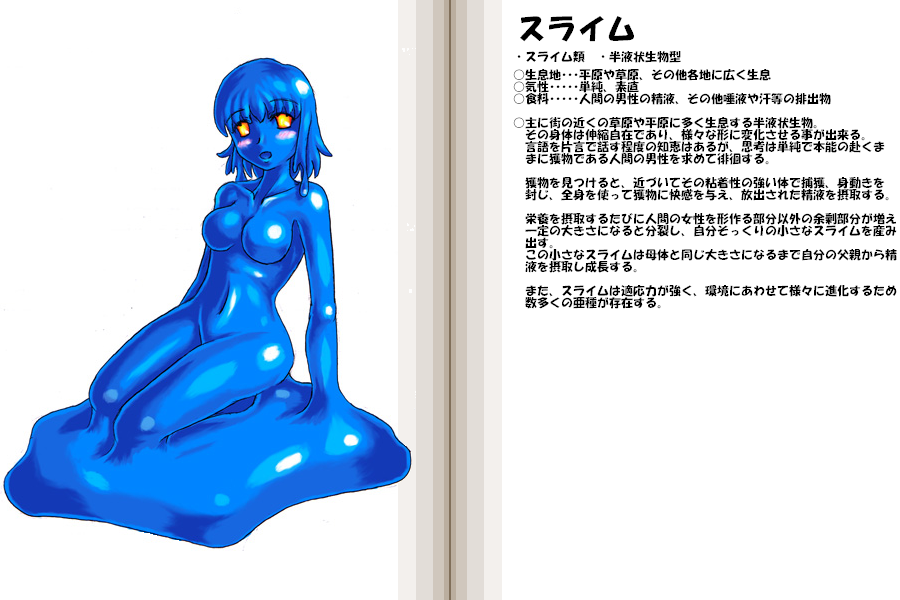
I had the idea for this setting ages ago, and I wrote a short story for it a while back. Now I’ve finally gotten a good start on the RPG version I wanted to make. It takes place in a world where portals suddenly started dropping cute monsters (like something out of a Korean MMO) into an ordinary contemporary world. In the game you play teenagers who hunt monsters as a hobby–and for spending money. To create a character you pick a Class (which decides how your character hunts monsters) and a Clique (which determines how he or she fits into society). Fighting monsters is a fairly simple hack-and-slash affair, but each session players create “Quests” for their characters. These can range from simple monster-hunting goals (earn $300, kill a salamander, etc.) to tricky social goals (ask Rita out on a date, convince Alex to let me go hunting with him), but they have to be things that you can do around an outing to hunt monsters (try to find the right moment to ask Rita out while you’re looking for more monsters). It’s very strange trying to come up with a bunch of monsters while making sure that none of them are even remotely sentient.

For both games I’m leaning towards using d20s, partly for what they’re referencing, and partly because isocahedrons don’t get much love outside of D&D.

Everyone’s Doing It: My Thoughts On D&D 4th Edition


I think I’ve figured out what it is I like about Dungeons & Dragons 4th Edition. To me, they’ve managed to laser-focus on the things where D&D is in fact better than most other RPGs. They’ve turned it into a combat-oriented dungeon-crawling game par excellence. If it’s not as strong on role-playing elements as some prior editions, there are plenty of other games that were better than D&D at such things to begin with, and it was never part of D&D’s paradigm to stress such things mechanically. Basically, I’m looking forward to playing 4th Edition with my friends because it’ll be a novel experience for me. We played 3rd edition some when it first came out, but otherwise we’ve pretty much abandoned it, and playing such a “game-y” and clearly-defined RPG would be something new after playing long campaigns with Fudge, Truth & Justice, and OVA.
Continue reading Everyone’s Doing It: My Thoughts On D&D 4th Edition

Thoughts on Anime RPGs

Over the past few days I’ve been working more on Zero Breakers (the tentative title for my fighting shonen manga RPG), though it’s mostly been filling in details I’d already thought of, and occasionally modifying parts to fit together better, so there isn’t a whole lot to post about. Though I did realize that part of what I’m doing with the game is taking stuff I do at the gaming table naturally and codifying it into rules.

I’m sorely tempted to write a lengthy essay on anime RPGs. The main thing is that for various reasons–among them that some people seem to set ridiculously high standards of authenticity–it seems like anime is not treated as just another medium that RPG designers can draw as much or as little inspiration as they want to, when it really should be. It comes back to that thing about how when people use a strict definition of “anime” or “manga” to exclude stuff like Avatar and Dramacon, they’re completely missing out on (1) the quality of the work, and (2) the fact that it does in fact have a lot of what makes the Japanese stuff appealing to people in the first place.

Of course, that’s just my impression from what I see on internet forums, which may or may not have anything to do with reality. The point is that we have insane amounts of anime (and other otaku media) available to us, and more and better techniques of RPG design than ever before, so there are vast stores of possible inspiration that remain untapped. I think this is the real reason why most of my RPG design projects wind up being about Japanese stuff; if people were designing as many games inspired by anime as they did from movies, novels, and comics, half the ideas I have would already have been done.

Here’s a list of every English-language anime-related RPG I know. The thing I notice about them is that there are (1) lots of mecha games, (2) lots of universal systems, and (3) lots of licensed games, and very few of these don’t fit into at least one of those three categories.

  • Teenagers From Outer Space (a.k.a. the stealth Urusei Yatsura RPG)
  • Mekton
  • Project A-ko (Dream Pod 9 did a licensed A-ko RPG)
  • Heavy Gear
  • Jovian Chronicles
  • Bubblegum Crisis (licensed game by R. Talsorian)
  • Armored Trooper Votoms (licensed game by R. Talsorian)
  • Tinker’s Damn (an obscure attempt at a universal anime RPG)
  • BESM
  • Licensed Tri-Stat RPGs include Sailor Moon, Demon City Shinjuku, Dominion Tank Police, Tenchi Muyo!, El Hazard, plus lots and lots of Fan Guides.
  • Dragon Ball Z (licensed RPG by R. Talsorian)
  • HeartQuest, a shoujo manga RPG, powered by Fudge.
  • OVA (A nifty game that IMO does what BESM 1e wanted to do. Unfortunately OVA seems to be kind of floundering right now in terms of follow-up support or even distribution)
  • RandomAnime
  • Panty Explosion (Sort of; it veers more towards the Japanese live action side of things)
  • Bliss Stage

At this point I don’t think anyone really believes that R. Talsorian is ever going to get the Gundam Senki RPG out in English. On the other hand, aside from all of the stuff I’m working on (or failing to work on, as the case may be), there are a couple of games in development that sound really interesting:

I just found out that Matthew Gandy is working on a game called Seiyuu, which as he explains it is something like anime’s answer to Prime Time Adventures.

Christian Griffen’s Anima Prime now has its own site and there’s a PDF of the beta version. I’ll have to read it when I have time, but it is a full 165 pages.

4chan is a place I don’t really recommend you visit, but it does have a “traditional gaming” board, which has produced some interesting projects. One of these is Trigger Discipline (I’ve found some blog posts about it here)/ The idea is that it’s a variant of There Is No Spoon about some kind of over the top giant robot anime, and you have to take the anime studio’s budget for the project into consideration as you do things. There’s also some other project called “necrololis.”

Maid RPG Is Coming

With love to all of the Masters...

Update: Hard to believe it’s been 5 months since I first posted this. This is the single most viewed post on my RPG blog, by a margin of 3:1 (and the next two most viewed after are also Maid RPG related). Anyway, for information on ordering, downloadable extras, and so on, check out the Official Maid RPG Website.

Maid RPG is a role-playing game designed by Ryo Kamiya and published in Japan by Sunset Games. And, with some substantial help from Andy Kitkowski, I will be publishing an English translated version. We’re aiming to release it at GenCon Indy 2008, and I’ll be posting full details as we get closer to the con. Although we hadn’t really planned it that way, Maid RPG will be the first ever Japanese RPG to be released in English. However, Andy will also be releasing a demo version of Jun’ichi Inoue’s Tenra Bansho Zero.

In Maid RPG, the players take on the role of maids who serve a Master who lives in a mansion. That’s the basic setup, but what ensues is often an excuse for the most bizarre chaos imaginable. This is a game that embraces randomness. Characters have random Special Qualities, ranging from Freckles and Glasses to Stalkers and Cyborgs. During the game, characters earn points of Favor by pleasing the Master, and one of the things they can spend Favor on is causing Random Events.

The English version of Maid RPG is going to be a compilation of the core rulebook and both supplements from the original Japanese version. That means it’ll include not only the core rules, but optional rules for butlers, randomly generated masters and mansions, seduction, costume changes, and special items, plus a grand total of 17 scenarios and three replays, and more besides.

You might be tempted to think that Maid RPG is the kind of thing you’d put on the shelf and never play, but I can say from personal experience that it is a perfectly playable (if very weird) game. It has the potential to become very twisted (though you can use it for light romantic comedy too), but it’s a lot like an anime version of Toon. With everything we’ll be packing into the English version, this one book will be able to provide months and months of gaming. You can even play it “random style,” and do everything off the cuff to kill time.

We’ll be launching a Maid RPG website next month! Stay tuned for more news!

If you have any questions about the game, feel free to comment here.

Mononoke Koyake: First Impressions

The stuff I ordered from Sunset Games came in the mail the other day. I’m going to write much more extensively about them some time in the future, and I’m thinking of writing thorough reviews of the Japanese RPGs I own when I have the time.

Mononoke Koyake is a supplement for Yuuyake Koyake that adds a new class of characters: mononoke. Where henge are animals with mysterious powers, mononoke are beings who are wholly made of the mysterious. The book consists of the rules for the five types of mononoke, some story/dialogue section to better introduce stuff, and two scenarios. Unlike with henge, each type of mononoke has the potential for several different variations, though in game terms these are a matter of flavor text.

The five types of mononoke are:

  • Michinoke: These are supernatural creatures that in myths appear to frighten or attack people on roads. I hadn’t thought about it before, but Japanese myth contains an awful lot of these. The signature character is Onbu, who in her base form looks like a hairball with arms and a massive lolling tongue, but others include a faceless person, that thing that’s an umbrella with a single leg sticking out, etc.
  • Oni: These ogres/demons are relatively straightforward, and they’re depicted as being aggressive to the point where they’re pushing the limits of what the game would allow. Variations include thunder gods, hags, hanya, etc.
  • Kappa: Kappa are a weird kind of monster to begin with, though here their defining trait is being water creatures. The variations include all kinds of beings that live in the water, including mermaids.
  • Visitor: Visitors are perhaps the most interesting and flexible character type. The signature character is Repushi, a cute little alien, but the variations listed in the book include time travelers, magicians, snow women, and even Santa Claus. Most of their Powers and Weaknesses have to do with them being far from home.
  • Ghost: Japan has a long tradition of ghost stories, and here ghosts can include classic lost souls, skeletons, vampires, cursed dolls, etc.

I still need to read through it more, but overall this seems to be a fairly straightforward, well-constructed supplement that (being only 56 pages) does what it does and finishes quickly. The new character types are probably trickier to handle (the text recommends playing the game with henge for a while before you try out mononoke), but they also seem like they would open up even more potential for creativity in character concepts.

I also got Aitsu wa Classmate!, a game about an idealized, zany manga high school lifestyle. It’s a fairly dense 176 pages, so it’ll take me a while longer to digest.

Want.

Although it goes without saying that S. John Ross is a living fountain of awesome, today I stumbled across the Adventures of Darcy Dare paper miniatures font. The art is done in that kickass illustration style that’s used by lots of industry pros, yet aside from the Esurance commercials hasn’t gotten anywhere near the mainstream exposure it deserves. Some time I seriously want to run a game based around the general feel of Darcy Dare, and have each player pick out a character from the font to represent their character.

Also, since I had more money in my PayPal account than I realized, I decided to order some more things from Sunset Games. I’m finally getting Mononoke Koyake, the sourcebook for Yuuyake Koyake that adds kappas, aliens, ghosts, oni, and michinoke (I’m not sure what those are either). Also, I ordered Aitsu wa Classmate! (“That’s My Classmate!”), a newer game (by an entirely different designer) about high school wackiness. Finally, I’m also getting the newest issue of A Local Paper, Sunset Games’ little in-house magazine thingy. Past issues have included convention reports, mini-RPGs, scenarios, etc., though I’m getting the newest issue which has a Yuuyake Koyake replay with designer commentary, and a Maid RPG scenario.

Catgirls The Dark Raspberry

Malcolm Sheppard has put together an OGL system called “Opening The Dark,” which is very much like Storyteller with the serial numbers filed off and some changes to the chassis. I need to make time to digest it at some point, but the SRD is available here. I may end up using it for Catgirl: The Storytelling Game.

I’ve also made major progress with the new version of Raspberry Heaven. I’m much more confident about it now, and depending on how much I get done I may run a playtest in a week or two. The new game is even more of a not-quite-an-RPG scene building story game, and it should be pretty easy to tweak for other things. It uses a deck of regular playing cards, and players put down cards trying to get the highest value for each phase of a scene (Introduction, Development, Turning Point, Climax) to get narration rights, but suits, special cards, and certain combinations all affect the mood and such.

A Small Update

While being egotistical enough to look for my own stuff on Google, I came across a free RPG called Catgirl Avengers, which I can’t believe I missed before. It’s a very simple traditional game, but it has a nice gonzo manga kitchen sink thing going, and some nice artwork too. I really can’t believe I never saw this before.

Also, I mentioned this briefly in the comment thread of my last post, but Guild of Blades is planning to offer POD services for cards. (Original Thread, Update). Aside from the fact that it’s just plain cool, I’m mentioning this because one of my back-burner projects suddenly got a lot more viable. I conceived Moonsick as a superflat-inspired RPG (Junko Mizuno’s Pure Trance was a particularly strong influence). The design of the game has evolved quite a bit since I started working on it, and as it stands now it’s more or less going to be a card game with strong RPG elements. And it’s something that’d be a massive pain to work on without a good way to print up the cards. Although I could make do with running thin cardstock through the inkjet printer, a POD solution makes me much more inclined to bring the whole thing to fruition.

Which isn’t to say it’ll be getting done soon… I’m getting close to being ready to make an announcement about something that’ll keep me entirely too busy over the next several months.

Lastly, I decided to get the $6 PDF of the D&D Rules Cyclopedia the other day. I have to say, the people who are complaining that D&D4e is going to be too different apparently need to get a better historical perspective. Just from D&D to AD&D a whole hell of a lot of stuff got changed:

  • It’s basically assumed that at 9th level a character has the option of becoming a land-owner. For the higher levels, most classes list land-owning and traveling paths. If you play a fighter, when you get to 9th level you can choose to become a land-owner, or become a paladin, knight, or avenger, depending on your alignment.
  • A lot of people already know that races (Elf, Dwarf, Halfling) are treated as classes. These have strict level limits (for “balance”), though they do still gain certain benefits for amassing XP beyond what it takes to get to level 10.
  • Druids are some kind of freaky prestige class type thing for high-level neutral clerics. Monks are called “Mystics.”
  • The game includes explicit rules for high level characters seeking immortality, for strongholds and domains, for mass combat, etc.
  • The section on the planes is short and when it comes to the outer planes very, very vague. (“There are planes where dragons come from, planes where Immortals live, planes where many undead spirits collect…”) Heroes turned Immortals are an important part of the milieu, but deities aren’t really mentioned.
  • There’s a default game setting in the appendix. That’s Mystara.

GenCon Indy: Sifting the Program Guide

Here’s my second post stemming from GenCon Indy 07. I went through the GenCon program guide looking for titles of games I didn’t recognize. Here’s the list, with URLs and short burbs from those websites wherever possible.

  • WEGS: “WEGS is an old school sword-n-sorcery rpg that revels in the ‘let’s get a game together tonight’mentality. Flavored with an air of whimsical high-fantasy, the rules are energized by an
    errant rule system which encourages players to take risks and, most of all, have fun.”
  • Dragon Storm
  • Witch Hunter: The Invisible World: “Such a duty is one that few would choose willingly, particularly if they understood the nature of their foes. And indeed, when those foes are invisible to the untutored eye, even a willing guardian would never know that his efforts were needed. But those precious few, given sight of the Adversary, and the will to face them, are the Witch-Hunters.”
  • Crusaders of the Holy Lands: “Crusaders of the Holy Lands is a 13th Night Role Playing game set at the time of the end of the First Crusade. The Crusaders have had a prosperous existence and look forward to a peaceful future.”
  • Cadwallon: “Cadwallon is a role playing game played with miniatures. It lets you represent one of the heroes of a tight-knit group of adventurers.”
  • Dark Refuge: “In the distant future the evil and tyrannical government of Mars has waged war on Earth. In the catastrophic battles that followed, refugees from Earth have fled to the furthest corner of the inhabited worlds to colony D-455, now called Refuge. Hidden, humanity looks forward to enjoying this eden. But this planet is not quite what it seems. Dimensional rips in the fabric of reality have allowed energy called Leyas to seep into the planet’s atmosphere.”
  • Chronicles of Ralmar: “The Chronicles of Ramlar is a fantasy roleplaying game, with the heroic setting of Eranon, one of the two major continents on a world created by Ramlar, the Maker of All. The premise behind the game is to create your own heroes and weave their own chapters of legend and legacy to be immortalized in The Book—the ultimate annals chronicling Ramlar’s world.”
  • Beyond Mere Mortals: “Beyond Mere Mortals is a unique d20 superhero roleplaying game that brings you all the excitement from your favorite comic books – brought to your game table from Noble Hero Press!”
  • Battlestations: “Battlestations is a pulp sci fi adventure boardgame. Ongoing adventures feature simultaneous ship-to-ship and boarding combat in space. Players work together as a starship crew aboard a ship of their own design facing referee-controlled forces. You’ll track the heroes’ positions on the starship layouts and the starships’ positions on the space map. The action in Battlestations is character driven. If you want the ship to turn, speed up, or launch a missile or blast the enemy ship, a hero has to take an action to make it so.”
  • The Great War of Magellan: “The vast and desolate galaxy of Richard Hatch’s new epic Sci-Fi saga, The Great War of Magellan is meticulously captured in this innovative new role playing game produced by DGA Games. The story is incredibly deep and offers a myriad of possibilities.”
  • Ustio: The Rebirth: “It is a ‘Neo-fantasy, non-Tolkien’ role-playing game. The world is not based on the mythos, geography, races or creatures of Earth; that is to say not intentionally, but many things could be likened to creatures or races of Earth in some fashion – the game was designed by humans after all. That disclaimer withstanding, the game, world, breeds, creatures and history of Hlomb are ours and not based of of any fiction or mythos known to us.”
  • Trin’ Dar: “Welcome to Trin’Dar. A continent formed from the aftermath of warring gods; a realm kept in balance by a superior race of Dragons that will only interact in the guise of mortals. Explore a world where the only absolute is the unknown.”
  • Four Colors al Fresco: “Four Colors al Fresco is a roleplaying game of pulp-style adventure, set in an alternate Renaissance. The setting is Renaissance Italy — as it might have been. Had there been fantastic, pre-industrial advanced technologies in the hands of a few.”
  • Sign In Stranger
  • Mundi Animalia: “Welcome to the world of Mundi Animalia. A comprehensive system that lets you play anything from an ant to an elephant. It includes 6 sets of supernatural powers using the KaSE system used in Edward Abbot Abbot’s Flatland (Inflated) the RPG. Mundi Animalia is primarily usable as an omni supplement to an existing campaign to show the hidden world of animals.”
  • Bounty Head Bebop: “This roleplaying game was inspired by the world of Cowboy Bebop and takes over where the animated series leaves off; presenting players the opportunity to jump in and experience the adventure, humor, and drama of Cowboy Bebop for themselves. So roll up a character, pop in your favorite jazz CD, and 3..2..1… LET’S JAM!”
  • So Ya Wanna Be A Rock ‘N’ Roll Star!
  • Skies of Glass
  • Cursed Empires
  • In Dark Alleys
  • Khymir
  • Adventures In Fantasy
  • Strikeforce: 2136: “The StrikeForce Role Playing Game is based on the Conflict System. Gaining experience, StrikeForce characters gain detailed skills and access to more powerful technology. The world is a place of violent competition between Corporations, Nations, and Independent Guilds. The characters are placed in a world, where on the surface they appear to be the power and strength of society. Only to discover they are simply pawn of the larger forces that run the world. From the UN to the rumors of Paulson units and Aliens, the StrikeForces tend to be the asset of choice to get the job done.”
  • Iridium Lite
  • Advanced Dimensional Green Ninja-Educational Preparatory Super-Elementary Fortress 555: “Based on the hit TV series of the same name, Advanced Dimensional Green Ninja-Educational Preparatory Super-Elementary Fortress 555 chronicles the lives of children attending the elementary school in the suburbs surrounding the city at the center of the universe.”

The following didn’t turn up anything on Google: Ascent, Bullseye, Cats, Century’s Edge, Demon Hunters, HiBRiD, Luchador: Way of the Mask, Mithuria, Realmsaga, Serial, Spacers, Supernatural, War Gods. Some have too generic titles to let me find anything, and for others it was just that nothing came up. Anyone out there have any info?