Gamma World Game Day

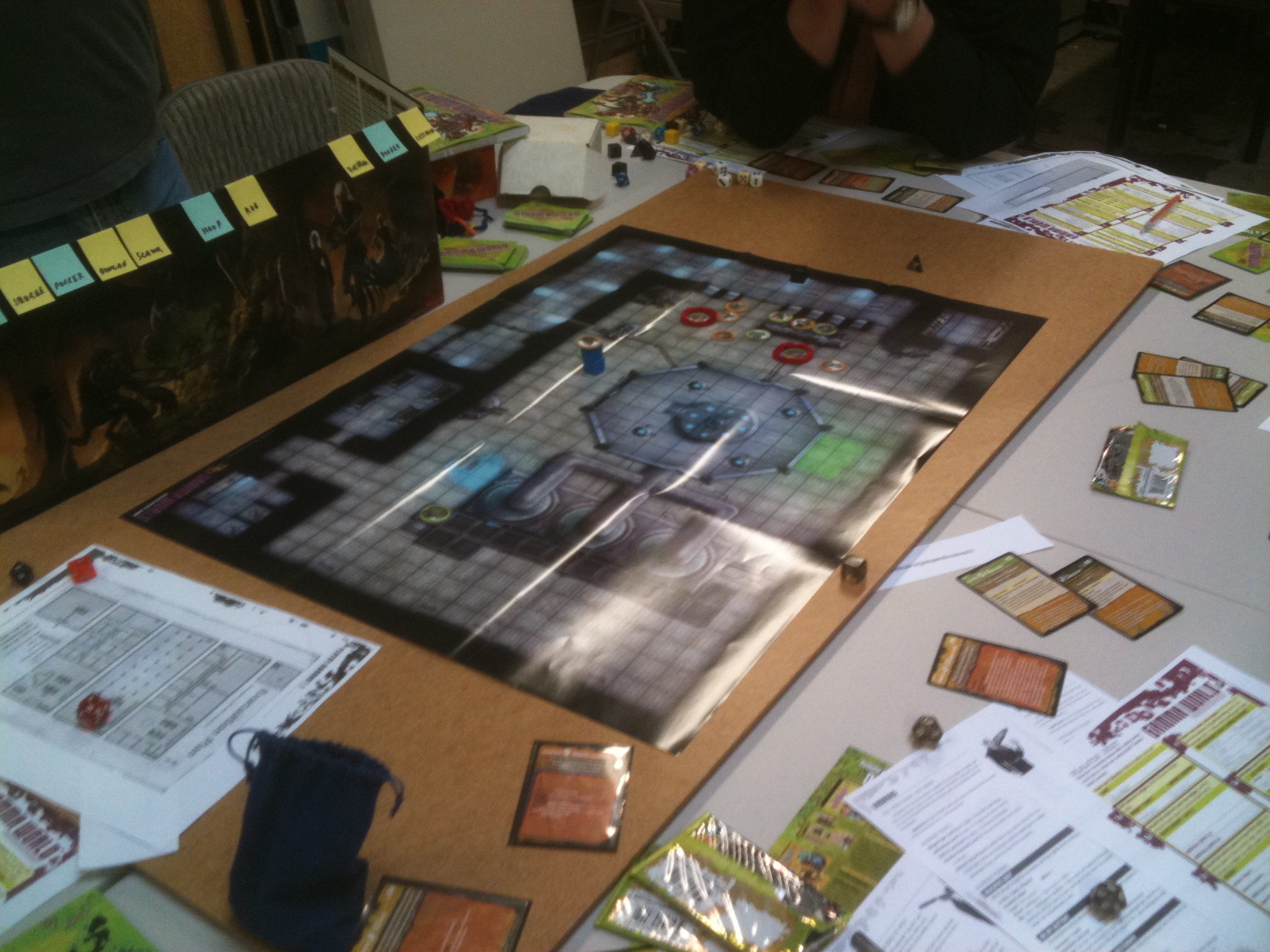
Having just come back from the official Gamma World Game Day event at the FLGS (Game Kastle in Santa Clara), I decided to blog a bit about it, since the game is pretty intriguing to me.

The new Gamma World uses a simplified and far more random version of the D&D4e rules, and it definitely lived up to GW’s reputation for zaniness. You could tell the designers made a conscious decision to update it, so for a new edition of a game first published in 1978 it feels pretty timely, to the point where it’ll probably look dated ten years from now. (And someone at WotC is definitely a Valve fan.) The box frankly looks a good deal bigger than it needed to be, since the rulebook is a mere 160 pages in a half-size format (just like Essentials). It only goes up to level 10 though, and it drops a lot of the fiddly rules and details (so for example the skills section is something like 3 pages).

Character creation is quick and random. You get two character types by rolling a d20 twice on a chart–I got Giant and Plant–which give you an encounter power each and certain other bonuses (and in the case of Plant, vulnerable 5 fire). Although it’s based on 4e, it drops the use of roles, and characters don’t have all many powers to juggle. You designate one type as primary and the other secondary, and when the time comes to determine attributes you get 18 in the one tied to the primary, 16 in the one tied to the secondary, and 3d6 in the rest (20 if they overlap). The dice were rather unforgiving to my character, so I wound up with 8s and 9s in everything but STR and CON. For all intents and purposes there’s only one “class,” which in D&D terms is average in everything (HP is CON+12, +5/level), and you add your level to things instead of half-level. Also, the character sheet is nicely designed and guides the player through the character creation process pretty well. There’s also a fan-made web-based character generator for it.

One thing I do like about Gamma World is how readily the game lets you reskin pretty much everything into whatever you want. With a Giant Plant I decided my character was Rob the Angry Flower (apologies to Stephen Notley), a giant mutant daisy that ran around smashing things with an old refrigerator (which in game terms was simply a Large Two-Handed Melee Weapon). It wasn’t quite on the level of Mike Mearls having a Seismic Giant be a 12-foot-tall baby, but Rob was fun to play all the same.

As much stupid nerdrage as the optional booster packs have caused, the Alpha Mutation and Omega Tech decks are one of the most fun parts of the game. Both essentially give you new encounter powers, and you get a different mutation for every encounter (and any time you roll a 1 on a d20), and if today’s adventure was any indication the game is pretty generous about letting you uncover new Omega Tech items. In the case of mutations you can also attempt to “overcharge” them. This makes them more powerful on a roll of 10+, but messes you up in some way on a roll of 9 or less. My favorite is the one that boosts your intelligence, but on a low roll you’re Stunned by the stupidity of those around you, though you can also sprout tentacles that might strangle you on a bad roll. While I don’t think the booster packs deserve a tenth of the vitriol they’ve evoked online, I can say with confidence that they’re every bit as optional as I thought, and the game should hum along nicely without them.

It’s hard to say how much was the game itself and how much was the way the module was designed, but it was pretty brutal, and 4 out of 6 PCs died by the end. A big part of this was the relative scarcity of healing compared to D&D proper though. There might be some character types that have healing as a matter of course, but in the party we rolled up healing was pretty much only available when a mutation or tech card happened to provide it, meaning it was woefully lacking at times even with the game’s beefed up version of Second Wind (which restores half your HP with a Minor Action). I am reminded a lot of my gaming group’s first foray into D&D4e, where the lack of a proper leader character was hurting us in a big way at every turn. With the one session Gamma World I probably made more death saves than in the entirety of two years or so of playing D&D.

The game uses cardstock tokens to represent PCs and monsters alike, and given that I’ve very seldom played with miniatures that exactly represent what’s going in the game, I didn’t miss a beat in that respect. The fold-out maps that came with the Game Day module were very much on-par with the stuff that WotC has done elsewhere, though it’s neat to see that stuff applied to relatively contemporary locations, even as we were fighting mutant pigs and cockroaches in them.
I wasn’t at all expecting Gamma World to be a game for long-term play or anything, and my first impression is that it is decidedly in the realm of beer and pretzels gaming. It’s not something you’d want to run a long campaign of (Penny Arcade’s opinion on the matter notwithstanding), but it’s pretty much the perfect game to pull out when your D&D4e group can’t do the regular campaign for whatever reason.
APE/Raspberry Heaven/Slime Story

APE 2010 Report
I went to the first day of APE (Alternative Press Expo), an indie comics event held yearly in San Francisco. If you want to see my thoughts on it you can check out my blog post over on Neko Machi. I’m really jazzed to have a booth there next year, which may include some RPG stuff, depending on what we can get together.

Raspberry Heaven: Rethinking
I’m thinking of giving Raspberry Heaven another major rewrite. This mostly came from looking at what I want it to do and comparing it to how Fiasco does what it does. It’s becoming a major theme in my grappling with RPG design lately that there’s a sharp distinction to be made between guided and unguided creative input. While as a player I don’t want a game to constrict what kind of character I can make too much, starting with a totally blank canvas is much harder. If I want to make a fully realized GURPS or BESM character, it’s going to be a major project, best undertaken a week or more before a campaign starts. Compare that to a game with more input provided be the rules, whether it’s a Fiasco playset, an In a Wicked Age oracle, or even just the suggestions inherent in picking a race and class in D&D, and I have a starting point to hold onto so that the whole thing goes much more quickly.

With the current version of Raspberry Heaven there’s a tension between the game wanting to be a light pickup thing and it requiring lots of unguided creative input to really get off the ground. While the source material (slice of life 4-panel manga about schoolgirls) lends itself to long-term storytelling (in an episodic kind of way), the tone of the genre and game are such that I think it needs to be more about getting into role-playing situations with ease and finding out where it goes from there. Although for a variety of reasons it’s definitely not going to be a clone of Fiasco, the generation of the situation and characters definitely needs to have something of Fiasco’s ease of use. That still leaves the question of what will go on during the actual play, for which I’m getting various ideas from Jeepform and Norwegian Style, and the Jeepform adage of “structure but not rules” is proving particularly helpful. The end result isn’t going to be much like a typical RPG, and it’s likely not going to be much of a “game” in any traditional sense, but I think it needs to be that way.

Slime Story: Relationships and Stuff
Right now the major thing I’m struggling with for the next revision of Slime Story is the relationship/connection rules. While I have the combat rules pretty much where I want them, the connection rules and the stuff surrounding them should pretty much be the entire other half of the game, and they need to both be interesting and have incentives to engage them. I’m still working out how to do that exactly, but the ability to strain a relationship in order to help you out with other things is likely going to be part of it.

Another thing I’m adding is explicit guidelines for “Stunts,” which is just a codeword for “stuff not explicitly laid out in the rules.” They are my attempt to pull back a bit from stereotypical D&D4e “pick a power and use it” combat, with the added advantage that in Slime Story if a proposed stunt seems especially difficult the GM can have it cost Awesome Points.

New TRPG Stuff

So, the other day Jono stopped by to give me the TRPG books he was kind enough to pick up for me in Japan. So now I have FIVE new RPGs to read through (the others being Apocalypse World and FreeMarket).

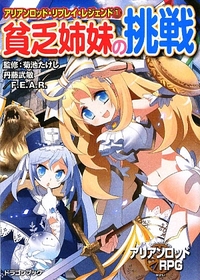
貧乏姉妹の挑戦 (Poor Sisters’ Challenge)
This is an Arianrhod replay that I got basically because I want to read a full-length replay of a game I’m reasonably familiar with. The book starts off with an introduction to TRPGs and Arianrhod, and then goes through the process of the group creating and introducing their characters before starting on the actual gameplay. The most interesting thing so far is that it shows how the GM uses “handouts,” which are a regular part of playing Arianrhod. There are as many handouts as there are players, and each one gives a player character a place in the world and a connection to the rest of the party. For example, in this replay PC #1 is the child of a wealthy merchant who suddenly found himself deep in debt, and who is going into gladiatorial fights to pay that debt. PC #2 is someone very close to PC #1 (which ended up being her twin sister), PC #3 is a close associate of the father’s with an obligation to take care of the kids, and PC #4 is a trainer who wants to develop PC #1’s potential.

This isn’t something you’d do with every game of course, but in my D&D group, although we’ve largely mastered the actual rules, figuring out a solid reason for why exactly the PCs are adventuring together and will stick together seems to have become harder and harder. Of course, when viewed as part of a coherent world the “adventuring party” model is a bit implausible.

りゅうたま (Ryuutama, or “Dragon Egg”)
I now officially wish I’d gotten this game sooner. Ryuutama takes place in a world born from dragons. In the game the players take the role of ordinary people who are on the greatest journey of their lives (the closest thing to a combat class is the Hunter, and others include Farmer, Healer, Minstrel, Merchant, Healer, etc.), while the GM plays a dragon that watches over them. The GM’s dragon records their story and then feeds it to one of the seasonal dragons so that the seasons can be more abundant. There are four kinds of dragons, and as the GM you pick one of the types according to what kind of story you want the game to aim for, and you get some special abilities to help make it happen.

迷宮デイズ (Meikyuu Days)
This is a sort of modern-day version of Meikyuu Kingdom that I’ve been curious about for a while now. The book has minimal illustrations (which is weird compared to other MK books and Satasupe, though less so when looking at Shinobigami I suppose) and very dense text. The essence of the setting is that it’s the present day, and the Dungeon Hazard (that totally consumed the world of Meikyuu Kingdom) is eating up parts of the world, turning normal buildings into mazes filled with terrible monsters. In this changed world, only a select few have the skill, courage, and resources to become Dungeoneers, people capable of venturing into the dungeons and facing the monsters to protect the ordinary people caught up in them. Dungeoneers face great danger, but also can reap great rewards.

Meikyuu Days winds up being a somewhat simplified version of Meikyuu Kingdom, which is to be expected when its single book has the same page count but a smaller format than the two MK books. It leaves out the entire kingdom-building aspect (and thus the rules for managing citizens, building facilities, etc.), it pares things down to five classes (Hero, Mercenary, Majin, Mage, and Civilian) and drops the Jobs system from MK (which gave each character a “secondary class” with one Job Skill and access to one or more categories of general skills). (So with the exception of Civilians, Meikyuu Days classes have about twice as many skills as MK ones). It’s interesting in that it does get into letting characters use firearms (that’s the Mercenary class’ main focus) as well as magic (Mage characters are from hidden magic traditions that went public to help the people face the Dungeon Hazard). It also has guidelines for converting stuff from Meikyuu Kingdom, and in fact includes the stats for the common skills and all the monsters in a super-compact format.

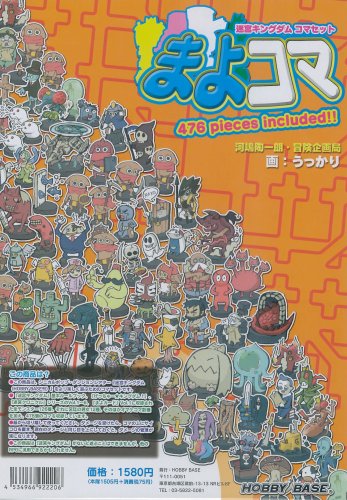
Tangentially, I also got the まよコマ/Mayo Koma set, which is basically a collection of over 400 cardstock tokens/pawns. I’ve talked a lot about MK’s Battlefield Map and how I used something very, very similar for Slime Story, and these are a well-made visual tool for showing your monsters and PCs on the map (including the basic stats for the monsters depicted on them as such). Unless Slime Story becomes incredibly big I’m going to have to settle for making PDFs (or maybe a paper miniatures font like S. John Ross’ Sparks line), but this is one of those things where WotC totally missed out on making an intensely useful tool for playing D&D, and is finally kinda sorta catching on with the stuff in the Essentials boxes.

Double Cross 3rd Edition
Double Cross is a game that Andy’s been really enthusiastic about. I haven’t had time to do more than skim it, but it’s about teenagers with special powers in a hostile (contemporary) world. It’s in bunko format, so there’s not a whole lot of art, but what art there is is excellent.

Slime Quest and Essentials and Stuff

On the whole I don’t think all that highly of either ranting on the internet or creating in response to perceived flaws in something. For example Houses of the Blooded (while not to my personal tastes) sounds a lot cooler when you sell it on its own merits instead of on the ways it’s not like D&D. On the other hand I really want to have a fantasy RPG of my very own, something just right for me and my friends. Slime Quest, my planned fantasy spinoff of Slime Story, is looking like it might just be that game some day, which has me really excited to make it happen. There are a lot of reasons why I want this, including but definitely not limited to the things I do and don’t like about 4E and the subcultural baggage that it comes with.

I probably shouldn’t bother with online forums, at least not quite so much as I have been lately. D&D Essentials (along with the interview with Mike Mearls that appeared in The Escapist) has revived the nonsense we had to put up with surrounding 4E before and after its release a couple years ago. This time around there are at least far fewer factually incorrect complaints about 4E (in 2008 those accounted for something like half or maybe even two-thirds of what I saw). People are at least arguing based mostly on actual reality. On the other hand, the identity politics side of things is alive and well, not to mention I still feel like a huge portion of complaints against 4E read like reasons to drop D&D entirely, and especially 3.x. It’s weird to complain about tieflings and dragonborn when you’re playing a game where half-dragons are not unknown, it’s weird to complain about classes being too rigid when you can play a game without any classes at all (i.e., one of the vast majority of RPGs that aren’t D&D), and it’s odd to say 4E doesn’t encourage role-playing enough when D&D was pretty much only the best system available for role-playing during a brief period in the 70s when it had no competitors. While it’s low on my list of reasons for working on Slime Quest, part of me does want to proudly display a middle digit and proclaim that I have my own awesome fantasy game to play.

I have said that I design games that I want to play with my friends, and I’ve realized that this isn’t always true. In fact some of the games I want to make have a sort of distantly hypothetical audience; I’m not sure if I can actually pull together a group that would play Raspberry Heaven the way I meant it to be played, for example. Slime Quest on the other hand looks like it would be more or less perfect for that group, because it’s going to build on what we like about 4E and hopefully avoid some of its problems. 4E has been a big hit among us, even with the people who weren’t the slightest bit interested in D&D before that. For my part I always liked the bizarre worlds of D&D (especially Planescape), but the actual game never became anything like what I wanted to play until 4E. 1E (which I stumbled across at the local used bookstore) was just strange to me, 2E was intriguing but nonsensical, and 3E we tried out and got tired of after a while.

4E clicked for us in a lot of different ways. It’s like D&D, only your characters have something of the heroic stamina that you would actually expect a fantasy adventurer to have. Old-school D&D is great as a game about a bunch of nobodies struggling to survive in a very dangerous world and eventually making something of themselves. It’s not as great as the game about fantasy heroes it sometimes claimed to be. In 4E, first-level characters, while nowhere near immortal[1], aren’t disposable weaklings, and recovering from getting hurt[2] doesn’t require weeks of healing or a literal miracle from a deity. The MMO players in our group like the optimization and tactical combat, while the non-MMO players like the awesome fantasy settings and can enjoy the tactical aspect of the game without feeling like total failures for not putting double-digit hours into character optimization. That’s not to say I’ve been totally satisfied with the game, but on the whole it’s been head and shoulders above most of the other games we’ve tried long-term, particularly in terms of the actual rules contributing to our fun.

The major things I want to keep from 4E is the interesting tactical combat and characters with clear roles and interesting in-game abilities. However, I want to make the tactical combats a bit simpler and quicker, and I want the game to encourage role-playing and characters with some personality. The former is pretty easy, and in Slime Story I already have the makings of the combat system I want. The latter will be trickier (especially in terms of marrying it to a game with tactical combat), and I’m still in the process of working out how to go about it. I don’t really find complaints about “dissociated mechanics” to be terribly compelling, least of all coming from people who like older versions of D&D, but one way or another I do feel that I want to make a game that’s a bit better at generating interesting stories at the table.

There has also been some talk of the new D&D being less about the influences that lie at the game’s original roots. Gary Gygax originally made the game a mishmash of all his favorite sword and sorcery novels–Conan, Dying Earth, and so forth–and grudgingly added Tolkien stuff in later at his friends’ insistence. It seems like in an important sense D&D stopped being about that stuff and started being more about itself and its spinoff novels[3], to the point where I’d welcome some video game influence simply because it would make the game’s fiction a bit less incestuous. But then the thing is that in the case of the people I play with, influences culled from novels are basically irrelevant to most of the group. References to Conan only hold sway if they fall into the most memorable bits of the movies (“Hear the lamentations of their women!”), and the likes of Jack Vance are off the radar entirely. In stark contrast to that, video games and anime are what we’re all about. Concepts culled from Final Fantasy or Dragon Quest are much more recognizable to us than ones drawn from the works of J.R.R. Tolkien or Robert E. Howard. Slime Quest is going to be unapologetically getting inspiration from anime and video games.

The setting of Slime Quest (the continent of Galania) isn’t going to be anything astonishing, but I do like having the opportunity to do some stuff that the official and implied D&D settings largely avoid, both in terms of cultural issues and simple surface stuff. Religion is a prime example of this. While religion is ubiquitous in D&D settings, it tends to be a vague polytheism, with plenty of meddling gods (and until relatively recently full game stats for them), but very little sense of what kinds of practices these religions involve or how they fit into people’s daily lives. Although I’m not going to make such things central to Slime Quest, it isn’t going to totally ignore them either. Galania is home to both a monotheistic religion (the Church of the One God) and animist/shamanism religion, which have been forced to more or less coexist for pragmatic reasons (for now). It’s also got firearms, trains, airships, a postal service, and some other nifty stuff. (Also, an organization called the Happy Slime Club.)

[1]As we very quickly found out when we first started playing and those kobold slingers really messed us up. 30 hp goes by a lot faster than you’d think.

[2]Or rather, recovering from losing HP, which can at (vague, undefined) times represent mere fatigue rather than injury.

[3]One really wonders how much the ranger class’ design has been informed by a need to make Drizzt a viable character.

In Other News
I got Apocalypse World in print from the FLGS, though I’m still reading through it. The writing style is very Vincent Baker, though it’s weird to get 300 pages of it at once. I also got the PDF manual of FreeMarket, but haven’t had a chance to do more than skim it a little bit. The good news is that if I really wanted to I could put together the materials to play without too much difficulty, which is fortunate considering I really can’t afford the $75+s/h for the boxed set. A friend picked up some RPG stuff for me from Japan last month… hopefully we’ll actually get a chance to meet up in person before too long.

Thoughts That Are Random

Pockylips Worldo
Apocalypse World has been generating a heck of a lot of discussion, and I think I’m going to have to join in, possibly in podcast form, especially once I finally get a copy of the actual book. I got to play it at the South Bay Story Games Day event at Game Kastle in Santa Clara, and was very impressed, though it’s worth noting that it was MCed by a gentleman named Carl who was very experienced with running it.


One particularly interesting thing about it–which somewhat ties in with what I talked about in the last podcast–is how the game very carefully and thoroughly delineates the GM’s job, to a degree that is basically unprecedented. (Which explains the change in terminology to “Master of Ceremonies.”) As Jonathan Walton put it, apart from explicitly encouraging hacks, “it makes no effort to offer flexibility to people with different tastes or desires.” On the one hand I don’t share Will Hindmarch‘s (apparent; I may be misreading him) discomfort with AW’s approach, but on the other hand I really like the idea of this development and the tools it implies existing, but on the third hand (I’m running Dark Sun this weekend; maybe it’s a hypothetical Thri-Kreen?) needless to say I wouldn’t want every game to work that way.

Over on Theory From the Closet’s interview, Vincent said he’s a game designer rather than a teacher, and in light of that it makes sense that he’s sending what he’s figured out about GM techniques out into the world in game form. While it goes without saying that he never meant it to be the end-all be-all of GMing techniques, the GM’s role is one of the single most ephemeral things in RPGs. There are definite advantages to that of course (another Theory From the Closet Episode has David Wesley explaining how using a human referee saved his wargaming hobby), but there’s also the problem that we don’t really have the vocabulary or techniques that we probably should for discussing (much less modifying) what exactly the GM does. There’s a lot of good advice out there, but it’s really hard to be concrete.

A Story of Slime

Of course, right now the thing with Apocalypse World that’s more immediately relevant to me is the Hx/History system (the one that gave Ryan Macklin a little trouble), since it’s pointed me to a way to improve Slime Story. Setting up connections between characters is currently one of those things that can easily become tedious because it asks for largely unguided creative input.[1] AW’s History mechanic the setup of the PCs’ relationships and shared history into kind of a minigame with different abilities per character type, which also serves to dump the players into having to work with mechanics and each other. While I’m not completely happy about stitching yet another piece onto this Frankenstein monster of a game, it looks like it has immense potential.

A while back I made the acquaintance of Steven Savage, who amongst other things does the Fan To Pro blog and the Seventh Sanctum name generator site. (And if we can ever get our schedules to coincide enough he’s going to be on the podcast.) When I told him about the game I was working on he, having recently seen the Scott Pilgrim movie, said Slime Story sounded like “magical realism.” While Slime Story doesn’t strive for a Jorge Luis Borges type of style or anything, it does juxtapose the real and fantastic, and I think that in terms of the setting that’s its real strength. There’s an inherent tension between the teenagers’ ordinary lives and the absurd monster hunting they do. I’m not sure what to do with this epiphany apart from including it in the text, but I think it’s very important to realizing the game I want to create.

Dice Within Dice
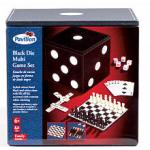
I was at Toys R Us the other day and wound up buying the “Pavilion Games Black Die Multi Game Set.” Pavilion Games is apparently a brand name TRU came up with for selling cheap and generic board game stuff. I’d seen this many times before and put off buying it because it was $19.99, but it was on sale for around $12. It’s a black faux-leather box like a black d6, about 6½ inches on a side. Inside are two decks of cards, four small dice, a doubling cube, a set of poker dice, a small game board for chess and backgammon (with pieces for both), a rather small set of double-6 dominoes, and a booklet of rules. I think I like it more for the novelty of the box than what’s inside, though I suppose even given that I’m not really into board games it’s not a bad idea to have those things around. (Someone was working on an RPG that uses dominoes, right?) Also, it has enough room to fit several of the other assorted game materials I’ve accumulated.

[1]I’ve heard such complaints about, for example, Prime Time Adventures’ pitch sessions. The results can be great sometimes, but I certainly don’t find that kind of thing terribly efficient with my friends.

Yaruki Zero Podcast #15: The Big Picture

Yaruki Zero Podcast #15 (34 minutes, 58 seconds)

This episode is an attempt to unpack certain underlying “big picture” things in role-playing games that I’ve been thinking about lately. It’s not about how they fare in the marketplace (though there’s a little bit of that), but RPGs are and how they work. There’s a good chance other (smarter) people have said this elsewhere, but I need to put it out there in my own words.

Show Notes

  1. Intro
  2. Text vs. Play
  3. Artists vs. Consumers
    • Non-Commercial Gaming
    • Gaming as Consumption
    • Structured RPGs and Creativity
    • Consumption as Shortcut
  4. Rules vs. Not-Rules

This podcast uses selections from the song “Time Machine” by To-den from the Grünemusik album of the same name, available for free from Jamendo.com. If you like the song, consider buying some CDs from Nankado’s website or via Jamendo.

Very awesome caricature of Ewen courtesy of the talented C. Ellis.

SRS: Movement and Engagement

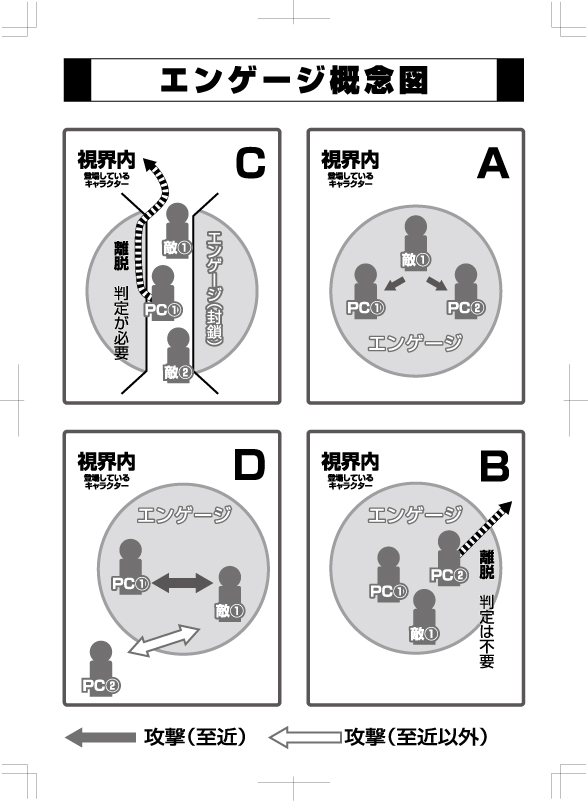
So, I finally sat down and read the 移動とエンゲージ (movement and engagement) rules in SRS (F.E.A.R.‘s house system), and it turns out they’re very simple and kind of interesting, so I thought I’d post about them here.

Here’s the diagram that they’ve included to make it a little clearer:

In SRS characters that are within melee range of one another are in an “engagement” (Figure A). If you’re in an engagement with an enemy, you have to take a Withdrawal action (離脱; Figure B), but that takes up a Full Action rather than a Minor Action like normal movement, so you can’t attack during a turn you move out of an engagement. You don’t normally have to make a roll to do a Withdrawal, but if you’re trying to do so through a confined space or in a place where it will otherwise be difficult, you’ll need to make a suitable check (what attribute depends on the particular SRS game, but generally something like Agility). Finally, ranged attacks can indeed go to and from outside of an engagement (Figure D). That’s a quick summary, but I don’t think I’ve really left anything out.

As the diagrams obliquely suggest, some of the books recommend using board game pawns to keep track of movement and engagements. All told it’s a very simple yet intriguing way to make positioning and tactics matter a little more, though I do wonder if they could do a little bit more with it. (That and in Arianrhod the Varna can take a racial skill that lets them do a Withdrawal as a Minor Action, which seems overpowered, though that may be my D&D4e senses talking.)

Kyawaii RPG #6: Four Fairies

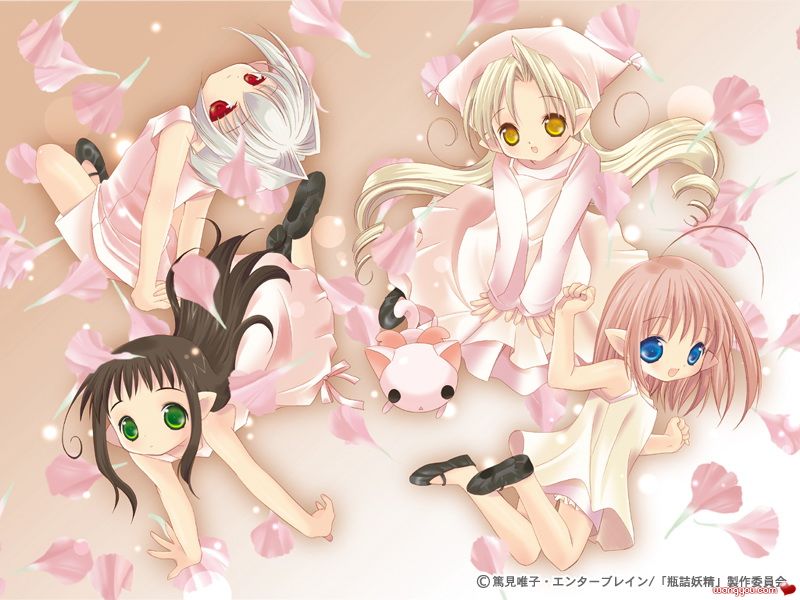
“Four Fairies” is a very simple and heartwarming role-playing thing (a little more involved than a role-playing poem, but not quite what I would call an RPG per se) about four fairies. They want to become human, but to do so they must first learn about the human world. With this game you can tell stories about how they learn. It is very directly inspired by a wonderful little anime series called Bottle Fairy.

Click here to download.

Updates On Stuff

After basically being unemployed apart from some sporadic freelance work throughout 2009, I now have a full-time job. I’m not going to discuss the details publicly unless I get explicit permission, but it’s in the video game industry, if an odd niche of such. Trying to keep up creative stuff while working 40 hours a week and having a considerable commute to contend with has been a challenge so far, especially since my social life has gotten busier too (I’ve had regular stuff going on four days a week, though that’s calming down a little too), but I’m starting to get a handle on it.

I don’t want to get into the details here, but I’ve decided I need to scale back my internet use a bit, or at least my use of certain parts of it. At work it’s hard to find much else to do during breaks other that surf the web, and after a month I just feel the toxicity of it too much. This won’t affect this blog except insofar as some of those sites give me ideas for stuff to post or podcast about, but you probably won’t see me posting on RPGnet or Story Games as much (not that I was ever a prolific forum poster anyway). I’ve also stopped using my main Twitter account for the time being in favor of a new one (@bunnymuse) where I tweet nothing but random bits of stories and other prose ideas. I don’t know how long I’ll keep this up, but so far every time I’ve gone back on this decision I’ve wound up regretting it.

Slime Story
Slime Story has reached a point where I basically have the core rules where I want them for this revision, but I have to deal with a bunch of interdependent crunchy bits to get it ready to playtest. Writing up monsters is particularly challenging, since I really need to have the right variety of them and ensure that they provide the right kinds of stuff for providing adversity and interesting monster parts to make “alchemical” items with. “Monsters” in general are not an aspect of RPGs I’ve ever dealt with very much, and I think that inexperience is part of what’s making things difficult. It’s also still damn hard to come up with Talents to go with cliques, especially since I severely reduced the importance of social conflicts, which were the most combat-like part of non-combat stuff. Still, Slime Story is easily the creative project that most excites me of late, and it’s gotten more of my limited time for doing that kind of stuff than any other.

All of that means I’m getting pretty close to being ready to playtest Slime Story again, maybe even as early as next week. Slime Quest is much further off, since it will require both changes to the rules and even more assorted crunchy bits (a wider variety of “monsters,” classes and races with talents, equipment including magic items, etc.). I wanted to mention that I also have other ideas for “Slime Engine” games, most notably a new version of Thrash (I think the battlefield map system is exactly what it needs) and a thing about teenagers with special powers in the vein of A Certain Scientific Railgun, Kampfer, s-CRY-ed, etc. (so a mixture of superpower battles and boarding school life). But if those ever amount to anything they’ll be a long way off.

A-Kon
A-Kon is coming up really fast, and I’ve got some preparation and such to tackle still, even with the convention handling a lot of the more basic logistics for me. I’m going to be involved in something like six different panels, a lot of which are in the evening (9 p.m. or so), and a couple of which will require some considerable preparation on my part. The one on Japanese RPGs especially will take a lot of prep, since I want to put together a PowerPoint thing to show stuff off rather than lugging a ton of books to Texas. OTOH I think I could do the one on Anime and RPGs more or less off the cuff, considering how long I’ve been blogging and podcasting about the topic.

Slime Story/Quest: Talents and Quests

Talents
Slime Story’s rules just keep on evolving, and the whole thing with Awesome and Suck Points has led me to make some significant changes to how Talents work, and also to make them less derivative of D&D4e. Some talents are Passive and just give an automatic bonus to something, but “active” talents can have Costs (in Awesome or HP) and/or Usage Limitations (once per scene, only on a triggering event, etc.), but are meant to be more or less equal in overall utility (which makes the advancement stuff much easier to work out).

I’ve basically dumped the “At-Will/Scene/Episode” thing for Talents, though there will be some with “1/Scene” among their properties. Arianrhod and Meikyuu Kingdom have both provided a lot of inspiration for how to go about setting up Talents. Arianrhod’s talents remind me a lot of 16-bit era Final Fantasy (and FF4 and 6 are two of my all-time favorite video games ever BTW), while Meikyuu Kingdom just does all kinds of crazy stuff, especially since it has Skills relating to different aspects of kingdom-building. I seem to have given myself tools that will let me rewrite the Talents I’ve already created with relative ease, though I need to keep working at it and come up with more and more creative abilities to put into the game.

The question of how many Talents characters get and of what kinds is pretty straightforward for Slime Story (two Base Talents each from clique and class, one Elective Talent each to start, and one new Talent per level). With classes, races, and backgrounds coming into play, Slime Quest is a little more complicated. In that game classes have Base and Elective talents much like in Slime Story, but characters also get a Racial Talent, a Background Talent, and they have the option to pick up Common Talents. Racial Talents are kind of analogous to the various racial abilities in 4e, except you’re not required to take any particular one, so you can go with whichever from the race’s selection best fits your character. Common Talents are ones that any character can potentially get (which makes them the closest to Feats in D&D), and each Background has a list of possible Common Talents that you can pick from.

Quests
I also have a handle on how I want to do Quests in Slime Story. These are very much like the quests you see in MMOs. I’d originally been planning to make them an optional rule, but now I’m inclined to have them be core, and potentially pretty central to the game experience.


“Quests” are a slang term for when people hire monster hunters to do stuff for them. People post up offers on the “Quest Board” at the local Monster Mart, or online (in the Slime Story setting Craigslist has an entire category for it), or wherever. They often offer cash rewards, but trades or favors can be in the offing too (especially if the client is an alchemist). A typical quest is MMO type stuff–kill 10 salamanders, bring me 8 slime cores, find my pet dog who wandered out where there are lots of monsters, etc.–but in Slime Story the NPCs who assign quests are often regular characters in the game (secondary characters). Thus, the quests provide an excuse to interact and develop relationships between characters who might otherwise be a challenge to really fit into the game properly.

In my Slime Story novel I totally want to add a part where Kelly’s mom, a card-carrying member of PETM, very reluctantly hires Doug and company to clear out monsters that are wreaking havoc at her workplace. There are just a ton of different things you could do with quests in terms of developing the story type stuff, but then in MMOs it seems like that’s one of the primary ways in which the developers put story in.