Category Archives: musings

2011 in Review

I’m apparently making a yearly review post a regular thing now. Also, I’ve been hugely inspired to blog over the past couple weeks, but then there have genuinely been a lot of exciting things going on.

Actual Gaming
This past year I did a lot of gaming with my Friday group, which has been going through a series of short campaigns for some time. Our longest game was also our best. We started off playing Smallville and then switched over to Primetime Adventures, which wound up working out incredibly well. The game was kind of a Smallville-ish thing, a present-day setting where people with superpowers were emerging (to the chagrin of the Greek gods), without any real DC-inspired elements per se. That was what inspired me to write Entanglements, which got its first test run as part of the setup for our “Ameripunk” Wushu game (my character was a bibliomancer trained by Mark Twain and entrusted with the Amerinomicon). I do still need to make some refinements to Entanglements, but it seems to work pretty well.

For a variety of reasons what had been my “main” group heavily dropped off gaming. We did get in some D&D and had a ton of fun with Gamma World, but we nonetheless went from gaming most weekends to someone maybe getting a bit of something together every other month. I think it has a lot to do with human factors more than anything. With working 40 hours a week, attending another game group, and hanging out with friends most Mondays, I’ve tended to spend the better part of most weekends writing and recuperating from the prior week. It also doesn’t help that our game of choice is D&D4e, which while definitely easier on the DM than 3rd Edition nonetheless takes a fair amount of work to run. I tried to run a Dark Sun game, but I kept ending up having plans slapped together an hour or two before the game started. I’m hoping to rope that group into playing Dragon World, because it’s a fun game I can bullshit my way through running, and because if our D&D games are any indication we can definitely get into the right spirit. We’re also getting back a member who’s been absent for a few years, and I’m hoping that will help reinvigorate our gaming.

Conventions and Whatnot
This year also saw the first time I ran a convention booth by myself, first at a tiny anime convention called Kin-Yoobi Con, and then at the Alternative Press Expo. Both were interesting learning experiences, though by the end of APE I was ready to swear of cons for a while. Anime fans are definitely more receptive to RPGs than indie comics fans though. Neko Machi had kind of a rough second year too, and we’re hoping to reinvent it somewhat (with a format change and such) and relaunch in early 2012.
Game Projects
I only did two Kyawaii RPG things this year, and one of them I started and finished yesterday. I still have like half a dozen unfinished ones that I’d like to work on and haven’t touched.

The anime series Madoka Magica was a massive thing in 2011. For me personally it was the dark deconstruction of the magical girl genre I’d been wanting for years, and it inspired me to design an RPG that I titled “Magical Burst.” I have far too many works in progress, but this is easily the most promising and most popular. I put the rough drafts of the game online just for people to read, and it totally took off, becoming a standard of the 4chan /tg/ crowd. I keep coming across threads where people suggest it, and in one case I came across an unfinished Black Rock Shooter game where the creators had thrown up their hands and said, “Just use Magical Burst.” I don’t know how much is my accomplishment as a designer (there are parts of it that make me wince) and how much is other factors, but it’s helping motivate me to actually get the game done for a change.

Dragon World is the other new game I started on, and it proved very fun to both work on and to play (when we did a 3-session playtest). The idea came from when I finally got around to reading the Dragon Half manga, and this “90s comedy fantasy anime” game also draws inspiration from Slayers and a host of other titles. It’s based on the Apocalypse World rules, though of course with plenty of changes for the game’s very different genre. I’m planning to put a “Dragon World Hack” PDF up for free once I get some more things done.

Golden Sky Stories is of course the Japanese RPG I translated and that we’re gearing up to do a Kickstarter to publish. I’ve posted a good amount about it already, but I’m really excited to finally get it out into the world. I’m also working on putting together an original replay that’ll be a free preview of the game in English. I have the rough manuscript and artwork all ready in fact, so I’m just waiting for a friend to tackle the editing and layout. For the game itself, Clay is still working on the layout, and for the Kickstarter I basically just need to wait for my friend to finish up tweaking the video and fill out stuff on the Kickstarter backend for the launch.

Gamer Culture and New Stuff
I’ve made a habit of lurking in the grognards.txt thread on Something Awful. It’s a collection of the most terrible things said by grognards, and is up to about 1500 pages now. It’s kind of therapeutic at times, and it’s helped me get a better perspective on how D&D has changed over time. Probably the biggest lesson from grognards.txt however is simply: people are at their best when they’re actually doing stuff they like instead of bitching about things they don’t like. There are OSR blogs that come off as obnoxious and curmudgeony (at best) when talking about RPGs published less than 20 years ago, and yet when they’re earnestly expressing their passion for old-school swords and sorcery I want to cheer[1]. I’m also contemplating doing a “grognards.mp3” podcast episode with dramatic readings, though with everything going on it’s been really damn hard to find time for podcasting. I have a whole solo episode recorded that I haven’t had time to edit.

For a while now I’ve been interested in trying to expand the medium of RPGs in new directions, particularly in terms of components and presentation. I’ve talked before about looking into using board game components (and I still want an RPG that makes good use of a spinner!), and I love how (for example) Jake Richmond is making good use of comics to teach people how to play his newer games. In December I hit on the idea of making an RPG in the form of a smartphone app and designing it around that medium as much as possible, an idea that won the “Brain Full of Games” contest, which consequently has me starting on a design document for Raspberry Heaven (my Azumanga Daioh inspired slice of life schoolgirl game) as an “RPG app.” I’m already talking to some programmers, so things stand to get really exciting on that front in 2012.

I’ve come to be a bit irritated at gamers, at least as represented on online forums, for how they can come across as having desperately narrow tastes in RPGs. For my part there are things that don’t interest me (board games, horror, zombies… I could go on), but there’s almost nothing in the way of RPGs I wouldn’t be willing to play if a friend really wanted to run it. And yet, if you propose any slight deviation from the books and (standard) dice formula you’ll get a chorus of naysayers. But on the other hand I’ve realized that there are a lot of potential design elements that are uncommon in RPGs in part because they’re difficult to use well. I think part of why resource-based diceless games are rare (for example) is that they only really work when you depart at least somewhat from the traditional paradigm of rolling for success and failure. An RPG that’s totally ordinary except for having players spend points instead of rolling dice for action checks is creating a bunch of perverse incentives and substantially changing the basic flow of things in an awkward way. On the other hand Golden Sky Stories works as a resource based game mainly because the tone of it is so non-competitive.

When all is said and done my desire to mess around with the medium is driven not so much by a desire to find a blue ocean strategy that’ll be a giant success or something, but rather the tantalizing creative challenges. I’ve lost some sleep over ideas for the Raspberry Heaven app, in part because there are so many things I can do differently from an analog RPG that I find just fascinating. I’ve also just started reading up a bit on interface design and such for mobile apps, and given that these days I rarely have my iPhone more than a few feet away from me for any length of time, taking a closer look at this thing that’s so ubiquitous in my everyday life would be really interesting even if I weren’t looking to design an app. I’m hoping that if I can get the Raspberry Heaven app off the ground it’ll at the very least merit making more attempts at this newish kind of game.

At this point 2012 is looking to be a really exciting year of making stuff happen. It’s hard to say what stuff specifically, though I sure has hell want Golden Sky Stories to be out the door and into people’s hands.

[1]On the other hand any discussions of sexism anywhere near the context of gaming seems all but guaranteed to produce posts that are maddening or just depressing depending on how tired I am.

Fantasy Flight Production Values

For the most part I don’t like board games, though I do occasionally let myself be dragged into playing one for social reasons, owing to the substantial overlap between RPG players and board gaming, not to mention my brother-in-law being so ridiculously into board games. For me it’s kind of like, why play a board game I feel like I’m playing an RPG where something important and essential has been taken out.

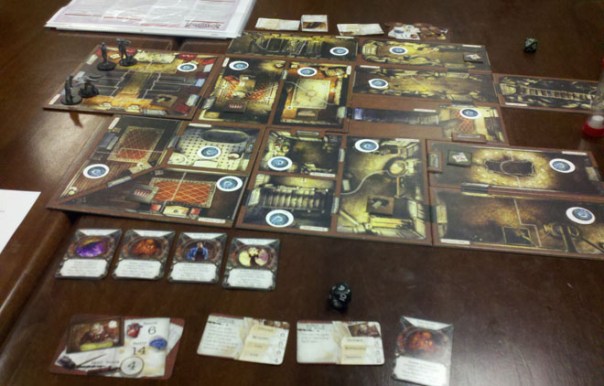
In any case, the other day we tried to play Mansions of Madness, an Arkham Horror derivative from Fantasy Flight Games. We actually didn’t get that far, in part because my friend who owns the game hadn’t actually even opened the box yet, and it seems to be the kind of game where you need to read the rules beforehand. What really struck me about it though, which was something that was also true of Warhammer Fantasy 3rd Edition, was that in some ways the very high production values of the game worked against it. Fantasy Flight apparently loves to have games with numerous components of various kinds, especially in that thick, colorful card stock you have to punch out before you play the game. Even more so than with Warhammer, this is a game that really would’ve benefited from dropping at least some of the tokens in favor of a more RPG style way of tracking things. For example, each character has separate skill cards, a character card, item cards, and can accumulate various tokens that can represent damage and madness. The Keeper has threat tokens, time tokens, a set of threat cards, three combat decks, and I think several other things that we didn’t actually get around to even using in the game. Looking at all that stuff, I can’t help but think that you could easily halve the number of components the game involves, which would in turn speed up play simply by reducing the need to sift through all the components to find the thing you need. On top of that, at least for Mansions of Madness, the designers seem to have been strangely reticent to label any given component according to its function. It would have been nice for example if the item cards had said “Item” on their backs, not to mention if the many, many kinds of tokens had given some indication as to what they are beyond a colorful picture.

This is really interesting to me because for a while I’ve wanted to explore how RPGs can use different kinds of components in different ways, and it hadn’t occurred to me that there could be a point at which components become a burden. I’m not familiar enough with the medium of board games to know how much of this is a board game thing and how much is a Fantasy Flight thing, especially given that I even more seldom let myself get dragged into playing the more elaborate board games. However, looking at Mansions of Madness, a game with absolutely amazing production values and an $80 price tag, it’s weird to me that design-wise it falls behind some much cheaper RPGs in certain ways. My friend Grant owns several titles from Fantasy Flight, but where we’ve played them he’s inevitably wound up griping about the poor organization of the rulebook. I feel like board game players put up with things that RPG players would be quick to brand as heresy, and I’m not sure what that says about either group. Mansions of Madness has apparently gotten favorable reviews and even won a Golden Geek award (for best thematic board game), whereas Warhammer Fantasy 3rd Edition was massively reviled online solely on the basis of news of how it would use certain board game components and not be exactly like prior editions. Of course, to the extent that I would advocate using board game components and techniques in RPGs, I would not advocate using entirely separate categories of components for things that could much more easily be tracked on paper in the manner of a traditional RPG (the fatigue tokens in Warhammer being a very prominent example).

Of course, considering where I am as a designer (and to a lesser extent where RPGs are in general), making a game with so many components that it costs $80 isn’t really a serious consideration no matter what. I do kind of wish that RPGs could get away with that kind of thing more (look at just how much people freaked out over the price tag of WFRP3e), but then the $75 price tag is the main reason I don’t own a copy of FreeMarket. On the other hand, I do wish that people who play RPGs (or at least people who post about them online) didn’t come off as being so over-the-top purists about the kinds of materials that games can use. People freak out about things like the possibility of losing components from an RPG in a way that they just don’t seem to about board games. This is especially weird to me given that tabletop gaming in general has such a DIY streak that you would think that people would be quite willing and able to overcome any limitations imposed by materials on their own. Certainly people have no problem using just about anything imaginable as miniatures for D&D, and Wizards of the Coast probably ought to be taking a hint from all the fan made expansion for the D&D board games.

RPG in an App

Over on Story Games there’s been a thread about RPGs/story games going digital, and I had an idea I thought was really interesting, even if I won’t be able to do anything with it any time soon.

Dungeon World now has an iOS app, which is basically an enhanced e-book. It includes several reference features, plus audio commentary, and Sage is planning to add more functionality over time. Which is all really neat (especially since Sage is planning to make the details of how he put the together available for free), but I think barely scratching the surface.

There are two GameCube games that did really interesting things in terms of their interactions with the players. The GameCube version of WarioWare has a multiplayer mode called “Listen to the Doctor,” where a doctor character tells you to do something (sing a song, touch your nose, etc.) while playing one of the micro-games. Afterward the other players can tap A to “applaud” depending on how well they think you did. That shows that a video game can still have a social, human element. Pac-Man Vs. is one of the very few games that made effective use of the Game Boy Advance link cable. One player plays Pac-Man, while the other players are all ghosts. The ghost players share the TV, which shows only the areas of the maze immediately around each ghost. The Pac-Man player holds the GBA, and the screen on it give them a private view of the entire maze. When a ghost catches Pac-Man, the players of that ghost and Pac-Man trade controllers, and the new player gets to be Pac-Man. It would be a bit much to expect every player to have a GBA and link cable, so having it be a thing you pass around as a reward for good gameplay turn having only a single GBA into a strength.

Suppose we have an RPG in the form of an iPhone app[1]. I have two gaming groups, and at best half of each group has iOS devices, and no game no matter how awesome is going to convince the ones without to pony up for an iPhone, even assuming they could afford it in the first place.[2] So the first thing we do is be sure to make it so that you only need one iOS device, and have it either rest with one player who takes up a particular role, or make it part of the game that you pass the device around. (Maybe give the app some kind of “reference mode” or something for if a player has an extra device and wants to use it.) Since the screen is relatively small and not good for doing any great amount of reading, we keep the amount of text relatively small and in digestible chunks. This points to a relatively simple story game type thing, and admittedly the idea crystallized in my head after listening to the Actual People, Actual Play podcast on Ron Edwards’ game It Was a Mutual Decision, which sounds like it’s a powerful experience but on-rails structurally.

Some of the things such an app could do include:

  • Take input from players in any number of ways. One obvious thing would be to let a player enter a character name, and then the game can seamlessly put it into the text for the duration of play.
  • Reveal or conceal things to/from different players at different times, possibly including things input by various players.
  • Do random number generation electronically (and possibly behind the scenes), presenting players with just the results. These could come from an extensive table of random elements so that the players only need to worry about what’s been generated for this instance of play.
  • Make sounds and/or pictures a part of the experience.
  • Integrate any number of “analog” things into the experience, in addition to role-playing of course. In some ways it would be better to make it so you just need the app and some friends, but equally you could put in other elements, whether traditional RPG trappings (dice, paper character sheets) or totally off the wall stuff (Jenga!).
  • Likewise, smartphones have plenty of stuff like GPS, motion sensors, cameras, internet access, vibration, etc. that a game could leverage in various ways.
  • Provide players with built-in tools to tinker with the experience in various ways. Have settings that tweak numbers for pacing mechanics, if the game has something analogous to Fiasco playsets have a way to submit and download new ones, that kind of thing.
  • Let players just peel back the game’s facade and fix stuff if things are going wrong. Change numbers during play, force the game to skip to Act 3, etc.
  • Include liner notes and other reference material available in hotlinks.
  • Let players save the game’s current state to be resumed later.
  • Where multiple devices are available, they could link up via the internet or Bluetooth.

[1]An Android app would be fine too (especially since Android is apparently gaining a ton of market share), or a web app or whatever, but I happen to own an iPhone so that’s what I’ll use as an example.

[2]It would be nifty to have something where, say, you do tactical battles a la D&D4e and everyone has their own device for it, but it’s not gonna happen.

A Small Update

I’ve kind of been all over the place lately, and getting creatively obsessed with different things at different times. I’ve done three playtest sessions of Dragon World (it’s getting there), then got into working on my UFO Girl novel, then started having a creative crisis over Neko Machi, then we went through a bit of a shakeup at work, and now I have a cold. I’ve been meaning to record and post up a solo podcast for ages now, and thinking of trying to do them as kind of a regular thing. Somehow I haven’t been able to find the time to even get started, and with this cold it’s not gonna happen this weekend.

Kin-Yoobi Con
I had a booth at Kin-Yoobi Con, and sold Neko Machi mini-comics and buttons, plus Maid RPG. It taught me some interesting lessons about the anime crowd, most notably that when it comes to art those folks gravitate much more strongly to characters they already know. I’m wondering if there’s a way to use that kind of appeal for RPGs but on the level of fan art seen at the artists alley at an anime convention.

Mascot-tan
A while back I had an idea to do new games based on the Maid RPG rules, which I would call the M.A.I.D. (Maniacs’ Asymmetrical Interactive Delusion) Engine. I decided to start working on a new version of Mascot-tan that’s basically a Maid RPG hack. So far it’s sticking fairly close to the basic Maid RPG rules, the main difference being that (by default) the group rolls and agrees on one mascot theme (bands, fighter jets, game consoles, RPGs, whatever), rolls up random stuff for their characters, and then each player picks which specific thing their character is a mascots of. Also, I started writing up new tables for most everything from scratch. Funnily enough even for anime maids I’d end up changing some things if I were to write up a Special Qualities table today, on account of anime has generated new kinds of cliches since Maid RPG’s original publication in Japan.

There’s also something else cooking for Maid RPG. :3

Ambitions
I want to bring Magical Burst or Dragon World to fruition in the next 6 months or so. Lately I’ve had kind of a love-hate thing going with Magical Burst, so it’s been hard to muster up the desire to actually look at it, but I have gotten some more feedback. (Plus I’m not good at balancing creative projects. I tend to work on one thing to the exclusion of others.)

Shout Outs

  • With Neko Machi I have the privilege of collaborating with C. Ellis, a woman who is very dedicated to creating comics. She’s doing a webcomic of her own (We’re All Star Children), is a contributor to the Womanthology project (which looks all kinds of amazing), and does plenty more stuff besides. I really do know a lot of amazing people these days, and she’s high on the list.
  • A while ago I translated a short story for Kizuna: Fiction For Japan, a charity fiction anthology for Japan tsunami relief, and it’s now available as a Kindle e-book.

RPG Wasteland

This post wound up being a lot of text (over 2200 words including this bit), and it’s about personal stuff rather than some RPG I’m working on and/or drooling over.

A book you should read.
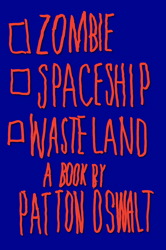
Patton Oswalt‘s book Zombie Spaceship Wasteland is well on its way to becoming one of those rare books that I periodically reread to refresh its influence. I’ve liked standup comedy for as long as I’ve been aware that there was such a thing, and Oswalt is easily my favorite. Not only is he a fellow geek, but he has a really profound passion for what he’s doing that’s always showing through. You get glimpses of it in stuff like his magician bit, which is a story from early in his comedic career, but his book is angry and sad and beautiful and puts his passions on display. It’s got humor mixed in, but more than anything it’s a series of self-portraits, snapshots of different moments in his life.

My own life has never been very good at furnishing events that would make good stories. In middle school and high school I came to dread autobiographical writing assignments because I never seemed to have anything to say. My most successful such essay turned the assignment into a lament about how boring my life was. Things have gotten more interesting with time–in my early 30s I have just enough personal history to be able to tell stories about myself now and then–but certainly nothing on the level of what you’ll read in Zombie Spaceship Wasteland. One place where life resembles role-playing games is that events just kind of happen, and without adrenaline burning them into your brain, memories of events can slip away. There are moments that stand out, but it takes effort and craft to form an enduring narrative.
Continue reading RPG Wasteland

King of Random Thoughts 2011

More on Magical Burst
I really want to bring Magical Burst to fruition, ideally within the next year or so. Not only is it a project I’ve been wanting to do for ages, but the game is already just on fire. It’s still a rough draft, yet it’s been played by something like five or six different groups that I know of, and checking site stats it turned out that some Taiwanese fans have already translated most of it. Although I doubt the creators of Madoka Magica are going to pull an Endless Eight and alienate all the fans, the current buzz about it won’t last forever.

Yesterday for the second time I went to the local Panera with all my notes to brainstorm, and this time I tried running a test combat (Yuna and Makoto vs. “Hellerina”). I think the combat system is more or less on the right track. The amounts of damage characters can dish out is pretty brutal (and I’m upping magical girls’ base Resolve to around 18), but I want combats to go pretty quickly. However, thinking back to the clouds and boxes stuff I’ve been re-reading lately I think I’ve allowed it to become a little too much of an abstract sub-game, so I’m going to pull back a bit on that.

Looking at Apocalypse World for inspiration, I ended up deciding to add a set of Normal Attributes (tentatively, Aggro, Cool, Social, and Sharp) and rules that use them in various ways. I’d been kind of avoiding doing that up until now, but I think having that dichotomy in the rules, with magic being explicitly stronger, is more interesting. It’ll also let normal people and potential magical girls actually have something to do in the rules. It’s also making me realize just how powerful AW’s “moves” model is. I was trying to figure out how to handle magical girls facing psychological shocks and how to handle what happens when they lose all their Resolve in a fight, and adding Stay Calm and Revive moves might be just the solution I was looking for. On the other hand that puts my notion of a Shinobigami-style scene-framing system like I wrote about in my last post into doubt, but I’ll just have to see how all that shakes out as I work on it more.

One thing I have explicitly decided to do is to let magical girls take Overcharge after the dice hit the table. In Smallville I definitely like how in a conflict you can struggle to spend Plot Points to win out, and I think that’s even better when each point gets you closer to Fallout. That also means I’m going to have to make voluntary relationship Strain a bit less of an attractive option compared to Overcharge, and I may just limit it to healing or some such. One thing I do need to get better about as a game designer is examining what incentives my rules are creating.

No Dice
Every now and then I’ll see someone post on a forum that they’ll refuse outright to play an RPG that’s diceless or that uses cards. Lately I’ve realized that if someone says this, I want to know what diceless/card-based RPGs people are playing that’s soured them on the idea, because in each case you can probably count the number of fully-developed games on one hand. In a sense they’re both underdeveloped “technologies,” especially compared to the hundreds or thousands of RPGs that use dice in countless different ways.

As a (wannabe) designer I try to design games based on what I think will work best for the game I’m trying to design. My preferences can intrude on things (I’ve come to really like the Japanese style 2d6+Bonus type thing, I mostly hate exploding dice, and I’m lukewarm on die-step systems), but I can’t imagine outright rejecting any given element or approach without considering its merits.

Of course, with something like playing cards you need to actually use its merits. There are a zillion things you can do with playing cards that are difficult if not impossible to do with dice, as well as drawbacks of playing cards that you would need to work around, but using them as 13-sided dice is a total waste. Diceless games seem to be harder to pull off, though I think that’s at least partly because there’s less existing stuff to build on and less of what is customary in RPG design works the same. Just comparing numbers is boring, but comparing numbers combined with die rolls somehow becomes much more exciting (though not sufficient in and of itself). Amber Diceless seems to get a lot of its success in play from how the people at the table handle things, and the only really successful (design-wise) resource-based RPG design I know of (Yuuyake Koyake) works in part because it has an unconventional tone and mode of play for an RPG, and mostly sidesteps the competitiveness that can make bidding an unsatisfying mechanic.

Rules and Not-Rules
The other day Ben Lehman did another guest post for anyway, about different kinds of rules and their functions. I’ve talked before about how things that aren’t normally rules, or that are “negative space” in the game (like Yuuyake Koyake’s lack of combat rules) can affect the game. In the essay Ben draws a distinction between “continuous” and “immediate” rules, where the latter is what we tend to think of as rules and the former is what we tend to think of as just how the game is played, stuff like speaking in character. Looking at Polaris, Ben is certainly willing to treat the continuous rules as part of his design space, and while not every game needs to mess with that, it’s definitely good to consider such things. There are people who’ve tried to characterize GM-less games as somehow an attempt to strike a blow against tyrannical GMs who are big meanies or something, but in my experience the consensus is overwhelmingly that this is simply something else that designers need to consider in terms of what what’s good for the game at hand, and that can include shaping participants’ responsibilities and interactions differently from a typical RPG. That goes back to Vincent Baker’s thing that games change the parameters of people’s social interactions, which I’m still digesting.

My Little Sunset
Alas, I have become one of those adult males who watches My Little Pony: Friendship Is Magic. It’s a cartoon for girls, but it has appealing, well-made characters, excellent animation, and good writing. I haven’t become one of the bronies, but I do sometimes see episodes in Yuuyake Koyake terms. Fluttershy just spent 2 Feelings to overcome her Scardey-Cat weakness, then made an Adult check to scold the dragon. I may have to write a hack at some point.

Webcomic Merchandise
I’ve been wanting to start doing merchandise and such for Neko Machi for a while, and it’s looking like we’re going to get into that finally in a small way with a booth at a local anime convention called Kin-Yoobi Con. There are a bunch of things that comic and webcomic folks do as a matter of course that might be interesting to explore more in RPGs. The big ones on my mind (on account of they’re the ones I’m planning to make for Neko Machi) are buttons and mini-comics.

To make buttons you have to make an initial investment in a button press (the cheap kind run about $120, and average bench press ones are $300+), but after that the materials are very cheap per unit, and you could very easily make a healthy profit selling them at $1 each. Being able to make glossy round things of an inch or so in diameter with any art you want seems like a natural boon to the right kind of RPGs. I could totally see replacing D&D minis with 1″ buttons, or using buttons as came tokens in some other way, not to mention just making buttons to go with a given game. There are also some places you can go to order buttons to be made for a reasonable fee, though you typically need to get at least 50 made of a single design, and if you do 4+ orders ever, you get to where a hand press would be cheaper in the long run.

If you go to any comics-related event, you’ll see lots of mini-comics. Some or more elaborate than others, but the standard mini-comic is simply photocopied, folded, and stapled from one of the common paper sizes, possibly cut in half. I have a box of these, and it fills up a bit more ever time I go to APE. RPGs have different standards of value than comics, so while there have been a few examples of RPGs taking up this kind of format–XXXXtreme Street Luge, Weird West, and House of Horiku come to mind–I don’t know that it’ll be received well among gamers. What I do know is that when I saw the Forge booth at Gen Con SoCal, I was really blown away by the 100-page coilbound books, which showed me that an RPG doesn’t have to be a giant 200 to 300-page tome. I’d kind of like to see that barrier broken down even more, though it raises the question of whether that stuff can create the kind of traction it needs for actual play to happen.

Magical Burst Brainstorming: Alternate Settings

I’m going to try hard to avoid spoiling the Madoka Magica finale, but among the revelations was the fact that in the series’ setting there are magical girls/puella magi in every part of the world, and they have existed throughout human history. Before that the series had largely avoided the question of what lay beyond Mitakihara Town, and indeed cultivated a surreal atmosphere to the point where I was beginning to wonder if there wasn’t a Dark City type thing going on. The architecture, which has landmarks from all over the globe, certainly added to that impression.

I didn’t need Madoka Magica’s “permission” by any means, but I do want to explore possible alternate settings and campaign concepts for the game. I’m going to come up with some ideas in this post, and I invite my readers to throw in more. I’ve stuck to ones that I might actually run, and that I think I could do justice, so I’m sure other people could do a lot more, especially when it comes to interesting historical settings.

War
What do magical girls do when a war breaks out? The power of their magic vastly exceeds the capabilities of any mortal war machines, so magical girls could decimate virtually any military force if they’re careful. Of course, magical girls are not immune to national loyalties, so there will inevitably be magical girls fighting not to end war but to bring victory to their homeland. Chances are the tsukaima don’t actually care about what strife is visited on humanity so long as their mission is fulfilled, so they won’t have any compunctions about providing magical girls to the great villains of human history.

In Space
Mankind expanding into space doesn’t mean that there won’t be any more magical girls. Whether a tiny moon colony, a gargantuan spaceship, a fragile agricultural colony on a distant world, a great galactic empire, or some other configuration that puts people in space, magical girls can still end up fighting youma.

Magical World
The Magical World setting I did way back when was based on the idea that magical girls were not only public, but so common that they’d started to become a nuisance. Anyone who cares will try to talk you out of becoming a magical girl, and there are people who see the destruction magic can cause and seek to eliminate magical girls from the equation.

In The Lab
Hello, and welcome to the Enrichment Center. Suppose someone decided that they needed to learn more about the magical girl phenomenon. The players’ magical girls are trapped in some kind of research facility under the control of a deranged AI, and they must find a way to escape despite all the dangers the “tests” hurl at them. This isn’t brave. It’s murder. What did I ever do to you?

Apocalypse Girls
The world as we know it has come to and end, and humanity struggles to survive in a blasted landscape where might makes right because there’s no other order left. There might be something about a psychic maelstrom too, and a Thunderdome is a distinct possibility. Are the tsukaima somehow responsible? Was the end of the world only the next stage in their plan? Whatever the case, magical girls still exist, and their powers can make all the difference in a world where there are men who would happily kill for a gallon of gas.

Magic Nine
Taking a cue from Alien Nine, youma outbreaks are such an everyday thing that people are almost blase about them. Each school has a tsukaima on the staff, and each class has to elect someone to become a magical girl who fends off whatever youma might come cause trouble at the school. This version would require changing the game a little, so that the relationship between magic and non-magic isn’t drastically one-sided.

I got a Kindle. It’s mostly awesome.

I’ve been thinking about it for a while now, but since I had a little bit of extra money to spare (thanks in large part to Maid RPG) I bought an Amazon Kindle. My home life has increasingly felt like a losing battle against clutter, so while I do appreciate the beauty of a book made of paper, I just have too many things, especially when it comes to books I’m not likely to read more than once or twice. I really want to take the opportunity to cull my book collection and have more room for stuff.

I get eyestrain a little too easily for a backlit display to be an option for serious reading (doubly so when I work in front of a computer all day), so frankly I find it kind of baffling to hear people saying the iPad is somehow superior to e-book readers despite having a display that shoves light into your eyeballs[1]. I already read half of the Harry Potter novels on a monochrome Palm Pilot back in the day, while on my iPhone I got through only two or three pages of Cory Doctorow’s For The Win (pictured on the Kindle below, and a great read so far BTW).

I specifically got the new Kindle 3, which is much improved (and much cheaper) compared to its predecessors. It is phenomenally easy to use, at least for things that are readable on its 6″ display. Books in .azw or .mobi format use the Kindle’s built-in font, which is eminently readable. There’s also text-to-speech, which is about what you’d expect. When you plug it in via the included USB cable it just acts like a drive, and you can drag and drop any supported file type into the documents folder. If you buy an actual Kindle book from Amazon it’ll be delivered to your device automatically via wireless at the next opportunity. (Its “whispernet” thing can also grab software updates and such.)

3x3 Eyes, Volume 1 (of 40)

Reading manga scanlations is shockingly easy too. You can put a folder of jpg files or even a .cbz file into the documents folder and it’ll read them more or less fine. (When it first starts up it sometimes fails to render part of the right-hand side of the image, but fiddling with the back and forward buttons fixes that.) The resolution is just about right for the big and breezy panel pacing of manga, and I would be worried about how well it’d work with more compact Western comics (or anything by Ken Akamatsu or Masamune Shirrow for that matter). There is a simple program called Mangle that can take files and put them into a numbered folder to make sure they show up on the Kindle and get displayed in the correct order, which seems to help a lot.

I don’t think the Kindle is going to have all that much to offer for RPGs in its current form. Although the Kindle 3 significantly improves the time it takes to turn pages, the kind of quick navigation you’d want to do for a typical RPG isn’t really there, as it’s more aimed at leisurely novel reading. (Though it would help if more people making PDFs would include bookmarks and so forth.) Thus for most RPGs it’s better as a way to read the book than as a format for having it at the table, though from what I’ve heard A Penny For My Thoughts can be played while reading the book from front to back, and thus might sidestep this problem.

The PDF reader works very well as long as the pages are small enough to fit on the Kindle’s screen. The above image is of Ben Lehman’s latest game, On the Ecology of the Mud Dragon, and as you can see its small pages (5.5×8.5″), relatively large text, and simple monochrome art look awesome on a Kindle screen. Things get more difficult with larger page sizes and smaller type, and I found the PDFs of Blowback and FreeMarket all but unreadable. You can zoom in and pan around, but it’s probably the single most cumbersome aspect of using a Kindle. It is possible to convert a PDF to a .mobi file to read as an e-book with programs like Calibre, but I suspect an RPG is exactly the kind of thing what could trip it up and become difficult to read.

It also features a web browser, which is pretty decent considering it’s on a device that’s not quite meant for that kind of thing–e-ink is at its best when stuff doesn’t move around much–and unsurprisingly it doesn’t support stuff like flash. It can also play mp3s and audiobooks, but since I already have that kind of thing taken care of with my iPhone I don’t have much reason to bother.

The Kindle is a device that’s meant to do this one thing, and does it incredibly well. It extends to a few other things, but it doesn’t try to be an all-in-one thing like the iPad. I don’t really see it becoming much of a thing for RPGs, at least not until the e-ink technology improves and navigation becomes dramatically faster, so the iPad and the Android tablets and such that are just hitting the market are probably legitimately better for such purposes. On the other hand if I ever decide to self-publish fiction (say, a Slime Story novel as an “accessory” to the RPG), the Kindle will definitely be a part of it.

[1]Though this seems to have more to do with publishers wanting to charge $14 or so for e-books instead of $10 or so, despite both price points being significantly more than a paperback, much less a used or clearance copy of a popular book. On the other hand, Amazon’s 70% share of Kindle e-book revenue is pretty painful, and I’d be seriously tempted to offer my own works in DRM-free mobipicket and epub formats.

Maid RPG Update: Donating For Japan

It seems like there have been a lot of natural disasters around the world lately, and the recent turmoil in Japan hit particularly hard because Andy and I have friends and family there. So far the people there we care about there (including Maid RPG designer Ryo Kamiya and his cohorts) are safe and sound, if uneasy. There are still aftershocks and rolling blackouts, to say nothing of people unaccounted for. Where people have said “Pray for Japan” I’ve been quick to add, “And please consider donating too,” and it’s time for us to put our money where my mouth is.

Here’s the deal: For the next month or so, for every copy of Maid RPG sold, print or PDF, we will donate the profit, plus $5 out of our own pockets to the Red Cross for disaster relief. That’s all there is to it. Buy it at the usual places, namely Indie Press Revolution or the Maid RPG website.

Update: Ben Lehman is also donating the proceeds of sales of his own game Bliss Stage to disaster relief until the end of the month!

There are plenty of other ways to donate to help Japan, and we encourage you to donate however works best for you. RPGNow is also taking donations, not to mention you can just donate to the Red Cross, Doctors Without Borders, or other aid organizations directly. And by the way, kudos to the guy who bought godhatesjapan.com and turned it into something positive.

Thoughts on Alignments

The recent spate of Story Games threads about d20 have got me thinking a bit about alignments. Alignments in RPGs are a weird thing. They’re a defining feature of the #1 RPG, but they’re fairly rare in the range of RPGs that have been published. And like a lot of things in D&D, they’ve become a fixture of the game while kind of losing sight of the way they were originally intended, much less the source material that Gygax and company pulled the concept from.

D&D style alignments are rather awkward when it comes to describing morality per se. I know in playing D&D I’ve ended up making lots of True Neutral/Unaligned characters, and for certain D&D haters love to harp on it as one of the game’s flaws. While the 9-point alignment system is okay for describing characters in terms of how they relate to a society, it gets weird when you consider clashes with other societies. Will a Lawful Good paladin have a problem with slaying orc women and children, who his Detect Alignment power tells him are objectively Evil?

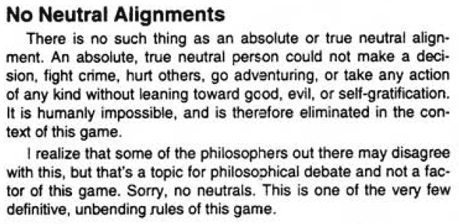
Another place I ran into some conundrums with alignment was in the various Palladium games. Palladium has of course clung to an alignment system that started with AD&D’s and went into something more to Kevin Siembieda’s liking, including the “No Neutrals” rant based on the idea that a True Neutral character would just stand there[1]. To be fair, neutral alignment was rather vague until D&D 3rd Edition or so, but it’s nonetheless weird to see rants against aspects of AD&D 1st Edition as recently as a new Robotech RPG published in 2008. This in turn led to animals being True Neutral in D&D (which made perfect sense to me; ethics are a matter for the sentient) and if I remember correctly Unprincipled or Anarchist in Palladium. It also didn’t allow for characters with different ethics depending on who they were dealing with. At one point I was writing up a race of tiger aliens (closely based on the Kzin), who would be perfectly good (Principled or Scrupulous) to each other, but treated those not of their own species as non-entities, utterly unworthy of respect. I ended up giving them a good alignment with a parenthetical, though I was maybe 15 years old when I was writing that. It might seem like an unlikely quandary, but in real life every people wants to believe they’re good, and it seems like there’s a constant struggle to own the meaning of “good” in the first place.

Hear that? An UNBENDING rule! Also, the XP and level system I use is extremely realistic an practical.

Pre-AD&D, alignment was inspired by the works of Michael Moorcock and Poul Anderson, and were limited to Lawful, Neutral, and Chaotic. More importantly, these reflected cosmic affiliations rather than moral leanings per se. That makes them less constrictive on character motive, and easier to relate to the setting. It’s less the difference between being nice or mean, and more like the difference between being Alliance or Horde. Adding the Good-Evil axis complicates this, but thinking of alignment as an affiliation lets Alignment Language make some small amount of sense. Planescape was probably the best D&D campaign setting for this, since everyone was a short jaunt away from the Outer Planes, which were manifestations of the alignments in the same way that the elemental planes represented the building blocks of the physical world. Truly being Lawful Good makes more sense if Tyr’s domain of Lawful Goodness is a place you can just go out and visit.

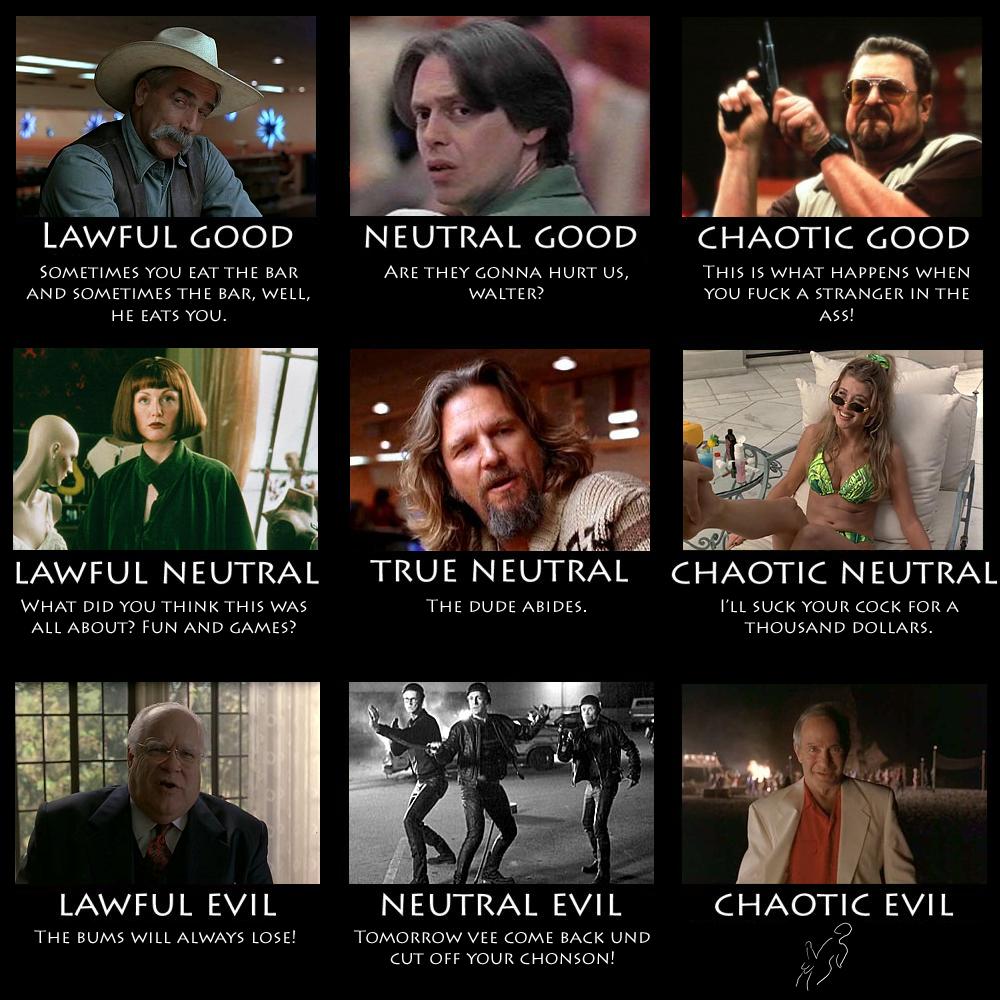
I don’t know that I want to be so overwhelmingly negative about alignments, but I do think that to the extent that the concept has merit, it hasn’t really been used to its full potential. Online conversations about old-school D&D too often seem to treat alignment as an excuse for DMs to dole out XP penalties, while in the more recent edition wars there seem to be a lot of complaints about how 4th Edition has deprived DMs of the ability to rob paladins of their powers[2]. I still like the various D&D approaches better than the Palladium approach of copying and pasting the same ranty alignment rules from a few decades ago into every single game, regardless of genre[3]. While alignments can sometimes produce interesting questions (and some amusing image memes), without giving it some cosmic significance or otherwise going beyond what they have been I feel like the whole concept can’t compare to good Aspects, Beliefs, Instincts, Values, Relationships, etc. in terms of informing how RPG characters relate to the world.

[1]Though amusingly, Erick Wujcik’s Mystic China (one of the few Palladium books I’ve kept) adds a Taoist alignment.

[2]Which strikes me as a little weird. Even if it’s not an assumption of the rules, when you have settings like Forgotten Realms where the gods are a little too involved in mortal affairs, a paladin who goes against his religious principles could have much worse things to worry about than whether or not he can still lay on hands.

[3]And I hate to sound quite so negative about Palladium (I had a lot of fun with their games in high school), but the treatment of alignments are a prime example of how the Megaversal system rules have basically been frozen in time since the early 80s.