Category Archives: musings

Happy Games

Lately there’s been some discussion of some pretty awful stuff that happens in the RPG scene, to the point where I get genuinely tempted to distance myself from the whole thing. I’ve been working on a blog post trying to address some of the awfulness, but it’s long and depressing and given the kinds of discussion that sort of thing can attract I’m not sure I can really handle it at the moment.[1]

Right now I want to blog about something more pleasant. I want to talk about happy, pleasant RPGs. It can be frustrating to try to talk to people about these kinds of things, and I see two major reasons. One is that violence is so ingrained into RPGs that many people just can’t even comprehend how you could have one without it, much less how it could be fun. The other is that I’ve found that any time you propose doing something unconventional in an RPG design, people act as though you’re demanding that the entire hobby should be that way from now on. I’m very big on variety, and while I’ve been involved in some very memorable long-term campaigns, to me the sheer variety of games available is one of the best things about the RPG scene we have today. When I say I want to see heartwarming, non-violent RPGs, I’m saying so from personal experiences that show to me that they can be great, and I mean I want to see them alongside all kinds of other games.

I’ve had direct experience with four such games–Golden Sky Stories, Raspberry Heaven, Clover, and Adventures of the Space Patrol[2]–which is probably a lot more than most people.


Continue reading Happy Games

Divine Machine

Divine Machine is the name of a setting I came up with for a what became a long-running campaign using OVA: Open Versatile Anime, if a campaign that ended on kind of a sour note because of things like my shortcomings as a GM at the time. Even so, I really like the setting that came out of it, and I definitely want to do something with it again. Like Beyond Otaku Dreams it’s another project I’m not going to get into any time soon, but which I feel like blathering about a bit on my blog.

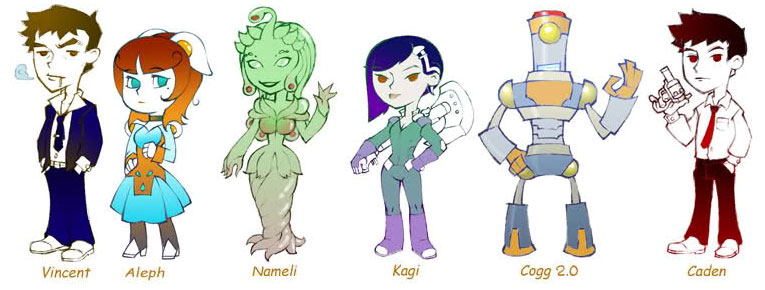
Most of the main cast of the original Divine Machine campaign; a guy who manifests different powers in each dimension, a girl who’s also a giant robot, a sentient plant and thief, a gray-skinned girl who can unlock anything, a modular robot, and a magic gunslinger/detective. Not Pictured: an anthro dog scientist/soldier, a Catholic priest with holy magic, a deranged goddess, the ship’s computer, and an obnoxious little demon girl.

At the heart of the multiverse is the Divine Machine, a great mechanism that takes up an entire universe, its parts made of solid information, where godlike beings create and shepherd entire universes. Magic is real, but it’s ultimately a way of accessing the Divine Machine in limited ways, and not available in all universes. The multiverse is home to a number of interdimensional nations, notably the Northstar Alliance (an interstellar civilization that expanded to be an interdimensional one, and which uses magic-tech kind of like the TSAB in Lyrical Nanoha), the Ix (terrible xenocidal cyborgs, which are kinda like Daleks), and the Holy Velkan Empire (expansionist mage supremacist religious fanatics). Looking back at my notes on the campaign, there was just a ton of really neat stuff in it that I’d like to do something with.

The huge campaign I ran before that was Star Sorcerer (which I’d toyed with renaming Ether Star or some such), which took place in an interstellar civilization that had rediscovered magic and refined it into “ether science” that in turn was behind a lot of their technology, including most of their faster than light travel and communications. I actually made some of the Star Sorcerer characters a key part of the Divine Machine campaign as part of an overall pattern of dropping characters from other things in now and then. Although I’d always intended for the Northstar Alliance to use magic-tech, if I do a full Divine Machine RPG I’ll definitely fold the Galaxy Alliance from Star Sorcerer into it, since they feel a bit redundant when they’re side by side.

Maya, an obnoxious little demon girl.

The big question is how the heck to make some kind of actual game out of it, especially given that I’ve made such a ludicrously broad setting. I’ll most likely have the game concentrate on some kind of elite troubleshooting squads from the Northstar Alliance, but that still means I need a game that can encompass a very wide range of characters and situations. At some point I’d like to make an RPG along the lines of one of F.E.A.R.’s SRS games (Alshard and its relatives), but that would let me make maybe a dozen solid archetypes through a lot of work. Right now I’m envisioning something in the general orbit of FATE, PDQ, and Cortex+, explicitly including a story mapping mechanic a la Pathways and Entanglements. Defining things in more narrative terms makes it easier to cover more ground without a ridiculous amount of design work, plus I’ve found that games like Spirit of the Century and Marvel Heroic Roleplaying are a lot closer to the type of game I really wanted all along than OVA[1]. I really need rules that can gracefully scale from a fistfight to literally universe-shaking conflicts. I can see the overall shape of the game in very general terms, but it’s going to be a while before I can really make time to properly work on it.

[1]OVA is great if it’s the kind of game you do want, and I’m not just saying that because I’m friends with Clay. I always say it’s the game that BESM was trying to be but never quite pulled off.

Magical Burst Update Number Whatever

Even though I have like a zillion other things to do, I got inspired to put in some more work on Magical Burst, which I’m sure a lot of you will be glad to hear. I have no ETA on when the next draft will be ready, but I’m in the thick of things working on it in any case. This post is a series of disconnected paragraphs on some of the different bits I’m working on.

I mentioned it in my last post on the game, but one of the big things I’m doing is more clearly writing out the procedures of play, which I think is really important. The big thing that I’ve kind of been groping towards is that the game and its source material are driven by “shocks.” In Madoka Magica the narrative has a constant escalation of shocking revelations, and in Magical Burst a lot of the rules are ultimately an engine for delivering similar kinds of shocks. I want to make it crystal clear in the text that this is the GM’s key tool for making things happen in the game. A whole lot of RPGs leave that kind of thing to trial and error, but I’m aiming for a fairly specific play style. There’s also the part about how my first playtest was kind of flat and I think not pushing the shocks was partly to blame.

In the 3rd draft I added Apocalypse World style moves to the game, especially for non-magical stuff. I did so kind of thoughtlessly, and now that I have some more experience with Apocalypse World (and Dragon World) I have a better idea what it is about the game that does and doesn’t work for me and the friends I play with.[1] The big problem I’ve had with moves is that players tend to want to treat moves as push buttons rather than role-playing towards them first. (Doubly so for moves that use a highlighted stat.) My solution is to treat moves a bit more as a thing the GM brings to bear, and to remove them from the player reference sheets. Moves don’t have to be secret from the players, but I do think the game could work better if the moves weren’t staring the players in the face the whole time. I’m also going to be rewriting them a bit to better fit this GM-oriented approach. I pared down the Normal Attributes to Charm, Insight, and Tenacity too, and let players assign points for them (but with fewer points and lower values than Magical Attributes). I still need to dig into moves and such to get a better feel for them though.

My philosophy for revising the rules for youma this time around is basically, “Make them fucking MEAN, and scale back later if need be.” My experience and pretty much all of the feedback I’ve gotten so far as been to the effect that as written youma tend to get wiped out pretty quickly, which isn’t anything like what I’d intended. It’s surprisingly hard to make good “boss monsters” (or solos in D&D4e parlance) that can effectively fight a full team of PCs, and I think that for the purposes of designing such enemies I need to ignore some of the kind of advice that I think of as good sense in other circumstances, like being stingy with extra actions in a combat round.

I renamed Appendix 1 to “Instant Magical Girl,” and I’m working on expanding the tables enough to make it possible to generate a completely random magical girl. I had intended for it to be more of an optional thing for people to turn to when they’re stumped, but it’s pretty clear it’s become core to how a lot of people play the game. The folks from the Empire Tabletop podcast (who previously did Maid RPG) did a Magical Burst AP episode, and their attitude was basically, “Why would you ever NOT make a character randomly?” For attributes I’m working on a d66 table that gets you one of 36 sets of attributes, and I rearranged the tables so that they follow the same steps as the character creation rules. When I mentioned that I want someone to make an online random magical girl generator on Twitter I got three replies almost immediately, so it’s pretty much guaranteed to be a thing that will happen. I may try to get the youma rules to the point where you can generate one totally at random too.

Update: Carly M. Ho put together a great little Magical Burst character generator!

Update Again: And then she went on to make a Youma Generator and a Tsukaima Generator!

I have a rough outline for a Magical Burst novel about Yuna and Makoto (from the intro comic script), though I’m struggling a bit figuring out how to get started and how to find the right tone. (Watching Brick the other day has me wanting to explore a stark noir style.) I like the idea of making it a tie-in with the game with game stats and info for the characters and such in the back, but first I have to, you know, write a novel and make it not suck. I’m actually worse at finishing novels than I am at games, if you can believe that.

I just finished re-reading Planet Guardian, a manga which hardly anyone but me seems to know. (Even scanlations haven’t gotten past chapter 2.) It doesn’t have all that much influence on Magical Burst, but I like it a lot nonetheless. The main character is Koyuki Kisaragi, a girl who got magical girl powers from a little critter named Pirosuke. Five years later there’s been no sign of the alien criminals that were supposed to show up, and Koyuki just wants to study hard and get a cushy government job (and Pirosuke has gotten so fat that he’s spherical). When the first bad guy shows up, Koyuki goes to fight it only after massive badgering from her brother Itsuki, who berates her for failing to be a properly cute magical girl like in anime. When another magical girl shows up it’s Ririka Saotome (real name: Yoshiko Yamada), an abject psycho whose desire to be the center of attention is potent enough to break the fourth wall at times. There’s also a boy named Shizuku, who treats being a Guardian as a serious duty, at least once he gets over his older sister’s attempts to dress him up in weird outfits. The story is kind of random and aimless, but I really like the differing attitudes towards being a magical girl (or boy) on display, as well as how Koyuki’s attitude evolves over the course of the story as she starts to take the responsibility of protecting the world seriously. But anyway. I may see about ordering the Madoka Magica novel, though it’s apparently over 500 pages.

[1]AW style experience tracking pretty much just fails for us, though that’s more relevant for Dragon World. It’s also related to enough other things that rejiggering the rules to work differently in Dragon World is going to be… interesting.

Beyond Otaku Dreams

I had yet another idea for a game. Not that I’m going to do much with it any time soon.

I recently went to FanimeCon, a local anime convention. I’ve watched Fanime grow from a meeting of multiple anime clubs at a community college to one of the bigger anime conventions in the U.S., and if I’m honest, for me it had a sweet spot in the late 90s that it’s left far behind. But there are about 20,000 people who think it’s worthwhile, and a lot of them seem to love it without reservation. Even so, there’s been drama among my friends at cons, and every now and then I’ve caught a glimpse of someone in real pain and wished I could do something. I feel like narratives about fandom tend to be either too sanitized or too cruel, presenting either an idealized vision of fandom or painting an entire swath of people as obnoxious and worthless. In real life, in my reality, anime fans are just people. They can be amazing as well as horrible, but most of all they never stop being human.

Another thing I’ve been wanting to put into some kind of creative project of some kind is the idea of otaku whose delusions take on a life of their own, who live somewhere between worlds of dream and reality. A character might have a perfect dream companion, an imaginary lair to retreat to, or special powers they wield in their world of delusion, which reveal things about them. Their delusions sometimes go out of control, sometimes intersect and combine in ways that should be impossible, and occasionally leak into normal reality. Lately I’ve been really enjoying Akibaranger, a parody/spinoff sentai series where the heroes’ battles take place in a shared delusion, at least at first, distracting them from their real-life troubles. The way they’re so conscious of sentai tropes adds a certain charm too, especially when things don’t line up with their expectations.

I’d had the idea to do a game like this before, but I think it was missing the pathos, the uncompromising human drama. The desire to escape from reality is at its most poignant when you have something to escape from. I also want it to be about people who do have a chance at redemption, who can overcome the issues that drag them down. Maybe it’s my way of telling people that there’s still hope. There was a thing called Densha Otoko (it started out as a forum thread and went on to be in a ton of different media) about a hopeless otaku who through happenstance made contact with a normal woman by saving her from a drunkard’s harassment on a train. The thing that bugged me (and I think a lot of people) about it was how he had to completely leave his fandom behind and force himself to be “normal.”[1] Real life experience tells me that you don’t quit your obsessions cold turkey, but rather find ways to make them grow up along with you.[2] You can change for the better without having to not be yourself.

I haven’t gotten very far with this game, and I don’t intend to until I’ve got some other things dealt with (Golden Sky Stories and Magical Burst). What I do know is that it will be something like an otaku version of Don’t Rest Your Head, one of those indie games with baroque mechanics that feed interesting stuff into the story.

[1]This assessment of the story may be a bit flawed because I never got around to finishing the Densha Otoko TV drama, but let’s ignore that because my version illustrates the point that comes next really well. OTOH the series’ opening was fantastic, a sendup to the Daicon IV opening animation.

[2]Personally I’m still working on it, but I’m getting there. I think.

The Futures of RPGs

Lately over on anyway. Vincent Baker has been musing about RPGs and how to make them more accessible. It’s one of those perennial bugbears of gaming, and way too many people are way too ready to just throw their hands up and conclude that as a commercial venture RPGs are just doomed. I don’t know whether we can ever change the direction things are going, but on the other hand I think a lot of the kinds of things that come up in these discussions are things that can benefit existing gamers, so long as they’re open-minded enough to take advantage of them.

One thing Vincent’s been talking about a lot is the social footprint of gaming, and there’s no denying that it’s the place where RPGs unequivocally lose out to basically every other form of entertainment ever. To play a game of D&D as it’s been for the past decade or more to its fullest you need to get 4-6 people to spend an hour or more making characters, and get together for 4-6 hours at a time, preferably once a week for several months to a few years to get the full effect. This isn’t an invalid way to play for those that can manage it–a long-term campaign has distinct payoffs–but even people who dearly love the game often find themselves forced have to admit that it doesn’t fit well into an adult lifestyle.

That’s where board games tend to have a tremendous edge over RPGs. There are some super-hardcore board games that require an elaborate setup and whose full appeal comes out in campaign play, but by and large those are the exception to the rule. An average board game gives you a discrete unit of play with minimal setup and no need to maintain a set group of people. There are some games like Fiasco that deliver that kind of formatting to an RPG, but the D&D model is still very much the norm. If you’re pitching the RPG experience to someone who doesn’t already play, it seems like it should be easier to sell if you can get them into the meat of play faster (like without having lengthy character creation) and the basic unit of play is something they can reasonably expect to fit into their lives. And really, that’s something that can benefit gamers too. Even if you have a regular D&D game going, less involved RPGs can be a nice fallback when someone can’t make it at the last minute, or someone new stops by and you don’t want to limit them to spectating.

The question of what RPGs can learn video games is tougher, because the medium has certain different capabilities and expectations. Although there is such a thing as a “solo RPG” experience (in Fighting Fantasy and its ilk), a video game’s capacity for solo play on your own terms isn’t really something a tabletop RPG can hope to reproduce. On the other hand, video games can be very good at putting players into the action and teaching them as they go. That’s what some in the RPG world have started to call “fluency play.” Rather than dumping the whole game onto players’ heads at once, you ease them into it in digestible chunks, with very little distinction between teaching and playing. Very few tabletop games have even tried this, so I’m very curious to see how well it will work when more designers try it.

There’s also the concept of the “party” to contend with, the idea that the players’ characters will generally be a group that sticks together constantly. It’s largely an artifact of D&D’s influence, and doesn’t really line up well with any other kind of fiction apart from those D&D itself has affected. These days the U.S. is in the middle of something of a golden age of TV drama, while fantasy is more of a niche genre. TV dramas typically have a strong central cast, but it’s entirely natural when an episode focuses on some and lets others fade into the background. Thus the ensemble cast type approach is both more pragmatic for gamers who have lives and more in line with the stories that more people enjoy. Even My Little Pony seldom involves more than 2 or 3 of its six main characters in any given episode. Apocalypse World doesn’t explicitly call for this approach, but I think it potentially supports it. AW characters are more likely to have their own distinct agendas, and thus a group of AW characters is less likely to be unable to function coherently if one or two are missing.

Where discussions of these kinds of things tend to crash and burn is when you get to the question of how to reach people. Cel*Style members’ experiences selling RPGs to anime fans have been encouraging overall, but rather mixed. Vincent’s attempt at selling games at a horror con pretty much bombed, and his commentary makes it clear that there are some very tough issues to face, among the biggest being how to communicate the experience and appeal of role-playing. If getting to a few dozen people who are already at a convention is a challenge, what hope is there for reaching millions, even if you do have the perfect game? The other day Robert Bohl pointed out something on Google+ that in hindsight is pretty blindingly obvious: you don’t have to aspire to change the whole world and get millions of people playing. His approach is simply to make games that he can play with lots of people, and that in turn means games that non-gamers can get into. That’s the kind of goal that an independent designer/publisher can get into and realistically achieve. It would be nice to get thousands and thousands of new people into the hobby, but having fun with lots of friends, including ones who don’t normally game, is I think a worthwhile goal too.

On a business level, the indie/Forge thing was about setting and achieving realistic goals. Don’t take out a second mortgage to print 20,000 copies of your game when you can print and definitely sell 200. In that respect I feel like there’s a definite parallel between RPGs and comics. In comics you have people doing webcomics and mini-comics and independent graphic novels and Kickstarters and everything, while Marvel and DC are seemingly not even trying to reach outside of hardcore superhero comics fans. (“DC Comics: Bad At Math“) In the tabletop RPG world the two biggest properties are D&D and a clone of D&D, whose introductory not-ginormous-hardcover-books boxed sets came out in 2010 and 2011, in each case 2 years after the original version. They’re both media where there’s these really amazing things going on at a grassroots level while in the mainstream the serpent is eating its own tail. The thing that superhero comics have on their side is getting made into quality cartoons and movies, like Young Justice and the recent Marvel movies. D&D’s forays into other media have been kind of lackluster. I’ve heard good things about the comics and board games, but those aren’t really reaching out to new audiences.

My own projects are all over the place when it comes to this kind of stuff. Slime Quest is going to deliberately be unambitious in terms of reaching out to non-gamers, because it’s an attempt to refine an existing style of play. On the other hand Raspberry Heaven (for which I really need to get more work done) is a super-casual RPG that aims to push the limits of the medium and be at its best for a decidedly atypical RPG audience. Marketing it is going to be a pretty interesting task to be sure. My first playtest of the Raspberry Heaven Practice Test went pretty well, and gave us a satisfying little RP experience in about an hour. I can’t help but think that something like that would be pretty alien to a lot of traditional RPGs, but then next week we’ll most likely get back to our Spirit of the Century game.

Slime Quest: The Big Idea

The other day some of my friends (Suichi and Mike B., with some help from Tim) went crazy brainstorming possible stuff for Slime Quest while I wasn’t around, and then laid out everything for me as best they could. They came up with some really intriguing ideas, though I’m kind of at a loss for what to do with them.

The core Big Idea is to speed up combat by getting rid of attack rolls (and defense rolls). Characters would have attacks and defenses of varying potency, and when an attack comes the onus is on the target to provide a sufficient defense and not take damage. Classes would thus be differentiated by the kinds of attacks and defenses they have, and how often they can use them. A tanking fighter could have defenses that let him defend against several enemies at once, a mage could be adept at making barriers to protect from magic, a leader could give allies boosts to attacks or defenses, a rogue might be able to lower or ignore a target’s defenses, and so on. The actual damage would be random, and more like in a typical RPG, with the difference that higher-level attacks get damage bonuses when they prevail against lower-level defenses. Teamwork also can become very important, since multiple characters working together can jump up in attack ranks to affect enemies that would be basically impossible to harm otherwise.

This cuts out several steps from typical D&D-style combat, but it also means adopting a new brain-bending paradigm of combat, and figuring out how to actually balance it so that characters have the right level of competence and challenge. Balancing resource-based stuff is that much harder, especially when you use the resources for typical RPG things. I like resource-based mechanics in RPGs, but I do feel that when you put them into places where they can determine success or failure they can create perverse incentives that are hard to properly manage.
Continue reading Slime Quest: The Big Idea

Slime Quest Thoughts

Lately I’ve been poking at Slime Quest a bit, and it has me really wanting to get into working on it in earnest. Of course, I have a bunch of stuff I need to get sorted out for Star Line Publishing, the Golden Sky Stories Kickstarter, and Raspberry Heaven. Still, I want to do a blog post to blather a bit about Slime Quest, which will probably include some stuff I’ve posted about before.

Slime Story is an idea I came up with around 2006, a world like ours except with the addition of magical portals spitting out MMO style monsters that people have taken to hunting for fun and profit. In some parts of the world corporations or warlords control the portals for the marvelously useful bits of monsters, but in suburban America monster hunting is mostly something teenagers do for fun. The system, which I think of as the “Slime Engine,”[1] owes a lot to Japanese tabletop RPGs like Arianrhod and Meikyuu Kingdom, plus a bit of Dungeons & Dragons and a drop of Apocalypse World. Making an anime fantasy game with the same rules was a pretty natural thing to do (and if I ever develop both enough you can be that the mystery of the portals in Slime Story will have something to do with the Slime Quest setting), but because it forces me to make the math a bit more rigorous I may end up finishing it first.
Continue reading Slime Quest Thoughts

An Oral History of D&D Discussion Online

There are plenty of things that annoy me about how RPGs in general and D&D particular are discussed online, from edition warring nonsense to the notion that D&D is THE RPG because I can’t find anyone to play other games because D&D is THE RPG. Lately I keep feeling like I’m the only one who remembers anything about how things went over the past 15 or so years of online discussions. A lot of new concepts have entered the discussion, including the stuff the OSR has championed, that have vastly altered the discourse.

T$R
In the mid to late 90s I saw some discussions on BBSes, usenet, and finally the web, though in my family we were lagging a bit behind in computer technology. Lots of people played and liked D&D (and made fan material and netbooks and such for it), but the overall consensus seemed to be that it was a game for mindless hack and slash. It was the arrogant, brainless, undeserving 800-pound gorilla, and thank god the likes of White Wolf, Steve Jackson Games, Chaosium, Palladium, etc. were giving us games with some room for actual role-playing or something. While people would sometimes cite D&D sessions without any die rolling, from what I saw the standard rebuttal from D&D fans was simply, “But we like dungeon crawls!” This was actually my first exposure to what would become the “badwrongfun” meme, and it really changed how I looked at RPGs, for the better. This was also the time when TSR was the great villain of the industry, even in the eyes of many people who liked D&D, with constant complaints about the company’s money-grubbing business practices and penchant for shutting down unauthorized fan activities. Some people accuse Wizards of the Coast of putting profit motive first today, but that minority is nothing compared to how just about everyone could type “T$R” with the dollar sign with a straight face and no fear of even being criticized for it. (“Micro$oft” has gone out of style too, come to think of it.)
Continue reading An Oral History of D&D Discussion Online

Reverb Gamers 2012

I decided to try doing the Reverb Gamers thing, but all at once because I’d rather do one big post than 31 tiny ones.

#1: What was your first roleplaying experience? Who introduced you to it? How did that introduction shape the gamer you’ve become?
In middle school my friend Alan got us into Palladium’s Robotech RPG. From then through much of high school various Palladium games dominated my gaming, and I think the fact that every other RPG I looked at had better rules made me appreciate good game design where some people seem inclined to gloss over it on the basis that the GM can fudge a bad game into submission.

#2: What is it about gaming that you enjoy the most? Why do you game? Is it the adrenaline rush, the social aspect, or something else?
It would be hard to narrow down to just one time. I guess I like the in-the-moment creativity of it.
Continue reading Reverb Gamers 2012

Fifth Edition

I’m really not sure what to think of the announcement of a new edition of Dungeons & Dragons being in the pipeline. That’s partly because there’s relatively little information to go on in the first place, so it’s a bit early to do much in the way of prognostication. This blog posts is thus mostly going to be about my reaction and other people’s reactions, and my reactions to other people’s reactions.
Continue reading Fifth Edition