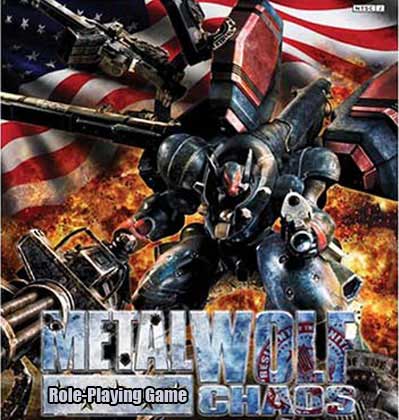
Role-Play This! Metal Wolf Chaos

mwc-rpg.jpg

What Is It?
It’s a truism in video games that the Xbox did very, very poorly in Japan, and the Xbox 360 only somewhat better. Despite that, for the very few people who owned Xboxes in Japan, there were in fact some rather interesting exclusive games that never made it to other markets. One of these was Metal Wolf Chaos. I’ll be perfectly honest, having seen a video of the game I wanted it, but could only get it by torrenting the disc image and playing it on a friend’s modded Xbox. It’s too bad it never was released in the U.S., because I and most of my friends would definitely have bought copies of it. It’s not impossible to get a legit copy, but it’s not cheap either.

The basic premise of the game is the kind of thing only a certain kind of Japanese game designer would come up with. The Vice President of the U.S.A. stages a coup, turning our great country into a military dictatorship overnight. With much of the military siding with the VP’s tyrannical regime, the President himself must don a power suit and blast his way to restoring liberty and freedom. Along the way you get to visit (and more often than not blow up) major American landmarks, upgrade your weapons, and see cut scenes with awesomely cheesy English/Engrish dialogue (“Suck my missile punch!”), until you finally get to have an epic confrontation on a space station.

Why’s It Awesome?
The President is in a presidential mecha, blasting the crap out of America’s enemies. The White House become an armored, mechanical monstrosity: The Fight House. It’s Independence Day plus Full Metal Panic, minus any and all shame. If you want a taste, check this out:

Gaming It
Most any reasonably customizable mecha game — Mekton Z, Exosuit A-OK, etc. — could handle the mayhem of MWC, though you could easily use a more generic system that can do mecha (BESM, OVA, etc.). Another option would be to go for a more descriptive system that concentrates on cinematic action, like Wushu. (And for a blast from the past, I might just dust off my copy of the old Project A-ko RPG…)

As an RPG scenario, MWC’s setup would probably need to be tweaked for more than one protagonist. The way I would handle this is to have the players campaign and vote (naturally) for who gets to be the President, and assign other cabinet positions from there.

MWC is not a thematically deep game by any means, but what depth of story it does have comes mainly from the President’s ties to others–a VP he’d thought he could trust, former comrades from the military, etc.–being tested by the present circumstances. A little bit of this can help keep the story from becoming nothing more than an excuse to blow stuff up, and a lot could make it either more of a serious drama, or crank the melodrama up to 11. In the latter case, my as-yet unrealized dream of a fighting shonen manga game would be idea if it existed, and the former case it starts to sound like a weird Dogs in the Vineyard hack might be the order of the day.

Up Next: Fighting Shonen Manga

Role-Play This! Higurashi no Naku Koro ni

Higurashi RPG

What is it?
Higurashi is a series of independently produced visual novel games, which have since been adapted to several other media, including an excellent anime series. It takes place in the summer of 1983, in a small town called Hinamizawa. When the government wanted to build a dam that would destroy the town, it bitterly divided the people between those who wanted to preserve it and those who wanted to take the government’s money. Every year since the end of the Dam War, there have been murders on the night of the town’s Watanagashi festival.

A teenaged boy named Keiichi Maebara has just moved to Hinamizawa, and he becomes friends with Mion, Rena, Satoko, and Rika, four girls who have a club where they play games, usually with dares over embarrassing costumes. The story unfolds through a series of alternate versions and re-tellings, which gradually reveal more and more of the town’s dirty secrets, and the kids wacky hijinks are often juxtaposed with horror and brutality.

Geneon was releasing the anime in the US, but then they sort of closed down all of their North American operations completely, so the license is kind of in limbo. There are fansubs out there, but they’re hard to find at the moment.

Why’s It Awesome?
SPOILER ALERT. All through the first season, Hirugashi keeps you guessing as to what is actually happening, and the audience can only wonder whether it’s really something supernatural at the heart of all this, or something else. At the end of the first season Keiichi remembers himself brutally murdering Shion and Rena, and doing so pulls him back from the brink of disaster. We also learn why little Rika switches between her bubbly little girl persona and a much more mature self. She has endured nearly a century of reliving the same life over and over. In the final story arc, she uses the knowledge gained from so many lives to rally her friends together to thwart the sinister forces threatening Hinamizawa and move on to a brighter future together.

Although Higurashi is situated in otaku culture, it is anything but typical, and it defies cliches at every turn. Amongst other things, it is willing to deal with social and government issues. Even in mainstream culture, Japanese entertainment always seems reticent to depict for example a courtroom scene, but Higurashi features a protest outside the local child welfare office. The characters, from busty Mion to Lolita Rika (who won the 2007 Saimoe Tournament), have a definite moe aspect to them, but they live in a realistic world and problems such as Satoko suffering domestic violence at the hands of her uncle, are not easy to solve. Unraveling a government conspiracy that could (and in many worlds does) destroy the town is the ultimate test.

Gaming It
There are many possible ways to approach gaming Higurashi. You could stick close to the original, or use the general premise with different characters, or even in a different place entirely. Higurashi is ultimately about the townspeople’s relationship with a unique virus that could redefine how we understand human behavior. it meshes well with a Japanese town with its own cult-like variation of Shinto and run by powerful yakuza families, but it’s not hard to imagine an insular town in the deep south with its own sinister variation of Christianity.

Sorcerer is probably the existing game that would fit best. With a little tweaking, the virus/curse that afflicts everyone in Hinamizawa could be defined in terms of a Demon, with Humanity loss representing the spiral of paranoia, insanity, and death that results from its full activation.

The fact that it uses multiple realities to reveal the mystery raises all kinds of interesting possibilities, regardless of what system one uses. For a shorter campaign or a one-shot the GM might give the players index cards with scraps of memories from the other worlds. Rika is the main one doing this remembering, but the others get occasional vague impressions, especially towards the end of the story. This would require lots of preparation by the GM, but it would be the best choice in terms of maintaining immersion.

On the other hand, especially if you want the mystery to be undecided at the start, it could be neat to do a troupe-style campaign where the players take turns being GM and inventing story arcs, which could be either new or examine an earlier one from a different point of view.

Next Week: Metal Wolf Chaos

New Feature: Role-Play This!

This is something I’ve been thinking about doing for a month or so now, and I decided it was time to finally get around to starting. “Role-Play This!” is meant to be a regular column where I discuss things in other media that I think could inspired interesting role-playing experiences, campaigns, or entire games. This is necessarily going to be about stuff that I like, which means an awful lot of it will be anime-related or otherwise Japanese, but by no means all.

Each installment of “Role-Play This!” will have three parts.

  • What Is it?: This is a quick rundown of the thing in question, including the specific medium (or media), genre, and style it’s in, where one might find it, and most importantly, what it’s about.
  • Why’s It Awesome?: This is where I let my fanboy drool show through, and explain why it is I think the thing in question is so awesome that I want to do something RPG-related with it.
  • Gaming It: Finally, I’ll throw out some ideas for how exactly one might go about running a game based on it. I intend to concentrate on using or modifying existing systems, but I definitely won’t shy away from pontificating on what an original game might entail. Here more than anywhere else I’d appreciate any and all feedback.

I definitely can’t promise I’ll actually get around to trying out all of the ideas that result from this — getting my gaming group together once a week is a herculean task as-is — but I’m definitely going to try to follow through where I can, and post the results up here.

Below is a tentative list of things I want to cover here, though of course I’m open to suggestions. I will of course be concentrating on things that interest me, though I’ll specifically avoid things about which I’m already working on games (like sentai).

Higurashi no Naku Koro ni (anime, etc.)
The Melancholy of Haruhi Suzumiya (anime/light novels)
Metal Wolf Chaos (video game)
Futurama (animated sitcom)
Magical Girl Lyrical Nanoha (anime)
Scott Pilgrim (comic)
The Dare Detectives! (comic)
jPod (novel/TV drama)
Empowered (comic)
Akihabara@DEEP (Japanese TV drama)
Shounen Fighting Manga (as a genre)
Oh! Edo Rocket (anime)
Bamboo Blade (anime)
Keroro Gunsou (anime)
.hack (anime/games)
Galaxy Fraulein Yuna (anime/games)
Super Mario Bros./Paper Mario (video games)
Dennou Coil (anime)
Q-ko-chan (manga)

In The Cards

I wound up going in and filling out the online list of my RPG collection on RPG.net, which you can view here. Sometimes I forget (1) that I have some very strange, obscure stuff in there, and (2) just how many books I’ve sold off over the years. I own almost no Palladium stuff now, a lot less GURPS and Tri-Stat, and a whole heck of a lot more indie stuff. Anyway.

I wound up doing some brainstorming for Dandelion Complex, Raspberry Heaven’s twisted younger sister game, and I think I’m seeing the outlines of the game I want. It’s going to also use playing cards (I’m seriously thinking of putting them into the same book anyway), albeit in very different ways. Characters have cards dealt to them face down, and they can spend them on different things, whereupon they pick a card to turn face-up. For random events you check the card against a table, but certain cards will cause things to happen in the game regardless of what the character is trying to do. Additional cards are earned by pleasing the teacher NPC, a la Maid RPG.

Although I came up with the idea for Dandelion Complex as a game that would in some ways be a polar opposite to Raspberry Heaven (instead of Uno… 52 Pickup), they’re turning out to both be playing-card-based pickup games that actively defy any substantial attempts at preparation. They’re even starting to reference each other, since RH’s character color is perfectly usable in DC, and DC’s tamer random event tables could be used to get out of creative blocks in RH.

On a side note, I decided to get a box to hold my two decks of cards for these games. I was looking online and kept seeing boxes with capacities topping out at around 85 or so, but when I got to a local comics shop to look at them in person, it turned out that these are mostly sized for cards with protective sleeves on, so one of the boxes I picked up can easily fit three standards poker decks. The plastic cases meant for baseball cards and such that claim they’re for 100 cards could easily hold twice that for playing cards.

Cards found around my house last night:

  • A deck of One Piece playing cards in a plastic case, from a grab back at Anime Palace.
  • The cards from the combat game that’s included with the Dream Pod 9 Project A-ko RPG
  • A set of Clow Cards (from Card Captor Sakura), printed in Japan and bought well before the series came to the US. Now I kind of wish I’d bought that book they did on how to use them for fortune-telling. (Though as it turns out someone’s working on an English fan translation).
  • Six different Brawl decks.

Raspberry Heaven 0.2 Playtest 1

Sunday night was the first playtest of the new revision of Raspberry Heaven, and I think it’s promising (and a vast improvement over the old version) but in need of much more testing and tweaking. It probably didn’t help that I started coming down with a cold an hour or two before we started though. On the plus side I had time to go buy some Japanese snacks (Pocky, melon bread, rice crackers) to munch on during the game.

For those that are interested in looking at the current draft of the game:

Anyway, I was joined by Mike S., Elton, and Tim for the playtest. I’d e-mailed my current draft of the rules out to everyone, but Elton hadn’t had time to read it, so I had to explain the rules to him verbally. This is half of my usual gaming group. Although they’re a creative bunch (especially Mike and Tim), we haven’t had occasion to play many indie games yet (I’ve been working on it), and the players, myself included, weren’t always prepared to narrate on the spot. I’m not sure how much of it is simply not being accustomed to that kind of improvisation, and how much is just not being cut out for it. Anyway.

Me, Tim, and Mike got together around 5:30 p.m. and watched some Azumanga Daioh and played a couple rounds of Uno to warm up. I think I’ve mentioned before that I don’t really like board or card games (Magic and Monopoly helped ruin both genres for me), but I find that Uno scratches roughly the same itch that Tetris does. I guess I have a thing for simple games with some simple logic tasks to them. I’m thinking of including (1) optional rules for playing Raspberry Heaven with an Uno deck, and (2) putting together rules for a custom Crazy Eights variant card game to play.

Character Creation
Elton showed up at about 7, and after another round of Uno we got into character creation. With the exception of Mike, everyone only really gave their characters a name and the requisite three Quirks. The PCs wound up being as follows:

  • Karin Takebashi (Elton): Tsukkomi, Tsundere, Physically Gifted
  • Yui Kinomoto (Mike): Boke, Obsession (Puppets), Genkisugi
  • Yama (Tim): Jock, Obsession (Eating), Busty
  • Kana Ninomiya (Ewen): Space Cadet, Slow, Genius

Characters

The decision to omit the fluff (likes, dislikes, best/worst subject, blood type, etc.) wasn’t conscious per se, and more to keep character creation from dragging on even further. I might try to have some game mechanical consequences to it (e.g., you can draw a card for a scene involving your Best Subject, but you have to discard one for your Worst Subject).

  • As I’ve been planning for ages, we took out my box of Pinky Street doll stuff and made representations of our characters that way. This wound up working pretty nicely, and it seems like after some fiddling everyone was pretty satisfied with that part. On the other hand I definitely need to see about getting some bases for the figures (they make them, but they’re mostly sold separately), since the dolls often fall down, and in Karin’s case the head would pop off every time that happened.
  • One thing I’m thinking about for character creation and such is to have a PDF for optional Quirk cards. You could use them to tangibly pick out Quirks and ensure each one is exclusive to one character, or randomly generate a character, or use them for reference.
  • Another thing I’ve been thinking about is making a small collection of iconic characters/templates that players can use to get into playing the game more quickly.

Scenes and Cards
I made a quick “Scene Template” that I think will prove indispensable to beginners playing the game. It contains all of the basic information for the core gameplay, and is a kind of visual guide as well. Everyone seemed to catch onto the mood values of the cards and the phases of a scene fairly quickly, though I think feeling out what does and doesn’t fit into a phase and the border between the narration part and role-playing part of each phase has a bit of a learning curve. We got through a total of five scenes, and ended the game where it felt appropriate to do so, partly because it had gotten kind of late on a Sunday night.

I had originally planned for the length of an episode to be measured in terms of how many times you shuffle the deck, but I also set it up so that characters get 3 new cards per scene, which means that with the base scene cards the four of us would burn through 18 cards per scene, and we’d get through as little as two scenes before needing to reshuffle. As is, those five scenes required three reshuffles. Playing with two or more decks shuffled together might be helpful–a basic Uno deck has 108 cards after all–but regardless I need to do something about the economy of cards. The 3 cards per scene did keep people from being stingy with cards as I had hoped at least.

Template
On the other hand, I’m not sure what to do with the basic way the cards are played. In practice the free-flowing Uno-style matching game is very non-confrontational, but it perhaps excessively rewards players who wait for others to play their cards. I’m not sure having it be oriented towards high cards is what I want exactly (it was interesting to see players choosing their cards in order to maneuver towards the mood they wanted for one thing), but perhaps a more structured turn order might help. Tim’s suggestion (which Mike seemed to dislike) was to have each player get a hand of five cards per scene, and set out one face-down for each phase, then flip them over all at once to determine the narration rights by high card (the 5th card would be usable for Special Moves, but you could only use one Special Move per scene).

Each Quirk gives a character a Special Move that lets them play cards differently (such as by treating certain cards as wild cards) at the expense of needing to include something related to it in the scene, but in the playtest there was only one instance of a Special Move being used for something other than a wild card. Some of them need to be tweaked to be more useful (I’m thinking you should be able to drop the tens digit of Addition Plays, so that e.g. a 6 and a 7 could be played as a 3), and some need to be tested period (like Draw Two). Still, on the whole I think I’ve found an effective way to motivate players to bring their character’s peculiarities into the game. It also eliminates the original version’s worries about checking for conflicting Quirks, though Play Adjacent is perhaps over-used in the Special Moves.

Emergent Story
The four girls are classmates in high school, and their homeroom teacher, Inoue-sensei, is a lazy, short-tempered otaku. The episode was about physical examinations (once a year students are weighed and measured), and anxiety about such. I’d originally thought it kind of a narrow subject for a full episode, but for the 5 scenes we played through it was about right. In homeroom, Inoue-sensei came in late, fuming that the release of the new game she’d lined up for had been delayed, and she decided to leave early. That Kana couldn’t quite tell the difference between Yui (who’d decided to jump in to “teach” the class) and the real teacher was enough to get Inoue-sensei to get back on track.

Lunch in the cafeteria led to Yama and Yui, massively laden with food, colliding in the middle of the cafeteria, while Kana watched helplessly.

Then we moved on to the physical exams. Yui gave plushies to everyone, and Kana went into the nurse’s office with a penguin on her head. Mr. Tuxedo wound up getting his own report from the nurse. Yui bragged about her own “secret weapon,” which turned out to be plushies stuffed into her bra. When it was Yama’s turn, Karin and Yui decided they needed to peek in, and Inoue-sensei (played by Elton at that point) came into the nurse’s office with a binder and started writing things down for some reason. Mike played a Joker, and got narration on the Resolution phase, so he said that the door Yui was leaning against collapse in, knocking down the privacy screens to boot so the boys could see in.

I had the next scene (which turned out to be the last) be in the principal’s office, where he was talking to Yui, Yama, Inoue-sensei, and the nurse to figure out what happened. He decided to let Karin decide Yui’s punishment. That scene wound up being all Spades, which means a Dream Sequence, so we wound up with Yui in some crazy bear costume, and then Kana waking up from sleeping in the middle of class to be scolded by Inoue-sensei.

Table

Conclusions
The use of scenes, phases, and moods from the cards seems to work pretty well, though it depends on the group playing, and I’d like to see how it turns out with players more accustomed to group improvisation type games. The major thing I need to do is work on how the cards are played, both in terms of the overall flow of the game and making sure Special Moves are sufficiently useful. We never actually used the rules for Memories, and while I think those serve a purpose in the rules, they no doubt need work too.
Mononoke Koyake: First Impressions

The stuff I ordered from Sunset Games came in the mail the other day. I’m going to write much more extensively about them some time in the future, and I’m thinking of writing thorough reviews of the Japanese RPGs I own when I have the time.

Mononoke Koyake is a supplement for Yuuyake Koyake that adds a new class of characters: mononoke. Where henge are animals with mysterious powers, mononoke are beings who are wholly made of the mysterious. The book consists of the rules for the five types of mononoke, some story/dialogue section to better introduce stuff, and two scenarios. Unlike with henge, each type of mononoke has the potential for several different variations, though in game terms these are a matter of flavor text.

The five types of mononoke are:

  • Michinoke: These are supernatural creatures that in myths appear to frighten or attack people on roads. I hadn’t thought about it before, but Japanese myth contains an awful lot of these. The signature character is Onbu, who in her base form looks like a hairball with arms and a massive lolling tongue, but others include a faceless person, that thing that’s an umbrella with a single leg sticking out, etc.
  • Oni: These ogres/demons are relatively straightforward, and they’re depicted as being aggressive to the point where they’re pushing the limits of what the game would allow. Variations include thunder gods, hags, hanya, etc.
  • Kappa: Kappa are a weird kind of monster to begin with, though here their defining trait is being water creatures. The variations include all kinds of beings that live in the water, including mermaids.
  • Visitor: Visitors are perhaps the most interesting and flexible character type. The signature character is Repushi, a cute little alien, but the variations listed in the book include time travelers, magicians, snow women, and even Santa Claus. Most of their Powers and Weaknesses have to do with them being far from home.
  • Ghost: Japan has a long tradition of ghost stories, and here ghosts can include classic lost souls, skeletons, vampires, cursed dolls, etc.

I still need to read through it more, but overall this seems to be a fairly straightforward, well-constructed supplement that (being only 56 pages) does what it does and finishes quickly. The new character types are probably trickier to handle (the text recommends playing the game with henge for a while before you try out mononoke), but they also seem like they would open up even more potential for creativity in character concepts.

I also got Aitsu wa Classmate!, a game about an idealized, zany manga high school lifestyle. It’s a fairly dense 176 pages, so it’ll take me a while longer to digest.

Raspberry Heaven 0.2

The stuff I ordered from Sunset Games has apparently been shipped, via EMS. That means that although the shipping charge was about 2600 yen, the package should come in a few days. I will of course post more about them when they’ve arrived and I’ve gotten a chance to read through them some.

Anyway, I think I have (the next iteration of) Raspberry Heaven basically figured out, at least enough for playtesting. The replies to the thread I started on Story Games helped immensely, and gave me more insight into how cards can be used in games in general.

The way the cards are used wound up being closer to Uno (which is in turn very much derived from Crazy Eights and its relatives) than poker. (And I’ve wound up playing Uno on Xbox 360 a decent amount of late). There’s a rotating “tutor” role, whose job is to deal cards and supervise the scene’s pacing. They set out four cards for the scene phases face down, and flip them over as they feel appropriate to the pacing of the scene, and move the played cards to the discard pile when it’s time for it to end. When a phase starts, the players then play cards, trying to match suit or rank, until no one wants to play any more cards, and the player with the top card gets narration rights.

Each Quirk gives your character a Special Move, which lets you play cards differently, but also introduces something which may or may not be flattering to your character, regardless of whether or not you win narration rights for the scene. I thought about giving characters two or more things per Quirk (and I really liked Filip’s idea of having an Aspect for each suit), but that gets to be too many different things to do with cards per character.

One of the major things that needs playtesting is the overall economy of cards. As I have it written now, players get 4 cards in the first scene, and one card at the start of each scene thereafter. I think that might not be enough, but of course it partly depends on the players’ behavior. I might try having the game run through the deck more aggressively, giving players more new cards per scene and having them discard down at the end. That way the desired length of an episode could be measured in terms of how many times you shuffle the deck.

Regardless, I’m going to aim for a playtest next weekend (the 19th for those keeping track). I’ll probably do the thing I was planning on, having the players make representations of their characters using Pinky St. dolls, though at some point I’d like to do an Azumanga Daioh game, and have each player take a plushie of one of the characters (since, weirdo that I am, I have the Azumanga cast twice over in plush form…). If only I could afford these Azumanga Daioh playing cards (the only one currently on eBay is for $70 plus shipping, though it is for six decks). OTOH I do see a Lucky Star deck for $4.75, even if it does look bootleg.

(Add a custom deck of cards with different pictures of Raspberry Heaven’s signature characters to the list of things I’d like to do but probably can’t any time soon).

Want.

Although it goes without saying that S. John Ross is a living fountain of awesome, today I stumbled across the Adventures of Darcy Dare paper miniatures font. The art is done in that kickass illustration style that’s used by lots of industry pros, yet aside from the Esurance commercials hasn’t gotten anywhere near the mainstream exposure it deserves. Some time I seriously want to run a game based around the general feel of Darcy Dare, and have each player pick out a character from the font to represent their character.

Also, since I had more money in my PayPal account than I realized, I decided to order some more things from Sunset Games. I’m finally getting Mononoke Koyake, the sourcebook for Yuuyake Koyake that adds kappas, aliens, ghosts, oni, and michinoke (I’m not sure what those are either). Also, I ordered Aitsu wa Classmate! (“That’s My Classmate!”), a newer game (by an entirely different designer) about high school wackiness. Finally, I’m also getting the newest issue of A Local Paper, Sunset Games’ little in-house magazine thingy. Past issues have included convention reports, mini-RPGs, scenarios, etc., though I’m getting the newest issue which has a Yuuyake Koyake replay with designer commentary, and a Maid RPG scenario.

Catgirls The Dark Raspberry

Malcolm Sheppard has put together an OGL system called “Opening The Dark,” which is very much like Storyteller with the serial numbers filed off and some changes to the chassis. I need to make time to digest it at some point, but the SRD is available here. I may end up using it for Catgirl: The Storytelling Game.

I’ve also made major progress with the new version of Raspberry Heaven. I’m much more confident about it now, and depending on how much I get done I may run a playtest in a week or two. The new game is even more of a not-quite-an-RPG scene building story game, and it should be pretty easy to tweak for other things. It uses a deck of regular playing cards, and players put down cards trying to get the highest value for each phase of a scene (Introduction, Development, Turning Point, Climax) to get narration rights, but suits, special cards, and certain combinations all affect the mood and such.