Category Archives: projects

Slime Story: First Playtest Report

Yesterday I finally ran the first playtest of Slime Story. For a first run I think it was very encouraging, though it definitely needs more work. The 2d6+Attribute mechanic does seem to work well, and having Fumbles on snake eyes and criticals on double 6s adds an oddly nice random element.

(Incidentally, I’ve cross-posted on The Forge and Story Games Praxis about a particular element I think I need outside help on.)

Character Creation
Making character was a bit time-consuming, but basically painless. I think combining a clique and class to get your character worked well, and buying gear was the most time-consuming part. Of course, I haven’t implemented non-Base Talents, which would add another element of choice-paralysis.

I had changed how you handle character ownership from an earlier draft without changing how you initialize character connections to match, and wound up giving each character a flat 2 connection ranks to assign as desired. That was still kind of time-consuming, though I’m not sure that’s avoidable apart from changing where that element fits into the session.

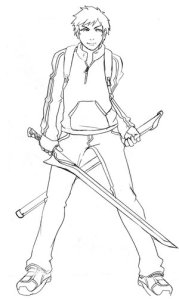
Rita by StreyCat

Encounters
The encounter rules seem to work well overall, and from here on out it’ll be a matter of refining rather than rewriting. The abstract range system and the system of actions and attacks and such seem to have worked pretty well, but with a group of 5 hunters the monsters were never much of a threat. They fought a bunch of squishies, then two salamanders, then a mixed group of two shadow dogs and three stumpies.

  • Suichi’s monster tamer character wound up being at a severe disadvantage. I need to figure out a better metric for selecting pet monsters, and having the tamer and monster have independent initiative slots makes it so the pet monster too often winds up just sitting there. I’m thinking Monster Tamers need a Base Talent to assist their monsters better.
  • Monsters die pretty quickly. On the one hand I don’t want combats to drag on, but on the other hand they’re dropping like flies and not having a chance to do much. With their current HP totals there would have to be more of them per encounter or something.
  • The only time monsters won a Positioning Check was when the protagonist rolling for the party rolled a fumble (auto-fail). This is partly due to letting PCs Help one another. I’m thinking monsters (and maybe characters in general) will just get a flat bonus for how many they have on their side. Allowing Help on Positioning Checks also means that whoever’s got the second- and third-highest Hunter ratings gets a mark on their connection to whoever has the highest for every single Encounter.
  • Consumable attack items suffer the same problem as alchemy items in D&D4e, which is to say that they’re really expensive for a one-shot attack that can miss.
  • Having Aura attacks (like the salamander’s fire aura) be a Clash actually makes it easier to hit the monster, which is not at all what I’d intended.
  • The Assist action potentially puts you at a disadvantage, especially if you’re dealing with a monster that has a high defense rating.
  • Since I used all common monsters, the players never once had to do a Monster Knowledge check, which in turn made the Geek character’s Monster Encyclopedia talent irrelevant.

Interludes
Interludes, which are meant to carry the lion’s share of the role-playing, were probably the weakest part of the game. Some of that came from the fact that we had too many secondary characters that weren’t particularly involved in monster hunting, plus I think I as the GM wasn’t trying hard enough to drive the role-playing oriented elements. I’m not sure what exactly needs to happen with this part of the game. We weren’t in fact playing it quite how the rulebook suggests, but then it wasn’t a difficult mistake to make.

Some of it is that I need to try to as the GM to do more RP-oriented stuff with the existing rules, but I’m thinking it might also be a good idea to put something in the rules to push towards role-playing. I really have no idea what that would be though.

Conclusions
On the whole a good start, but I’ve got a fair amount of writing, revising, and brainstorming to do before I do another serious playtest. There were also a fair number of elements we didn’t touch on, including achievements and social conflicts, so we’ll have to see where those go next time.
Slime Story: Playtest Version 2

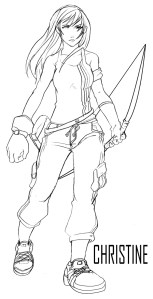
slime_story_christine

If you’ve been following this blog, then by now you know that Slime Story is my RPG of “teenagers hunting cute monsters for spending money.” Basically, imagine monsters from Ragnarok Online and Maple Story invading American suburbia. I finally have the new playtest document for Slime Story ready to go. It’s very different from–and hopefully altogether better–than the last one.

This game is a weird hybrid of traditional, indie, and Japanese RPG design sensibilities, or to put it another way, Meikyuu Kingdom, D&D4e, and Mouse Guard were all key inspirations (though there’s a long list of others). It has a rigid scene structure (you alternate between encounters and interludes), powers usable depending on the game’s time units, an abstract range map, characters defined by a “class” and “clique,” achievements (kind of like in video games, but a bit free-form), relationship mechanics, and other wacky stuff. It’s also meant to be largely player-led, and protagonists need to define and pursue their own goals.

Playtest Notes
I’m making this playtest draft publicly available so that people can read it and perhaps even try it out. If you do, I want to hear all about it! Tell me what you think, tell me how it plays, and share your war stories! However, it hasn’t been playtested yet AT ALL–I’ll hopefully be rectifying that fairly soon–so some of the stuff that I thought looked good on paper might not work at all.

The playtest version is deliberately incomplete, on account of me not wanting to try to come up with over 100 Talents and 40 or 50 monsters just to wind up having to rewrite them to make up for rules changes. I also left out the supplemental rules chapter (which is meant to have rules for experimental alchemy and quests, amongst other things) because it’s nowhere near ready. There’s enough to sit down and play the game though, and the overall goal at this stage is simply to make sure the basic design is sound.

Tasty, Tasty Files
I’ve put together the necessary materials in PDF form to the best of my ability, though especially for the character sheet I don’t really have the necessary skills to make something great-looking. For action cards, I recommend just using index cards, but most anything will do. Likewise, you can easily substitute miniatures for the battlefield tokens (which at this stage are just a placeholder using dingbat fonts).

Slime Story RPG Rules (Playtest v2) PDF
Protagonist Sheet
Secondary Character Sheets
Battlefield Map
Battlefield Tokens
Rules Quick Reference Sheet

Slime Story Design Journal: Advancement

Slime Story Phoebe

I got kind of lazy with my original version of the character advancement in Slime Story. I did the thing where characters accumulate points and then spend them piecemeal on whatever they want to improve, like in a White Wolf game. (I also did that with Tokyo Heroes by the way.) There was some neat stuff with how you got those points–a combination of video game style achievements, deepening connections with other characters, invoking characters’ issues, and achieving goals–but the way you used them was still just lazy design.

That’s why I’ve wound up giving it a level-based mechanic, which is a bit Savage Worlds and a bit D&D4e. There are one or two other uses for Character Points, so characters don’t level up automatically, but instead spend points to gain levels between episodes. Having what characters gain at what level be predefined makes character growth a little more interesting. There was a time when I disdained classes and levels as artificially limiting, but just throwing points around more or less like in character creation is really boring and lazy (if functional). Levels aren’t the only way to go–not by a long shot–but they seem to be a good fit for Slime Story.

Anyway, this was another one of those things I thought up in the middle of the night and implemented right away. At this point a playtest draft (albeit a simplified one without many Talents or monsters included) will just be a matter of filling in some necessary details, more equipment and such than rules per se. If I don’t get distracted by other stuff (which is a very distinct possibility) I’ll be posting it up in the next week or two and hopefully doing some playtesting myself in the near future.

And Some Other Stuff

  • Guy Shalev has a blog called Geekorner-Geekulture which deals mainly with anime/otaku stuff, including regular features on anime/game/etc. figures (and his obsession with Saber from Fate/Stay Night). Not wanting to start up yet another blog myself, I’ve started contributing posts there, which will all be under the “Ewen’s Corner” tag. Most of these will be reviews of strange manga I’ve read, but my first post is about my experiences commissioning custom plushies.
  • I’ve started a second podcast, called Trapped Inside the Dream Forever. It’s all recordings of my bizarre fiction writing (and probably some of my poetry too at some point). So far it’s updating every Friday, but that’s because I still have a big backlog of stories to record. If anyone thinks they can do better recordings than me and wants to do so, let me know.
  • I may have inspired Ben Lehman to make a new game, for a second time.

Slime Story Design Journal: Bits and Pieces

Since Slime Story has become a very ambitious project that I’m very determined to complete (i.e., turn into a complete, playable, and fun RPG), I’ve decided to start posting “Design Journal” entries so that folks can see the process and maybe get a little more excited about the game. (And maybe offer suggestions too.) I do kind of feel like I’ve been piling lots of bells and whistles onto the game, and I’m wondering if I won’t have to just get rid of some of them depending on how they work out in playtesting, but that’s how it goes, I guess. Here are the major things with the game that are on my mind at the moment:

Encounters
Slime Story’s encounter rules are meant to be a relatively simple tactical game that players can enjoy on its own merits. It’s turned into a sort of D&D4e-light, mixed with bits of Meikyuu Kingdom and a few other things. Characters take turns and can do one Full Action (attacking and other involved stuff) and one Maneuver Action (moving and other actions that help indirectly) per turn.

The Action Stack is a set of cards representing each participant in an encounter. The GM simply shuffles the cards, and that’s the initiative order. (Certain conditions will let characters shift their card up or down in the stack.) The GM simply flips through the cards, and whoever’s card is on top gets to act.

The Battlefield Map is an abstract map with seven spaces arranged vertically. Characters can attack enemies that fall are within a number of spaces based on the Range of their attacks (a typical melee weapon has a range of 0-1, so it can hit enemies in the same area or an adjacent one), and can use a Maneuver Action to move from one area to an adjacent one.

To make both elements work more smoothly, I’m thinking of having a PDF with three sets of generic action cards and battlefield tokens/pawns for monsters (numbers, letters, and symbols), which you can use rather than having to prepare them for each type of monster you want to include in advance.

Right now the main boondoggle with encounters is that I want to have some way for characters to try to get a positional advantage, but I’m not sure how to go about that without having it be too time-consuming or giving too overwhelming of an advantage.

Achievements
Achievements are probably one of my favorite things about the game. Achievements are very much like the things from Xbox 360 and other video game platforms, in that they archive a character’s accomplishments and contribute to his or her overall reputation. In Slime Story, the GM hands them out to players where appropriate during play, and everyone can suggest achievements after the session is over. Characters can “cash in” achievements for Character Points (to improve attributes and buy new abilities) and/or Influence (to buy stuff with).

I have a notion of having achievements cause characters to gradually build up a Renown rating, but I’m not sure what it would actually do in the game.

Happenings
This is the newest thing, which wound up being a combination of a couple different things that were rattling around inside my head. During Interludes (the stuff that goes between encounters, where characters can quarrel, bond, make items, etc.), players have a limited number of Action Points (they get one per Interlude, and each gets one extra AP per episode) to spend on doing stuff. I’ve been wanting to have some mechanism for players to earn more AP if they want/need to. I also had a vague idea of having rules for random events, which the GM would periodically throw in to make things more interesting (so the monster hunters might run into a dead deer, get caught in a sudden downpour, bump into a police officer, get a call from home, etc.). It occurs to me that inconvenient “Happenings,” whether rolled randomly, devised by the GM in advance, or suggested by the people at the table, make an excellent way to both make protagonists’ lives more interesting and give an appropriate “fee” for awarding Action Points.

Reblog this post [with Zemanta]

Slime Story: Conflicts Redux

A combination of reading Agon, re-reading Meikyuu Kingdom, and thinking about some of the little tricks we’ve come up with in my group’s D&D4e campaign have inspired me to get back to work on Slime Story at long last. The major stumbling block was getting the conflict rules to work how I wanted them to, and I think I’ve got that about figured out.

Slime Story: Kelly

Before I had a “footing” system, where each character in a conflict is in Forward, Middle, or Rear footing (or in some special circumstances Off-Balance or Ambush footing), which was basically a trade-off of offense for defense or vice-versa. The thing is, once you’ve set your footing, there’s not much motivation to change it, which kind of defeats the purpose of having a map and character tokens and such. Meikyuu Kingdom and Agon both use abstract range maps. MK calls it the “battlefield,” while Agon has a “range strip“. (And apparently Traveller had something similar too, so it’s a much older idea than I’d originally believed.) This lets me do some neat stuff with range, movement, and positioning, and in particular, outnumbering the enemy within a given position on the map gives characters an advantage. I think this will help provide about the right level of tactical elements, enough to make encounters interesting in their own right, but not so much that they eat up too much time.

And, straight from Agon, the social conflict rules are basically the combat rules but with the map/positioning elements taken out completely. Much simpler and IMO altogether better, since having positioning in a social conflict is getting a little too abstract for my tastes.

The other important thing I’ve come up with is the “action stack.” This is my attempt at doing something more interesting with initiative, an area that has seen surprisingly little innovation over the years. In order to simplify combat in my group’s D&D campaign, we’ve taken to having a combat card for each character and monster with the relevant stats on it. Once the initiative rolls are in, the DM just arranges the cards in order and cycles through the stack of cards as needed. This in turn lets me do interesting things with the stack of cards that would be awkward otherwise, including meta-effects that change a character’s spot in the initiative order. It’s also made it easier to keep track of “reactions,” a class of actions that interrupt regular actions; your card gets turned face-down in the stack, and when it comes up again it’s righted, but you don’t get to go until it comes around face-up again.

On the whole, I’m feeling a lot better about how all of this stuff is coming together, though of course it’s continuing the pattern of tearing out some bits of the system and keeping others. (But, the bits getting discarded are becoming smaller and smaller.) On paper, it looks like it’s achieving the right balance of tactically interesting and intuitive to play, even if it does involve a lot of fiddly bits. But, if I can get the encounter and conflict rules straightened out, I can finally write up the talents and get the game ready to properly playtest.

Announcing Witch Quest!

witch_tarot

I haven’t been all that inspired to work on my own projects (though I did have some nifty ideas for Slime Story the other day), so I’ve been translating various things of interest, and I’ve hit on a project to tackle to kill time.

Witch Quest is a Japanese RPG that originally came out in 1991. It was designed by Adventure Planning Service and published by Oozora, which mainly specializes in shoujo manga. In 1995 they released a “share text” version, a set of free text files with the complete rules. After it went out of print, a doujinshi circle called Majo no Kai bought the rights and put out a revised version in 2001. My aim is to produce an English translation of the share text version and make a simple but pleasant PDF. It’s not the most recent, but it is free and complete.

The game is an “everyday magic” RPG. Players form pairs where one is a 13-year-old witch, and the other is a 1-year-old cat. Together, they solve magical problems and generally help people out. It’s very much in the vein of Kiki’s Delivery Service.

The share text consists of two books. Book I contains two full replays and two scenarios, while Book II contains the actual rules. Of both preference and necessity, I’ll be tackling Book II first. I need to nail down the game terminology and understand the rules to have any hope of translating a replay, and the rulebook part is more interesting to me anyway. I’m not desperate for assistance, but I’d welcome help with the translation if anyone with the requisite skills is so inclined, and I could use some help with layout stuff, especially when it comes to making a character sheet.

A lot of the rules are fairly traditional, and characters have attributes and skills and such, you roll dice to figure things out, and there are even hit points. One of the more interesting things is the “Witch Tarot” the game comes with. It’s a set of customized tarot cards that you use in character creation, and there are also instructions for using it for fortune-telling. One amusing thing with the share text is that, as with the character sheets and everything else, it includes text-based cards for you to print out.

As it’s a simple matter of cut and paste, I’ve made a PDF of the text-based cards (a PDF so those the folks who don’t have Japanese text support installed can see). The first four pages are the actual cards, and the last three are pages of the three different backings. If you want to make a set, print out pages 1-4, flip your paper around, and pick page 5, 6, or 7, whichever you like more.

Text-Based Witch Tarot Cards (PDF)
Japanese Share Text (LZH Archive)

Ewen vs. Slime Story

Slime Story continues to be a game that fights against its own completion every step of the way. I tried to do a very simple test of the conflict rules by myself–let’s have Phoebe and Matt have an argument!–and it totally fell apart. But, as has been the case since the beginning, each step leaves me with a bit more usable stuff.

3cb76b8983e5ac16b6ecf2ab27fb7dc5
(Joe Hunter Archetype illo by StreyCat)

Aside from the fact that just because stuff sounds good on paper doesn’t mean it’s actually going to work (something every designer knows, or will learn very quickly), there are two Slime Story specific things I noticed:

First, making players spend their one action for the round on changing footing doesn’t work with the game as written. It works with the range map in 3:16, but then 3:16 works quite a bit differently. This led me to have “Full Actions” and “Maneuver Actions”, and you can take one of each (or two Maneuvers) during your turn. This lets players change footing before (but not after!) attacking, and lets me put some other nifty things into the game. Of course, it also makes the rules a little more baroque, and a bit more like 4e. This will hopefully alleviate the overwhelmingly optimum status of planting oneself in one footing and making an attack every round.

Secondly, the death spiral sucks. I originally had it as a -1 penalty for each point of Stress a character takes, but when you’re rolling 2d6+Attribute (ranks range from 4 to 10 or so for starting characters), getting hit with a -3 penalty from taking one hit is just too damn much. I need to find the right balance between giving players an incentive to avoid damage, and punishing them too severely for taking it.

Once I get the conflict rules down, I’ll have the proper chassis on which to mount the rest of the game. Probably the single biggest reason I’ve been procrastinating on working on the game more is that I have to get this one highly mechanical and game-y part of things all nailed down before I can really go any further. The Talent descriptions and monster writeups all depend heavily on interacting with the conflict rules, so I’d be wasting my time if I tried to work on them, even if they’re potentially more candy-like and interesting.

In Other News: Shinobigami
I special-ordered a copy of Shinobigami (“Ninja God”), published by Role&Roll Books, and designed by none other than Toichiro Kawashima, designer of Meikyuu Kingdom and Satasupe. The game is sold in the form of a small paperback, and it’s uniquely Japanese in that the book starts with a 160-page replay (littered with explanations of the game), and then has about 60 or 70 pages of actual rules. The game is about modern-day ninja with over-the-top powers having epic battles. I’ll be posting more about this when I’ve had a chance to read through it, which will probably take a while. I’m especially intrigued by the “Velocity System”, which involve a chart that goes from 0 (Mundane) to 7 (FTL).

Miscellany

Of Podcasts
As I alluded to before, I’ve decided to slow down the podcasting a bit, not that I ever had much of a schedule to speak of. I’m slowly setting up a couple more interviews, but I have more than enough other stuff going on at the moment.

However, WalkerP over at The RPG Haven has started up a podcast of his own. The first episode, an interview with Cynthia Celeste Miller (of Spectrum Games), just went online today.

More on Raspberry Heaven
PIC-0024
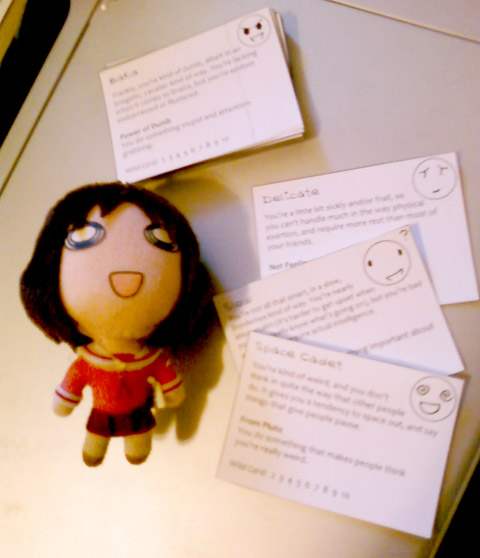
As you might have surmised, I’m gearing up to start playtesting Raspberry Heaven, and having entirely too much fun preparing the materials for it. I printed and cut out two sets of quirk cards, and even made a (flimsy) box for them. There was also a short thread on the game on Story Games, where it was pointed out (not for the first time) that the text doesn’t make it clear enough that the characters are all schoolgirls; I’m working on fixing that now.

I’m also working on scripts for 4-koma comics to put in the book, but I’m not having any luck finding an artist to hire who can actually draw 4-panel comics with screen tone. I may have to look into getting someone from Japan, something I’ve been wanting to figure out how to do anyway.

Raspberry Heaven Playtest Version 0.3

PIC-0022

After getting some important inspiration out of the blue, and doing a good amount of writing, I’ve got a new playtest draft of Raspberry Heaven, my silly high school slice of life RPG.

The biggest change is that I’ve vastly simplified how Special Moves work in play. Players pick a card rank from 2 to 10 for each Special Move to be a wild card associated with it. This also makes it really easy to create new Quirks. I’ve put together a set of Quirk Cards, which will hopefully make it all-around easier to keep track of things. On the cards you circle the number of the card rank you’re using as wild cards for that Special Move.

The introduction mentions some stuff I’m working on/thinking about for the game. I’ll hopefully be doing some serious playtesting/playstorming soon, and generally whipping the game into shape.

Update (9/22/09): Added v. 0.3.2.

Raspberry Heaven Playtest Version 0.3.2
Scene Template
Character Cards
Quirk Cards2

Slime Story: Playtest Document 1

Illustration of Rita by Sue-chan (www.sue-chan.com)

Here’s (mostly) what I have so far of Slime Story:

Download Slime Story Playtest 1 PDF

If you’ve been following this blog or if you’ve let me talk to you in person much lately, you more or less know the drill. A world like ours, only teenagers hunt cute monsters for spending money. I’m working on a novel or two, and this is the RPG version, which is a strange hybrid of traditional, indie, and Japanese game design sensibilities. In A Wicked Prime Time 4th Edition Mouse Kingdom Koyake. Or something. To play you will need some friends, some six-sided dice, and some character sheets that don’t exist yet.

It’s rough all around, but I have the core rules in place how I want them, which means that it’s theoretically playable. There’s some other stuff (experimental alchemy, random events, achievements, etc.) that I haven’t yet put in, not to mention I’ve left out most of the monster write-ups. Some things I’m not yet sure how to implement, and for others I just don’t want to put all the work in, especially since there’s a good chance I’ll have to radically rewrite them later.

Aside from the really basic stuff (“Do the conflict rules actually work?”), the things on my mind are:

  • Are the Feats reasonably balanced against each other? What new and better ones could I put in?
  • Could the combat system do more to drive role-playing?
  • Does the game’s economy of Resources actually work?

UPDATE (2/3/09): Ideas from talking a bit about the game with friends:

  • Replace “Resources” with “Influence”, indicating both your character’s cash and his or her ability to call in favors and such from the local monster hunting community. Spending a certain amount of Influence on a healing potion could represent buying one from Monster Mart, or wheedling one from your NPC alchemist friend.
  • Weapons can be customized/upgraded in various ways, some of which require monster parts. Hunters prefer weapons that are modular to varying degrees, and look down on people with “stock” gear.
  • Achievements, kind of like in video games, are how the game represents gaining renown in the monster hunting community. Everyone participating gets to make up new achievements.
  • Combat probably needs to be a little simpler. I’m thinking of a range map, a lot like 3:16, but you use dice to show how many hits the monsters have left. Still not sure how to work more social stuff into it though.
  • OTOH the stuff with Tactical Actions may need to go, as it potentially makes combat considerably more complicated. Which would in turn require taking a closer look at the selection of attributes, especially since right now the main use of Athletics is tactical actions.
  • The rules assume hunters are trying to stack the deck in their favor by researching portals, spawns, monster types, tactics, etc. (kind of like how the Exalted combat rules don’t have called shots because when you’re fighting you’re always going after the vulnerable bits).