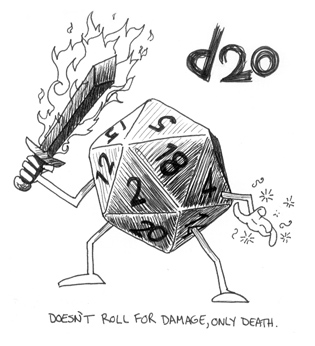
I think I’ve figured out what it is I like about Dungeons & Dragons 4th Edition. To me, they’ve managed to laser-focus on the things where D&D is in fact better than most other RPGs. They’ve turned it into a combat-oriented dungeon-crawling game par excellence. If it’s not as strong on role-playing elements as some prior editions, there are plenty of other games that were better than D&D at such things to begin with, and it was never part of D&D’s paradigm to stress such things mechanically. Basically, I’m looking forward to playing 4th Edition with my friends because it’ll be a novel experience for me. We played 3rd edition some when it first came out, but otherwise we’ve pretty much abandoned it, and playing such a “game-y” and clearly-defined RPG would be something new after playing long campaigns with Fudge, Truth & Justice, and OVA.
Continue reading Everyone’s Doing It: My Thoughts On D&D 4th Edition
Category Archives: musings
Bits and Pieces
The other day I was searching online for generic colored pawns to use for a Maid RPG scenario (and whatever else they might come in handy for), and I stumbled across all kinds of neat stuff for board game supplies.
I wound up ordering not only pawns, but a whole bunch of other stuff from Great Hall Games. I also came across the website of a company called Rolco, that does all kinds of molded plastics, albeit mainly in bulk. However, they have a “Kits & Bits” page where you can order, amongst other things, a “Game Inventor Kit” ($19.99) that includes a blank board and box, and zillions (well, about 170) of different plastic pieces. eBay also has a category for “Game Pieces, Parts,” where you can find stuff like this as well as replacement parts for mainstream board games.
Anyway, here are some specific game components, and thoughts on how they might be useful:
- Pawns: Pawns are a very generic way to keep track of location. I decided to buy some because of the Maidenrangers of Love and Justice scenario for Maid RPG, in which you build up a “board” out of playing cards that represent both a room and the random event that happens there when the PCs enter (which also has the benefit of making sure random events are never repeated). Pawns also come in different varieties, and there are little plastic stands for cardstock figures as seen in many commercial board games. There’s also stuff like the Icehouse pyramids, which are colored, vary in size, and are stackable.
- Boards: Boards might be a little harder to make, though I think it would be relatively easy to, say, print our two pieces of cardstock and tape them together to form a decent-sized board. Boards can contain a crapload of information, and can provide locations (physical or otherwise) and information on them. Also, boards can be modular, either used at different times (like how there are wargames with a strategic-level main board and a tactical-level “battle board”) or assembled together to form a map. I’m thinking of putting together a Maid RPG scenario that involves a board representing the mansion, and my concept for that “Black Hole Girls” game involved making a board representing a neighborhood, which would affect certain things in the game.
- Cards: I’ve posted about cards before, and I’m working on three different games that use them in different ways, so I won’t retread all of that here. Regular playing cards are even more readily available than six-sided dice, and cards in general can contain all kinds of information, including text, colors, and pictures. On top of that you can do all kinds of things with placing, stacking, holding, and shuffling them. Also, apparently Guild of Blades has indeed launched their POD cards service (while I wasn’t looking).
- Spinners: The only RPG I know of that used spinners was TSR’s Bullwinkle game (and I have a copy I got off eBay for about $12 BTW). The thing about a spinner is that as a game designer you can use it as a random generator for pretty much anything. You can throw together a template in Illustrator in minutes, print it out, paste it to cardstock, and attach a spinner that costs 50 cents or less, and you’re good to go. You can put numbers, symbols, colors, pictures, and so on, and you can put more than one kind of thing in the same spaces or in concentric circles.
- Play Money/Poker Chips: I’ve never seen an RPG that uses Monopoly money (or a Cheapass equivalent), but there are games like DeadLands that have used poker chips to keep track of certain things in a game. Play money feels more like you’re dealing with actual money, while poker chips have the advantage of being available everywhere. When I went into a drugstore the other day looking for something I might be able to salvage for generic pawns, I saw packs of poker chips.
- Sand Timers: Using real-time stuff in an RPG is tricky, but if you do it for the right reasons it could be neat. I’ve noticed that for whatever reason FLGSs often stock small sand timers.
- Scrabble Tiles: The wooden chips from Scrabble are like playing cards in that they contain multiple kinds of information (letters and the frequency numbers), and on top of that you can form them into words. One of /tg/’s flashes of brilliance was the idea to make a superhero game where you form scrabble tiles into “POW” and whatnot for extra power.
Using this kind of stuff in an RPG would be a turn-off to some people, but sufficiently creative uses would more than justify the effort. Some of these are things where it’s a toss-up whether gamers would have them on hand, and they’re just enough out of the way to be a little annoying to get a hold of. I know I don’t have a roulette wheel or a Jenga set on hand, and with spinners you have to either order from a specialty shop or raid a very kiddy board game for parts. Looking at boardgamegeek.com, I stumbled across Piecepack, a sort of public domain standardized collection of parts, made by a few different manufacturers. It’s meant to be a board game set similar to a pack of playing cards in that you can buy it and use it for tons of different games, and along with the aforementioned Icehouse pyramids and Stonehenge (which looks like it’s a good deal more elaborate).
Although it’s almost certainly impossible to change the hobby in such a way as to make more board game components a standard in RPGs, there’s a lot of unexplored territory here, and apparently if you know where to look it’s dirt cheap to explore it. (Manufacturing might be another matter entirely, but still). There’s always going to be the risk of people calling the game a “gimmick.” Of course, you’re going to get that just for doing anything remotely interesting with dice anyway, but it is good to ask the question, “Does this do something that more conventional materials can’t?”
Lastly, some other places that sell neat stuff:
- Spielmaterial
- PlainCards
- PerforatedPaper.com
- Koplow Games
- Gameparts
- Chessex
- Wholesalers USA
- Meeple People
Update: Some more nifty things.
- Blank Dice With Labels. Only $4.95 for a set of 12.
- Spinners. These give the equivalent of a 2d6 roll.
- Poker Dice.
- Sparks Dice. S. John Ross’ free PDF some assembly required dice. Includes 6-sided, Fudge, and blank dice.
Anime Games I Want
Another issue I had largely dismissed as irrelevant until a friend pointed it out to me is that some people are put off by anime. Titles like Avatar are hurt as well as helped by the label. That’s another example of how it’s become a loaded word for some people. Some people who like Exalted like it because of its anime inspirations, others like it despite them and play up the Greek myth side more, and still others dismiss it entirely because of the anime slant. (And amusingly, Andy has mentioned that the Japanese publisher of WoD–Atelier Third–found Exalted just too overwrought for Japan).
My ideal model for drawing inspiration from anime and manga would be Bryan Lee O’Malley‘s comic, Scott Pilgrim. There are a lot of elements that are reminiscent of manga, but if he was inspired by Japanese comics, he’s fully metabolized them and he’s doing what he wants to do with them. No imitation, self-consciousness, just a kickass comic. (Also, Scott Pilgrim needs an RPG).
Anyway, this time around I’m going to post my thoughts on what things in anime I think would make for really neat RPGs. (Though there are some more that I’m going to save for future installments of “Role-Play This!”).
- Horror Heroes: While Japan does have a tradition of scary-as-hell horror stories, there’s also a genre of anime about good guys fighting the to protect us from the supernatural. These range from deadpan titles like Blood+ to the wackiness of Phantom Quest Corp.
- Miyazaki: Hayao Miyazaki’s animated movies are in many ways unlike mainstream anime–deliberately so–and they have captivated audiences of all ages. I’d love to see one or more games try to capture some of Studio Ghibli’s modern fairy tale feel. Yuuyake Koyake is probably the RPG that comes closest.
- Postnuclear: In Japan the atomic bombings of 1945 have been so politicized that no one has really made any effort to confront those issues directly in art. Instead, anime series like Yamato and Evangelion express the repressed feelings and urges while studiously avoiding real-world blame. Bliss Stage‘s scenario starts with some of the same end of humanity nihilism, but I’d like to see a game that tackles these issues more directly.
- Sekai-kei: Sekai-kei is a genre that focuses on a relationship between two young people, juxtaposed with the end of the world. Jake Richmond’s The Year We All Died is very much based on Saishuu Heiki Kanojo, but The Melancholy of Haruhi Suzumiya, Voices of a Distant Star, Iriya no Sora UFO no Natsu, and Evangelion are all considered part of the genre.
- Otaku: Dramacon, Akihabara@DEEP, Aoi House, Genshiken, and Megatokyo all show different ways that stories about obsessed fans can make for interesting characters. I want to see a game with the otaku troubleshooter agency angle of Akihabara@DEEP, and the zany, exaggerated, and deep setting sensibilities of Megatokyo.
- Sci-Fi Western: I want to see a totally over-the-top Western with sci-fi elements a la Trigun, and maybe some fantasy gun magic like in Kurohime.
- Shinigami: At some point someone needs to write a pretentious essay analyzing the Japanese fascination with shinigami, or “death gods.” In the meantime, I want to see an RPG that draws on stuff like Bleach, Death Note, Soul Eater, Shinigami’s Ballad, and so on.
- Super Robots: This is the other end of giant robots: cheesy, cinematic, and bold. The robot is an extension of the hero’s blazing heart. Gurren Lagann is the most recent example of the genre to make a splash.
What about you?
In Other News
The layout of Maid RPG has begun. I got to see a sample today. It’s directly based on the original Japanese sourcebooks, and I really like how it looks so far. Andy’s been plugging away at the editing too, so while there will be a lot of rushing around on everyone’s parts, it looks like things are on track. Also, I’ve been poking at my own Maid RPG material (tentatively titled “Maid RPG 120%”), mainly putting together a table of scenario seeds covering old west, reality shows, superheroes, and more.
I’ve started playing with WordPress’ “pages” feature. There are now pages for “About Me” and “My Games.” I didn’t realize I had SIXTEEN different games in various stages of design (from a mere idea to a more or less final draft). Sigh.
Thoughts on Anime RPGs
Over the past few days I’ve been working more on Zero Breakers (the tentative title for my fighting shonen manga RPG), though it’s mostly been filling in details I’d already thought of, and occasionally modifying parts to fit together better, so there isn’t a whole lot to post about. Though I did realize that part of what I’m doing with the game is taking stuff I do at the gaming table naturally and codifying it into rules.
I’m sorely tempted to write a lengthy essay on anime RPGs. The main thing is that for various reasons–among them that some people seem to set ridiculously high standards of authenticity–it seems like anime is not treated as just another medium that RPG designers can draw as much or as little inspiration as they want to, when it really should be. It comes back to that thing about how when people use a strict definition of “anime” or “manga” to exclude stuff like Avatar and Dramacon, they’re completely missing out on (1) the quality of the work, and (2) the fact that it does in fact have a lot of what makes the Japanese stuff appealing to people in the first place.
Of course, that’s just my impression from what I see on internet forums, which may or may not have anything to do with reality. The point is that we have insane amounts of anime (and other otaku media) available to us, and more and better techniques of RPG design than ever before, so there are vast stores of possible inspiration that remain untapped. I think this is the real reason why most of my RPG design projects wind up being about Japanese stuff; if people were designing as many games inspired by anime as they did from movies, novels, and comics, half the ideas I have would already have been done.
Here’s a list of every English-language anime-related RPG I know. The thing I notice about them is that there are (1) lots of mecha games, (2) lots of universal systems, and (3) lots of licensed games, and very few of these don’t fit into at least one of those three categories.
- Teenagers From Outer Space (a.k.a. the stealth Urusei Yatsura RPG)
- Mekton
- Project A-ko (Dream Pod 9 did a licensed A-ko RPG)
- Heavy Gear
- Jovian Chronicles
- Bubblegum Crisis (licensed game by R. Talsorian)
- Armored Trooper Votoms (licensed game by R. Talsorian)
- Tinker’s Damn (an obscure attempt at a universal anime RPG)
- BESM
- Licensed Tri-Stat RPGs include Sailor Moon, Demon City Shinjuku, Dominion Tank Police, Tenchi Muyo!, El Hazard, plus lots and lots of Fan Guides.
- Dragon Ball Z (licensed RPG by R. Talsorian)
- HeartQuest, a shoujo manga RPG, powered by Fudge.
- OVA (A nifty game that IMO does what BESM 1e wanted to do. Unfortunately OVA seems to be kind of floundering right now in terms of follow-up support or even distribution)
- RandomAnime
- Panty Explosion (Sort of; it veers more towards the Japanese live action side of things)
- Bliss Stage
At this point I don’t think anyone really believes that R. Talsorian is ever going to get the Gundam Senki RPG out in English. On the other hand, aside from all of the stuff I’m working on (or failing to work on, as the case may be), there are a couple of games in development that sound really interesting:
I just found out that Matthew Gandy is working on a game called Seiyuu, which as he explains it is something like anime’s answer to Prime Time Adventures.
Christian Griffen’s Anima Prime now has its own site and there’s a PDF of the beta version. I’ll have to read it when I have time, but it is a full 165 pages.
4chan is a place I don’t really recommend you visit, but it does have a “traditional gaming” board, which has produced some interesting projects. One of these is Trigger Discipline (I’ve found some blog posts about it here)/ The idea is that it’s a variant of There Is No Spoon about some kind of over the top giant robot anime, and you have to take the anime studio’s budget for the project into consideration as you do things. There’s also some other project called “necrololis.”
Maid RPG: Update 4

I’ve finished the last of the scenarios, which means the base translation (which will need plenty of editing) is done at long last. The last one I did was “Tales of Suspense,” though I can’t really explain what it’s about without spoilers. Regardless, the scenario file–about 48,000 words, 117 pages in a basic MS Word format–is off to Andy for editing.
Translating
One of the things that can be really aggravating about translating from Japanese to English is the use of the passive voice. In English you’re not supposed to use the passive voice because it sounds weak and weaselly. In Japanese, sentences often leave the subject implied, so effectively using the passive voice actually makes you clearer. In Japanese RPGs, this lets designers talk about the PCs or whatever without having to start every other sentence with “a character who” or “if the PCs.” But it also means that the translator (that’s me) gets to play detective trying to figure out what the subject of a sentence actually is, and then do a sort of written Rubik’s cube exercise to turn it into a decent English sentence. As much as I love Japanese, one of these days I want to learn and start translating, say, Spanish, so I don’t have to deal with this kind of thing.
Scenarios
I know I’ve posted about the scenarios already, but they both show what’s different about the game itself and in many cases show a novel approach to scenarios/adventures in general.
There are several scenarios that have a very tight structure. Very often these involve the PCs working towards some kind of goal (ranging from throwing a birthday party to conquering the world, depending on the particular scenario), and it very carefully delineates what they can do to work towards it, and how much. These scenarios allow for more freedom than you might think–especially for PCs who are willing to use the seduction rules to get what they want–but certainly not as much as you’d ordinarily expect. The furthest extreme is “Maidenrangers of Love and Justice!” which actually bills itself as a “Maid Board Game,” where you build up a 4×4 grid of playing cards (representing both rooms and random events that occur in them) for the PCs to move around in.
Owing no doubt to the game’s basic nature, there are a lot of scenarios that deal with social situations of one kind or another. The game still has plenty of room for the action-adventure stuff that’s more typical of RPGs (albeit with a spin that only Maid RPG can give), but there are also scenarios about competing to marry the Master, becoming friends with a ghost girl, helping little kids have a place to play, and so on.
There are also very few scenarios that you could use in an ongoing campaign without major retooling, though there are some that give advice for launching into sequels (“Miko RPG!” even advocates developing a new game), and in one case, there is a sequel provided (“Be Our Demon King!” is followed by “Rise of the Demon King”). Although there are some major Western RPGs available in translation in Japan (notably D&D, WoD, and GURPS), my experience with Japanese-made games is that they tend to focus on short-term play rather than long campaigns. In F.E.A.R.’s Alshard ff, “Campaign Play” is actually listed in a sidebar rather than being part of the actual section on styles of play. In Maid RPG you can store up Favor to raise your maid’s attributes (it’s one of the more expensive things to do with Favor), but the game’s text doesn’t really address the idea of running a campaign at all.
Maid RPG scenarios often assume a particular master, or at least a general type of Master (e.g., a young Master who thinks he’s Sherlock Holmes), and won’t really work without him. On the other hand, there are also a lot of scenarios that leave at least some of the prep work up to the GM. This could be flexibility or laziness depending on how you choose to look at it, but there are scenarios where the fine details of the Master and/or mansion are left up to the GM to create.
There are still some scenarios that are fairly traditional (like “Liberty: The Final Maid Maiden”), and the game certainly holds up just fine with a traditional play style, or with no scenario at all.
Promotional Stuff
Wayne from Anime Expo’s tabletop gaming department has confirmed that Maid RPG is on the schedule for AX, Saturday at 10 a.m. Hope to see… someone there!
Random Thought
I’m sorely tempted to write a Maid RPG scenario to enter into Fight On! magazine’s contest. The rules say that entries have to make use of Otherworld Miniatures‘ products in some way, but otherwise they can be for pretty much any game. And Maid RPG has already gone to weirder places than involving Pig-Faced Orcs. The due date for entries in July 20th though, so whether or not I can even write something up depends heavily on what’s going on with work and whatnot.
3-Hit Combo!
Shatter The Wall Between Zero and Infinity!
I’ve well and truly gotten started on my fighting shonen manga RPG. I’ve tentatively titled it “Zero Breakers” (zero like “wandering the void between zero and infinity” and like Yaruki Zero Games). I’ve mostly been typing up the stuff that was already in my head and my notebook, but it’s going pretty smoothly so far. Assuming it doesn’t manage to completely come apart at the seams, I think I may be on the way to designing my dream game. And I think it’s starting to look more and more like a diceless technicolor cousin of Dogs in the Vineyard. OTOH I think it may actually turn out to be a great game for playing online (which I’ll definitely have to try once it’s ready).
And incidentally, I just found out that Christian Griffen is working on a somewhat similar game, called Anima Prime. I’ll have to find time to read through it, though from a casual skim its overall approach is a bit different from Zero Breakers (it uses dice for one thing).
Breaking Molds
Adventures of the Space Patrol has been kind of an unusual project for me in that while I have a certain look and feel in mind, and although I’ve certainly been putting all the B-movie cliches rattling around my noggin to good use, it’s not particularly based on something from another medium. I’m wondering if I haven’t been too beholden to source material in the past. AotSP has been an unusually easy and fun project to work on, though it helps that the rules are like a mashup of FATE 3.0 and Yuuyake Koyake, off the shelf components rather than all-original stuff. Of course, I get so much inspiration from outside sources that I wouldn’t dream of abandoning that approach, but I think I need to be more able and willing to come to projects from other angles. This is especially true considering that I tend to latch onto a genre and spend an inordinate amount of time (and sometimes money) immersing myself into it. The number of hours of sentai I’ve watched for Tokyo Heroes is literally well into the triple digits, for example. AotSP could easily have had me trying to absorb and imitate endless hours of Buck Rogers and Commander Cody, and frankly there’s something to be said for not having to spend that much time, however enjoyable, to get things done.
Interstellar Skulduggery!
I have, however, started reading the Lensman series. It’s basically the first space opera epic, and the earlier parts of it came out in the 30s. So far it’s rip-roaring pulpy sci-fi action with dastardly villains, square-jawed heroes, and lovely damsels in a universe of ancient aliens and sometimes literally world-shattering technology. I really want to know why it was allowed to go out of print, though on the plus side I was able to get a hold of the books for relatively cheap. There was a GURPS worldbook for it (and for the longest time I never knew what it was), but I’d love to see a treatment of it with SotC or similar some time.
Assorted Things
So, apparently Malcolm Sheppard has decided to pull the plug on Opening The Dark, for some reason or other. Although strictly speaking I could still use it since it’s OGL, I think I’m going to stick with my original plan to use a ST-ish Fudge variant for Catgirl: The Storytelling Game.
A Certain Japanese Game I’ve been translating will hopefully be moving forward very, very soon. I will have news on it as soon as I am able to reveal such to the public. It’s gonna be neat. :3
For Adventures of the Space Patrol, I basically have the entire outline of the game figured out (it helps that most of it is made from stock parts, after all), though there will no doubt be new challenges popping up as I go along. I had to go in and give some more thought to the selection of archetypes, and finally settled on seven:
- Atomic Ranger
- DroidBot
- Plucky Kid
- Galactic Spy
- Space Trooper
- Astro-Jockey
- Altarian Engineer
The trick was to focus on what core roles to cover, and then to give them appropriately spacy-sounding names. I’m probably going to write up an appendix, PDF, or whatever of bonus archetypes (Cat Princess, Martian Barbarian, Pleiadeian Mentalist, etc.). More on all that as it comes along. In the meantime, here are some examples of the awesome artwork that so inspires me:
My Gaming Confession
I have a confession to make: I don’t like board or card games.
There are some very, very rare exceptions, like Uno and certain kinds of solitaire, but for the most part I just plain don’t derive any particular enjoyment out of them. That’s kind of a shame, considering that (1) some of my friends do like them, and (2) my awesome brother-in-law has a wall of such games, and regularly buys new ones. Some of it is simple burnout from the wrong kinds of games; Magic: The Gathering and Monopoly each went a long way towards ruining their respective genres for me. I’m also not all that good at such games, but a lot of that no doubt comes down to not feeling any desire to invest in them enough to develop such skills. Still, that doesn’t really explain it, especially since I like RPGs so much.
I think the real problem is that I don’t enjoy competition. I don’t like losing, and I don’t enjoy winning at my friends’ expense, but I’ve yet to encounter such a game that can really be fun even when I don’t play to win. It’s not a warm-fuzzy-hippie things either; it’s not “everyone should win,” but rather a dull irritation that rises up after a while until it becomes unbearable. Video games can be an exception at times. Even in multiplayer I can find ways to enjoy Halo (the glaring exception to my dislike of most FPS games) without worrying too much about winning, but I still prefer co-op, single-player, or even anonymous online multiplayer matches.
When I read or translate the part of an RPG’s text where it says that there are no winners or losers per se, unlike other kinds of games, my eyes usually glaze over from having read it so many times, but it really is an important distinguishing characteristic of the genre. On the other hand, I enjoy storytelling in pretty much any form—creative, passive, or interactive—and while some methods work better for me than others, there aren’t any I’ve dismissed outright. (Although there are some genres that don’t do it for me, and some combinations of genre and medium that I don’t care for. I only really like horror in prose form, and I have no particular interest in sexuality in tabletop role-playing).
That said, I do think that one of the ways we might innovate in and revitalize RPGs is by drawing inspiration from card and board games. Raspberry Heaven is a perfect example of that, considering it was Uno that helped redeem the game from oblivion, but that’s only one of a zillion different possible games to look at.
The other day I had the opportunity to look through my brother-in-law’s copy of SPANC (Space Pirate Amazon Ninja Catgirls) from Steve Jackson Games. It very much looks like the result of that approach in reverse. You create a crew of three characters, who are defined by four attributes (Space Pirate, Amazon, Ninja, and Catgirl, naturally). You can give them equipment cards to modify the attributes, and you basically throw them at challenge cards, picking a catgirl who tries to roll under the requisite skill (often with a modifier). You could turn it into a very simple RPG with no modification at all. Just let each player pick a character card, and have the GM use challenge cards or make up new ones on the fly, and you’re golden.
The Shab-al-Hiri Roach is a game that in many ways straddles the divide, and the one time my group played it (I do want to play again some time) it was surprisingly successful and won over the skeptics among us. Its basic structure is competitive, based as it is around accumulating influence tokens, but depending on how one choses to play it can be little more than a framing device. It surely has a good number of players who are interested in exploring the setting’s inherent perversity, and can do so to their heart’s content rather than worrying about “winning” the game according to the rules. The use of customized cards to keep things interesting is a definite board game touch, and it’s vital to the overall experience.
Then there’s Once Upon A Time, a “storytelling card game” that is more of a group storytelling exercise. It’s not an RPG per se (no one self-identifies with any of the characters, after all), and its use of cards is more of a way to introduce memes into the story being told and provide a way to win/end then game. Like the Roach, it shows how customized cards can be a vector for introducing information into the game’s fictional world. That’s one of the key concepts of that Moonsick game I’ve been neglecting. It also allows for a level of simplicity and abstraction not often seen in RPGs, and since (as the last post on Adventures of the Space Patrol illustrates) I’m interested in short, pick-up RPGs, this is something I think worth exploring.
Although of course there have been any number of RPGs that make good use of miniatures and maps in the style of the wargames from which the hobby originally arose, I haven’t yet seen any that take a cue from boardgames per se. If an RPG takes place in a limited geographic area, it could have a board, and the effects of different locations could be encoded into that board (this seems ridiculously common in board games). If the locations need to vary more, we could use mapping tiles (like in Zombies!!!), either randomly placed or set out according to someone’s wishes.
On a similar line of thought, a friend of mine was working on a kind of “limit break” mechanism for an RPG, which involved a 3×3 grid on the character sheet. Making use of location as a determining factor is possible even without an elaborate board, and it can accomplish all kinds of interesting things.
This is why I wish I did like board and card games more than I do (and it’s not like I haven’t given them a chance either). I really wonder what other neat things someone who’s actually familiar with a wide variety of of games could come up with.
Anyway. In another day or two I’ll hopefully be posting up the next installment of Role-Play This!, dealing with Fighting Shonen Manga.
In The Cards
I wound up going in and filling out the online list of my RPG collection on RPG.net, which you can view here. Sometimes I forget (1) that I have some very strange, obscure stuff in there, and (2) just how many books I’ve sold off over the years. I own almost no Palladium stuff now, a lot less GURPS and Tri-Stat, and a whole heck of a lot more indie stuff. Anyway.
I wound up doing some brainstorming for Dandelion Complex, Raspberry Heaven’s twisted younger sister game, and I think I’m seeing the outlines of the game I want. It’s going to also use playing cards (I’m seriously thinking of putting them into the same book anyway), albeit in very different ways. Characters have cards dealt to them face down, and they can spend them on different things, whereupon they pick a card to turn face-up. For random events you check the card against a table, but certain cards will cause things to happen in the game regardless of what the character is trying to do. Additional cards are earned by pleasing the teacher NPC, a la Maid RPG.
Although I came up with the idea for Dandelion Complex as a game that would in some ways be a polar opposite to Raspberry Heaven (instead of Uno… 52 Pickup), they’re turning out to both be playing-card-based pickup games that actively defy any substantial attempts at preparation. They’re even starting to reference each other, since RH’s character color is perfectly usable in DC, and DC’s tamer random event tables could be used to get out of creative blocks in RH.
On a side note, I decided to get a box to hold my two decks of cards for these games. I was looking online and kept seeing boxes with capacities topping out at around 85 or so, but when I got to a local comics shop to look at them in person, it turned out that these are mostly sized for cards with protective sleeves on, so one of the boxes I picked up can easily fit three standards poker decks. The plastic cases meant for baseball cards and such that claim they’re for 100 cards could easily hold twice that for playing cards.
Cards found around my house last night:
- A deck of One Piece playing cards in a plastic case, from a grab back at Anime Palace.
- The cards from the combat game that’s included with the Dream Pod 9 Project A-ko RPG
- A set of Clow Cards (from Card Captor Sakura), printed in Japan and bought well before the series came to the US. Now I kind of wish I’d bought that book they did on how to use them for fortune-telling. (Though as it turns out someone’s working on an English fan translation).
- Six different Brawl decks.
Old Video Games
The Discovery Channel has started up a documentary series called Rise of the Video Game. I’ve read up on the history of video games before, but what makes this series so fascinating (so far) is that it puts a lot of emphasis on the place video games held in human culture. It’s interesting that they brought up Godzilla, because like video games he’s changed with the times. In the original 1954 Gojira, the monster was a symbol of the horrors of the nuclear bomb–and as far as I know no other kaiju movie has ever had a protagonist see a little girl about to die from the monster’s radiation–but in the 60s and 70s he became a friendlier defender of Japan, and in the 90s and onward he became more morally ambiguous.
Video games started with guys finding new ways to use expensive military and educational equipment for fun after hours. Tennis For Two was a relatively simple repurposing of an oscilloscope (and even today those things are expensive). Games like Spacewar! not only moved video games forward, but reflected America’s fascination with outer space and the fears of where the Cold War might lead. Space Invaders, on the other hand, could be said to have some grounding in Japan’s fears and memories of outside attack.
The Magnavox Odyssey was especially important because as the first home console, it let people do something they never could before. In an era when the TV could only tune into a handful of channels, which (it being the time of the Vietnam War) always seemed to be brining ever more bad news, the Odyssey let people have some control over what was on their TV sets beyond changing channels or turning it off. As the show put it, in the early Cold War the words “push the button” could only mean the button that would bring about the end of the world. We take it for granted now in virtually every aspect of our lives–I press buttons on my computer, video games, to buy train tickets, my cell phone, iPod, etc.–but at the time it was revolutionary, and no wonder people found it so fascinating.
Going from early CRT war simulations to the prototype of the Odyssey is about 20 years of firsts in video games, but the beginning of the video game industry was with Nolan Bushnell starting up Atari. Pong was the first arcade game to catch on. The game didn’t actually have a CPU; it was basically hard-wired, and when the time came to develop a home system (the 2600) they had to start over from scratch.
Especially in light of the recent stuff about Jade Raymond, some of the comments by Bushnell and Pac-Man creator Toru Iwatani are particularly striking. According to Bushnell, when Pong was catching on as an arcade game, because women on the whole have better fine motor control than men, there were a fair number of women going around sharking people at Pong. Iwatani on the other hand was specifically trying to make a game that would appeal to women as well as the customary young male demographic when he came up with Pac-Man. Granted, he was going off of a stereotype (“Girls always want dessert after a meal”), but his intentions at least were to be inclusive. What went wrong?
Anyway, most of the rest of the first episode is about the industry crash of 1983, owing to ludicrous market oversaturation, owing partly to Warner’s mismanagement on the assumption that video games would continue to rain money down on whoever put them out. Although it’s not covered in the first episode, if you know the history, this is what set the stage for Nintendo to step in and dominate the industry.
Almost as an afterthought, the episode concludes with a few minutes on Tetris and Alexey Pajitnov. I loved Tetris from the first moment I saw it, and I’ve always liked everything I’ve heard about its creator. When talking about how the Soviet regime basically held the rights to Tetris until its fall, he basically said that the important thing to him was having been able to make something so many people enjoyed. I didn’t know until I looked at the Wikipedia page just now that he designed Hexic. I’m going to have to try it out now.
Anyway, the fun part of this post is where I try to turn these ramblings into something to do with RPGs. It’s pretty easy to draw parallels between the early histories of Atari and D&D, of course. Both were created by some impassioned guys doing their own thing, rather than following any kind of corporate plan. Both achieved meteoric success (albeit on different scales). And both were standing on the shoulders of giants. For Atari there were precedents in the form of Tennis For Two, Spacewar!, the Odyssey, etc., and for D&D there were all the different wargames that represent transitional forms from little counters representing the armies of Napoleon to character sheets representing wizards and swordsmen. For both video games and RPGs we’re well past the point where you can just step in and do whatever and hope to turn a profit.
Although it’s pretty niche compared to the legions of GTA and Madden players out there, there’s a strong retro gaming community among video gamers. Some play emulators, some still have the old systems in working order, some buy those tiny “flashback” systems, and a tiny handful have actually made new games for consoles like the Atari 2600. I think a lot of the appeal of older video games is in their elegant simplicity. This I think is what RPGs can learn from retro games, and the design aesthetic of some of the best indie games is based on a simple but engaging gameplay mechanic–Dogs in the Vineyard is probably the best possible example. Pac-Man, Space Invaders, Tetris, etc. all do something that is ultimately extremely simple, but they do it extremely well. One of the guys from Bungie once said that the way to make a good video game is to create 30 seconds of consistently engaging gameplay, and make it work over and over. That’s all of those games right there. Dodge the ghosts, eat the power pill, and come back to eat three at once before going on to clear out that corner of the maze. Hold on just a little longer until the 1×4 piece comes and gets you a tetris, etc. That’s probably why the video game I’ve been playing most over the past few days is Super Mario World… ^_^;
Aside from the “some guys doing fun stuff in a basement” thing (not to be taken literally), what OD&D and many indie games have in common is simplicity. The earlier basic versions of D&D were stapled in the middle rather than perfect-bound, and the Rules Cyclopedia, which many seem to regard as the definitive version of basic D&D, weighs in at a mere 210 pages. Whether or not you agree with the “kill things and take their stuff” meme, there’s a lot to be said for knowing what you want to do and making a game that serves it. Aside from creating a protagonist (as opposed to a paddle or a spaceship) that could be anthropomorphicized (channeling some Scott McCloud here), Pac-Man changed its essential verb from something like “shoot” to, of all things, “eat.” While other kinds of tabletop games are perhaps better suited to one-verb designs than RPGs, I think there’s (still) a lot to be explored here.
None of this is to say that I think that drawing on these things will “save” tabletop RPGs, or become “the future of tabletop RPGs.” I think it’s more important to think about what makes for good games. If the world of video games has room for both Metal Gear Solid and Cake Mania, the world of tabletop games can surely handle both Exalted and Primetime Adventures. The thing about RPGs is that if you try to strip them down as far as they’ll go you wind up with either free-form role-playing or several different possible cornerstones.
(I just realized this goes back to a post of mine from last year about how video games divide genres up by how they play rather than what the story is about).
 Yaruki Zero Games