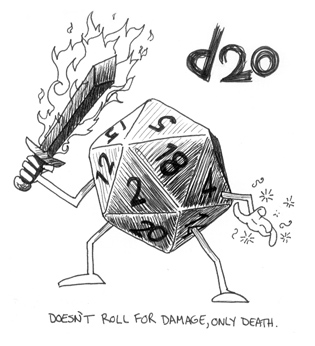
I think I’ve figured out what it is I like about Dungeons & Dragons 4th Edition. To me, they’ve managed to laser-focus on the things where D&D is in fact better than most other RPGs. They’ve turned it into a combat-oriented dungeon-crawling game par excellence. If it’s not as strong on role-playing elements as some prior editions, there are plenty of other games that were better than D&D at such things to begin with, and it was never part of D&D’s paradigm to stress such things mechanically. Basically, I’m looking forward to playing 4th Edition with my friends because it’ll be a novel experience for me. We played 3rd edition some when it first came out, but otherwise we’ve pretty much abandoned it, and playing such a “game-y” and clearly-defined RPG would be something new after playing long campaigns with Fudge, Truth & Justice, and OVA.
Continue reading Everyone’s Doing It: My Thoughts On D&D 4th Edition
Role-Play This! Fullmetal Alchemist
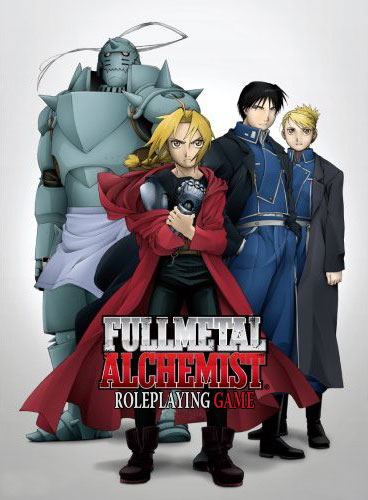
What Is It?
It’s been a while since I did one of these, but I started borrowing the manga from the library and got inspired. Anyway. Fullmetal Alchemist is a manga by Hiromu Arakawa, adapted into an anime series by Bones. The two versions diverge at a certain point because the manga was only up to volume 7 or so at the time, and the studio basically crafted a second half for the story.
It’s about two brothers, Edward and Alphonse Elric. They learned alchemy at an early age, and when their mother passed away they did the forbidden and attempted human transmutation to bring her back. They bore a terrible price for it: Edward lost his leg, and Alphonse’s body was completely absorbed. Edward sacrificed his right arm to bind Alphonse’s soul to a suit of auto-mail armor. Determined to get their original bodies back, Edward went through painful surgery to get auto-mail prosthetic limbs, and the two brothers set out to find the Philosopher’s Stone.
Why’s It Awesome?
FMA is good for traditional role-playing in that it has more world-building than your typical anime. We get to see the nation of Amestris and its military embroiled in conflicts, and (in the manga) contact with the distant nation of Xing. It’s sort of a steampunk setting too. Amestris is based on Europe during the industrial revolution, and it has trains, guns, prosthetic limbs, and so on.
However, the series’ approach to alchemy is probably the most unique thing about it. Edward is very clear that alchemy is a science. It has specific laws and principles, and represents a natural phenomenon, if a very powerful one that few people understand. The most important thing is that no one can violate the Law of Equivalent Exchange, and the Elric brothers’ biggest mistake in trying to bring back their mother was that they underestimated the value of a soul. Basic alchemy involves drawing a circle and thereby transmuting matter, but Amestris’ State Alchemists invariably have some kind of tricks to let them use some form of alchemy on the fly. Roy Mustang wears special gloves that heighten the amount of oxygen in the air and create sparks, earning him the moniker of Flame Alchemist. Armstrong (one of the most awesome characters in the series) creates massive spiked gauntlets for himself out of whatever material is handy. And Edward, called the Fullmetal Alchemist for his artificial limbs, can create a transmutation circle simply by putting his palms together. I’m not going to get too much into human transmutation, mainly because for the anime it would involve spoilers, and for the manga the issue hasn’t been settled yet as far as I know. Suffice to say that’s where it becomes apparent that the alchemists’ understanding is incomplete.
In addition to all the cool toys, FMA tells a story with deep themes. The Elric brothers are burdened by their sins, yet still hopeful they can restore their original bodies. However, they are confronted with the question of what price must be paid for the Philosopher’s Stone, and by whom. Likewise, Edward’s decision to become a State Alchemist gives him access to research materials to get him much closer to his goal, but the possibility of being ordered to do something he finds immoral always looms over his head. This is not a forgiving series; characters die, because of ambition, greed, or stupid, random chance.
Gaming It
The Elric brothers’ issues are fairly specific, and unlike a lot of anime this is a setting that invites further exploration in a relatively traditional mode. It would take a little work to put together a suitable system for FMA-style alchemy, but I could see it working well in Fudge, GURPS, BESM, Spirit of the Century, Savage Worlds, etc. The rest of the “stuff” involved would be the prosthetic limbs and making sure there was an appropriate selection of guns and such. You could put together a campaign with the PCs being state alchemists, Amestrian soldiers (Ep. 37 of the anime is all about Roy and his subordinates), Ishbalans trying to survive, human chimeras on the run, maybe even homonculi.
Going into wacky indie game territory means having a good idea what you want to do with the setting. For example, In A Wicked Age would be perfect with a well-made FMA oracle, and a game about military investigators or Ishbalan priests looking for signs of wickedness and alchemy could make for an interesting Dogs in the Vineyard variant. Primetime Adventures is a possibility too (the Elric brothers have one heck of an Issue).
Maid RPG: Update 6

Editing: Done!
Andy has finished the editing for Maid RPG, after which he has to get back into Tenra (AFAIK still on track for February 2009). He’s been going insane about editing, much like how I’d been going nuts with translating day in and day out, but that part is pretty much done. We did decide to change some things that seriously just went too far outside the realm of good taste (and it took a lot for a given thing to earn that judgment, honestly), and a few (especially in the item table) that were just too ridiculously obscure to Americans (like the references to Akumetsu and Patalliro). Regardless, Andy tried to be subtle about it, or at least find something keeping with the wacky and referential spirit of the original.
Anyway, that means that except for some possible last-minute fine tuning, we are well and truly into the layout stage. Exciting, huh? :3
Actual Play
I ran a scenario from the book, “Black Cat Mansion.” It went rather smoothly and surprisingly quickly. I don’t think I’ve ever once gotten through a game session in 2 hours before. In that scenario, the Master hasn’t shown up yet, so the maids need to use the seduction rules just to have Favor points to accomplish stuff. I got two interesting things from running the scenario. First, the two players who I expected to be the most skeeved out by having their characters seduce each other were the ones who went all-out doing so. The other thing is that the relatively simple, structured setup of the scenario helped the game laser-focus on certain things. That’s almost certainly why the session went by so quickly. It probably wasn’t as immersive, but then (1) being a wacky one-shot with totally random characters will do that anyway, and (2) it likely helped the players get their characters into seduction and shows of affection without feeling embarrassed. And they got the mega-happy ending, although one of the PCs had to get a good roll and then go crazy spending Favor to pull it off.
Mini-Maids
There are still some details to work out, but we’re planning to put together a free PDF (or some such) for paper miniatures of several maids, plus a handful of masters and butlers. The game in no way requires them, but (1) they’re fun, and (2) they would in fact be handy for the Maidenrangers scenario. Very silly chibi art, and I’m thinking of putting together full stats for each of the characters pictured.
Bits and Pieces
The other day I was searching online for generic colored pawns to use for a Maid RPG scenario (and whatever else they might come in handy for), and I stumbled across all kinds of neat stuff for board game supplies.
I wound up ordering not only pawns, but a whole bunch of other stuff from Great Hall Games. I also came across the website of a company called Rolco, that does all kinds of molded plastics, albeit mainly in bulk. However, they have a “Kits & Bits” page where you can order, amongst other things, a “Game Inventor Kit” ($19.99) that includes a blank board and box, and zillions (well, about 170) of different plastic pieces. eBay also has a category for “Game Pieces, Parts,” where you can find stuff like this as well as replacement parts for mainstream board games.
Anyway, here are some specific game components, and thoughts on how they might be useful:
- Pawns: Pawns are a very generic way to keep track of location. I decided to buy some because of the Maidenrangers of Love and Justice scenario for Maid RPG, in which you build up a “board” out of playing cards that represent both a room and the random event that happens there when the PCs enter (which also has the benefit of making sure random events are never repeated). Pawns also come in different varieties, and there are little plastic stands for cardstock figures as seen in many commercial board games. There’s also stuff like the Icehouse pyramids, which are colored, vary in size, and are stackable.
- Boards: Boards might be a little harder to make, though I think it would be relatively easy to, say, print our two pieces of cardstock and tape them together to form a decent-sized board. Boards can contain a crapload of information, and can provide locations (physical or otherwise) and information on them. Also, boards can be modular, either used at different times (like how there are wargames with a strategic-level main board and a tactical-level “battle board”) or assembled together to form a map. I’m thinking of putting together a Maid RPG scenario that involves a board representing the mansion, and my concept for that “Black Hole Girls” game involved making a board representing a neighborhood, which would affect certain things in the game.
- Cards: I’ve posted about cards before, and I’m working on three different games that use them in different ways, so I won’t retread all of that here. Regular playing cards are even more readily available than six-sided dice, and cards in general can contain all kinds of information, including text, colors, and pictures. On top of that you can do all kinds of things with placing, stacking, holding, and shuffling them. Also, apparently Guild of Blades has indeed launched their POD cards service (while I wasn’t looking).
- Spinners: The only RPG I know of that used spinners was TSR’s Bullwinkle game (and I have a copy I got off eBay for about $12 BTW). The thing about a spinner is that as a game designer you can use it as a random generator for pretty much anything. You can throw together a template in Illustrator in minutes, print it out, paste it to cardstock, and attach a spinner that costs 50 cents or less, and you’re good to go. You can put numbers, symbols, colors, pictures, and so on, and you can put more than one kind of thing in the same spaces or in concentric circles.
- Play Money/Poker Chips: I’ve never seen an RPG that uses Monopoly money (or a Cheapass equivalent), but there are games like DeadLands that have used poker chips to keep track of certain things in a game. Play money feels more like you’re dealing with actual money, while poker chips have the advantage of being available everywhere. When I went into a drugstore the other day looking for something I might be able to salvage for generic pawns, I saw packs of poker chips.
- Sand Timers: Using real-time stuff in an RPG is tricky, but if you do it for the right reasons it could be neat. I’ve noticed that for whatever reason FLGSs often stock small sand timers.
- Scrabble Tiles: The wooden chips from Scrabble are like playing cards in that they contain multiple kinds of information (letters and the frequency numbers), and on top of that you can form them into words. One of /tg/’s flashes of brilliance was the idea to make a superhero game where you form scrabble tiles into “POW” and whatnot for extra power.
Using this kind of stuff in an RPG would be a turn-off to some people, but sufficiently creative uses would more than justify the effort. Some of these are things where it’s a toss-up whether gamers would have them on hand, and they’re just enough out of the way to be a little annoying to get a hold of. I know I don’t have a roulette wheel or a Jenga set on hand, and with spinners you have to either order from a specialty shop or raid a very kiddy board game for parts. Looking at boardgamegeek.com, I stumbled across Piecepack, a sort of public domain standardized collection of parts, made by a few different manufacturers. It’s meant to be a board game set similar to a pack of playing cards in that you can buy it and use it for tons of different games, and along with the aforementioned Icehouse pyramids and Stonehenge (which looks like it’s a good deal more elaborate).
Although it’s almost certainly impossible to change the hobby in such a way as to make more board game components a standard in RPGs, there’s a lot of unexplored territory here, and apparently if you know where to look it’s dirt cheap to explore it. (Manufacturing might be another matter entirely, but still). There’s always going to be the risk of people calling the game a “gimmick.” Of course, you’re going to get that just for doing anything remotely interesting with dice anyway, but it is good to ask the question, “Does this do something that more conventional materials can’t?”
Lastly, some other places that sell neat stuff:
- Spielmaterial
- PlainCards
- PerforatedPaper.com
- Koplow Games
- Gameparts
- Chessex
- Wholesalers USA
- Meeple People
Update: Some more nifty things.
- Blank Dice With Labels. Only $4.95 for a set of 12.
- Spinners. These give the equivalent of a 2d6 roll.
- Poker Dice.
- Sparks Dice. S. John Ross’ free PDF some assembly required dice. Includes 6-sided, Fudge, and blank dice.
Maid RPG: Update 5
I don’t have any news that’s directly related to Maid RPG, but at FanimeCon I attended an interesting panel called “Butler Cafes Exposed,” hosted by some ladies from Yaoi-Con‘s Cafe Verfuhren (which means “to lead astray” in German). I took some notes, and hopefully I didn’t get anything wrong. It’s interesting as a cultural thing in general, and it provides some insight into why people are so into maids and butlers.
Maid cafes are taking off in Japan (and popping up here and there in the U.S.), and with more and more women otaku out there, it was only natural that someone would try to make an equivalent that appeals to them. Butler and maid cafes have somewhat different aesthetics–black and wood grain versus white and pink–but they are both essentially a place where customers go to spend time in a safe environment and enjoy viewing a fantasy. Although interaction between the customers and staff is an important part of the experience, there is a very prominent divide. Despite the gimmick, these establishments have a proper client-customer relationship in place. Maid/butler cafes are not host clubs. In a host club, a customer is essentially paying someone to be their date, but in a maid or butler cafe the customer is just a customer at a cafe with some added flavor. Maid cafes still outnumber the butler cafes probably by a ratio of 4:1 or so, and in both cases these businesses come and go.
Each cafe creates something of a distinct brand, and the staff creates their own personas for the cafe. They use assumed character names, and build up a personality to play while they’re at work. In a sense, they are drawing on anime, manga, etc. to create a fantasy experience grounded in the media that the customers enjoy so much. The customers are coming home to an English country home, where handsome servants welcome them and wait on them hand and foot. This is a factor in all of these cafes, but in fact butlers are more often than not women playing the part of men. This calls to mind the Takarazuka Revue all-female theater group, and indeed it does create a greater feeling of safety. They tend to push the BL angle and build up a story more than the cafes with actual male staff. Amusingly, there’s also at least one butler cafe with English-speaking Western men for the butlers, and being able to practice your English is one of the selling points.
Maid cafes may be a little different, but the customers of butler cafes are mainly women in their 20s and 30s. I get the impression that the female fans (“otome”) tend to live relatively normal lives and work ordinary jobs, and go get their fix of BL manga and spend time at a butler cafe once a week or once a month. Many of them do serve alcohol, and all of them are fairly expensive. They also don’t allow photography, but will be happy to sell you signed pictures, along with other merchandise. Surprisingly, the women on the panel saw a lot of men at butler cafes. This is partly because a lot of maid and butler cafes are run by the same people (as with Pinafore and Checkmate), and in some cases there would be (for example) a special opening of a butler cafe where you have to buy something at a given maid cafe to get tickets. For that matter, maid and butler cafes alike often have theme nights, and some maid cafes will actually have “butler nights” where the girls who are normally maids dress up as butlers.
The panel also touched on the experiences setting up a butler cafe at an American con. There were the inevitable difficulties with unions and convention center policies getting in the way of doing things that should by all rights be relatively simple. It was also an explosive success the first year, to the point where they were running out of food to serve people, to say nothing of what happened when they lost the hot water. The second year they worked things out to be in a better space, to serve better food and even alcohol, and so on. Also, at some point the owner of Eighty Plus One (a Japanese number pun on the syllables of yaoi, in case you’re wondering) visited the cafe. Some people even said that Verfuhren provided the only decent food they’d eaten all weekend. (Which makes me appreciate the variety and quality of food available in downtown San Jose during Fanime, if nothing else).
So, as I’ve mentioned before, Maid RPG’s butler rules require you to have one single butler among the maids, who is a badass and an island of calm in a sea of chaos. I want to put together rules for “stewards” (the Japanese word, 執事/shitsuji, can mean either), junior butlers who are more on par with maids, though I think I’m going to need some input from fans of such things if I’m going to get it right. Even among the 4chan crowd, there are people who want to do a game purely about butlers, whether because they’d be more comfortable with it, because they’ve been watching Hayate no Gotoku, or just because they really like butlers. In terms of They Are My Noble Masters, the existing butler rules would be perfect for creating the Colonel, and I want to make rules for creating the likes of Ren.
Anime Games I Want
Another issue I had largely dismissed as irrelevant until a friend pointed it out to me is that some people are put off by anime. Titles like Avatar are hurt as well as helped by the label. That’s another example of how it’s become a loaded word for some people. Some people who like Exalted like it because of its anime inspirations, others like it despite them and play up the Greek myth side more, and still others dismiss it entirely because of the anime slant. (And amusingly, Andy has mentioned that the Japanese publisher of WoD–Atelier Third–found Exalted just too overwrought for Japan).
My ideal model for drawing inspiration from anime and manga would be Bryan Lee O’Malley‘s comic, Scott Pilgrim. There are a lot of elements that are reminiscent of manga, but if he was inspired by Japanese comics, he’s fully metabolized them and he’s doing what he wants to do with them. No imitation, self-consciousness, just a kickass comic. (Also, Scott Pilgrim needs an RPG).
Anyway, this time around I’m going to post my thoughts on what things in anime I think would make for really neat RPGs. (Though there are some more that I’m going to save for future installments of “Role-Play This!”).
- Horror Heroes: While Japan does have a tradition of scary-as-hell horror stories, there’s also a genre of anime about good guys fighting the to protect us from the supernatural. These range from deadpan titles like Blood+ to the wackiness of Phantom Quest Corp.
- Miyazaki: Hayao Miyazaki’s animated movies are in many ways unlike mainstream anime–deliberately so–and they have captivated audiences of all ages. I’d love to see one or more games try to capture some of Studio Ghibli’s modern fairy tale feel. Yuuyake Koyake is probably the RPG that comes closest.
- Postnuclear: In Japan the atomic bombings of 1945 have been so politicized that no one has really made any effort to confront those issues directly in art. Instead, anime series like Yamato and Evangelion express the repressed feelings and urges while studiously avoiding real-world blame. Bliss Stage‘s scenario starts with some of the same end of humanity nihilism, but I’d like to see a game that tackles these issues more directly.
- Sekai-kei: Sekai-kei is a genre that focuses on a relationship between two young people, juxtaposed with the end of the world. Jake Richmond’s The Year We All Died is very much based on Saishuu Heiki Kanojo, but The Melancholy of Haruhi Suzumiya, Voices of a Distant Star, Iriya no Sora UFO no Natsu, and Evangelion are all considered part of the genre.
- Otaku: Dramacon, Akihabara@DEEP, Aoi House, Genshiken, and Megatokyo all show different ways that stories about obsessed fans can make for interesting characters. I want to see a game with the otaku troubleshooter agency angle of Akihabara@DEEP, and the zany, exaggerated, and deep setting sensibilities of Megatokyo.
- Sci-Fi Western: I want to see a totally over-the-top Western with sci-fi elements a la Trigun, and maybe some fantasy gun magic like in Kurohime.
- Shinigami: At some point someone needs to write a pretentious essay analyzing the Japanese fascination with shinigami, or “death gods.” In the meantime, I want to see an RPG that draws on stuff like Bleach, Death Note, Soul Eater, Shinigami’s Ballad, and so on.
- Super Robots: This is the other end of giant robots: cheesy, cinematic, and bold. The robot is an extension of the hero’s blazing heart. Gurren Lagann is the most recent example of the genre to make a splash.
What about you?
In Other News
The layout of Maid RPG has begun. I got to see a sample today. It’s directly based on the original Japanese sourcebooks, and I really like how it looks so far. Andy’s been plugging away at the editing too, so while there will be a lot of rushing around on everyone’s parts, it looks like things are on track. Also, I’ve been poking at my own Maid RPG material (tentatively titled “Maid RPG 120%”), mainly putting together a table of scenario seeds covering old west, reality shows, superheroes, and more.
I’ve started playing with WordPress’ “pages” feature. There are now pages for “About Me” and “My Games.” I didn’t realize I had SIXTEEN different games in various stages of design (from a mere idea to a more or less final draft). Sigh.
Thoughts on Anime RPGs
Over the past few days I’ve been working more on Zero Breakers (the tentative title for my fighting shonen manga RPG), though it’s mostly been filling in details I’d already thought of, and occasionally modifying parts to fit together better, so there isn’t a whole lot to post about. Though I did realize that part of what I’m doing with the game is taking stuff I do at the gaming table naturally and codifying it into rules.
I’m sorely tempted to write a lengthy essay on anime RPGs. The main thing is that for various reasons–among them that some people seem to set ridiculously high standards of authenticity–it seems like anime is not treated as just another medium that RPG designers can draw as much or as little inspiration as they want to, when it really should be. It comes back to that thing about how when people use a strict definition of “anime” or “manga” to exclude stuff like Avatar and Dramacon, they’re completely missing out on (1) the quality of the work, and (2) the fact that it does in fact have a lot of what makes the Japanese stuff appealing to people in the first place.
Of course, that’s just my impression from what I see on internet forums, which may or may not have anything to do with reality. The point is that we have insane amounts of anime (and other otaku media) available to us, and more and better techniques of RPG design than ever before, so there are vast stores of possible inspiration that remain untapped. I think this is the real reason why most of my RPG design projects wind up being about Japanese stuff; if people were designing as many games inspired by anime as they did from movies, novels, and comics, half the ideas I have would already have been done.
Here’s a list of every English-language anime-related RPG I know. The thing I notice about them is that there are (1) lots of mecha games, (2) lots of universal systems, and (3) lots of licensed games, and very few of these don’t fit into at least one of those three categories.
- Teenagers From Outer Space (a.k.a. the stealth Urusei Yatsura RPG)
- Mekton
- Project A-ko (Dream Pod 9 did a licensed A-ko RPG)
- Heavy Gear
- Jovian Chronicles
- Bubblegum Crisis (licensed game by R. Talsorian)
- Armored Trooper Votoms (licensed game by R. Talsorian)
- Tinker’s Damn (an obscure attempt at a universal anime RPG)
- BESM
- Licensed Tri-Stat RPGs include Sailor Moon, Demon City Shinjuku, Dominion Tank Police, Tenchi Muyo!, El Hazard, plus lots and lots of Fan Guides.
- Dragon Ball Z (licensed RPG by R. Talsorian)
- HeartQuest, a shoujo manga RPG, powered by Fudge.
- OVA (A nifty game that IMO does what BESM 1e wanted to do. Unfortunately OVA seems to be kind of floundering right now in terms of follow-up support or even distribution)
- RandomAnime
- Panty Explosion (Sort of; it veers more towards the Japanese live action side of things)
- Bliss Stage
At this point I don’t think anyone really believes that R. Talsorian is ever going to get the Gundam Senki RPG out in English. On the other hand, aside from all of the stuff I’m working on (or failing to work on, as the case may be), there are a couple of games in development that sound really interesting:
I just found out that Matthew Gandy is working on a game called Seiyuu, which as he explains it is something like anime’s answer to Prime Time Adventures.
Christian Griffen’s Anima Prime now has its own site and there’s a PDF of the beta version. I’ll have to read it when I have time, but it is a full 165 pages.
4chan is a place I don’t really recommend you visit, but it does have a “traditional gaming” board, which has produced some interesting projects. One of these is Trigger Discipline (I’ve found some blog posts about it here)/ The idea is that it’s a variant of There Is No Spoon about some kind of over the top giant robot anime, and you have to take the anime studio’s budget for the project into consideration as you do things. There’s also some other project called “necrololis.”
Maid RPG: Update 4

I’ve finished the last of the scenarios, which means the base translation (which will need plenty of editing) is done at long last. The last one I did was “Tales of Suspense,” though I can’t really explain what it’s about without spoilers. Regardless, the scenario file–about 48,000 words, 117 pages in a basic MS Word format–is off to Andy for editing.
Translating
One of the things that can be really aggravating about translating from Japanese to English is the use of the passive voice. In English you’re not supposed to use the passive voice because it sounds weak and weaselly. In Japanese, sentences often leave the subject implied, so effectively using the passive voice actually makes you clearer. In Japanese RPGs, this lets designers talk about the PCs or whatever without having to start every other sentence with “a character who” or “if the PCs.” But it also means that the translator (that’s me) gets to play detective trying to figure out what the subject of a sentence actually is, and then do a sort of written Rubik’s cube exercise to turn it into a decent English sentence. As much as I love Japanese, one of these days I want to learn and start translating, say, Spanish, so I don’t have to deal with this kind of thing.
Scenarios
I know I’ve posted about the scenarios already, but they both show what’s different about the game itself and in many cases show a novel approach to scenarios/adventures in general.
There are several scenarios that have a very tight structure. Very often these involve the PCs working towards some kind of goal (ranging from throwing a birthday party to conquering the world, depending on the particular scenario), and it very carefully delineates what they can do to work towards it, and how much. These scenarios allow for more freedom than you might think–especially for PCs who are willing to use the seduction rules to get what they want–but certainly not as much as you’d ordinarily expect. The furthest extreme is “Maidenrangers of Love and Justice!” which actually bills itself as a “Maid Board Game,” where you build up a 4×4 grid of playing cards (representing both rooms and random events that occur in them) for the PCs to move around in.
Owing no doubt to the game’s basic nature, there are a lot of scenarios that deal with social situations of one kind or another. The game still has plenty of room for the action-adventure stuff that’s more typical of RPGs (albeit with a spin that only Maid RPG can give), but there are also scenarios about competing to marry the Master, becoming friends with a ghost girl, helping little kids have a place to play, and so on.
There are also very few scenarios that you could use in an ongoing campaign without major retooling, though there are some that give advice for launching into sequels (“Miko RPG!” even advocates developing a new game), and in one case, there is a sequel provided (“Be Our Demon King!” is followed by “Rise of the Demon King”). Although there are some major Western RPGs available in translation in Japan (notably D&D, WoD, and GURPS), my experience with Japanese-made games is that they tend to focus on short-term play rather than long campaigns. In F.E.A.R.’s Alshard ff, “Campaign Play” is actually listed in a sidebar rather than being part of the actual section on styles of play. In Maid RPG you can store up Favor to raise your maid’s attributes (it’s one of the more expensive things to do with Favor), but the game’s text doesn’t really address the idea of running a campaign at all.
Maid RPG scenarios often assume a particular master, or at least a general type of Master (e.g., a young Master who thinks he’s Sherlock Holmes), and won’t really work without him. On the other hand, there are also a lot of scenarios that leave at least some of the prep work up to the GM. This could be flexibility or laziness depending on how you choose to look at it, but there are scenarios where the fine details of the Master and/or mansion are left up to the GM to create.
There are still some scenarios that are fairly traditional (like “Liberty: The Final Maid Maiden”), and the game certainly holds up just fine with a traditional play style, or with no scenario at all.
Promotional Stuff
Wayne from Anime Expo’s tabletop gaming department has confirmed that Maid RPG is on the schedule for AX, Saturday at 10 a.m. Hope to see… someone there!
Random Thought
I’m sorely tempted to write a Maid RPG scenario to enter into Fight On! magazine’s contest. The rules say that entries have to make use of Otherworld Miniatures‘ products in some way, but otherwise they can be for pretty much any game. And Maid RPG has already gone to weirder places than involving Pig-Faced Orcs. The due date for entries in July 20th though, so whether or not I can even write something up depends heavily on what’s going on with work and whatnot.
Maid RPG Update 3
There are a lot of people who’ve helped make this project possible. Andy Kitkowski is the most obvious and important, since he’s doing pretty much all of the business side of things (me being so helpless and useless with that stuff). Ryo Kamiya not only designed the game, but has been really awesome about answering my questions. My good friend Mike S. has been evangelizing the game, and offering help in the form of editing and suggestions.
One thing that deserves special mention at this point is my Eee PC. I bought a green 2G Surf a few months ago at Micro Center (the only place in town that actually had them in stock, and just the color I wanted too). It has let me work on Maid RPG on trains and buses, at friends’ houses and at school, and (while the battery lasted) during yesterday’s power outage, sitting on the front porch as the sun set. It runs on a variation of Xandros Linux, and I’ve been typing stuff up in OpenOffice Writer and using Gjiten (which I’m finding to be a brilliant little program) to look things up. Also, I don’t think I’ve ever owned anything that was quite that much of a conversation starter. While I was using it at a local Starbucks (to work on Maid RPG, naturally), not less than six people asked me about it in the space of an hour. (And one guy jokingly asked if it was made by Hasbro) .
Right now I have about 30 pages of scenarios to translate, which comes out to six scenarios total. Just this morning I finally finished translating the very last scenario in the very last book, “Liberty: The Final Maid Maiden.” It’s epic, both in terms of its story and its size (12 pages, which is about 3 times the length of a typical Maid RPG scenario), and it takes the tropes established in the game and renders them on a worldwide scale.
In the year 20XX the “Maid Hazard,” a mental waveform sent through the internet blanketed the world, and caused a forced an evolutionary leap in a significant portion of the population. Countless people, men and women, young and old, became young, beautiful Maids. The Maids possessed superhuman abilities, but needed Favor from normal humans (Masters) to function. That’s just the start of the 50 years of the A.M. (After Maid) calendar covered in the back story. By the time the scenario actually begins, it’s the year 50 A.M., and the few surviving Masters are desperately seeking a way to stop the machinations of the tyrannical Maid Empire, lead by the Final Maid, Eve. The PCs are “Alternative Maids,” Masters who don special “Alternative Maid Suits” to gain the powers of Maids without falling under the Final Maid’s influence.
Anyone who knows the kind of fiction I write can tell you, this is the kind of awesomely screwed up thing I would think of. I seriously want to put together a prequel scenario about people enduring the Maid Hazard and its aftermath.
Lastly, in response to some questions asked, Andy has posted a bit about how and where we’ll be selling Maid RPG in the comments of Update 1.
Maid RPG: Update 2
Progress Report
At this point I have eight scenarios left to translate, and after that the project is pretty much in other people’s hands until GenCon. Ideally I need to get this done within two weeks or so, which means there’s something of a silver lining to the fact that my hours are becoming spotty to nonexistent for me crappy day job. After going through enough text to fill a largish novel, I’ll be entirely too glad to be done with this project.
That’s partly because it means I’ll have time to work on my own RPG projects, and partly because I’m looking forward to actually being able to play Maid RPG again, and enjoy all this material I’ve translated. I’m already picking out some scenarios and such to run with my friends. For that matter, every time I’m stuck away from my computer, I keep thinking up more and more original material for the game. I’m not sure I want to go to the point of actually putting together a book though. It’s possible, but it’s a long way off too.
Butler RPG
Anyway. There was a thread about Maid RPG on 4chan’s /tg/ board (if you don’t know what that is, you should probably stay away). There seem to be a fair number of people who are into butlers (and hey, they do have a few butler cafes in Japan), so I might as well tell you about the butler rules. Butlers are an optional character type, and as group of PCs can only have one butler. The butler has much higher attributes, but (1) automatically loses opposed rolls against the Master or maids, (2) must spend Favor to remove Stress, and (3) cannot spend Favor on Random Events. The “Maids at the End of the World” replay features a butler character, and demonstrates how although the rules theoretically limit how much they can cause chaos and such, they can still be part of the total wackiness of the game.
Seduction (Or, How To Cause Trouble)
The first supplement of the Japanese version is called “Koi Suru Maid RPG” (Maid RPG In Love). The Seduction rules are one of the main reasons it’s called that. These let characters make rolls to emotionally dominate others. If you seduce someone you can give them orders, but they can gain Favor and remove Stress through romantic activities with you. And that doesn’t prevent them from seducing you back. Calling “Seduction” was kind of a compromise. The Japanese word used is closer to “enticement,” but where it’s heavily used in some scenarios it can be bent into forming an emotional attachment in general. Based on the replays, it’s the kind of thing that would make some people uncomfortable, but it can also make life a heck of a lot more interesting.
Demo Games
I’m running two registered Maid RPG events at GenCon Indy 2008, one on Thursday (which still has 3 slots open!) and one on Saturday (all full). I and a couple of my friends who will be coming plan on running some more sessions at Games On Demand (something you should check out anyway if you’re attending). I’m also in the process of signing up to run a session at Anime Expo 2008, and if there’s interest I’ll be running a session or two at FanimeCon‘s open gaming area. If you’re attending any of those, let me know if you want to play. :3
(Also, my friend Mike is planning to run it at KublaCon).
 Yaruki Zero Games